
Decide in 3 Seconds: U.S. Active Shooter Response Options, FBI/CISA Backed

The accepted civilian response options for an active shooter are Run, Hide, and Fight, sometimes framed as Avoid, Deny, Defend. Federal guidance from the FBI, DHS, and CISA treats these as situational choices, not a fixed sequence: the right move depends on your distance from the threat, your exits, and who is around you. The guiding principle is simple. Protect your life first, then act on whichever option actually fits the moment you’re in.
Table of Contents
Run: When Evacuation Is Your Best Active Shooter Response Option
Evacuation is the strongest option whenever you can put distance between yourself and the threat safely. Before you move, take three seconds to orient: where are the exits, which direction is the gunfire coming from, and is a crowd bottlenecking a doorway? If your path takes you toward the sound of shots or into a mass of panicked people, it’s not an escape route. It’s a trap.
Once you’ve confirmed a clear path, commit fully.
Leave belongings behind. A laptop or purse is not worth the seconds it costs you.
Help others escape if you can do so without slowing yourself down or creating a second target.
Prevent others from entering the area you’re fleeing, if it’s safe to warn them.
Keep moving until you reach a safe distance, then call 911.
Follow instructions from any police officers you encounter on the way out.
A common and dangerous mistake is defaulting to the exit you always use, out of habit, without checking whether it leads past the shooter. Another is stopping to move an injured person who cannot walk. Federal guidance is clear that this can cost you the window you need to get clear.
Pro Tip: Identify at least two exits every time you enter an unfamiliar building. It takes five seconds and it’s a common habit missing in post-incident interviews.
Hide: Securing a Location When You Can’t Evacuate
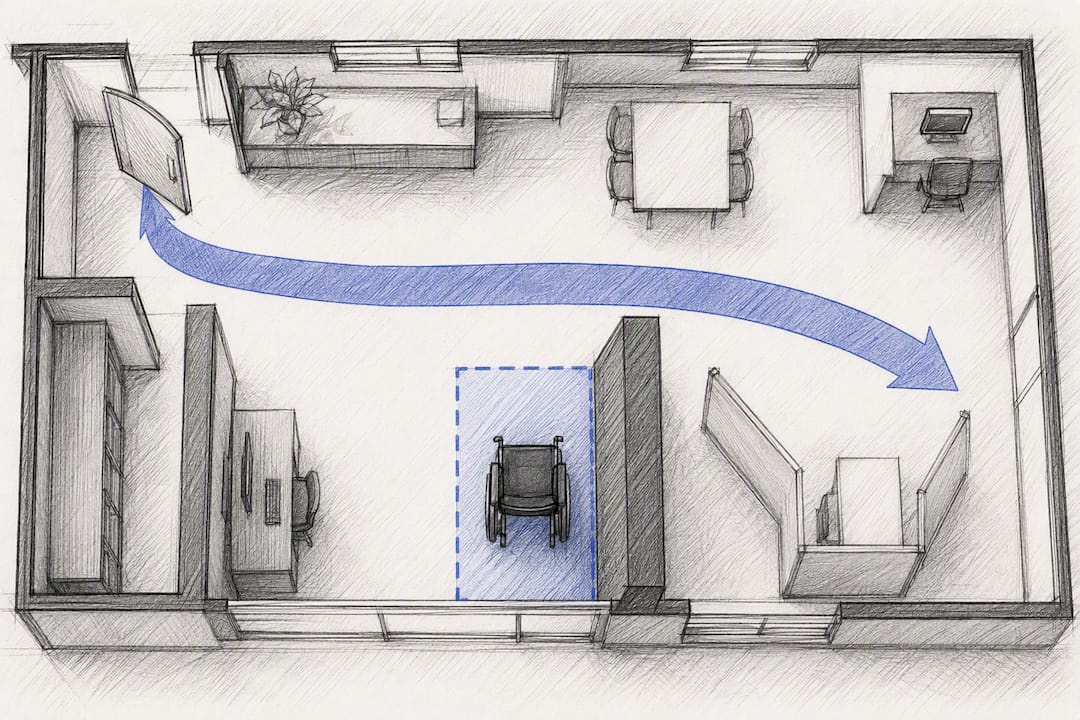
When there’s no safe path out, hiding buys you time and reduces your visibility. Not every hiding spot is equal. A good one is out of the shooter’s direct line of sight, offers you options to move if the situation changes, and ideally has some solid structure between you and the hallway, not just a curtain or a thin partition.
Once you’ve picked a spot, work fast and quietly:
Lock the door if it locks, and barricade it with furniture, filing cabinets, or anything heavy you can move without noise.
Turn off the lights and stay away from windows.
Silence your phone completely, including vibration, and mute any smartwatch alerts.
Stay quiet and still. Do not respond to knocking or shouting unless you can confirm it’s law enforcement.
Hiding does not mean going passive. Some historical cases show worse outcomes for people who froze in exposed positions rather than actively concealing themselves or repositioning when conditions changed. If law enforcement is clearing the area and identifies themselves clearly, you can signal by raising your hands or speaking calmly once you’ve verified who’s outside the door.
Organizations planning for this option need to think about people who use wheelchairs, have hearing loss, or otherwise can’t move or hear the way an able-bodied adult can. A hiding plan that only works for the fastest, most mobile person in the room isn’t a plan. For more on choosing a location that actually offers protection, see CVPSD’s breakdown of cover versus concealment.
Fight: The Last-Resort Option and How to Commit to It
Fighting back is the option of last resort, reserved for moments when you can’t run and can’t hide, and the shooter is close enough that your life is in immediate danger. This is not a hypothetical scenario reserved for the physically strongest person in the room. It’s a decision forced by circumstance.
If you’re in that position, tactics matter:
Recruit anyone nearby. A coordinated group overwhelming one person has a far better chance than a single individual acting alone.
Use whatever is available: a fire extinguisher, a chair, scissors, a laptop swung with force.
Target the threat decisively rather than trying to negotiate or reason.
Commit fully once you’ve decided to act. Hesitation in this scenario is more dangerous than the decision itself.
Acting to stop an imminent threat to your life or others’ lives falls under long-standing self-defense principles, but this option carries real physical risk no matter how it’s executed. It exists because sometimes it’s the only option left, not because it’s preferable to escaping or hiding.
What to Expect When Law Enforcement Arrives
The first officers on scene have one job: locate and neutralize the shooter. That single-minded focus means they are trained to move past injured people rather than stop to render aid, and rescue or medical teams typically follow only after the immediate threat is controlled. Understanding this in advance keeps you from feeling abandoned or confused if you’re waiting for help that hasn’t come yet.
When officers reach you, your behavior determines how quickly they can tell friend from threat. Follow these steps:
Drop anything in your hands immediately, including phones or bags.
Raise your hands and keep them visible at all times.
Avoid sudden or quick movements toward officers.
Follow all verbal commands without arguing or explaining.
Wait for officers to direct you to safety rather than moving on your own.
If you call 911, give responders your specific location, the number of shooters if known, a physical description, and the type of weapon you saw. That level of detail shapes how many units respond and how they approach the building. Officers arriving with accurate information move faster and take fewer wrong turns, which can matter more than any other single factor in the first minutes of a response.
Building Real Preparedness: EAPs, Drills, and Practical Steps
Most people freeze for a few critical seconds when a crisis starts, not from cowardice but from disbelief that it’s actually happening. Training is what shortens that gap, and it starts with a written Emergency Action Plan.
A functional EAP includes:
Clearly marked evacuation routes for every regularly used space.
A simple, well-known reporting method for staff to alert others.
Defined roles for staff during an incident, including who locks doors and who accounts for people.
A coordination protocol for when law enforcement arrives on scene.
CISA’s guidance stresses that an EAP only works if it’s paired with regular, realistic drills, not a document reviewed once a year and filed away. Simulated drills that include realistic sounds and public address messages help people move past denial faster and into decisive action when it counts.
On an individual level, preparedness is a habit, not a one-time training. Scan exits when you enter a new room. Notice what could serve as a barricade or improvised weapon. Mentally rehearse what you’d do if you heard gunfire right now, wherever you happen to be sitting.
Organizations serious about prevention also invest in behavioral threat assessment, watching for warning signs before an incident occurs, and scripted internal communications so staff know exactly what language to use during an emergency alert. CVPSD’s guide on going beyond slogans in active assailant training covers why memorizing three words isn’t the same as being prepared to act on them.
Pro Tip: Run one drill per year that includes a scenario your team hasn’t rehearsed before. Predictable drills build muscle memory for the wrong situation.
Avoid, Deny, Defend vs. Run, Hide, Fight: Does the Language Matter?
Avoid, Deny, Defend and Run, Hide, Fight describe the same three decisions using different words, and the underlying survival logic doesn’t change between them. Some schools and workplaces prefer the Avoid/Deny/Defend framing because it reads as more inclusive of people with mobility limitations, and because “Deny” better captures the active work of barricading than the passive-sounding “Hide.”
For instructors choosing between the two models:
Pick the terminology that fits your audience and any state or district requirements already in place.
Focus training on decision-making principles over rigid steps, since real incidents rarely match a script.
Build drills that reflect actual mobility, hearing, and cognitive differences among participants.
Avoid treating either acronym as a complete plan on its own. The Avoid-Deny-Defend framework is a memory aid, not a substitute for practiced judgment.
CVPSD’s Approach to Active Assailant Training
CVPSD builds active assailant training on a layered foundation: crisis intervention skills, de-escalation techniques applied wherever a threat can still be talked down, behavior analysis to catch warning signs earlier, and physical self-defense as a genuine last resort. This piece was written from that practitioner perspective, drawing on how organizations translate federal guidance into training people actually retain under stress. For a deeper look at how these pieces fit together in practice, CVPSD’s guide to active assailant response walks through the layered decision-making in more detail.
Get Instructor-Led Active Shooter Response Training for Your Organization
CVPSD delivers both in-person and online active shooter response training built for the reality that most staff have never rehearsed a crisis under real stress. Beyond individual courses, CVPSD works directly with schools, healthcare systems, corporations, and government agencies on Emergency Action Plan consulting and train-the-trainer certification, so your own staff can keep skills current after the initial session ends.
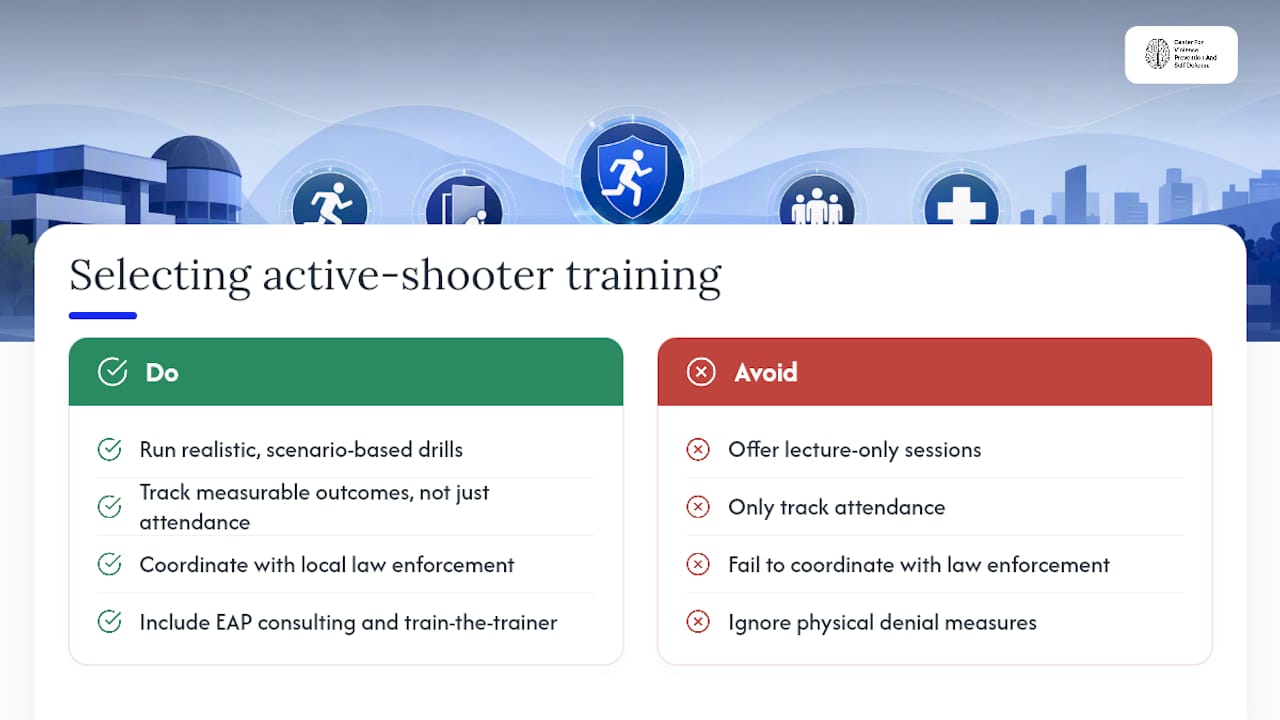
Not every training provider delivers the same value. When you’re evaluating options, look for programs that run realistic, scenario-based drills instead of lecture-only sessions, that track measurable outcomes rather than just attendance, and that coordinate directly with local law enforcement so your plan matches how officers actually respond in your area. Facilities working on physical denial measures, like reinforced door hardware, should also check resources such as UFDoors’ security guidance to pair training with the right equipment.
If your organization needs a program built around your building, your staff, and your existing Emergency Action Plan, start the conversation with CVPSD at Cvpsd and request a training consultation.
Sources
For primary guidance behind this article, review the FBI’s Active Shooter Attack Prevention and Preparedness resources, DHS’s active shooter response poster, and CISA’s Interagency Security Committee planning guide. CVPSD’s behavioral health crisis response training page covers related prevention measures for organizations.
FAQ
What is the best response to an active shooter event?
There is no single best response for every event. Federal guidance recommends running if you have a clear escape path, hiding if you don’t, and fighting only as a last resort when no other option exists.
What are the three options you can take in an active shooter situation?
The three accepted options are Run (evacuate), Hide (secure your location), and Fight (defend yourself as a last resort), also known as Avoid, Deny, Defend.
How do police respond to active shooters?
The first officers on scene move directly toward the threat to neutralize it rather than stopping to treat injured people; medical and rescue teams follow once the shooter is controlled.
What should I do when officers arrive during an active shooter incident?
Drop anything you’re holding, raise your hands, keep them visible, avoid sudden movements, and follow every verbal command without hesitation.
What is the best choice in an active shooter emergency?
The best choice depends on your specific circumstances at that moment. Evacuating is preferable when it’s safe, hiding and denying access is the fallback, and fighting back is reserved for when your life is in immediate danger with no other option, a decision-making framework organizations like CVPSD build entire training programs around.
Recommended
About the Author: William DeMuth is the Director of Training at the Center for Violence Prevention and Self Defense (CVPSD) in Freehold, NJ. With over 35 years of research in violence dynamics and personal safety, William specializes in evidence-based training that bridges the gap between compliance and real-world conflict resolution. The architect of the ConflictIQ™ program, he holds advanced certifications and has trained under diverse industry leaders. Today, he actively trains civilians, hea


