
Make Anonymous Threat Reporting Work for Leaders: Checklist and Triage

Anonymous threat reporting is a system that lets students, staff, and community members flag safety concerns without giving their name, and its core benefit is simple: people who fear retaliation or social fallout will speak up when they would otherwise stay silent. That earlier warning gives school leaders a window to intervene before a threat becomes an incident. What follows covers how these systems actually work, what the evidence shows, the policy landscape shifting under districts right now, and how to evaluate and operationalize a program correctly.
Table of Contents
How Anonymous Reporting Systems Actually Work
A functioning system offers more than one way in. Most districts now deploy a combination of channels so no single barrier stops a report from reaching staff:
Mobile apps for quick, private submission from a personal device
Web forms accessible from any browser
Text or SMS lines for students who prefer messaging
Phone hotlines staffed around the clock
QR codes posted in hallways, gyms, and buses linking directly to the intake form
Safe2Tell built its model around exactly this multi-channel design, pairing a mobile app and website with a 24/7 hotline so a tip never depends on one method being available.
“Anonymous” and “confidential” are not the same thing, and vendors blur the line constantly. True anonymity means no identifying data is captured at all. Confidential intake means the platform knows who submitted the tip but promises not to disclose it. The gap matters because plenty of platforms still collect IP addresses, device fingerprints, analytics tags, or EXIF metadata embedded in uploaded photos, any of which can re-identify a reporter without anyone intending it. Reviews of reporting software note that buyers need to check capture and retention practices directly rather than take the anonymous label at face value.
Two-way anonymous follow-up solves the biggest weakness of one-shot tips: no way to ask a clarifying question. Systems that issue an access code or case key let a reporter check back in, answer a staff question, or receive an update, all without revealing identity. Compliance guidance on whistleblower reporting treats this access-code model as the practical standard for preserving anonymity while keeping a tip usable.
Pro Tip: Ask any vendor to walk you through their default retention window and whether uploaded images get stripped of metadata automatically. If they can’t answer in plain terms, that’s your answer about how anonymous the system really is.
Why Anonymous Reporting Matters
The case for anonymous reporting rests on more than intuition. Practitioner-cited research summarized by Lightspeed Systems points to a notable reduction in violent incidents in schools that used anonymous reporting paired with strong follow-through. That pairing is the part districts underestimate.
Volume alone does not equal safety. A system that generates hundreds of tips means little if nobody triages them fast enough to act. What separates programs that prevent harm from ones that just collect data:
Trained staff assigned to review every incoming tip within a set window
A documented escalation path to administrators, counselors, or law enforcement
A feedback loop so students see that reporting actually leads somewhere
Anonymous tips have a track record of surfacing plans, weapons, and self-harm risk earlier than traditional reporting channels, largely because the anonymity removes the social cost of speaking up.
Policy and Legal Context to Watch
Law is starting to catch up to practice. Minnesota now requires school districts and charter school boards to adopt an anonymous threat reporting policy by June 30, 2027, and implement a working system by July 1, 2028. The law specifically calls for a 24-hour mobile app, website, or toll-free hotline, which sets a practical floor for what “anonymous reporting” has to mean in a compliant district.
Federally, CISA’s toolkit for K12 schools lays out the operational expectations that tend to show up in state law later: continuous intake, a documented triage workflow, and clear steps for assessment and response once a tip lands. Districts building a program now should treat that toolkit as a baseline, not a suggestion.
A few things worth confirming before you sign a contract or finalize a policy:
Whether your state has passed or proposed a reporting mandate with a compliance date
Whether your district’s current policy language matches what CISA recommends for triage documentation
Whether your vendor contract explicitly states retention periods and who can access raw data
Policy sets the minimum. What you build on top of it determines whether the program actually works.
Practical Evaluation and Implementation Checklist for Districts
Choosing a system is only half the job. The other half is building the human process around it, and most districts underinvest here.
Vendor evaluation should cover these points before you sign anything:
Data minimization: does the platform collect only what it needs, or does it default to capturing more?
Retention and purge schedules: how long is a tip stored, and who decides when it’s deleted?
Audit logs: is every access to a case tracked and reviewable?
Role-based access: can only assigned staff see identifying details, if any exist?
Third-party independence: is the platform run by an outside operator, separate from district IT?
Hosting and subpoena posture: where is data stored, and how does the vendor respond to legal requests?
Two-way messaging: can a reporter follow up without breaking anonymity?
Operational design is where most programs succeed or fail quietly:
Assign specific triage roles so tips don’t sit unreviewed over a weekend
Build a clear escalation path to mental health staff or law enforcement based on severity
Document every case with notes and timestamps, even ones that turn out to be low risk
Set an internal response time goal, such as reviewing every tip within one business day
Adoption and training determine whether students trust the system enough to use it. Awareness campaigns need to explain, in plain language, what counts as reportable and what happens next. Staff need training on how to triage a tip calmly and how to de-escalate if a report leads to a direct conversation with a student.
Performance metrics worth tracking monthly include tip volume, time-to-triage, case closure rates, repeat concerns about the same student or situation, and any signs that reporters feel exposed or distrustful.
Pro Tip: Track “repeat concerns” separately from total volume. A cluster of tips about the same person or place, even small ones, is often a stronger warning sign than a single detailed report.
CVPSD: Why Training and Threat-Assessment Capacity Matter After a Tip Comes In
A reporting system only works as well as the people responding to it. CVPSD, a 501©(3) nonprofit, builds its training around evidence-based crisis intervention and de-escalation, the exact skills a triage team needs once a tip lands on their desk, as highlighted by the Community Safety Initiative | Free Active Shooter Training for Nonprofits.
Staff who receive an anonymous report about a struggling student need more than a workflow chart. They need the judgment to tell the difference between a student in crisis and a genuine threat, and the composure to respond without escalating either situation.
Training programs relevant for districts running a reporting program include:
De-escalation techniques for direct follow-up conversations
Behavior analysis to interpret warning signs described in a tip
Crisis intervention for immediate safety concerns
Documentation and evidence handling so case notes hold up under review
Customizable training can be built around existing reporting workflows.
Integrating Anonymous Reporting With Compliance and HR Systems
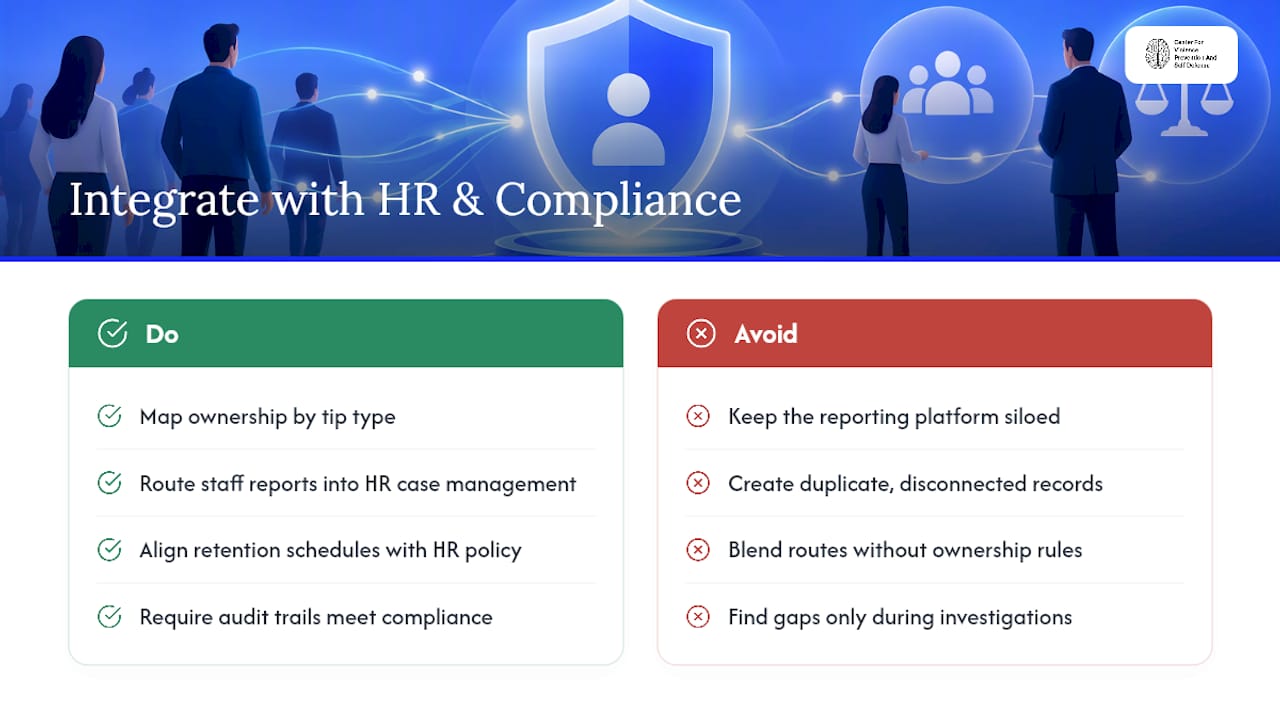
A tip that never touches your existing compliance infrastructure creates a second, disconnected record of student and staff safety concerns. That gap causes real problems. If your reporting platform sits entirely apart from HR case management, you end up with duplicate documentation, no clear ownership when a tip involves an employee, and no single timeline when an incident later gets reviewed by a board, insurer, or attorney.
The fix starts with mapping who owns each type of tip. A report about student behavior typically routes to a school counselor or administrator. A report involving a staff member, harassment, or a labor dispute needs to route into HR’s existing case management process, following the same documentation standards HR already uses for other personnel matters. Blending those paths without clear ownership rules is how tips get lost.
Retention policy is the second piece that needs alignment. Your HR system likely has its own record-retention schedule tied to employment law. Your anonymous reporting platform needs a retention schedule that doesn’t conflict with it, particularly for cases that could become part of a personnel action or legal proceeding later.
Finally, audit trails need to satisfy both your reporting vendor’s security standards and whatever compliance framework your HR or legal department already answers to, whether that’s a state public records law or an internal risk-management policy. Districts that treat the reporting platform as a silo, separate from HR and compliance, tend to discover the disconnect during an investigation, which is the worst possible time to find it.
CVPSD’s Perspective: Common Implementation Mistakes
Districts treat intake as the finish line. It’s the starting line. Without trained triage, response, and de-escalation capacity behind it, a reporting tool just collects concerns nobody acts on fast enough.
Insist on technical transparency about what data is captured, demand two-way anonymous follow-up, and require audit logs before launch, not after an incident forces the question.- Shawn Lebrock
How CVPSD Can Help Build the Response Behind Your Reporting System
A reporting platform tells you a tip exists. It doesn’t train your staff to handle what’s inside it. That’s the gap CVPSD fills. Districts that stand up an anonymous reporting system without building triage and response capacity behind it end up with tips nobody knows how to act on quickly or correctly.
CVPSD’s ConflictIQ™ training series covers de-escalation, co-regulation, and behavior management for PreK12 staff, giving your triage team the judgment to respond to a tip without escalating a situation further. For districts with specific workflows or compliance requirements already in place, customized training can be built around your existing reporting policy rather than replacing it. You can also browse the full training catalog to see self-paced and instructor-led options. Program overviews and consultations can help identify suitable training tracks for district needs.
Guidance and Toolkits Worth Reviewing
CISA’s anonymous threat response toolkit: federal steps for assessment and response
Safe2Tell: a working example of a multi-channel state reporting program
Minnesota’s reporting mandate: a state timeline and minimum feature example
Texas School Safety Center’s anonymous reporting guidance: confidentiality and retention practices
Sources
FAQ
Will the police get involved if I report anonymously?
Yes, if the tip describes a credible threat, a triage team typically escalates it to law enforcement or mental health professionals regardless of whether the reporter’s identity is known. Anonymity protects the reporter’s identity; it doesn’t stop appropriate agencies from investigating and responding to the underlying concern.
What actually happens after I submit an anonymous tip?
A trained staff member reviews the tip, usually within a set internal window, and decides whether it needs immediate escalation, further information, or routine documentation. Systems with two-way follow-up may prompt the reporter with a case key for clarifying questions before the case is closed or escalated further.
Are anonymous alerts actually anonymous?
It depends entirely on the platform’s technical design. Some systems capture no identifying data at all, while others log IP addresses, device details, or file metadata that could theoretically re-identify a reporter, which is why independent reviews recommend asking vendors directly about their capture and retention practices before assuming a tool is fully anonymous.
Is anonymous reporting really anonymous, or just confidential?
The two terms get used interchangeably in marketing, but they mean different things. True anonymity means the platform never collects identifying information in the first place, while confidential reporting means the platform knows the reporter’s identity but agrees not to disclose it.
How do I make sure my tip actually gets acted on?
Include as much specific detail as possible: names, locations, timing, and what you observed, since vague tips are harder to triage quickly. If the platform offers a two-way access code, check back for follow-up questions, since staff often need clarification before they can escalate a case appropriately.
Recommended


