
Behavioral Health Crisis Response Training for Organizations

Behavioral health crisis response training teaches staff to recognize warning signs, avoid escalation triggers, de-escalate tense situations, and respond safely when a colleague, client, or student is in psychological distress. If your organization has not run a formal readiness assessment in the last twelve months, that is the first move to make, before you shop for a curriculum, or book a workshop.
A readiness assessment tells you where your gaps actually sit: staffing coverage during high-risk hours, incident reporting habits, physical space hazards, and whether frontline supervisors know who to call when a situation escalates past what training alone can handle. Programs built around ASIST (Applied Suicide Intervention Skills Training), the PREPaRE curriculum from the National Association of School Psychologists, and the National Guidelines for Crisis Care toolkit all agree on this starting point: assess before you train.
Three quick moves before you sign a training contract:
Assemble a small working group — HR, safety/security, a clinical or behavioral health lead if you have one, and a frontline supervisor.
Produce one near-term deliverable: a written summary of your current incident reporting process and its known gaps.
Confirm your emergency escalation contact — know when your team calls 911 for active danger versus when a lower-intensity internal response is appropriate.
Key Takeaways
Effective behavioral health crisis response requires training built on evidence-based curricula plus organizational changes in policy, environment, and incident reporting.
Point | Details |
Start with assessment | Conduct a readiness assessment before selecting a curriculum or provider. |
Confidence gains are real, incident reduction is not automatic | Training raises confidence, but the PRISMA review shows multicomponent programs are needed to reduce violence rates. |
Match model to risk level | Choose standalone, structured, or multicomponent programs based on your organization’s exposure and prior incidents. |
Measure across time | Track confidence, knowledge, incident trends, and fidelity at baseline, post-training, 3 months, and 12 months. |
Choose a provider with proof | CVPSD offers evidence-based curricula, train-the-trainer certification, and consulting support for organizational follow-through. |
Table of Contents
What Should a Behavioral Health Crisis Response Curriculum Cover?
A credible curriculum does more than teach staff to stay calm. It builds a specific, repeatable skill set tied to your organization’s actual risk profile.
At minimum, expect these elements:
Crisis recognition — behavioral, verbal, and physiological warning signs specific to escalating distress.
Trauma-informed de-escalation — verbal techniques, body positioning, and voice control that lower tension instead of raising it.
Risk screening — a structured way to gauge severity, including suicide risk indicators.
Safety planning — a documented, individualized plan for managing known risk with a specific person or situation.
Role boundaries — clarity on what staff should attempt themselves versus when to hand off to security, clinical staff, or emergency services.
Documentation and referral pathways — what gets recorded, who reviews it, and where someone goes next.
Strong programs write learning objectives as observable outcomes, not vague intentions. “Participants will demonstrate a three-step verbal de-escalation sequence during a simulated scenario” is testable. “Participants will understand de-escalation” is not.
Format matters as much as content. Instructor-led sessions build confidence through practice, blended formats stretch a limited training budget further, and live simulations expose gaps that a slideshow never will. Crisis counseling training that includes role play consistently outperforms lecture-only formats on skill retention.
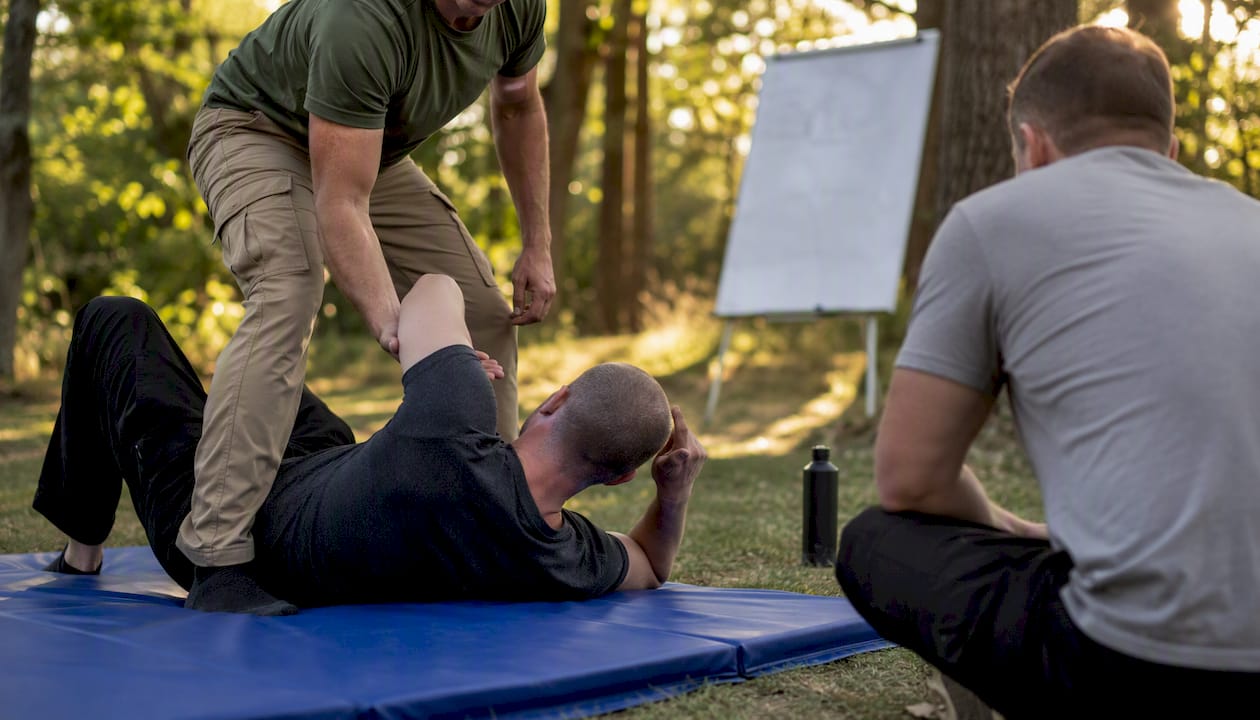
Pro Tip: Cap any single training block at 90 minutes of new content, then dedicate the rest of the session to scenario practice. Retention drops sharply once lecture time exceeds practice time.
Does Crisis Response Training Actually Reduce Incidents?
Training reliably raises confidence. It does not, by itself, reliably reduce how often crises turn into incidents.
A controlled intervention study found participants in workplace violence prevention training scored a mean confidence rating of 27.49 versus 23.92 for the control group, a statistically significant gap (p<0.001). That is a real, measurable shift in how prepared staff feel walking into a tense situation.
Confidence is not the same as prevention. A PRISMA-based systematic review of interventions against workplace violence found that standalone training improved knowledge and confidence scores across the board, but multicomponent interventions, meaning training paired with policy changes and environmental redesign, were the ones associated with actual reductions in violence rates. A RAND Europe rapid evidence assessment reached a similar conclusion: de-escalation training reduces lost workdays and complaints, but it may not move overall incident counts unless organizations also change how they operate.
What this means for your planning:
Budget for policy and environment work alongside the training line item, not instead of it.
Track incident trends separately from training completion rates; they answer different questions.
Treat non-punitive incident reporting as part of the intervention, not an afterthought.
Which Training Model Fits Your Organization’s Risk Level?
Not every organization needs the same configuration. A community nonprofit running occasional evening programs has a different exposure profile than a hospital emergency department or a mid-size school district.
Three models cover most needs:
Standalone short workshops work as an entry point or annual refresher for lower-risk settings. They build baseline awareness and vocabulary fast but leave less time for scenario practice.
Structured multi-session programs, often including train-the-trainer (ToT) tracks, suit organizations with recurring exposure to distressed individuals, such as schools, behavioral health clinics, or customer-facing government offices. These programs build internal capacity so the organization is not dependent on outside instructors for every refresher.
Multicomponent organizational programs pair training with policy updates, environmental changes, and incident reporting reform. This is the model the PRISMA review associates with measurable violence reduction, and it’s the right baseline for healthcare systems, correctional-adjacent settings, and any organization with a documented history of incidents.
Model | Best For | Minimum Baseline |
Standalone workshop | Low-risk, occasional exposure | Half-day session, annual refresher |
Structured multi-session | Recurring exposure, need for internal trainers | ToT certification for 2+ staff, quarterly practice |
Multicomponent program | High-risk, prior incidents, regulated settings | Training + policy review + environment audit + reporting reform |
Whichever model you choose, look for curricula that align with ASIST, the PREPaRE framework, or the National Guidelines for Crisis Care toolkit, which builds trauma-informed care and suicide-safe practices into every recommended crisis training program.
How Do You Implement a Crisis Response Program Step by Step?
A training rollout succeeds or fails on sequencing. Skipping the assessment phase to get instructors in the room faster is the most common mistake organizations make.
Conduct a readiness assessment covering staffing, physical environment, and current incident data.
Engage stakeholders across HR, safety, clinical leadership, and frontline supervisors before selecting a curriculum.
Update policy, particularly incident reporting procedures, so staff have somewhere to route what they learn.
Review your physical environment for line-of-sight issues, exit access, and de-escalation-friendly spaces.
Contract with a provider, confirming instructor credentials and ToT availability.
Pilot the program with a single department or shift before rolling out organization-wide.
Roll out broadly, staggered by department to avoid coverage gaps.
Run drills that simulate real scenarios, not just tabletop discussions.
Set a maintenance schedule for refreshers, at minimum annually.
For internal ownership, NAMI’s workplace crisis guidance recommends a named Crisis Response Team with clear roles:
CRT lead — coordinates response and post-incident debriefs.
Frontline responder(s) — trained to engage directly during a crisis.
Communications liaison — manages internal notifications and, if needed, family or media contact.
Backup for each role — because crises rarely happen when your primary responder is on shift.
Pro Tip: Run your pilot with your most experienced supervisors first, not your newest hires. Their feedback on curriculum fit will be sharper, and they’ll become informal coaches once the full rollout begins.
How Do You Measure Whether Crisis Training Is Working?
If you cannot point to a metric, you cannot tell your board or funders whether the training budget delivered results. Build your measurement plan before the first session, not after.
Metric | What It Tells You |
Pre/post confidence surveys | Whether staff feel more prepared immediately after training |
Knowledge checks | Whether core content (de-escalation steps, referral pathways) was retained |
Incident report trends | Whether frequency or severity of incidents shifts over time |
Lost workdays | A proxy for injury severity and staff strain tied to incidents |
Referral timeliness | Whether staff connect people to services faster after training |
Fidelity checks | Whether the program is being delivered as designed across sites |
A workable timeline runs baseline measurement before training, an immediate post-session survey, a 3-month check on knowledge retention and reporting behavior, and a 12-month review of incident trends and policy adoption.
Sample survey items worth adapting:
“I feel confident identifying early warning signs of a behavioral health crisis.”
“I know the specific steps to take when a colleague or client shows signs of escalating distress.”
“I know who to contact internally, and when to escalate to 911, during an active crisis.”
“Our current reporting process makes it easy to document a crisis incident.”
Pair the numbers with qualitative input: short debrief interviews after drills often surface gaps a survey misses entirely.
What Should You Require From a Crisis Training Provider?
Choosing a provider is a due-diligence exercise, not a procurement formality. Ask direct questions and expect direct answers.
Vendor questions worth putting in your RFP:
Does the curriculum align with recognized standards like ASIST, PREPaRE, or the National Guidelines for Crisis Care?
What are instructor credentials, and is train-the-trainer certification available?
Does the program include live simulation, not just lecture and slides?
What evaluation services come bundled, and can the provider help interpret incident-report trends afterward?
Can the curriculum be customized for our specific setting (healthcare, school, corporate office, community site)?
Deliverables to confirm before signing:
A written curriculum outline mapped to your identified risk areas.
A defined timeline from kickoff to full rollout.
A sample budget structure, whether per-person, per-session, or full-contract.
Post-training evaluation support, including survey design.
CVPSD builds programs around exactly this checklist, combining in-person and online instruction with train-the-trainer certification and consulting support tailored to healthcare, education, corporate, and government settings. Organizations evaluating vendors should look for that combination of evidence-based curriculum, credentialed instructors, and organizational follow-through, not a one-day workshop sold as a complete solution.
What Did One Organization Gain From Crisis Response Training?
A health and human services organization partnered with CVPSD to address rising staff concern around client-facing crisis incidents. The engagement combined instructor-led training with policy review and reporting-process updates, not training alone.
The scope covered frontline staff and supervisors across multiple sites, with de-escalation skills, risk recognition, and documentation standards as the core curriculum, delivered alongside a review of incident reporting procedures.
Staff reported measurably higher confidence in recognizing and responding to crisis situations after the engagement, and the organization adopted updated incident reporting protocols as a direct result of gaps identified during training.
Read the full case study for the complete before-and-after breakdown.
Lessons other organizations can lift directly:
Pair training with a policy review from day one; do not treat them as separate projects.
Use training feedback to identify reporting-process gaps you did not know existed.
Track confidence and procedural change as two separate outcomes, not one.
What Do Practitioners Wish Every Organization Understood?
Practitioners who deliver this training repeatedly see the same disconnect: leadership treats a single workshop as a finish line, when it is closer to a starting gate.
The organizations that see real change are the ones that budget for the boring parts, updated reporting forms, environmental walkthroughs, refresher scheduling, right alongside the training line item. Skilled instructors can teach a room full of staff to de-escalate a tense conversation in an afternoon. What they cannot do is fix a reporting process that punishes staff for flagging a near-miss, or a physical space with no safe exit route. Those are organizational decisions, and they matter as much as anything taught in the classroom.
A few tips worth adopting immediately:
Treat your incident reporting form as part of the curriculum. If staff won’t use it, redesign it.
Rotate scenario practice topics quarterly instead of repeating the same drill every year.
Assign a designated backup for every Crisis Response Team role before your first drill, not after someone is unavailable.
Debrief every real incident within 48 hours, while details are still fresh.
Pro Tip: Ask frontline staff, not supervisors, to help write your scenario drills. They know which situations actually happen on shift, and their scenarios expose weaknesses that generic templates miss.
How Can CVPSD Support Your Training Rollout?
CVPSD is a practical starting point for organizations that need training built around their actual risk profile rather than a generic slideshow. The nonprofit delivers in-person and online seminars covering crisis intervention, de-escalation, behavior analysis, and workplace violence prevention, with train-the-trainer certification available for organizations that want internal capacity instead of ongoing dependence on outside instructors.
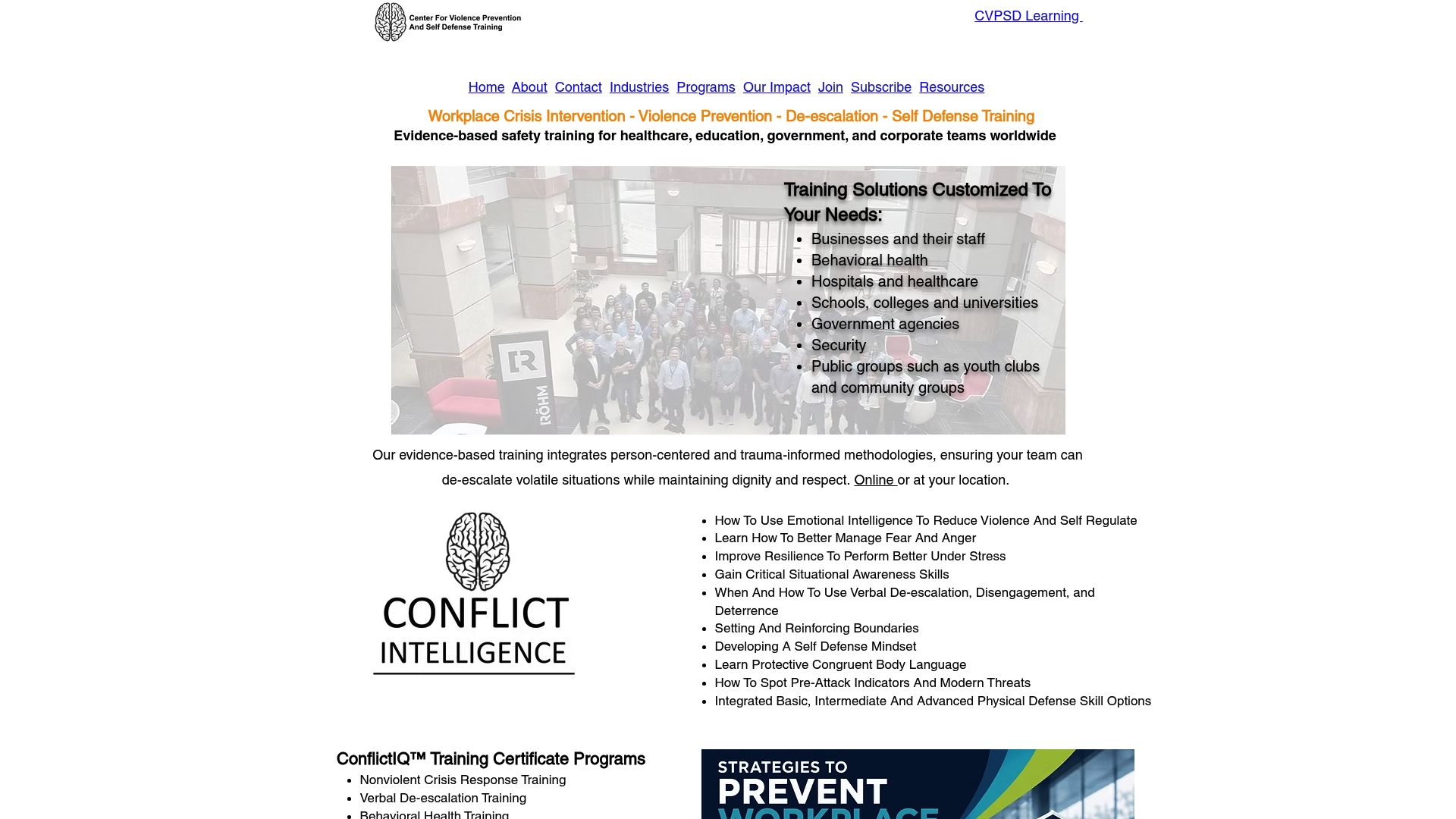
Services map directly onto the framework in this article: instructor-led and blended courses for core curriculum delivery, ToT certification for building internal trainers, and consulting support for the policy and environment work that research shows matters just as much as the training itself. Budgeting works on a contract basis scaled to group size and format, whether that’s a single-department pilot or a multi-site rollout.
If your organization is ready to move past the assessment stage, request a program consultation through CVPSD to scope a pilot tailored to your setting and risk profile.
Useful Resources for Program Planning
National Guidelines for Crisis Care – A Best Practice Toolkit — defines core crisis service components and recommends ASIST-aligned training standards.
PubMed intervention study on workplace violence prevention training — statistical evidence for confidence gains after training.
RAND Europe rapid evidence assessment on de-escalation training — evidence on what de-escalation training does and does not achieve alone.
NAMI workplace crisis guidance — practical Crisis Response Team templates and escalation guidance.
CVPSD case study on staff safety and confidence — real-world results from a training and policy engagement.
Organizations adapting programs for faith-based settings can also reference this practical mental health guide for churches.
Sources
PubMed: workplace violence prevention training intervention study (meta-analyses reference)
RAND Europe: Reviewing the evidence base for de-escalation training (rapid evidence assessment)
National Guidelines for Crisis Care – A Best Practice Toolkit
NAMI: Navigating a mental health crisis at work (organizational guidance)
FAQ
What Is Behavioral Health Crisis Response Training?
It is staff training that teaches recognition of crisis warning signs, de-escalation techniques, risk screening, and safe response protocols, distinct from clinical treatment or emergency dispatch services.
Does Training Alone Reduce Workplace Violence Incidents?
Not reliably on its own. A PRISMA-based systematic review found multicomponent interventions, training plus policy and environmental changes, are more strongly linked to actual reductions in violence.
How Long Does It Take to Implement a Program?
Most organizations move from readiness assessment to full rollout over three to six months, including a pilot phase before organization-wide training.
What Should We Look for in a Training Provider?
Look for alignment with recognized standards like ASIST and PREPaRE, credentialed instructors, train-the-trainer options, and evaluation support. CVPSD offers this combination for healthcare, education, corporate, and government organizations.
How Often Should Staff Receive Refresher Training?
At minimum annually, though organizations with higher incident rates or high staff turnover often schedule refreshers quarterly to maintain skill retention.
Recommended
Center for Violence Prevention and Self Defense Training | CVPSD
CVPSD Crisis Intervention Training CIT: Empowering Organizations to Manage Challenges Safely In NJ
Staff Safety Training - Regulatory And Compliance Crisis Protection For Workplace Teams
Case Study: Enhancing Staff Safety and Confidence in Crisis Management In Health and Human Services


