
Scenario-Based Training Benefits for Educators and Trainers

Scenario-based training places learners inside a realistic situation and asks them to make decisions, then shows the consequences. The approach consistently outperforms passive instruction on five measures: engagement, retention, decision-making under pressure, confidence, and transfer to the actual job. Organizations like the Association for Talent Development (ATD) track this shift closely, and CVPSD builds its own crisis intervention and de-escalation curricula around the same principle, because a slideshow cannot prepare someone for a shaking voice and a raised fist.
The evidence and the practical steps both matter here. A handful of benefits explain why scenario work sticks:
Learners stay engaged because they have a stake in the outcome, not just information to absorb.
Retrieval practice at each decision point strengthens memory more than review does.
Practicing judgment under ambiguity builds decision-making skill that transfers to real incidents.
Confidence rises measurably once learners have already faced a version of the crisis.
Skills acquired through scenarios move to the job faster than skills learned by lecture alone.
Key Takeaways
Scenario-based training works because it forces decisions under realistic pressure, and decisions create the retrieval events that make skills stick and transfer to the job.
Point | Details |
Decisions drive retention | Each decision point in a scenario acts as a retrieval event, strengthening memory more than passive review. |
Evidence is strongest in clinical settings | Comparative studies show scenario methods beat passive video for high-pressure skills like BLS. |
Fidelity should match the decision | Overspending on realism without aligning to the learning objective can reduce effectiveness. |
Measure behavior, not just completion | Pair pre/post tests with manager observation windows to catch real transfer. |
CVPSD applies these principles directly | CVPSD builds crisis intervention and de-escalation programs on decision-first scenario design. |
Table of Contents
Why Scenario-Based Training Outperforms Passive Instruction
Each of these benefits shows up differently depending on the field, but the mechanism is consistent: scenarios force a decision, and decisions are what the brain remembers.
Engagement and motivation. A scenario gives learners a role, a stake, and a consequence. Instead of watching a video about de-escalating an agitated patient, the learner has to choose a response. That choice creates the kind of attention that a passive lecture rarely earns.
Retention through retrieval practice. Every decision point in a scenario is a small test. Retrieval practice research, including work summarized by the Vanderbilt Center for Teaching, shows that generating an answer strengthens memory far more than simply recognizing one on a slide.
Decision-making and judgment. Real incidents rarely hand you clean information. Scenario training deliberately introduces ambiguity, so learners practice weighing incomplete facts instead of memorizing a flowchart they will forget under stress.
Faster skill acquisition. Role-based tasks, from operating new software to running a crisis checklist, tend to reach competency faster when learners rehearse the actual sequence of choices rather than reading about them.
Soft skills and teamwork. Role-play scenarios put communication and empathy to the test in a way multiple-choice questions cannot. A learner who has to calm an actor playing an angry customer builds a different muscle than one who reads a tone-of-voice checklist.
Scalability and cost. Digital branching scenarios and e-learning modules scale to hundreds of learners at a fraction of the cost of live role-play, without losing the decision-based structure that makes the training work.
Pro Tip: If you can only afford one high-fidelity element in your scenario, spend it on the decision point, not the visuals. Learners remember the choice they made, not the resolution of the graphics around it.
What the Research Actually Shows
The strongest evidence for scenario-based training comes from clinical education, where outcomes are easy to measure. A comparative study published in BMC Medical Education found scenario-based methods statistically outperformed passive video instruction for teaching high-pressure skills like Basic Life Support. Separate nursing research reported measurable gains in clinical competencies, communication, and teamwork after scenario-based sessions, not just self-reported confidence.
Outside clinical settings, a 2025 study on interactive scenario training in cybersecurity reported up to a large improvement in situational awareness for the treatment group compared to control. That number is striking, but it comes from one controlled study in a technical domain, so treat it as a strong signal rather than a universal guarantee.
Decision points inside a scenario function as retrieval events. Each one forces the learner to reconstruct knowledge rather than simply recognize it, which is why scenario training tends to outlast passive review long after the training session ends.
Adoption data backs the pattern up. Industry reporting synthesized by TrainerCentric points to widespread use of scenario and simulation methods across organizations, with engagement and applied retention cited as the top reasons teams adopt them.
How to Design Scenarios That Actually Transfer
Start with the decision, not the story. Before writing a single line of dialogue, name the exact on-the-job choice you want learners to be able to make afterward. Everything else in the scenario should serve that choice.
Write the decision point first, then build the surrounding narrative around it.
Match fidelity to the decision, not to the budget. A Springer analysis of the “fidelity trap” warns that expensive realism without pedagogical alignment can actually reduce learning effectiveness.
Build branching paths that reflect real consequences, including paths that end badly, so learners feel the weight of a poor choice.
Add immediate feedback after each decision, then close with a structured debrief that asks what the learner noticed, what they would change, and why.
Pro Tip: Write your debrief questions before you write the scenario itself. If you can’t think of a good question to ask afterward, the decision point probably isn’t strong enough to build a scenario around.
Functional congruence, the idea that realism should match the decision rather than the production budget, is the design principle that separates scenarios people remember from ones they merely sit through. CVPSD applies this exact logic in its own crisis intervention and behavior management programs, keeping the simulation focused on the choice a staff member actually has to make in the field.
Measuring Whether the Training Worked
Most pilots fail at measurement, not design. Teams stop at completion rates and satisfaction surveys, which tell you nothing about whether behavior changed.
Short-term: track decision accuracy inside the scenario, completion rate, and reaction time at each branch point.
Mid-term: collect manager observations of behavior change on the job, ideally with a simple before-and-after checklist.
Long-term: watch the metrics that matter to leadership: incident reductions, compliance audit results, or performance KPIs tied to the trained skill.
Design tip: pair a pre/post test with a sampled observation window, where a manager or peer rates a handful of real interactions weeks after training. That combination catches behavior change that a survey alone will miss.
Where Scenario Training Shows Up in Real Work
The same decision-first design applies whether the setting is a hospital floor or a call center.
Healthcare: simulated clinical decision points and Basic Life Support drills that mirror the pacing of a real code.
Customer service: branching scenarios that walk a rep through escalating a frustrated caller before the situation boils over.
Safety and de-escalation: role-play and video-based scenarios, the same format CVPSD uses in its behavioral health crisis response programs, where staff practice reading body language before a situation turns physical.
Leadership: ethics and judgment scenarios with branching outcomes that force a manager to weigh competing obligations, not just recite a policy.
Where Scenario-Based Training Falls Short
Scenario training is not automatically better than a lecture. It fails when teams fall into the fidelity trap, chasing realistic graphics while the actual learning objective gets lost, or when they lean on satisfaction scores instead of measuring real behavior change.
High-fidelity simulations can demand more budget and staff time than a training team actually has.
A scenario built around the wrong decision teaches the wrong lesson, no matter how polished it looks.
For pure information transfer, like a policy update or a new software feature, plain instruction or mentorship is often faster and cheaper.
A Low-Risk Way to Pilot Scenario Training
You don’t need a full simulation budget to test whether this approach works for your team.
Pick one high-impact decision or incident type worth training.
Build a low-cost prototype: a role-play script, a branching video, or a simple e-module.
Run a small pilot and collect pre/post data plus at least one behavioral measure.
Use what you learn to refine the scenario, then scale it once the improvement holds up.
What Actually Predicts Whether Training Transfers
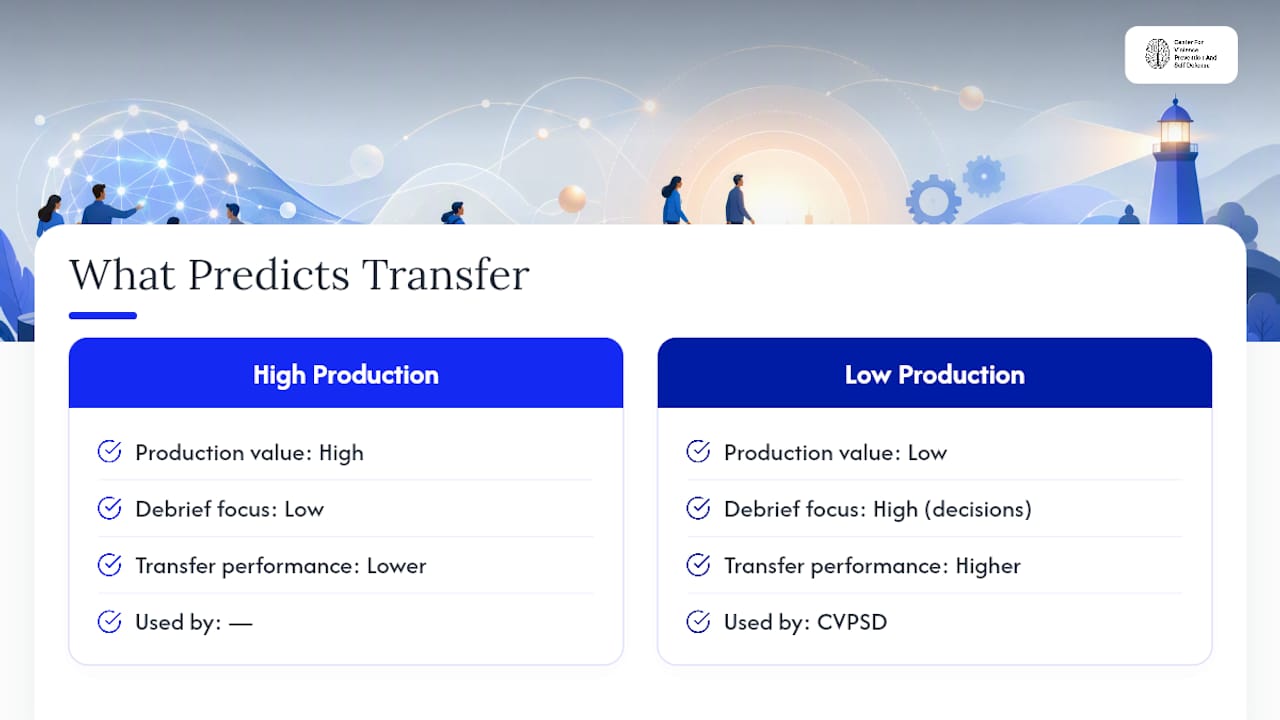
The pattern that shows up again and again in applied training is simple: transfer follows the decision, not the production value. Teams that obsess over graphics while skipping the debrief consistently underperform teams that keep it plain but ask sharper questions afterward. CVPSD builds its de-escalation and crisis intervention curricula on that same principle, because the moment that matters most in a real crisis is the same one we rehearse in the room.
Bring Scenario-Based Training to Your Organization
CVPSD is the nonprofit alternative to generic corporate training vendors for crisis intervention and de-escalation, built on evidence-based scenario design instead of one-size-fits-all slide decks. Its seminars and in-person programs put staff through the same decision-first scenarios described above: realistic conflict situations, structured debriefs, and feedback loops designed to hold up under real pressure, not just a training-room evaluation.
Programs are built around the actual roles your staff face, from healthcare units to school administrators to corporate security teams, and every curriculum meets state and local requirements. If your organization is weighing whether to pilot scenario-based training, CVPSD’s staff safety and compliance training programs offer a practical starting point. Reach out through CVPSD’s program page to request a pilot consultation and get a curriculum built around your team’s highest-risk decision points.
Sources
FAQ
What Is Scenario-Based Training?
Scenario-based training places learners inside a realistic situation with a decision to make, then reveals the consequences of that choice, unlike passive instruction that only presents information.
What Are the Advantages of Case-Based Learning?
Case-based and scenario-based learning both build decision-making skill through practice with ambiguity, and both tend to improve retention because learners have to generate an answer rather than just recognize one.
What Are Some Examples of Scenario-Based Learning?
Common examples include clinical simulations for Basic Life Support, branching customer-service scenarios for handling escalation, and role-play or video-based de-escalation drills like those CVPSD uses in its crisis intervention programs.

Does Scenario-Based Training Improve Confidence on the Job?
Yes. Learners who have already faced a version of a high-pressure situation in training report and demonstrate higher confidence when the real situation occurs, because the decision feels familiar rather than novel.
Is Scenario-Based Training More Expensive Than Traditional Training?
Not necessarily. Low-fidelity formats like role-play and branching e-modules can match the learning benefits of expensive simulations, since the decision point drives the results, not the production value.
Recommended


