
Conflict Prevention Best Practices for Community Leaders


Conflict prevention best practices are defined as structured, evidence-based methods that address tensions before they escalate into harm. These methods rely on three core pillars: early intervention, behavioral analysis, and mediation frameworks. The Harvard Program on Negotiation identifies misdiagnosis of root causes as the leading reason conflict interventions fail.
Cvpsd applies these same principles through crisis intervention training designed specifically for community leaders and at-risk environments. When prevention is treated as a system rather than a reaction, it protects people, preserves relationships, and reduces the cost of conflict at every level.
1. How early intervention reduces conflict escalation
Early intervention is the single most effective tool for preventing conflict from becoming a crisis. Addressing tension at the first sign of friction stops the cycle before it gains momentum. Organizations that act early spend far less time and money managing formal disputes.
The evidence is clear. Organizations integrating proactive mediation frameworks reduce formal grievance caseloads by 68% within 12 months. That reduction translates directly into fewer tribunal claims, lower legal costs, and healthier team dynamics.
Practical early intervention methods include:
Monitor communication cues. Watch for withdrawal, sharp tone shifts, or repeated misunderstandings. These are early signals that tension is building.
Use manager-led dialogue. Train supervisors to open a calm, non-accusatory conversation the moment friction appears.
Create structured check-ins. Regular one-on-one meetings give people a safe channel to surface concerns before they harden into grievances.
Apply de-escalation language. Phrases like “Help me understand your concern” reduce defensiveness and invite honest dialogue.
Understanding the conflict spectrum helps leaders recognize which stage a dispute has reached and respond with the right level of intervention.
Pro Tip: Train leaders with just-in-time mediation skills so they can act confidently under pressure, not just in calm conditions. A leader who hesitates loses the window for early resolution.
2. What role behavioral assessments play in conflict prevention
Data-driven prevention proactively reduces conflict risk by identifying friction points before they surface as disputes. Behavioral assessments give leaders a factual basis for understanding why certain team combinations produce tension.

Tools like DISC and CliftonStrengths map individual behavioral drives and communication styles. When leaders understand that one person is highly task-focused while another is relationship-driven, they can structure collaboration to reduce friction rather than create it. Behavioral differences are not flaws to fix. They are patterns to understand and manage.
A data-driven prevention approach works through four steps:
Assess baseline behavior. Use validated tools to profile team members’ communication and decision-making styles.
Map team compatibility. Identify pairings or group dynamics that carry a higher risk of friction based on style mismatches.
Apply predictive analytics. Track patterns in communication frequency, response times, and escalation history to forecast conflict hotspots.
Design proactive coaching. Use assessment results to guide targeted conversations before problems emerge.
Data-driven prevention lets leaders design teams to minimize friction by understanding behavioral differences early. That is a fundamentally different posture than waiting for a complaint to arrive.
One critical caution: behavioral data must be used to inform, not label. Misusing assessment results to stereotype team members creates new conflicts rather than preventing them. Always communicate the purpose of any assessment process transparently so people understand how the data will be used.
Pro Tip: Pair behavioral assessment results with a facilitated team conversation. Data alone does not build trust. The conversation does.
3. What mediation best practices resolve conflicts sustainably
Mediation enables voluntary, sustainable agreements through neutral facilitation. Unlike formal grievance processes, mediation preserves the relationship between parties and gives them ownership of the outcome.
The six-step mediation process from Harvard’s Program on Negotiation provides a reliable framework:
Planning. The mediator meets separately with each party to understand the core issues and set expectations.
Introduction and ground rules. Both parties agree to speak respectfully and listen without interruption.
Opening remarks. Each party states their perspective without interruption from the other.
Joint clarification. The mediator identifies shared concerns and areas of genuine disagreement.
Private caucuses. When emotions run high, the mediator meets with each party separately to manage tension and build trust.
Negotiation of solutions. Both parties work toward a mutually acceptable agreement with the mediator’s guidance.
The mediator’s role is not to decide who is right. Mediators act as neutral translators who restate and clarify each party’s concerns, building mutual understanding rather than imposing a verdict.
“Mediation training increases conflict resolution efficacy, reduces costs compared to litigation, and builds a constructive culture where people feel heard rather than judged. Organizations that invest in mediation training build internal capacity that pays dividends across every team interaction.”
Private caucuses deserve special attention. Many mediations stall because emotions block rational problem-solving. A skilled mediator uses the caucus to let each party vent privately, then returns to the joint session with both parties in a calmer state. This technique alone resolves a significant number of disputes that would otherwise escalate.
4. Which organizational strategies support long-term conflict prevention
Long-term conflict prevention requires institutional commitment, not just individual skill. Effective prevention relies on four pillars: an institutional home with budget authority, data systems measuring risk by people and places, broad multi-stakeholder coalitions, and transparent sequencing of stabilization before prevention.
The table below outlines the core elements of a sustainable prevention structure:
Element | Purpose | Example |
Dedicated budget authority | Funds training, staffing, and data systems | Annual prevention budget line in organizational plan |
Risk data systems | Track friction points and escalation patterns | Incident logs, behavioral analytics dashboards |
Multi-stakeholder coalitions | Broaden buy-in and share responsibility | Faith leaders, business groups, security agencies |
Stabilization sequencing | Address immediate safety before prevention work | Crisis response protocols before mediation programs |
Community-level prevention requires an additional layer of integration. Community mediation is most effective when bundled with economic and civic programming, especially in deprived areas. Behavior change is more durable when people also have access to employment support, civic participation, and social services.
Coalition-building is not optional. Prevention programs that rely on a single organization or leader are fragile. Broad coalitions that include faith leaders, business associations, and local security institutions create shared accountability and survive leadership transitions.
Key elements that sustain long-term prevention:
Reliable data systems that track both risk indicators and outcomes
Regular coalition meetings with clear decision-making authority
Transparent communication about program goals and progress
Integration of conflict prevention with broader social and economic programs
Systemic prevention that connects nonprofits, community groups, and civic partners produces more durable results than isolated training events.
5. What common pitfalls undermine conflict prevention efforts
The most damaging mistake in conflict prevention is treating conflict as a problem to eliminate rather than a tension to manage. Better leaders create environments where manageable tensions surface early and are contained, not suppressed. Suppression guarantees a larger explosion later.
Misdiagnosing root causes is the most common reason conflict interventions fail. A leader who addresses interpersonal hostility without examining the systemic or structural cause will see the same conflict return in a different form. Ask whether the issue is a style mismatch, a resource conflict, a process failure, or a values difference before choosing an intervention.
Other pitfalls to avoid:
Prioritizing visible quick fixes. Announcing a policy change or holding a single workshop creates the appearance of action without addressing the root cause.
Ignoring political resistance. Political leaders often favor immediate, visible responses over sustained prevention investment. This bias undermines long-term programs.
Using the wrong intervention style. Mediation works for interpersonal disputes. It does not resolve structural inequities. Match the tool to the problem.
Skipping continuous training. A one-time training event fades quickly. Prevention skills require regular reinforcement and practice.
Failing to measure outcomes. Without data, leaders cannot tell whether their prevention efforts are working or need adjustment.
The most effective prevention programs treat conflict as a signal, not a failure. When tension surfaces early, it means the system is working.
Key takeaways
Conflict prevention works best when leaders combine early intervention, behavioral insight, and structured mediation within a sustained institutional framework.
Point | Details |
Early intervention is most effective | Address tension at the first signal to prevent formal grievances and reduce costs. |
Behavioral data reduces friction | Use assessments like DISC to understand style differences and design teams proactively. |
Mediation preserves relationships | A six-step mediation process gives parties ownership of outcomes and avoids litigation. |
Long-term prevention needs systems | Sustainable prevention requires budget authority, data systems, and multi-stakeholder coalitions. |
Misdiagnosis is the top failure point | Identify whether conflict is interpersonal, systemic, or structural before choosing an intervention. |
What I’ve learned about conflict prevention that most guides won’t tell you
The hardest part of conflict prevention is not the technique. It is the timing. Most leaders wait too long because surfacing a conflict feels riskier than ignoring it. That instinct is understandable. It is also wrong.
The leaders I have seen succeed in high-risk community settings share one habit: they treat early discomfort as information, not threat. They ask questions before the tension has a name. They build rapport and trust before they need it. That relational investment is what makes early intervention possible at all.
Data systems and mediation frameworks matter enormously. But they only work if the leader using them has the patience to let a process unfold rather than forcing a quick resolution. Sustainable peace in any community or organization is built through consistent, unglamorous relationship work. The results are slow to appear and hard to attribute. That is exactly why most organizations underinvest in it.
My strongest recommendation: build local mediation capacity tied directly to your social and economic programs. Prevention that stands alone is fragile. Prevention that is woven into the daily life of a community becomes self-sustaining. Embrace conflict as a signal that growth is possible.
The goal is not a tension-free environment. The goal is a community that knows how to work through tension together.
Cvpsd training for conflict prevention and community safety
Cvpsd is a 501©(3) non-profit that provides evidence-based conflict prevention education to community leaders, organizations, and at-risk groups across the country. Its programs combine crisis intervention techniques, de-escalation methods, and behavioral analysis into practical training that works in real environments.
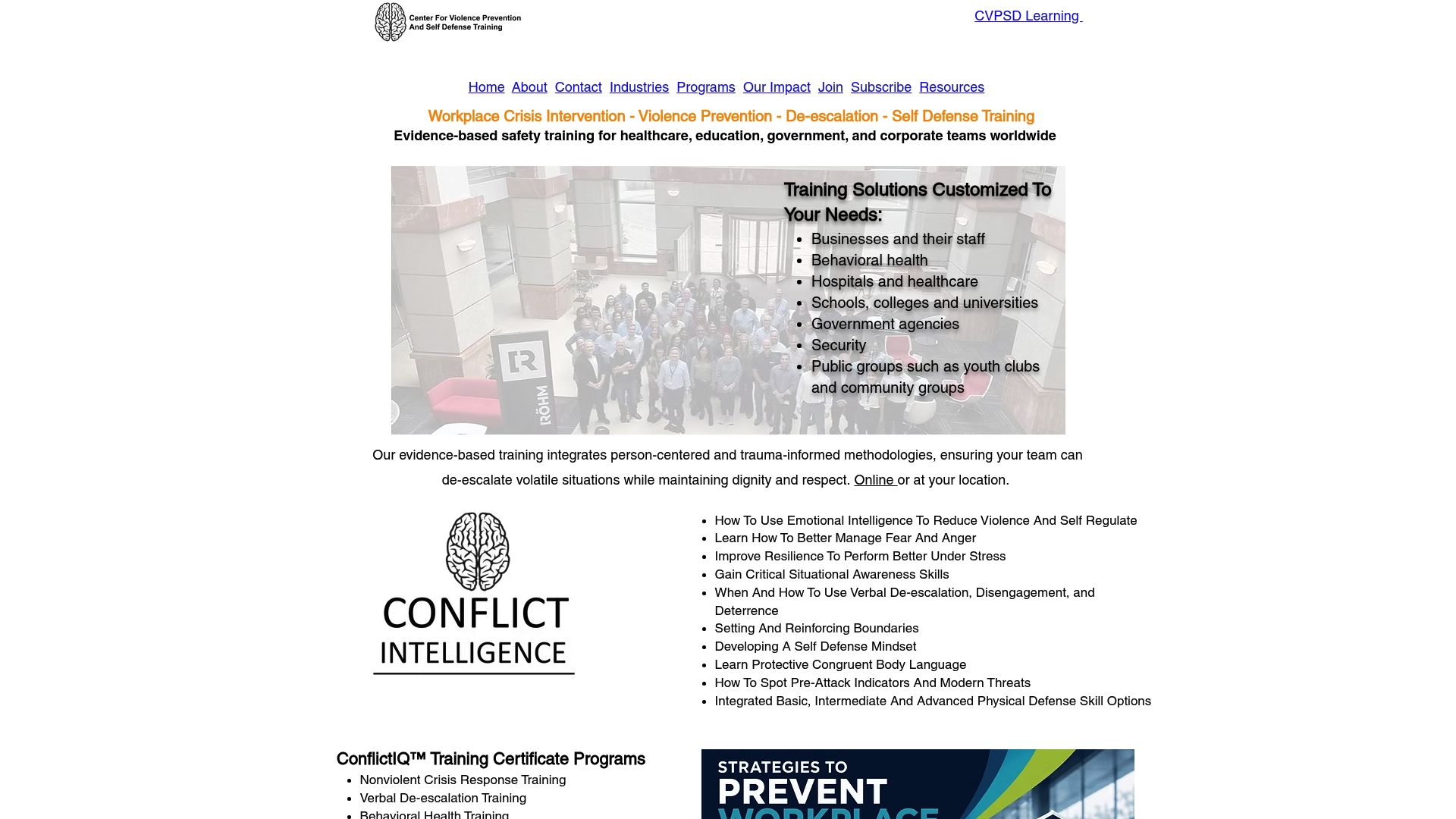
Cvpsd delivers both virtual and in-person training, including its Conflict IQ program for community organizations. Leaders who complete this training leave with concrete skills for recognizing early warning signs, applying mediation frameworks, and building prevention systems that last. Visit Cvpsd’s training programs to find the right option for your team or community.
FAQ
What are conflict prevention best practices?
Conflict prevention best practices are structured methods that address tension before it escalates, including early intervention, behavioral assessment, and mediation frameworks. They reduce formal grievances, protect relationships, and lower the cost of unresolved disputes.
How does early intervention reduce workplace conflict?
Early intervention stops disputes from hardening into formal grievances. Organizations using proactive mediation frameworks reduce formal grievance caseloads by 68% within 12 months.
What is the mediator’s role in conflict resolution?
A mediator acts as a neutral facilitator who restates and clarifies each party’s concerns without deciding who is right. The goal is a voluntary, mutually acceptable agreement that both parties own.
Why do conflict prevention efforts fail?
The most common reason is misdiagnosis. Leaders address interpersonal hostility without examining whether the real cause is systemic, structural, or a behavioral style mismatch.
How can community leaders build long-term conflict prevention capacity?
Sustainable prevention requires a dedicated budget, reliable data systems, and broad coalitions that include civic, faith, and business stakeholders. Bundling mediation with economic and social programs produces the most durable results.
Recommended

About the Author: William DeMuth is the Director of Training at the Center for Violence Prevention and Self Defense (CVPSD) in Freehold, NJ. With over 35 years of research in violence dynamics and personal safety, William specializes in evidence-based training that bridges the gap between compliance and real-world conflict resolution. The architect of the ConflictIQ™ program, he holds advanced certifications and has trained under diverse industry leaders. Today, he actively trains civilians, healthcare workers, and corporate teams in situational awareness, threat assessment, behavior analysis, de-escalation strategies, and physical tactics.


