
Use Five Metrics: Conflict Resolution Training for Employers


Yes, organizations should adopt recurring, role-specific conflict resolution training that combines short didactic lessons with active practice, delivered inside a formal workplace violence prevention program rather than as a one-time seminar. Two steps come first: run a quick risk analysis to identify which units face the highest exposure, and schedule a skills-focused pilot with real practice time, not just a lecture, before scaling anywhere else.
Executive Summary
Units with high exposure to aggression, such as emergency departments or security teams, should be prioritized based on incident history and staffing risk.
Role-specific de-escalation training, combining didactic lessons with active practice like role-play, yields better long-term behavior change than lectures alone.
Implementing a phased rollout starting with a pilot unit and training trainers helps organizations scale without disrupting operations or quality.
Measuring success through restraint frequency, staff injuries, and confidence assessments over time proved essential to determine training effectiveness.
One-time, annual training is insufficient; ongoing, scheduled refreshers aligned with actual risk levels are crucial for sustained safety improvements.
Table of Contents
Who Needs Conflict Resolution Training First?
Not every department carries the same risk, and treating them identically wastes budget and training hours. Emergency departments, behavioral health units, school front offices, security teams, and transport staff face the highest frequency of aggressive encounters and belong at the front of the line. Front-desk and intake staff, who absorb the first wave of a person’s frustration or crisis, are also higher priority than many organizations realize.
Training outcomes should map to organizational goals your leadership already tracks: fewer physical restraints, fewer staff injuries, reduced lost workdays, and lower regulatory exposure under OSHA’s workplace violence enforcement guidance.
A short prioritization checklist helps sequence rollout:
Review incident logs for the past 12 to 24 months, looking for units with repeat restraint, injury, or verbal-aggression reports.
Flag roles with direct, unsupervised contact with agitated individuals, including intake, security, and transport.
Check for regulatory or accreditation triggers that mandate training frequency in your sector.
Weigh staff turnover and shift patterns, since high-turnover units need training built into onboarding, not annual refreshers alone.
What Should a De-escalation Program Include?
A defensible program is built on the same skeleton OSHA outlines for workplace violence prevention: management commitment, worksite analysis, hazard control, training, and recordkeeping, as laid out in the agency’s enforcement guidance. Training content should translate those components into concrete curriculum items.
Trauma-informed care principles so staff understand why a person may respond defensively before ever reaching a training room.
Warning-sign recognition covering both physiological cues (pacing, clenched fists, raised voice) and situational triggers specific to your environment.
Verbal de-escalation technique, including tone, distance, and phrasing that lowers rather than raises tension.
Safe-room protocols and environmental controls, matching OSHA’s healthcare and social-service guidelines on layout and egress.
Progressive behavior control and post-incident support, giving staff a clear escalation ladder and a debrief process afterward.
Operationally, that means role-specific curricula rather than one generic module, documented attendance and competency checks, and a training cadence that follows OSHA’s recommendation of at least annual refreshers, with quarterly practice in the highest-risk units.
Pro Tip: Don’t build one curriculum for the whole organization. A billing department needs 30 minutes on recognizing warning signs and reporting; an inpatient psychiatric unit needs hours of hands-on practice tied to its specific patient population and physical layout.
Does Role-Play Training Actually Work Better Than Lectures?
Lecture alone rarely changes behavior under stress, and the research backs that up plainly. A systematic review of de-escalation curricula in health professions education found that every strongly supported training design paired didactic instruction with role-play or simulation. Active practice is what converts knowledge into a reflex that survives an actual confrontation.
A cluster randomized controlled trial on CRSCE-based de-escalation training found statistically significant reductions in both the frequency and duration of physical restraints, along with fewer level II/III unexpected events and injuries, in units that received the combined training model.
Organizations choosing a delivery format have real options, each suited to a different risk level:
Tabletop discussions for lower-risk administrative roles that need awareness, not hands-on reps.
Role-play scenarios for staff who regularly face verbal aggression, building tone and phrasing under mild pressure.
High-fidelity simulation for security, behavioral health, and emergency staff who need to rehearse full escalation sequences.
In-situ drills run on the actual unit floor, exposing gaps a classroom setting never reveals.
A reasonable cadence starts with an intensive initial session covering both lecture and practice, then shifts to scheduled refreshers, spaced tighter in high-risk units than in administrative ones.
How Do You Roll Out Training Without Disrupting Operations?
Rolling out training across an entire organization at once almost always fails. A phased approach protects both quality and staff buy-in.
Run the risk assessment first. Use incident history and role exposure to rank units, following the prioritization approach already covered above.
Design a focused pilot. Pick one high-exposure unit, set clear objectives (competency scores, staff confidence ratings), and define the metrics you will track before day one.
Deliver the pilot with full active practice, not an abbreviated version, so results reflect what full rollout will actually produce.
Train the trainers. Identify staff who complete the pilot well and can lead role-specific sessions elsewhere, which controls cost as you scale.
Build scheduling templates that map frequency to role risk, following the tiered approach OSHA guidance recommends for high-risk versus administrative staff.
Integrate with incident reporting and post-incident support, so every real event feeds back into refresher content instead of disappearing into a file.
CVPSD’s guide on evidence-based realistic de-escalation training and its school-specific implementation notes both walk through this same phased logic in more sector-specific detail.
Pro Tip: Document the pilot the same way you would document any safety intervention. That paperwork becomes the evidence you need later, both for staff confidence and for regulators asking what your program actually does.
How Should Organizations Measure Training Success?
Training without measurement is a guess dressed up as a program. Five metrics give you a real picture: restraint or seclusion frequency and duration, staff injury counts, lost workdays, incident report volume and severity, and periodic staff confidence assessments.
Evaluation should follow a set cadence rather than a one-time check:
Baseline metrics collected before any training begins.
Immediate post-training competency checks, ideally through observed simulation.
Trend reviews at three months and twelve months to catch fade-out in skills.
Annual program audits tied to staffing changes, unit layout changes, or incident spikes.
The evidence base supports realistic, bounded expectations. The CRSCE-based RCT found statistically significant reductions in restraint frequency and duration alongside fewer serious unexpected events. RAND Europe’s rapid evidence assessment adds an important caveat: training improves staff ability to manage aggression and reduces lost workdays and costs, but training alone may not reliably cut raw incident counts unless it sits inside a broader organizational strategy with environmental controls and reporting systems built around it.
What Makes CVPSD’s Approach to This Training Different?
CVPSD is a 501©(3) nonprofit that builds its crisis intervention, de-escalation, behavior analysis, and physical self-defense training on the same evidence base cited throughout this guide, not on generic corporate compliance content. Programs are developed for the specific pressures of healthcare units, school campuses, corporate offices, and government agencies, and they meet state and local requirements rather than a one-size template.
Shawn Lebrock has written extensively for CVPSD on conflict resolution and de-escalation training design, including the organization’s overview of conflict resolution training programs and its guidance on workplace violence training requirements for HR teams. Organizations evaluating a provider should ask directly about trainer credentials, documented outcome data from past engagements, and case studies specific to their sector. Ask for those specifics before signing a contract, not after.
Why Safety-Focused Training Gets Underfunded Until It’s Too Late
The uncomfortable truth about this category is that most organizations only fund it seriously after an incident, not before one. That’s backwards, and the evidence explains why. The CRSCE trial showed measurable drops in restraint frequency and duration well before any crisis forced the issue, and RAND’s evidence assessment is explicit that training pays off in reduced lost workdays and cost, independent of whether headline incident counts move right away.
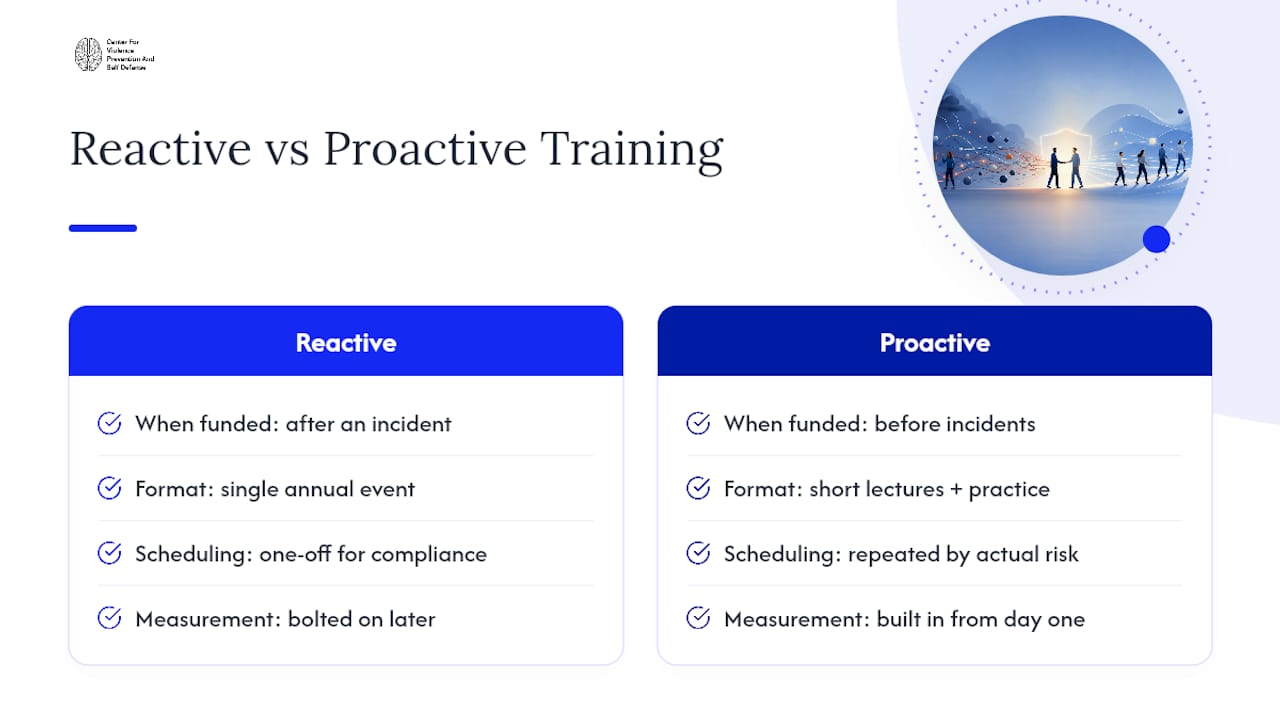
Where conventional advice falls short is treating training as a single annual event that satisfies a compliance box. It doesn’t work that way. The research consistently rewards organizations that pair short lectures with real practice, repeat it on a schedule tied to actual risk, and build measurement in from day one rather than bolting it on later.
If you take one thing from this guide, prioritize the risk assessment before you shop for a curriculum. Knowing which units and roles carry the real exposure should drive every decision that follows, including the training format you choose and how often you repeat it.
Ready to Start? Here’s How CVPSD Can Help
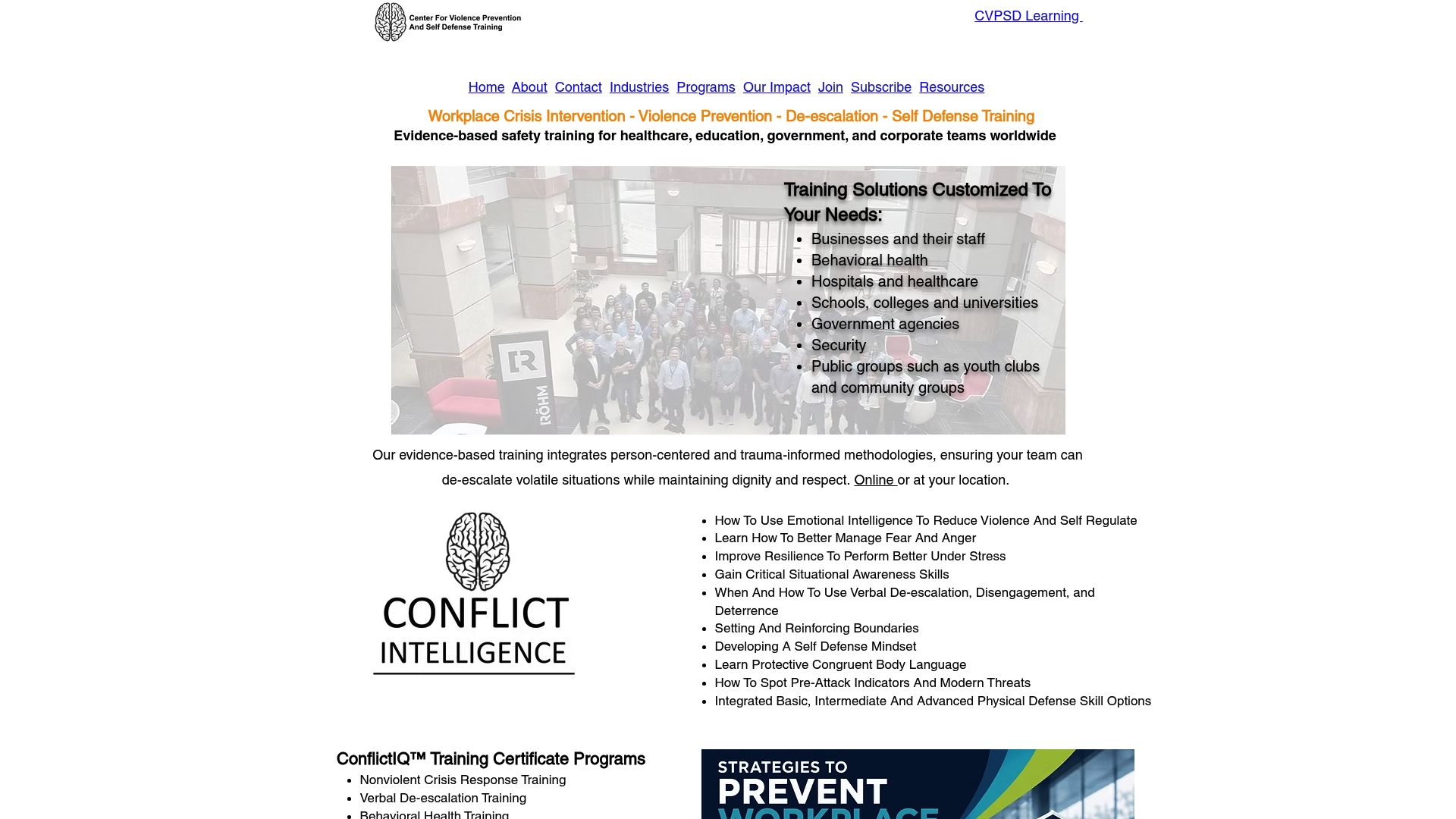
Training organizations design and deliver evidence-based crisis intervention, de-escalation, and workplace violence prevention programs tailored to healthcare, education, corporate, nonprofit, and government settings, rather than a generic template stretched across every industry.
If your organization hasn’t run a risk analysis in the past year, that’s the logical starting point. From there, a focused pilot workshop with real skills practice gives you the evidence you need before committing to full rollout, and it gives your staff a chance to build confidence in a low-stakes setting first. Visit the CVPSD training program page to schedule a risk assessment or book an initial pilot session for your highest-priority unit.
Sources
FAQ
Is De-escalation Training Legally Required?
OSHA doesn’t mandate a single national standard, but its enforcement guidance treats a documented workplace violence prevention program, training included, as part of the general duty to provide a workplace free of recognized hazards.
How Often Should Staff Repeat Conflict Resolution Training?
At minimum annually, with quarterly or monthly refreshers for high-risk roles like security, behavioral health staff, and emergency department personnel, per OSHA guidance on training frequency.
Does This Training Actually Reduce Physical Restraints?
Yes. A cluster randomized controlled trial found CRSCE-based de-escalation training significantly reduced both the frequency and duration of physical restraints compared with control units.
What’s the Best Format for Teaching De-escalation Skills?
A systematic review found the strongest evidence supports pairing brief didactic lessons with active practice like role-play or simulation, not lecture alone.
How Do We Choose a Conflict Resolution Training Provider?
Look for evidence-based curriculum design, role-specific content, documented outcome measurement, and sector-specific experience, criteria CVPSD builds directly into its conflict resolution training programs.
Recommended
About the Author: William DeMuth is the Director of Training at the Center for Violence Prevention and Self Defense (CVPSD) in Freehold, NJ. With over 35 years of research in violence dynamics and personal safety, William specializes in evidence-based training that bridges the gap between compliance and real-world conflict resolution. The architect of the ConflictIQ™ program, he holds advanced certifications and has trained under diverse industry leaders. Today, he actively trains civilians, hea


