
Crowd Safety Self-Defense Explained: Your 2026 Guide

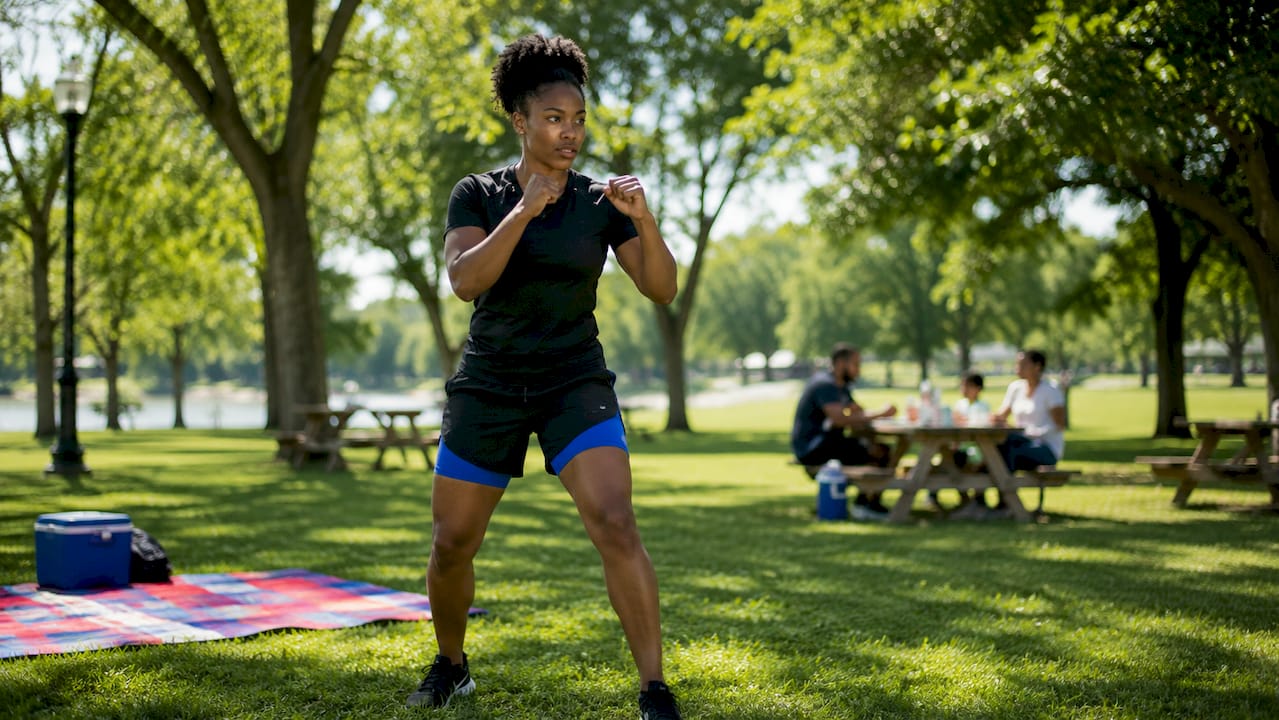
Crowd safety self-defense is the practice of using targeted body postures, situational awareness, and deliberate movement to protect yourself in high-density crowd scenarios. The industry term for this discipline is crowd survival tactics, and it covers everything from reading crowd energy to adopting the boxing-guard arm position when density becomes dangerous. Most people attending concerts, festivals, or large public events have no training in self-defense strategies in crowds. That gap costs lives. This guide draws on 2026 crowd safety guidelines and CVPSD’s evidence-based training to give you the knowledge you need before the next event.
How does crowd density affect personal safety?
Crowd density is measured in people per square meter, and that number determines your survival options. At low densities of 1–2 people per square meter, you move freely and can exit at will. As density climbs toward 4 people per square meter, movement slows and you lose the ability to choose your direction. When density exceeds 5–6 people per square meter, the escape window shrinks dramatically and compressive asphyxia becomes a real threat.
Compressive asphyxia occurs when crowd pressure on your chest prevents your lungs from expanding. You do not need to be knocked down for this to happen. Standing upright in a crush, with no room to breathe, is enough to cause loss of consciousness within minutes. This is why crowd management techniques that focus only on exits miss the point. Personal defense tactics for large groups must address what happens to your body before you ever reach a door.

Pro Tip: Arrive early to any large event and walk the perimeter. Note where the crowd thins, where barriers create bottlenecks, and where medical stations are located. This five-minute habit is the most effective crowd safety measure you can take.
Density level | People per sq. meter | Mobility status | Primary risk |
Low | 1–2 | Free movement | Minimal |
Moderate | 2–4 | Slowed, directional | Tripping, jostling |
High | 4–5 | Restricted | Panic, disorientation |
Critical | 5–6+ | Near zero | Compressive asphyxia |
What defensive postures improve survival in dense crowds?
The boxing-guard arm position is the single most important physical technique in crowd safety self-defense. Holding your forearms horizontal with elbows out creates a protected space around your ribcage. That space lets your lungs expand even when the crowd presses in from all sides. CVPSD includes this posture in its street-ready self-defense skills training because it works without any equipment and can be adopted in seconds.
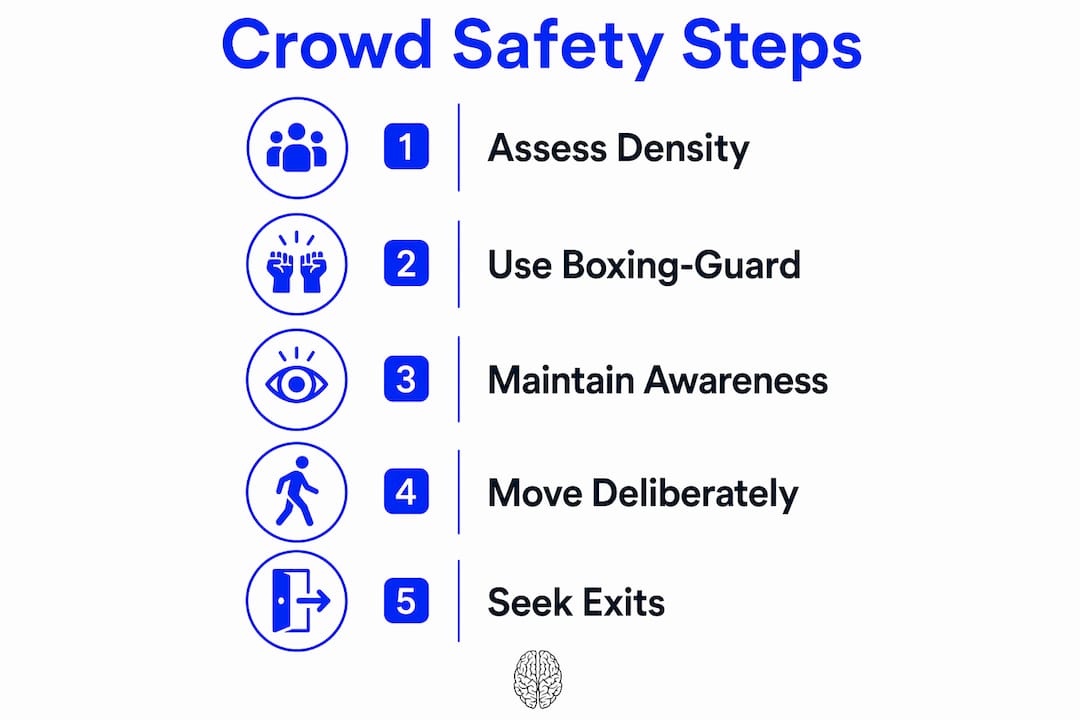
The mechanics are straightforward. Raise both arms to chest height. Bend your elbows so your forearms point forward, parallel to the ground. Keep your elbows wide, roughly shoulder-width apart. Your hands can be open or loosely fisted. This position does two things at once: it protects your ribs from direct lateral compression, and it signals to people nearby that you are holding your ground without being aggressive.
If you fall in a crowd crush, the rules change completely. Curling into a fetal position protects your head, neck, and chest far better than trying to crawl or lying flat. Lying flat exposes your spine and makes it nearly impossible for others to avoid stepping on you. The fetal posture tucks your knees to your chest, covers your head with your arms, and presents the smallest possible profile to the crowd above you.
Key mistakes to avoid in a crowd crush:
Grabbing fixed structures. Holding onto poles or barriers creates a mechanical disadvantage. Crowd forces will pull you away and the sudden release causes serious injury.
Pushing against the flow. Fighting crowd momentum increases pressure on everyone around you and exhausts you within seconds.
Screaming continuously. Sustained screaming depletes oxygen faster than controlled breathing. Save your voice for one clear call if needed.
Crossing your arms over your chest. This collapses the breathing space the boxing-guard creates. Keep elbows out, not in.
Pro Tip: Practice the boxing-guard position at home until it feels automatic. In a real crush, your brain defaults to trained responses. Muscle memory built in calm conditions saves you in chaotic ones.
Detailed guidance on protective stances for self-defense covers how these postures integrate with broader personal safety training.
How does situational awareness prevent crowd emergencies?
Situational awareness is defined as a state of relaxed alertness in which you actively process your environment without anxiety. Most people operate in Condition White, a zoned-out state where they miss early warning signs entirely. Condition Yellow is the target state for anyone at a public event. You are calm, present, and scanning without fixating on any single threat.
The difference between these two states is not stress. It is habit. Situational awareness is a skill you build through daily practice, not something that switches on automatically when danger arrives. CVPSD trains individuals to shift into Condition Yellow before entering any crowded space, not after something goes wrong.
Recognizing early warning signs gives you time to act before a situation becomes critical. Watch for these signals:
Sudden crowd energy shifts. A wave of movement or noise that does not match the event is a reliable indicator of a problem forming at the source.
Bottleneck formation. When people begin compressing at a single point, such as a narrow gate or a blocked exit, density spikes fast. Move away from that point immediately.
Crowd flow reversal. People pushing back against the primary direction of movement signals a blockage or panic ahead.
Reduced personal space without explanation. If the crowd tightens around you without a visible reason, density is rising faster than the event structure can manage.
Loss of crowd sound coherence. Screaming that replaces cheering, or sudden silence, both indicate a shift from celebration to crisis.
Proactive risk assessment before and during events is the foundation of how to ensure crowd safety at the individual level. Locate exits when you arrive. Identify where security and medical personnel are stationed. Choose a position near the perimeter rather than the center of a dense crowd. These decisions take less than ten minutes and reduce your personal risk substantially.
Non-verbal threat recognition is a related skill covered in depth through situational awareness training resources that CVPSD makes available to community groups and individuals.
What movement and communication strategies reduce crush risk?
Movement in a dense crowd follows one rule: work with the flow, not against it. Pushing against crowd momentum increases pressure on everyone in your immediate area and accelerates crush conditions. The correct approach is to move diagonally toward the perimeter, using the crowd’s own energy to carry you sideways rather than fighting it head-on.
Crowd pulses are the key to safe movement in extreme density. A crowd pulse is a brief 1–2 second window when crowd pressure releases slightly before the next wave builds. These windows are your only safe opportunity to reposition. Move during the release. Stop and hold your boxing-guard during the compression. Trying to move continuously in a crush exhausts you and worsens your position.
“In a crowd crush, the instinct to fight your way out is the instinct that kills you. The crowd is stronger than any individual. Your survival depends on reading its rhythm and moving with it, not against it. One deliberate step during a pressure release is worth ten panicked pushes against the flow.”
Communication during a crush must be visual, not vocal. Screaming depletes oxygen rapidly and communicates panic to those around you, which worsens crowd behavior. Use eye contact and hand gestures to signal those near you. If local pressure is building dangerously, a calm, firm call of “PUSH BACK” directed at the people immediately around you can create a small relief zone. One clear phrase, repeated calmly, is more effective than continuous shouting.
Use eye contact first. Direct eye contact signals calm authority and gets attention without escalating panic.
Keep gestures low and deliberate. Wide overhead gestures can be misread as distress signals and trigger reactive crowd movement.
Coordinate with those nearest you. A small group of two or three people moving together in a crush is far more effective than one person acting alone.
Key takeaways
Crowd safety self-defense requires three things working together: knowledge of density thresholds, trained physical postures, and practiced situational awareness before any emergency begins.
Point | Details |
Know the critical density threshold | At 5–6 people per square meter, compressive asphyxia risk rises sharply and escape options shrink. |
Use the boxing-guard posture | Forearms horizontal, elbows out protects your ribcage and maintains breathing space in a crush. |
Adopt fetal position if you fall | Curl knees to chest and cover your head to protect vital areas until you can stand. |
Move with crowd pulses | Use brief 1–2 second pressure-release windows to reposition diagonally toward the perimeter. |
Practice Condition Yellow awareness | Scan for bottlenecks, exits, and crowd energy shifts before a situation becomes critical. |
Why most people learn these skills too late
The hardest part of crowd safety self-defense is not the physical technique. It is the mindset shift required to practice Condition Yellow awareness before anything goes wrong. Most people I have worked with arrive at training after a frightening experience at a concert or festival. They felt the crowd tighten around them, they panicked, and they got lucky. Luck is not a strategy.
What strikes me most is how quickly the boxing-guard posture becomes second nature once someone practices it even a handful of times. The body remembers. But the window to build that memory is before the event, not during it. Waiting until you feel the crowd compress is waiting too long.
The other thing I have observed is that people consistently underestimate how much their awareness of crowd safety for communities protects the people around them, not just themselves. When you hold your boxing-guard and move calmly with crowd pulses, you create space for others. When you call “PUSH BACK” in a controlled voice, you give nearby strangers a cue to act. These skills ripple outward. One trained person in a crowd changes the outcome for many. That is worth taking seriously.
— Will
CVPSD training for crowd safety and personal protection
CVPSD is a 501©(3) nonprofit that provides evidence-based self-defense education to individuals, schools, community groups, and government agencies across the United States. Its programs cover crisis intervention, behavior analysis, and physical self-defense skills grounded in current research.
For anyone attending large public events, CVPSD offers both online and in-person training that covers crowd survival tactics, protective postures, and situational awareness in practical, accessible formats. Programs meet state and local laws and are designed for real people in real situations. Public safety awareness efforts like those supported by nonprofit safety initiatives reinforce why community-level education matters. Visit CVPSD’s training programs to find the right course for your needs and your community.
FAQ
What is crowd safety self-defense?
Crowd safety self-defense is the practice of using protective body postures, situational awareness, and deliberate movement strategies to reduce injury risk in high-density crowd situations. It is also called crowd survival tactics in professional safety training contexts.
When does crowd density become dangerous?
Crowd density becomes dangerous when it exceeds 5–6 people per square meter. At that threshold, individual movement is severely restricted and compressive asphyxia becomes a serious risk.
What is the boxing-guard arm position?
The boxing-guard arm position involves holding your forearms horizontal at chest height with elbows pointed outward. This posture creates protected space around your ribcage, allowing your lungs to expand even under crowd pressure.
What should you do if you fall in a crowd crush?
Curl into a fetal position with your knees drawn to your chest and your arms covering your head and neck. This protects your vital areas and reduces the risk of serious injury until you can safely stand.
How do you move safely in an extremely dense crowd?
Move diagonally toward the perimeter during brief crowd pressure-release windows called crowd pulses. Never push directly against crowd momentum, as doing so increases pressure and accelerates crush conditions.
Recommended


