
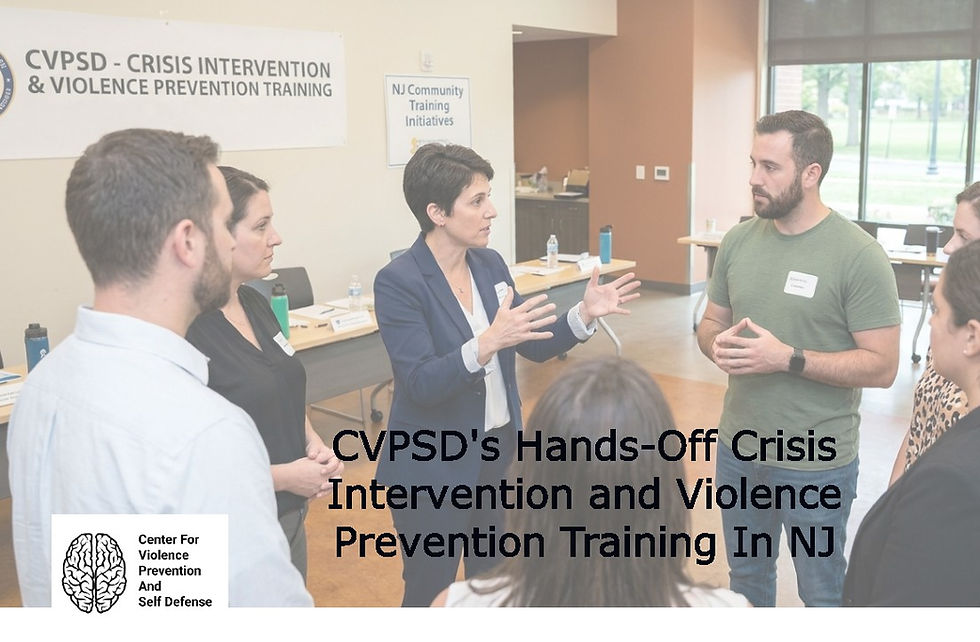
CVPSD's Hands-Off Crisis Intervention and Violence Prevention Training In NJ

Hands-Off Crisis Intervention and Violence Prevention doesn't announce itself. It can arrive in the form of a patient pacing a hospital corridor, a student overwhelmed in a classroom, or a client in social services who has reached their breaking point. In these moments, the instinct to physically intervene can feel like the only option but more often than not, it is the wrong one.
The Center for Violence Prevention and Self-Defense (CVPSD) has built its training philosophy around a different premise: that the most effective response to a crisis is rarely physical, and that with the right skills, most dangerous situations can be resolved before they ever become dangerous at all.
Who Is CVPSD?
The Center for Violence Prevention and Self-Defense is a 501(c)(3) nonprofit organization based in Freehold, New Jersey, dedicated to protecting at-risk communities through evidence-based research and life-saving intervention training.
Through a combination of online and in-person training seminars, CVPSD delivers crisis intervention techniques, de-escalation solutions, behavior analysis, and physical self-defense skills to a wide range of sectors. Its partners include schools, hospitals, nonprofit organizations, social service agencies, correctional facilities, community groups, and government agencies anywhere that people in crisis come into contact with professionals trained to help them.
CVPSD's mission is to empower individuals and organizations with the knowledge and skills needed to recognize, avoid, and respond effectively to threats. Central to that mission is the belief that safety should be proactive, not reactive and that violence can most often be prevented before it begins.
The Hands-Off Crisis Intervention and Violence Prevention Training Philosophy: All Behavior Is Communication
At the heart of CVPSD's approach is a simple but transformative idea: all behavior is communication. When a person escalates into a crisis, they are not simply "being difficult" they are expressing an unmet need, processing trauma, or reacting to a brain and body that have been overwhelmed. Understanding this reframes everything.
Rather than responding to escalating behavior with force or control, CVPSD-trained professionals learn to respond with de-escalation verbal, emotional, and environmental tools that address the root cause of distress rather than suppressing its symptoms. The hands-off model prioritizes human dignity, clinical best practices, and the fundamental principle that restraint and physical intervention carry serious risks for everyone involved: the person in crisis, the staff member, and the organization.
This philosophy is not passive. It requires rigorous training, genuine psychological skill, and the ability to remain composed under pressure. In fact, CVPSD's framework demands more of its participants than reactive, physical approaches do because preventing a crisis before it erupts is harder, and more important, than managing one after the fact.
What the Hands-Off Crisis Intervention and Violence Prevention Training Covers
CVPSD's Nonviolent Crisis Response Training is a comprehensive, customizable program designed for professionals across healthcare, education, human services, and public safety. Its curriculum is structured around four interconnected pillars:
Assess. Before any intervention is possible, professionals must be able to accurately read a situation. CVPSD training teaches participants to critically analyze situational dynamics distinguishing between routine friction, escalating conflict, and immediate threats. This involves learning to identify early warning signs of behavioral escalation and recognizing the pre-incident indicators that signal danger before it materializes.
Communicate. Verbal de-escalation is the cornerstone of the hands-off model. CVPSD's programs develop the psychological confidence and verbal fluency needed to de-escalate volatile behavior. Participants learn evidence-based communication models, proactive limit-setting strategies, and the specific language techniques that can interrupt an escalating cycle and return a person in crisis to a state of calm. This goes far beyond simply "talking someone down" it is a structured, intentional approach rooted in behavioral science.
Mitigate. When prevention and de-escalation are not enough, CVPSD equips professionals with advanced disengagement techniques that reduce the need for physical restraint. These "safety-first" escape and disengagement skills allow staff to safely exit volatile physical encounters and create space without resorting to holds or force. The goal is always to reduce harm, not escalate it.
Advocate. Throughout every phase, CVPSD's training emphasizes person-centered advocacy an inclusive, trauma-informed, and culturally sensitive framework that preserves the dignity of every individual in crisis. Participants are trained not just in technique, but in perspective: to see the person behind the behavior, to understand the lasting impact of trauma, and to bring genuine empathy to every encounter.
Understanding What Drives the Crisis
One of the most distinctive elements of CVPSD's curriculum is its deep focus on the neuroscience and psychology behind crisis behavior. To truly manage a crisis, professionals must first understand where it comes from.
CVPSD training explores how trauma and brain chemistry influence both the individual in crisis and the person responding to them. Participants learn to recognize the signs of a brain in fight-or-flight mode the physiological state that drives much of the aggressive, irrational, or dangerous behavior that frontline workers encounter. By understanding the "why" behind behavior, staff are able to apply compassionate, evidence-based interventions that address root causes rather than reacting to surface symptoms.
Equally important is what CVPSD calls Rational Detachment the ability of the responder to self-regulate their own stress response in the midst of a volatile encounter. High-risk behaviors naturally trigger an emotional reaction in the people witnessing or managing them. Without training, that reaction can escalate a situation rather than resolve it.
CVPSD teaches professionals to separate personal emotions from the crisis at hand, maintaining professional composure and objective clarity rather than being drawn into a counterproductive power struggle.
Who Needs Hands-Off Crisis Intervention and Violence Prevention Training Training?
The scope of environments where hands-off crisis intervention training is essential is broader than many people realize. CVPSD serves professionals in:
Healthcare settings, where patients experiencing mental health episodes, medication reactions, or extreme distress can become physically dangerous to themselves and others.
Schools and educational institutions, where overwhelmed students particularly those with developmental, emotional, or behavioral challenges require responses grounded in de-escalation rather than discipline.
Social service agencies, where clients navigating poverty, trauma, housing instability, or substance use may arrive in states of acute distress.
Correctional and public safety settings, where effective de-escalation can prevent injury on both sides of an encounter.
Community organizations and nonprofits, which serve vulnerable populations but often lack the institutional resources for robust safety training.
In all of these settings, the stakes are high and the margin for error is narrow. A poorly handled crisis can result in physical injury, legal liability, psychological trauma, and damaged relationships between institutions and the communities they serve.
Flexible, Customized, and Compliant Hands-Off Crisis Intervention Training
One of CVPSD's key differentiators is its commitment to meeting organizations where they are. The training is fully customizable, with curricula that can be scaled and tailored to align with an organization's specific risk levels, compliance requirements, and workforce composition. Whether an organization needs foundational de-escalation skills for frontline staff or advanced physical disengagement training for specialized response teams, CVPSD builds programs to match.
Training is available both online and in-person, including an Instructor Certification Program delivered through a hybrid format that blends online learning with in-person skill development. This approach allows large organizations to train entire teams efficiently without sacrificing the hands-on practice that crisis intervention demands.
Critically, all CVPSD programming is nationally recognized, court-defensible, and designed to comply with state and federal regulations for workplace violence prevention. In an era of increasing regulatory scrutiny around workplace safety and growing awareness of the legal and ethical risks of improper physical intervention this matters enormously to the organizations that rely on CVPSD's training.
The Measurable Difference
The value of hands-off crisis intervention training extends well beyond individual incidents. Organizations that adopt CVPSD's approach report measurable, institution-wide benefits: fewer staff injuries, greater confidence among frontline workers, lower employee turnover, and stronger compliance with human rights standards and best practices in care.
By shifting organizations away from reactive, "command and control" responses and toward proactive, person-centered safety cultures, CVPSD's training changes not just how staff respond to crises but how often crises occur in the first place.
The numbers tell only part of the story. The real measure of this training's impact is in the moments that don't happen: the escalation that never reached its peak, the restraint that was never applied, the injury that never occurred. Hands-off crisis intervention, done right, means that the most powerful intervention is often the one that leaves no mark at all.
Getting Trained
For organizations interested in building a safer, more compassionate response culture, CVPSD offers consultations to help identify the right training program for your team's needs and risk environment. Programs are available for a wide range of group sizes and can be delivered on-site or through CVPSD's online learning platform.
To learn more or connect with CVPSD directly, visit cvpsd.org or call 732-598-7811. The Center for Violence Prevention and Self-Defense is located in Freehold, New Jersey, and serves organizations and communities nationwide.
The Center for Violence Prevention and Self-Defense (CVPSD) is a registered 501(c)(3) nonprofit organization. Its training programs are nationally recognized, court-defensible, and designed to meet state and federal workplace violence prevention compliance standards.

About The Author
William DeMuth, Director of Training
William DeMuth is a recognized authority in violence dynamics and personal safety, with more than three decades of applied research and evidence-based instruction. He is the Co-architect of the ConflictIQ™ program a comprehensive, layered curriculum grounded in behavioral science and designed for real-world conflict resolution. DeMuth holds advanced certifications across multiple disciplines and has studied under some of the field's most distinguished practitioners, including Lt. Col. Dave Grossman and Craig Douglas of ShivWorks. His academic foundation includes studies in Strategic Management at The Wharton School, University of Pennsylvania.
His training reaches a diverse professional population civilians, law enforcement agencies, healthcare institutions, and corporate organizations with a curriculum encompassing behavioral analysis, situational awareness, de-escalation methodology, and applied physical skills.


