
How to De-escalate Road Rage Incidents Safely

Updated: Jul 30
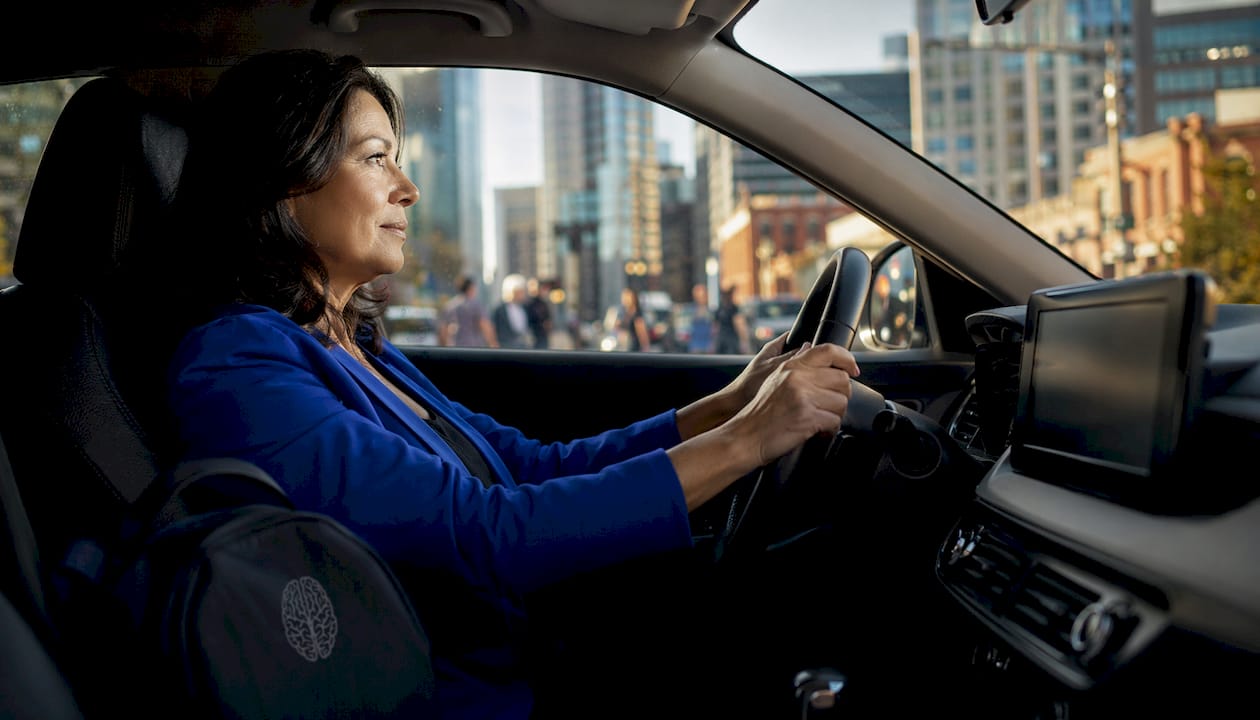
Road rage is defined as aggressive or violent behavior by a driver in response to a traffic conflict, and knowing how to de-escalate road rage incidents safely is one of the most practical safety skills any driver can develop. Over 25% of Americans frequently witness road rage on public roads. That number means most drivers will face a hostile encounter at some point. The good news is that emotional regulation, situational awareness, and a few proven defensive driving techniques give you real control over how these encounters end. CVPSD’s evidence-based training in crisis intervention and de-escalation confirms that the driver who stays calm almost always stays safe.
How to recognize early warning signs and prepare to de-escalate road rage incidents safely
Situational awareness is the first line of defense. Professional drivers treat early recognition of aggression as more effective than any attempt to calm a driver once hostility peaks. Catching warning signs early gives you time to create space before a situation demands a response.
Common triggers that precede road rage include:
Tailgating. Drivers who follow too closely feel pressure and often interpret it as a personal challenge.
Cutting off or merging without signaling. These moves feel intentional even when they are not.
Aggressive gestures or horn use. These are escalation signals, not communication.
Brake-checking. A deliberate slow-down designed to intimidate the driver behind.
Prolonged eye contact or staring. In conflict psychology, sustained eye contact reads as a dominance signal.
Watch for these early behavioral cues in other drivers: erratic lane changes, excessive speeding followed by sudden braking, and visible agitation such as animated gesturing inside the vehicle. These behaviors signal that a driver is already emotionally dysregulated.
The mental frame you carry into the car matters as much as any physical technique. Psychological depersonalization means accepting that another driver’s hostility is almost never actually about you. Road anonymity makes it easy for drivers to project frustration onto strangers. Recognizing this removes the emotional charge from the encounter before it starts.
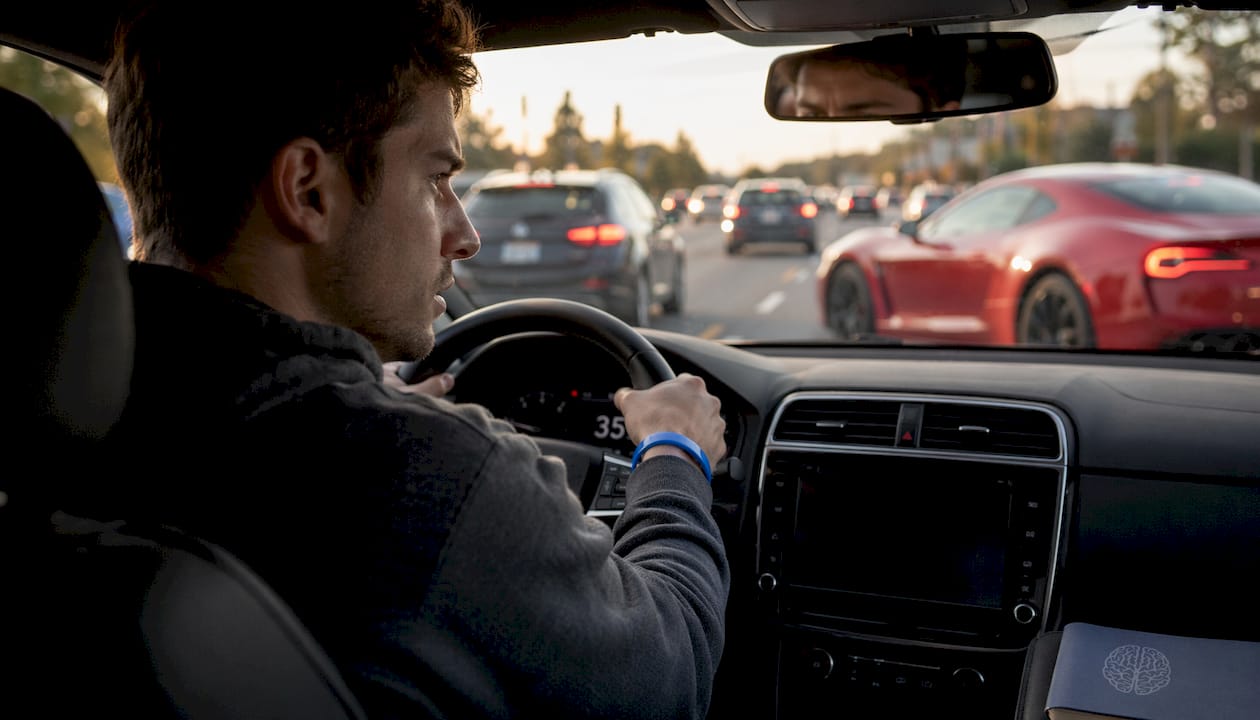
Keep windows up and doors locked as a baseline habit, not just during incidents. This simple physical barrier reduces your exposure and gives you more time to respond calmly if a situation develops.
Pro Tip: Practice scanning traffic three to four cars ahead rather than focusing only on the vehicle directly in front of you. This wider field of awareness lets you identify aggressive drivers early and create distance before they reach you.
What are the best steps to safely handle road rage in the moment?
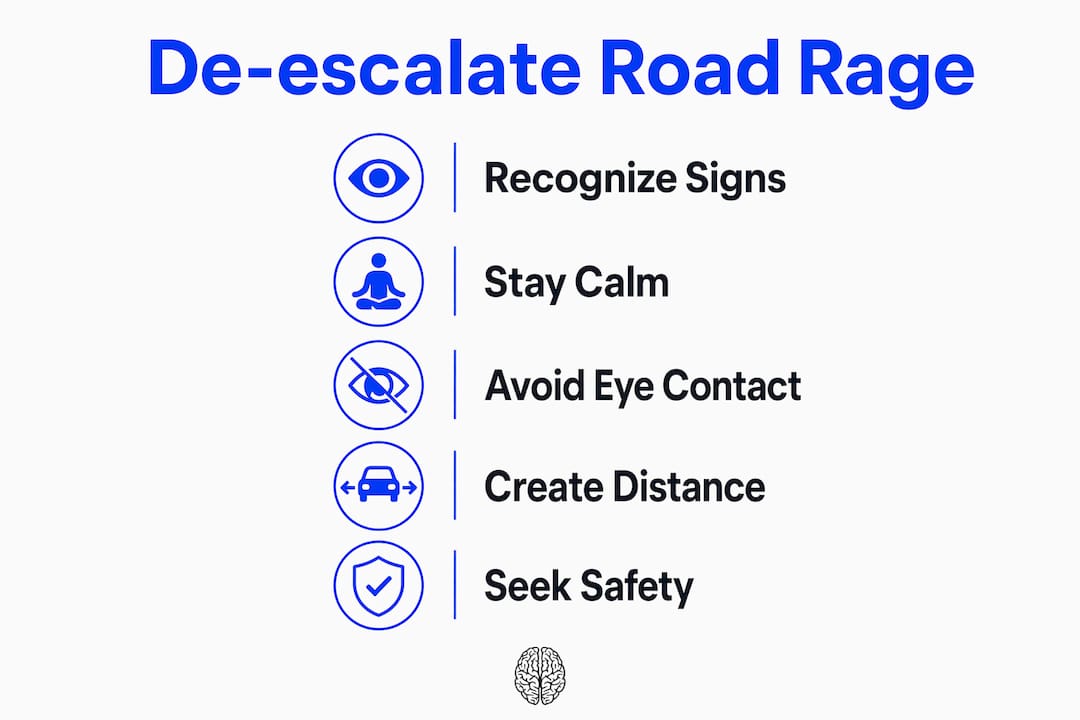
The single most effective response to an active road rage encounter is immediate disengagement. Drivers cannot control another person’s behavior; the only goal is to reach your destination safely. Every action you take should serve that goal.
Follow these steps when facing an aggressive driver:
Avoid eye contact immediately. Eye contact sends a provocative signal that can trigger further escalation. Look at the road, not the other driver.
Do not respond to gestures. Any engagement, including a calming hand wave, can validate the aggressor’s hostility and make things worse. Complete non-engagement is the safest response.
Create physical space. Increase your following distance, change lanes if safe, or slow down gradually to let the aggressive driver pass. Distance is your best protection.
Use clear, passive signals. If you need to change lanes or turn, use your turn signal early and clearly. Predictable driving reduces friction.
Reset your nervous system. Deep, diaphragmatic breathing with an exhalation three to four times longer than your inhalation rapidly lowers heart rate and reduces the fight-or-flight response. This is a physiological reset, not just a relaxation tip.
Keep doors locked and windows up. Locked doors and closed windows create a physical barrier that prevents physical confrontation and buys you time.
Call 911 if threatened. If an aggressive driver follows you, does not back off, or exits their vehicle, call emergency services immediately. Do not wait to see if the situation resolves itself.
Drive to a populated area. If you are being followed, drive to a police station, a busy gas station, or a public parking lot. Never drive home or to your workplace.
The physiological reset deserves extra attention because most drivers skip it. Controlled breathing neutralizes the fight-or-flight response at a biological level. When your heart rate drops, your decision-making improves. That calm directly reduces the risk of a reactive mistake.
Pro Tip: Monitor your inner dialogue during a tense encounter. Replace “How dare they” with “This is not about me, and I am choosing to disengage.” Changing the internal script reduces emotional reactivity faster than any external technique.
Preventive techniques to avoid road rage escalation altogether
Prevention is more reliable than response. The goal is to reduce the number of encounters that reach the point of active hostility.
Plan your route and timing. Congestion is a primary stress amplifier. Leaving ten minutes earlier or using a less-traveled route removes a significant source of frustration before it starts.
Practice defensive driving with increased following distance. Tailgating is the top frustration for a large share of drivers. Keeping a generous following distance signals patience and reduces the chance of triggering someone behind you.
Adopt a buffer mindset. Expecting that other drivers will make errors removes the element of surprise and the anger that comes with it. When you expect imperfection, you stop taking it personally.
Use calming audio. Music at a moderate tempo or a podcast you enjoy lowers baseline stress during the drive. High-energy or aggressive audio raises arousal levels and makes you more reactive.
Manage stress before you drive. Emotional regulation starts before you turn the key. If you are already angry, anxious, or exhausted, your threshold for frustration on the road drops significantly.
Avoid the horn and aggressive gestures. The horn is a safety tool, not a commentary on other drivers. Using it to express frustration almost always escalates rather than resolves.
Reframing driving as a cooperative activity rather than a competition changes everything. When you see other drivers as people trying to get somewhere, not obstacles or adversaries, the emotional charge of traffic disappears. This single mental shift reduces frustration more reliably than any driving technique.
The buffer mindset works because it removes the expectation of perfect behavior from strangers. You would not expect every pedestrian on a busy sidewalk to move perfectly. Roads are no different.
What should you do if road rage escalates to a physical threat?
Some encounters move past verbal hostility into genuine physical danger. Recognizing that shift early is critical.
Signs that escalation is imminent include:
The other driver exits their vehicle.
The other driver follows you after you have changed lanes or turned.
The other driver attempts to block your path or force you to stop.
Visible weapons or threatening objects appear.
When these signs appear, your response must shift from de-escalation to pure safety. Disengaging and driving to a safe location is the law enforcement recommendation in every serious road rage scenario. Do not stop. Do not confront. Do not exit your vehicle.
Drive to the nearest police station if one is accessible. A busy gas station, a fire station, or any well-lit public space with people present are all safer destinations than your home or workplace. Never lead a hostile driver to a location where you are alone or where your family is present.
Call 911 while driving if you are being followed. Give the dispatcher your location, a description of the other vehicle, and the direction of travel. If you have a dashcam, it is already recording. If you do not, a passenger can use a phone to document the incident. Documentation supports law enforcement and protects you legally.
Do not exit your vehicle under any circumstances unless law enforcement instructs you to. The vehicle is your protection. Exiting removes that barrier and places you in direct physical proximity to an aggressor.
Key Takeaways
Staying calm, disengaging immediately, and creating physical distance are the three actions that resolve the vast majority of road rage encounters without harm.
Point | Details |
Disengage immediately | Avoid eye contact, gestures, and all engagement the moment hostility appears. |
Create physical space | Increase following distance, change lanes, or slow down to let the aggressor pass. |
Use physiological reset | Breathe with exhalation three to four times longer than inhalation to lower heart rate. |
Drive to safety if threatened | Go to a police station or populated public area; never drive home if being followed. |
Prevention beats response | A buffer mindset and defensive driving reduce encounters before they start. |
Road rage is not a test of character. It is a test of judgment.
After years of working in conflict intervention and safety education, the pattern I see most often is this: drivers treat road rage as something that is happening to them. They feel disrespected, challenged, or targeted. That feeling is real. The interpretation is almost always wrong.
The other driver does not know you. They are not responding to who you are. They are responding to stress, fatigue, or a bad day that started long before they got behind the wheel. The moment you accept that, the encounter loses its power over you. You stop trying to correct them or prove a point, and you start making decisions that actually protect you.
What I find most telling is that professional drivers, people who spend their working lives on the road, do not talk about road rage in terms of winning or losing. They talk about situational awareness and early space creation. They see an aggressive driver three cars ahead and they simply move. No emotion. No reaction. Just a calm, deliberate choice to not be in that space.
That is the skill worth building. Control over your own behavior is real and available to you right now. Control over another driver’s behavior is an illusion. The sooner you let go of the second, the more effectively you exercise the first.
Road rage encounters are also, if you choose to see them this way, practice. Every time you disengage cleanly, breathe through the frustration, and arrive safely, you reinforce a pattern that makes the next encounter easier.
Patience on the road is not passive. It is a trained response, and it gets stronger with repetition.
CVPSD training programs for safer driving and conflict resolution
Knowing what to do in a road rage encounter is one thing. Having the practiced skills to do it under pressure is another.
CVPSD is a 501©(3) non-profit that delivers evidence-based de-escalation and conflict resolution training to individuals, community groups, schools, and government agencies. The programs cover crisis intervention techniques, behavior analysis, and emotional regulation skills that apply directly to high-stress driving situations. CVPSD partners with public and private organizations to bring this training to the communities that need it most. Visit CVPSD’s training programs to learn how to build the skills that keep you and others safe on the road.
FAQ
What is the fastest way to calm road rage?
The fastest method is physiological resetting through controlled breathing, with exhalation three to four times longer than inhalation. This directly lowers heart rate and reduces the fight-or-flight response within seconds.
Should you ever respond to an aggressive driver’s gestures?
No. Any engagement, including a calming hand wave or brief eye contact, can escalate the encounter. Complete non-engagement is the safest and most effective response.
What should you do if someone follows you after a road rage incident?
Drive to a police station, fire station, or busy public location. Call 911 while driving and provide your location and a description of the vehicle. Never drive home or to your workplace.
How does a buffer mindset help prevent road rage?
A buffer mindset means expecting that other drivers will make mistakes. This removes the element of surprise and the anger that follows, making it easier to respond calmly rather than reactively.
Can de-escalation training help with road rage situations?
Yes. Training in crisis intervention and emotional regulation, such as the programs offered by CVPSD, builds the practiced skills needed to respond calmly and safely under pressure, rather than relying on instinct alone.
Recommended


