
Best MedBox.com Alternatives for Secure Storage or Home Delivery


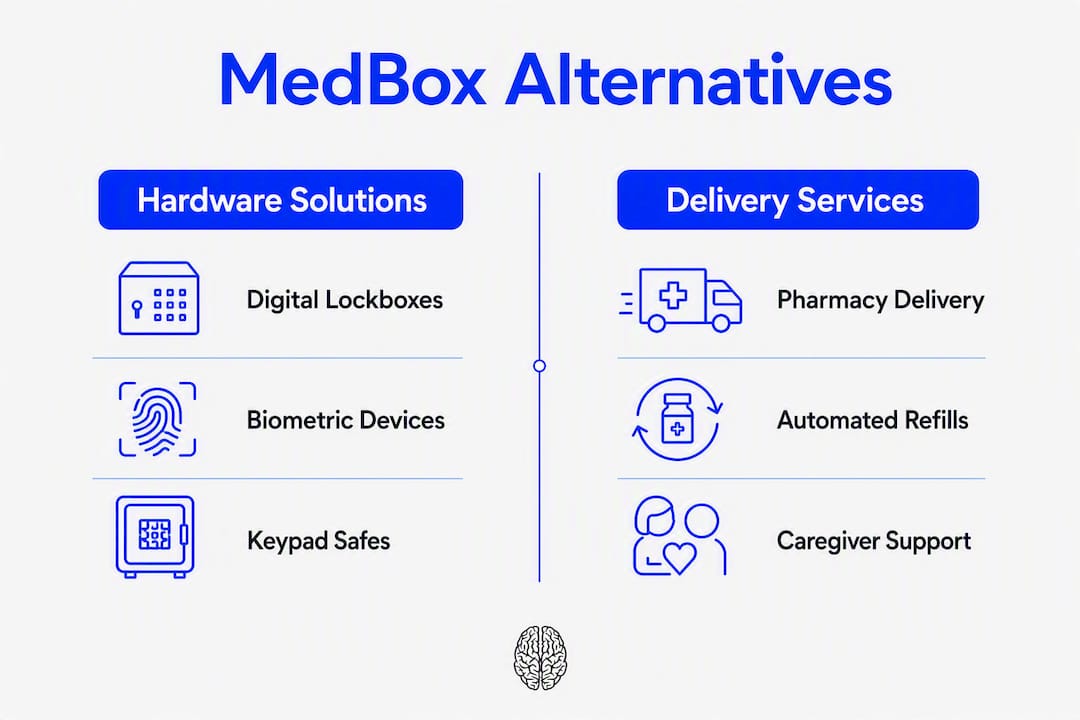
For most people searching for medbox.com alternatives, the right starting point is a pharmacy-managed delivery service — PillPack by Amazon Pharmacy, Alto Pharmacy, Capsule, NowRx, Truepill, or CareZone — if your primary need is pre-sorted fills, refill automation, and pharmacist access. If your need is restricted physical access to medications in a clinical or residential setting, a digital-keypad lockbox or automated pill dispenser is the correct category, and pairing that hardware with staff training from a qualified provider like CVPSD is what actually reduces misuse long term.
Ask yourself one question first: Do you need delivery and pharmacist support, or do you need locked storage and restricted access? The answer determines which path to follow.
Delivery and adherence path:
PillPack (Amazon Pharmacy): Pre-sorted daily packets, automatic refills, nationwide coverage, accepts most insurance and Medicare Part D. Best for people managing five or more medications.
Alto Pharmacy: Same-day or next-day delivery in select metro areas, strong app experience, pharmacist chat, accepts most major insurance. Best for urban users who want speed and direct pharmacist access.
Capsule: Same-day delivery in New York City and select cities, free delivery, pharmacist messaging, no membership fee. Best for city-based patients who want a personal pharmacy feel.
NowRx: Same-day delivery with a focus on affordability, free delivery, accepts most insurance. Best for cost-conscious patients in covered service areas.
Truepill: Primarily a B2B fulfillment infrastructure provider powering telehealth platforms; less suited for direct consumer use but relevant for organizations building medication-delivery workflows.
CareZone: A medication-management app with refill reminders, medication lists, and caregiver sharing. Best as a coordination layer on top of any pharmacy, not a standalone delivery service.
Secure storage path:
Digital-keypad lockboxes or automated pill dispensers (such as the MED-E-LERT family) for home or clinical use, combined with written access protocols and staff training.
Table of Contents
What are the best MedBox.com alternatives? A side-by-side comparison
Key differences that matter when switching from MedBox to another solution
What do costs and insurance look like across these alternatives?
Why secure hardware paired with training is safer than hardware alone
The case for training alongside any medication-management solution
CVPSD training supports any medication-safety solution you choose
Useful sources and official references to check before you decide
What are the best MedBox.com alternatives? A side-by-side comparison
The table below compares the major alternative categories across the dimensions that affect daily use and safety decisions.
Category | Coverage area | Delivery speed | Packaging type | Controlled substances | Insurance / Medicare | Pricing model | App / pharmacist access | Refill / adherence support |
Pharmacy-managed delivery (PillPack, Alto, Capsule, NowRx) | Varies by provider; PillPack is nationwide | Same-day to 2 days depending on provider and location | Pre-sorted daily packets or standard bottles | Limited; most decline Schedule II; verify per provider | Most accept major insurance and Medicare Part D | Per-fill or subscription; free delivery common | App + pharmacist chat or phone | Automatic refills, reminders |
Telehealth / marketplace platforms (Truepill, CareZone) | Nationwide (platform-dependent) | Varies; fulfillment speed depends on partner pharmacy | Standard bottles or app-only (CareZone) | Depends on partner pharmacy | Varies; confirm per platform | Subscription or per-transaction | App-first; pharmacist access varies | Reminders, caregiver sharing (CareZone) |
Automated pill dispensers (MED-E-LERT and similar) | Hardware ships nationwide | N/A (hardware purchase) | Dose-scheduled compartments with alarms | Supports any medication loaded by caregiver | Not covered by standard pharmacy benefits | One-time hardware cost plus optional service fee | No pharmacist; caregiver-managed | Dose alarms, scheduled dispensing |
Digital-keypad lockboxes | Hardware ships nationwide | N/A (hardware purchase) | Locked storage; no sorting | Supports any medication stored by caregiver | Not covered by standard pharmacy benefits | One-time hardware cost | No app; audit logs on keypad models | No automated reminders |
Why each column matters:
Coverage area: Same-day delivery is only available in select cities; confirm your zip code before committing.
Delivery speed: For time-sensitive medications, same-day capability is a safety requirement, not a convenience.
Packaging type: Pre-sorted daily packets reduce dosing errors significantly compared to standard bottles for complex regimens.
Controlled substances: Most pharmacy-delivery services do not fulfill Schedule II medications. Verify this before transferring prescriptions.
Insurance / Medicare: Pharmacy-delivery services often accept Part D; hardware purchases are typically out-of-pocket.
Pricing model: Subscription fees vary; always request a sample invoice before enrolling.
App / pharmacist access: Direct pharmacist messaging is a meaningful safety feature, especially for caregivers managing multiple patients.
Refill / adherence support: Automated refills reduce the risk of gaps in critical medications.
CB Insights and AVIA Health both note that users frequently conflate two distinct categories: telehealth marketplace platforms that connect patients to prescribers and pharmacies, and pharmacy-specific home-delivery services that manage fulfillment and packaging. Choosing the wrong category wastes time and may leave a real safety gap.
What does MedBox actually do?
MedBox is a dispensing hardware and infrastructure company, not a pharmacy-delivery subscription. According to AVIA Marketplace, MedBox uses patented dispensing technology and biometric access controls for inventory management and compliance in clinical settings. It sits within the digital front door and virtual health segments of enterprise health systems, not the consumer pharmacy-delivery market.
Two things MedBox is not:
It is not a pharmacy that ships pre-sorted medication packets to your home.
It is not a telehealth marketplace where you consult a prescriber and get a prescription filled.
For clinical buyers, HIPAA compliance and DEA registration are relevant checkpoints when evaluating any dispensing hardware. Any vendor operating in a clinical setting should be able to provide documentation on both.
Key differences that matter when switching from MedBox to another solution
The practical differences between MedBox-style dispensing hardware and pharmacy-delivery services affect daily workflows in ways that go beyond packaging.
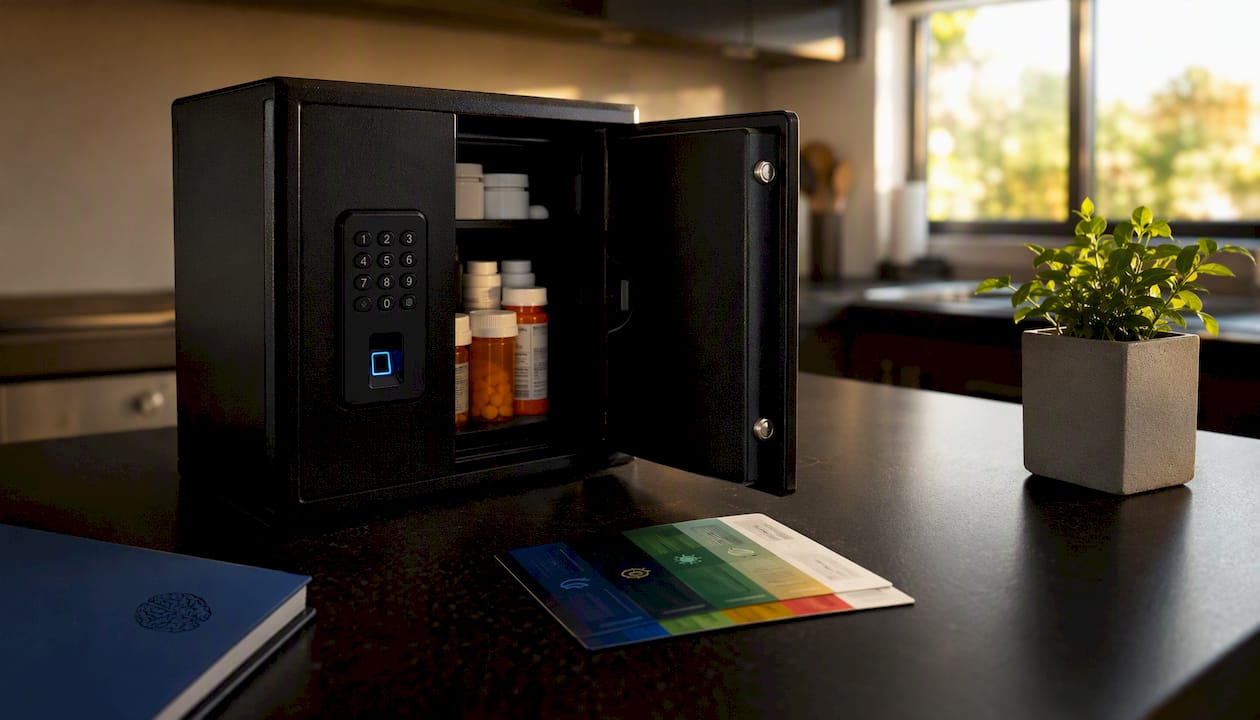
Access model: Dispensing hardware controls who retrieve a medication and when, using biometric or keypad authentication. Pharmacy-delivery services ship medications to a home address with no access controls at the point of storage.
Caregiver workflows: Delivery services like Alto and Capsule support caregiver accounts and shared medication lists. Hardware solutions require a caregiver to physically manage the device and load medications.

Emergency access: A locked dispenser or keypad lockbox can delay access in an emergency if the authorized user is unavailable. Delivery services have no physical access barrier at the storage end.
Refill automation: PillPack and Alto handle refill requests automatically. Hardware solutions depend entirely on the caregiver to reorder and reload.
Controlled-substance handling: Hardware allows any medication to be stored, including Schedule II drugs. Most pharmacy-delivery services decline Schedule II fulfillment; verify this before transferring a controlled-substance prescription.
Common migration challenges when moving away from MedBox-style hardware:
Transferring prescriptions to a new pharmacy takes 3–7 business days on average; plan ahead.
Controlled-substance prescriptions require the prescriber to send a new order directly to the receiving pharmacy in most states.
Insurance billing may change when switching from a local dispensing arrangement to a mail-order pharmacy; confirm your plan’s mail-order tier.
Patient data held in a dispensing system is subject to HIPAA; request a data export or deletion confirmation from the outgoing vendor.
Pro Tip: When multiple caregivers need access to stored medications, choose a digital-keypad lockbox over a keyed model. Keypads eliminate the lost-key risk and, on audit-capable models, log every access event — a meaningful safeguard in residential and clinical settings.
How do you choose the right alternative for your situation?
Start with the diagnostic question: Do you need delivery and pharmacist support, or do you need secure physical storage with restricted access?
If you need delivery and pharmacist support, work through these checks:
Coverage: Confirm same-day or next-day delivery is available at your address. Alto, Capsule, and NowRx are metro-focused; PillPack covers most of the country but ships 2-day.
Controlled substances: Ask explicitly whether the service fulfills your specific medications, including any Schedule II or III drugs.
Insurance: Verify your plan’s mail-order pharmacy tier and whether the provider is in-network. Medicare Part D coverage is common across the major delivery services, but formularies vary.
Pharmacist access: Confirm whether pharmacist chat is available 24/7 or only during business hours. For complex regimens, after-hours access matters.
Refill automation: Ask whether automatic refills require opt-in and how far in advance the service ships before you run out.
Privacy: Confirm HIPAA compliance and ask how the service handles prescription data if you cancel.
If you need secure physical storage, work through these checks:
Lock type: Digital keypads support multiple caregivers and audit logs; keyed locks are simpler but carry loss risk.
Capacity: Match the lockbox or dispenser size to the number of medications and dosing frequency.
Dispenser vs. lockbox: Automated dispensers like MED-E-LERT are better for complex regimens with dose scheduling; static lockboxes cost less and require no maintenance.
Audit capability: For clinical or residential settings, require access logs as a non-negotiable feature.
Training: Hardware alone does not prevent misuse. Pair any storage solution with written access protocols and staff training.
Pro Tip: Before finalizing any provider, request a sample invoice or price breakdown in writing. Verbal quotes for subscription services often omit transfer fees, packaging surcharges, or out-of-network copays that appear on the first bill.
What do costs and insurance look like across these alternatives?
Pricing structures differ significantly between delivery services and hardware, and the gap between what insurance covers and what you pay out-of-pocket can be substantial.
Pharmacy-delivery services:
Most charge no separate delivery fee and bill your insurance the same way a retail pharmacy would.
Your out-of-pocket cost is your standard copay or coinsurance under your plan’s pharmacy benefit.
Medicare Part D covers most medications dispensed by mail-order pharmacies, including PillPack; confirm your specific plan’s mail-order tier.
Some services charge a monthly subscription for premium features (packaging, adherence tools); others are purely per-fill.
Hardware (lockboxes and dispensers):
Lockboxes are a one-time purchase, typically ranging from under $30 for a basic keyed model to $100 or more for a digital-keypad model with audit capability.
Automated pill dispensers carry higher upfront costs and may include ongoing service or refill-cartridge fees.
Standard pharmacy benefits do not cover hardware purchases for home storage. Flexible spending accounts (FSAs) and health savings accounts (HSAs) may cover qualifying medical devices; confirm with your plan administrator.
Clinical-grade dispensing systems (the category MedBox occupies) are typically leased or purchased through a procurement contract, not a consumer subscription.
Practical steps before you commit:
Ask for a written price breakdown that includes all fees: delivery, packaging, transfer, and any monthly platform charge.
For controlled medications, ask whether prior authorization is required at the new pharmacy and whether the service will handle that process.
If you use Medicare, ask whether the provider participates in your specific Part D plan before transferring prescriptions.
What do users say about the top alternatives?
User feedback across pharmacy-delivery services and hardware products follows consistent patterns. Knowing the common praises and complaints helps you match a service to your priorities.
Pharmacy-managed delivery services (PillPack, Alto, Capsule, NowRx):
Common praises:
Pre-sorted packets eliminate daily pill-counting and reduce dosing errors for complex regimens.
Automatic refills and proactive shipping reduce the risk of running out of critical medications.
Pharmacist chat or phone access is faster than waiting at a retail counter.
Free delivery removes a recurring errand.
Common complaints:
Same-day delivery is unavailable in many zip codes; confirm coverage before relying on it.
Controlled-substance prescriptions are frequently declined or require extra steps.
Packaging errors, while uncommon, are harder to catch when medications arrive pre-sorted.
Customer support response times vary; some users report difficulty reaching a pharmacist after hours.
CareZone (app-based coordination):
Common praises:
Medication lists and refill reminders are easy to set up and share with caregivers.
The app works alongside any pharmacy, not just one delivery service.
Common complaints:
CareZone does not fulfill prescriptions; it is a coordination layer only.
Users expecting a delivery service are often surprised to find it is app-only.
Automated pill dispensers and digital lockboxes:
Common praises:
Dose alarms reduce missed medications for users managing complex schedules.
Digital keypads make multi-caregiver access straightforward without key management.
Common complaints:
Higher upfront cost compared to a basic lockbox.
Dispensers require regular loading and maintenance; errors in loading can cause missed or double doses.
No pharmacist access or refill support built in.
Common user concerns across medication-management services include value for money, clarity on subscription versus per-fill pricing, and whether services are designed primarily for seniors or serve a broader population.
Why secure hardware paired with training is safer than hardware alone
Secure storage is a necessary first step, not a complete solution. Hardware controls who can physically reach a medication, but it does not address the human behaviors that lead to medication errors, diversion, or misuse over time.
CVPSD’s position is direct: pairing audit-capable hardware with behavioral education and written access protocols produces better safety outcomes than hardware alone. This applies whether the setting is a residential care home, a school health office, a behavioral health program, or a household managing a complex medication regimen.
For organizations implementing any dispensing or storage solution, three practical steps matter:
Define access policy in writing. Specify who is authorized to access medications, under what conditions, and what the escalation path is when the authorized person is unavailable.
Choose hardware with audit capability. Digital keypads that log access events create accountability and make it easier to identify patterns that signal misuse or error.
Train staff before go-live, not after an incident. A 2025 study on hands-on safety training found that practical, skills-based training produces stronger safety outcomes for healthcare workers than knowledge-only approaches.
Pro Tip: For residential programs and clinical teams, combine behavioral threat assessment training with your hardware rollout. Staff who can recognize early behavioral signals of medication misuse or diversion are a more effective safeguard than any lock alone.
The AVIA Marketplace notes that enterprise buyers evaluating digital health solutions should confirm deployment experience across systems of different sizes and request client references before committing. The same principle applies to training providers: ask for documented outcomes, not just a curriculum overview.
Key Takeaways
The most effective approach to medication management combines the right delivery or storage solution with clear access policies and staff or caregiver training.
Point | Details |
Start with the diagnostic question | Decide first: do you need delivery and pharmacist access, or secure physical storage with restricted access? |
Delivery services suit adherence needs | PillPack, Alto, Capsule, and NowRx handle pre-sorted fills, refills, and pharmacist access; confirm coverage and controlled-substance eligibility before transferring. |
Hardware requires written protocols | Digital-keypad lockboxes and automated dispensers need access policies and audit logs to be effective in clinical or residential settings. |
Insurance covers delivery, not hardware | Medicare Part D and most insurance plans cover pharmacy-delivery services; lockboxes and dispensers are typically out-of-pocket purchases. |
CVPSD training completes the picture | Organizations adopting any storage or dispensing solution should pair it with CVPSD’s behavioral safety training to reduce errors and misuse long term. |
The case for training alongside any medication-management solution
Hardware and delivery services solve the logistics problem. They do not solve the behavioral one.
CVPSD’s work with nonprofits, healthcare providers, and residential programs consistently shows that the organizations with the strongest medication-safety records are not necessarily the ones with the most sophisticated behavioral health and therapy resources. They are the ones where staff understand the access policy, know how to recognize early signs of diversion or misuse, and have practiced the response before an incident occurs.
The typical CVPSD client in this space is a behavioral health program, a residential care facility, or a healthcare organization that has already invested in physical security and is now addressing the human side of the equation. The practical outcomes CVPSD targets are straightforward: reduced medication errors, improved caregiver confidence, and staff who can respond calmly and effectively when something goes wrong.
For caregivers managing medications at home, the same principle applies at a smaller scale. A lockbox is a good start. Knowing what to do when a family member attempts to circumvent it, or when a dose goes missing, is what actually keeps people safe.
CVPSD training supports any medication-safety solution you choose
There are solid options on both sides of the medication-management decision: pharmacy-delivery services like PillPack, Alto, Capsule, and NowRx for adherence and fulfillment, and digital-keypad lockboxes or automated dispensers for controlled access. Each solves a real problem.
What none of them provides is the behavioral layer: the staff training, the access protocols, and the crisis-response skills that determine how safely a team or household actually manages medications day to day.
CVPSD works with healthcare organizations, residential programs, behavioral health providers, schools, and nonprofits to build exactly that layer. Programs are evidence-based, meet state and local requirements, and can be delivered online or in person to fit your team’s schedule. The result is staff who are more confident, better prepared, and less likely to face a medication-safety incident they were not trained to handle.
To learn how CVPSD training can complement your hardware or delivery solution, request a consultation at cvpsd.org.
Useful sources and official references to check before you decide
These sources support licensing verification, marketplace comparisons, hardware reviews, and training guidance.
NCBI — Medication Safety Overview: Authoritative clinical reference on medication safety principles; useful for understanding the evidence base behind storage and adherence interventions.
ACHC — Accredited Organization Directory: Use this to verify whether a pharmacy-delivery service holds accreditation from the Accreditation Commission for Health Care.
URAC — Accreditation Details: Confirms URAC accreditation status for specialty pharmacy and mail-service pharmacy providers; a key trust signal for insurance and compliance purposes.
PR Newswire — Medbox, Inc. Press Releases: Primary source for Medbox, Inc. corporate history, patent filings, and infrastructure-licensing announcements; useful for understanding the company’s original dispensing-hardware focus.
CB Insights — MedBox Alternatives and Competitors: Lists telehealth and digital health platforms commonly grouped with MedBox alternatives; helps clarify the marketplace vs. dispenser distinction.
AVIA Marketplace — MedBox Alternatives: Enterprise-focused comparison of MedBox alternatives across health-system segments; most relevant for organizational buyers.
CVPSD — Evidence-Based Safety Training: 2025 study findings on hands-on training outcomes for healthcare workers; supports the case for pairing hardware with behavioral education.
FAQ
What is MedBox, and why are people looking for alternatives?
MedBox is a dispensing hardware and infrastructure company focused on biometric inventory control in clinical settings, not a consumer pharmacy-delivery service. People search for alternatives because they need either home prescription delivery or secure medication storage, which are different product categories.
Is MedBox covered by insurance?
MedBox dispensing hardware is a clinical infrastructure product and is not covered by standard pharmacy benefits or Medicare Part D. Pharmacy-delivery services like PillPack and Alto Pharmacy typically accept most major insurance plans and Medicare Part D for medication costs.
Is MedBox only for seniors?
MedBox’s dispensing hardware is designed for clinical and institutional settings, not specifically for seniors. Pharmacy-delivery services like PillPack serve anyone managing multiple medications, though they are particularly useful for older adults with complex regimens.
What does a pharmacy-delivery subscription typically cost?
Most pharmacy-delivery services charge no separate subscription fee and bill your insurance the same way a retail pharmacy does; your cost is your standard copay. Some services offer premium packaging or adherence features for an additional monthly fee, so request a written price breakdown before enrolling.
How do I know if a pharmacy-delivery service is properly licensed?
Check the provider’s ACHC or URAC accreditation status using the ACHC directory or URAC’s accreditation lookup, and confirm the pharmacy holds a valid license in your state before transferring any prescriptions.
Recommended


