
NIMS vs ICS: What Emergency Managers Need to Know

NIMS is the national framework; ICS is the on-scene management system that lives inside it. Confusing the two leads to training gaps, documentation failures, and grant eligibility problems that surface at the worst possible moment.
When you are working at the scene of an incident, you are using ICS: assigning roles, managing span of control, and running an Incident Action Plan.
When you are coordinating across jurisdictions, managing resources, or documenting decisions for federal reporting, you are operating under the broader NIMS framework.
Both FEMA’s NIMS guidance and the introductory courses IS-700 (NIMS) and IS-100 (ICS) treat these as distinct but inseparable systems. Understanding where one ends and the other begins is the first practical step toward real compliance.
Key Takeaways
NIMS is the national doctrine; ICS is the on-scene management system inside it, and treating them as interchangeable creates training gaps, documentation failures, and grant eligibility risks.
Point | Details |
NIMS is the broader framework | It covers Command & Coordination, Resource Management, and Communications across all incident phases. |
ICS operates within NIMS | ICS is the on-scene tactical system with five core functions: Command, Operations, Planning, Logistics, Finance/Administration. |
Grant eligibility requires NIMS adoption | Jurisdictions must adopt NIMS, not just complete courses, to remain eligible for federal preparedness grants. |
Both IS-700 and IS-100 are required | IS-700 covers NIMS doctrine; IS-100 covers ICS; they address different competencies and both are needed. |
EOC supports the ICP, not the reverse | The EOC coordinates resources above the field level; it does not command on-scene tactical operations. |
Table of Contents
What NIMS is and why it applies to every organization
NIMS, the National Incident Management System, is a nationwide doctrine that gives every level of government, every nonprofit, and every private-sector partner a shared language and common set of standards for managing any incident, regardless of cause, size, or complexity. It does not replace local plans. It aligns them.
FEMA’s NIMS components page identifies three core component areas:
NIMS Component | What It Covers |
Command & Coordination | ICS, Emergency Operations Centers (EOCs), Multiagency Coordination Groups (MAC Groups), and Public Information |
Resource Management | Identifying, ordering, tracking, and demobilizing resources using standardized typing |
Communications & Information Management | Interoperable communications, information sharing, and situational awareness across agencies |
NIMS was codified after the September 11 attacks revealed how badly fragmented incident management had become across jurisdictions. The 2017 third edition of the NIMS doctrine expanded guidance on mutual aid, resource typing, and command-and-coordination responsibilities, making clear that NIMS is a living doctrine, not a one-time certification.
Grant eligibility depends on NIMS adoption. State, local, tribal, and territorial jurisdictions must adopt NIMS to remain eligible for federal preparedness grants. That requirement is not satisfied by completing a course; it requires documented adoption across the organization.
ICS is one piece of NIMS, sitting within the Command & Coordination component. The rest of NIMS, including resource typing, mutual aid agreements, and interoperable communications standards, operates whether or not a formal ICS structure is active at a scene.
How ICS works: structure, principles, and functional areas
ICS is a management system designed to give any incident, from a single-agency fire to a multi-state disaster, a consistent command structure that scales up or down as needed. Its five major management functions are the foundation of every response.
According to FEMA’s ICS-200 lesson materials, those functions are:
Command: Sets objectives, approves the Incident Action Plan, and maintains overall authority.
Operations: Executes tactical assignments to meet incident objectives.
Planning: Collects and analyzes information, prepares the IAP, and tracks resources.
Logistics: Provides facilities, transportation, supplies, equipment, and services.
Finance/Administration: Tracks costs, manages contracts, and documents time for reimbursement.
A sixth function, Intelligence/Investigations, can be added when the incident requires managing sensitive information or active investigative work. FEMA’s position paper on this function notes it can be integrated into Command Staff or the Planning Section depending on the incident’s complexity.
Several principles hold ICS together in practice:
Unity of command: Every person reports to exactly one supervisor.
Modular organization: The structure expands or contracts based on incident needs; only the positions required are activated.
Span of control: One supervisor manages three to seven people, with five being the standard target.
Incident Action Plan (IAP): Every operational period has a written or verbal plan that all sections work from.
Integrated communications: All responders use a common communications plan and shared terminology.
Pro Tip: The IAP is often where ICS discipline breaks down under pressure. Require a written IAP for every operational period, even on smaller incidents. That habit builds the documentation trail that matters during FEMA Public Assistance audits.
Common ICS terms practitioners must know: the Incident Command Post (ICP) is the physical location where the Incident Commander operates; Unified Command is the structure used when multiple agencies share authority over an incident; and span of control is the ratio that keeps communication manageable across the command structure.
NIMS vs ICS: a side-by-side comparison
The distinction between these two systems is not academic. It shapes who gets trained, what gets documented, and whether your organization passes a federal grant audit.
Dimension | NIMS | ICS |
Scope | Nationwide doctrine covering all phases: prevention, protection, mitigation, response, recovery | On-scene management system for a specific incident |
Primary purpose | Coordination, common standards, shared vocabulary across all partners | Tactical management of personnel and resources at the incident site |
Core components | Command & Coordination, Resource Management, Communications & Information Management | Command, Operations, Planning, Logistics, Finance/Administration (plus optional Intelligence/Investigations) |
Typical users | All levels of government, NGOs, private sector, healthcare, schools | Incident personnel, field supervisors, agency representatives at the scene |
Training baseline | IS-700 (NIMS introduction) | IS-100 (ICS introduction), ICS-200 (basic ICS) |
Administrative implications | Grant eligibility, mutual aid documentation, resource typing records | Incident Action Plans, ICS forms, cost documentation for reimbursement |
The most consequential practical differences:
Documentation scope: ICS forms capture on-scene decisions. NIMS requires broader records, including EOC logs, MAC Group decisions, and resource-typing documentation, that ICS forms alone do not cover.
Procurement errors: Software marketed as “NIMS-compliant” sometimes addresses only ICS functions. Verify that any tool covers resource typing, mutual aid tracking, and EOC coordination, not just incident command forms.
Training gaps: An organization whose staff has completed IS-100 but not IS-700 understands ICS but may lack the broader NIMS coordination knowledge needed for multi-jurisdictional incidents.
Small single-agency incident: A local fire department responds to a structure fire. The Incident Commander activates ICS, assigns Operations and Logistics sections, and runs the IAP. NIMS standards apply in the background (shared terminology, resource typing), but no EOC or MAC Group is needed.
Multi-jurisdictional disaster: A hurricane affects three counties. Each county EOC activates. A MAC Group prioritizes competing resource requests. Unified Command coordinates field operations across agencies. Every layer of NIMS, including ICS at the scene, EOC coordination, and MAC Group prioritization, is active simultaneously.
How NIMS and ICS work together during a real response
The relationship between the ICP, the EOC, and the MAC Group is one of the most misunderstood operational dynamics in emergency management. FEMA’s NIMS FAQs are direct on this point: the EOC does not command on-scene tactical operations. It supports the ICP.
Here is how information and authority flow in a complex incident:
The Incident Command Post (ICP) manages tactical operations at the scene. The Incident Commander sets objectives and runs the IAP.
The Emergency Operations Center (EOC) coordinates resources, policy decisions, and interagency communication above the field level. It fulfills resource requests from the ICP and manages public information at the jurisdictional level.
The MAC Group (Multiagency Coordination Group) operates at a strategic level, prioritizing resources when multiple incidents compete for the same assets and setting policy priorities across the response.
New York’s Division of Homeland Security and Emergency Services describes this clearly: NIMS defines these operational systems, and implementing NIMS means understanding how ICS, EOCs, and MAC Groups interact, not just how to fill out ICS forms.
A practical workflow: the ICP Operations Section identifies a resource gap and submits a request. The EOC coordinates mutual aid through pre-established agreements and uses NIMS resource typing to match the right assets. If two incidents are competing for the same specialized equipment, the MAC Group makes the prioritization call. The ICP receives the resource and updates the IAP.
Pro Tip: Assign a dedicated EOC liaison at the ICP for any incident that activates an EOC. That single role prevents the communication breakdowns that cause resource delays and documentation gaps.
Unified Command is the ICS structure that applies when two or more agencies share incident authority. Each agency maintains its own chain of command internally, but the Unified Command makes joint decisions on objectives and the IAP. This structure is common in hazmat incidents, terrorism events, and large natural disasters where law enforcement, fire, and public health all have statutory authority.
Training, baseline courses, and what compliance actually requires
FEMA’s baseline training progression is built around three foundational courses, and understanding what each one covers prevents the most common compliance mistake: treating IS-700 and IS-100 as interchangeable.
FEMA’s Emergency Management Institute lists the baseline courses as:
IS-700: An Introduction to the National Incident Management System. This course covers the full NIMS doctrine: components, resource management, communications standards, and the relationship between ICS, EOCs, and MAC Groups. It is the NIMS compliance course.
IS-100: An Introduction to the Incident Command System. This course covers ICS structure, the five functional areas, and basic ICS principles. It is the ICS entry point.
ICS-200: Basic Incident Command System for Initial Response. This course builds on IS-100 with more depth on ICS organization, Unified Command, and the IAP process. It is appropriate for personnel who will serve in supervisory roles at incidents.
IS-700 and IS-100 are designed to work together. IS-700 introduces the doctrine; IS-100 introduces the tactical system used within it. Agencies should track completions of both, separately, for compliance and capability planning.
Grant and audit implications: NIMS adoption requires documentation beyond course completions. Federal preparedness grant audits look for evidence of resource typing, mutual aid agreements, and EOC activation records. ICS course certificates alone do not satisfy those requirements.
Staff who complete only IS-100 understand how to function at a scene. Staff who complete both IS-700 and IS-100 understand where that scene fits within the broader coordination system. For training coordinators, that distinction determines which staff need which courses, and in what order.
A 90-day checklist for adopting NIMS and using ICS effectively
Moving from understanding to implementation takes deliberate sequencing. The following checklist gives organizations a practical starting point.
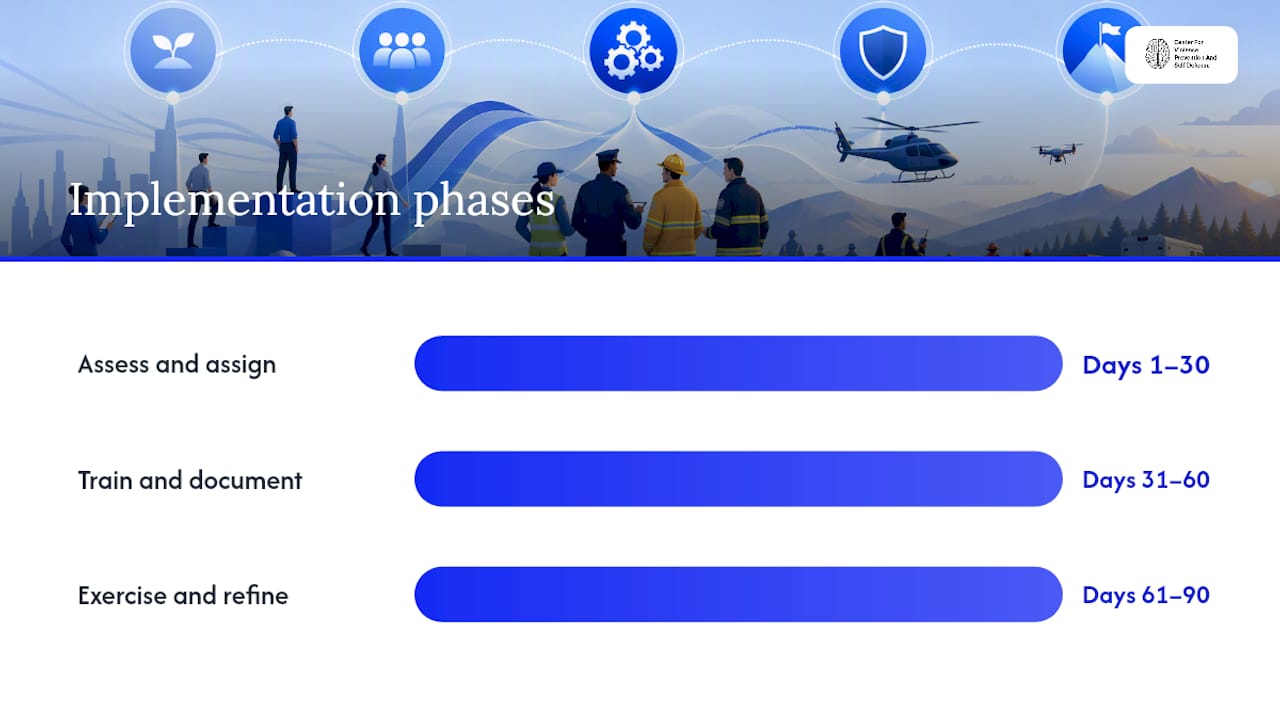
Days 1–30: Assess and assign
Designate a NIMS Coordinator responsible for tracking adoption, training records, and documentation.
Conduct a training gap analysis: identify which staff have completed IS-700, IS-100, and ICS-200, and which have not.
Review existing emergency plans for NIMS-compliant terminology and ICS structure alignment.
Inventory current resources and begin the resource-typing process using FEMA’s standardized resource-typing definitions.
Days 31–60: Train and document
Enroll staff in IS-700 and IS-100 through FEMA’s Independent Study program (free, online, self-paced).
Supervisory and leadership staff should complete ICS-200 before the 60-day mark.
Establish a documentation protocol for EOC activations, including log formats and decision records that satisfy FEMA Public Assistance audit standards.
Draft or update mutual aid agreements using NIMS-compliant language and resource-typing categories.
Days 61–90: Exercise and refine
Conduct a tabletop exercise that activates both ICS at the scene level and EOC coordination, so staff practice the ICP-to-EOC communication flow.
Run a Unified Command scenario if your organization shares incident authority with another agency.
After the exercise, complete an After-Action Report (AAR) and Improvement Plan (IP) using FEMA’s standard format.
Schedule annual refresher training and set a calendar reminder for IS-700 and IS-100 recertification cycles.
Pro Tip: Structure your EOC activation logs so that every resource request includes the NIMS resource-type code, the requesting unit, and the time of request. That three-field habit makes FEMA Public Assistance reimbursement documentation straightforward rather than a reconstruction effort after the fact.
Pro Tip: For crisis intervention training that complements ICS roles, assign staff who will serve as Liaison Officers or Public Information Officers to scenario-based de-escalation practice. Those roles require communication skills that ICS courses do not teach.
CVPSD’s perspective on why this distinction matters for training and safety
The gap between NIMS and ICS is not a doctrinal footnote. Organizations that treat them as the same thing tend to under-train their coordination staff, over-rely on ICS forms for documentation, and discover the difference only when a grant audit or a real multi-jurisdictional incident exposes it.
CVPSD works with schools, healthcare systems, government agencies, and nonprofits across the United States to build safety programs that hold up under pressure. The pattern we see most often is this: organizations invest in ICS training for field staff and assume that covers NIMS compliance. It does not. NIMS coordination, resource typing, EOC protocols, and mutual aid documentation require separate attention and separate training.
Practical recommendations for organizations:
Do not substitute ICS-only training for NIMS coordination training. Both IS-700 and IS-100 are required; they address different competencies.
Assign NIMS coordination responsibilities to specific roles, not just to “whoever is available.” Document those assignments.
Connect staff safety training to your NIMS adoption plan. Compliance and capability are not separate goals.
For organizations in healthcare, behavioral health, or education, crisis intervention skills belong alongside ICS training, not instead of it. The two reinforce each other during complex incidents involving vulnerable populations.
CVPSD is a 501©(3) nonprofit. Its programs are built on evidence-based research and designed to meet state and local requirements. Organizations that want to align safety training with NIMS and ICS compliance will find that the doctrinal framework and the human-skills training are stronger together.
Sources
The following official sources provide primary documentation for NIMS and ICS implementation:
FAQ
Is ICS the same as NIMS?
No. ICS is one component of NIMS, sitting within the Command & Coordination section of the broader framework. NIMS also covers Resource Management, Communications & Information Management, and coordination structures like EOCs and MAC Groups that operate above the field level.
Are IS-700 and IS-100 the same course?
They are not. IS-700 introduces the full NIMS doctrine, including its components and coordination structures. IS-100 introduces the Incident Command System specifically. Both are required baseline courses, and they address different competencies.
Can ICS and NIMS be used interchangeably?
No. ICS is a tactical on-scene management system; NIMS is the national doctrine that contains ICS along with resource management, communications standards, and multi-agency coordination systems. Using ICS correctly does not mean an organization has adopted NIMS.
What are the five functional areas of ICS?
The five major ICS management functions are Command, Operations, Planning, Logistics, and Finance/Administration. A sixth function, Intelligence/Investigations, can be added for complex incidents that require managing sensitive information or active investigative work.
Does completing IS-700 satisfy NIMS compliance?
Course completion is one part of NIMS adoption, but not the whole picture. FEMA requires jurisdictions to document NIMS adoption across their organization, including resource typing, mutual aid agreements, and EOC protocols, to maintain eligibility for federal preparedness grants.
Recommended
Navigating the Unforeseen: Disruptive Event Management and Critical Incident Response
What Is Trauma Informed Care: How Understanding (TIC) Can Help And Provide Relief To Care Givers
Political Leanings and Crisis Management: How Ideology Shapes Organizational Response
ConflictIQ: Enhancing Violence Prevention Through Conflict Intelligence


