
Prevent Violence in Public Spaces: Implementation Guide

Updated: Aug 13

Adopt a documented, OSHA-aligned violence prevention program that pairs behaviorally-based de-escalation training with instructor-led simulation, clear escalation protocols, and regular measurement. This is the core of any credible prevent violence public spaces guide, and it applies whether you lead a hospital, school district, transit authority, or government agency.
Act on these three priorities now:
Appoint a program owner with authority to draft policy, assign roles, and schedule a training pilot within 30 days.
Open a baseline incident and hazard log immediately, even if it starts with zero entries.
Schedule an initial training pilot in your highest-risk unit before the 90-day mark.
Why these three first? OSHA and NIOSH both emphasize that leadership commitment and documented recordkeeping are prerequisites, not afterthoughts. CVPSD’s experience across schools, healthcare, and government settings confirms the same: organizations that skip governance and jump straight to training see limited, short-lived results.
Table of Contents
What does a complete violence prevention program include?
OSHA’s guidelines for healthcare and social service workers define five program building blocks: management commitment and employee participation; worksite analysis; hazard prevention and control; safety and health training; and recordkeeping and program evaluation. These five elements apply across public-facing sectors, not just healthcare.

Role chart: who owns what
Role | Primary Responsibility |
Program Owner | Policy authorship, budget, and executive reporting |
Threat Assessment Lead | Behavioral threat review, external referrals, law enforcement liaison |
Incident Response Team | On-scene coordination, containment, and post-incident documentation |
Supervisors | Daily hazard observation, staff coaching, and near-miss reporting |
Trainers / CVPSD Facilitators | Curriculum delivery, simulation facilitation, and competency verification |
HR | Post-incident support, corrective action tracking, and return-to-work |
Facilities / Security | Engineering controls, alarm coverage, visitor protocols, and safe-room access |
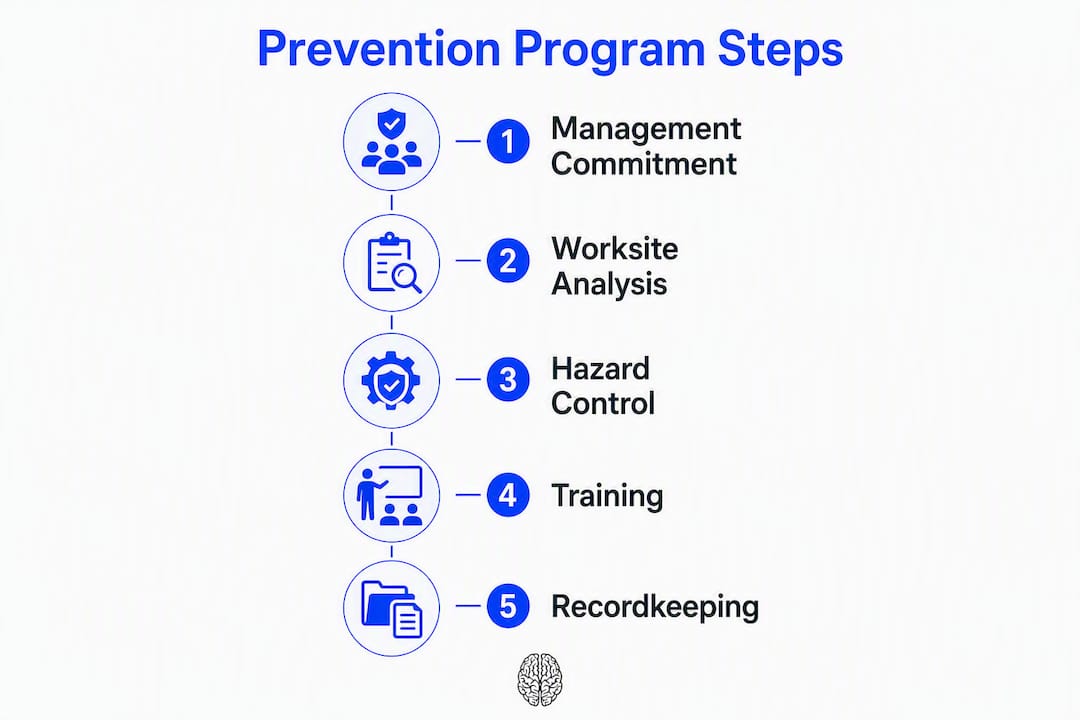
Operational controls matter as much as training. OSHA’s risk-factor guidance identifies working alone, exchanging money with the public, volatile clients, and late-night shifts as common precursors. Administrative responses include adjusted staffing patterns, visitor sign-in protocols, and universal precautions for violence, meaning staff treat every escalating interaction as potentially dangerous until it is not.
Behavioral-based training focuses on observable conduct, such as tone, body language, and breath patterns, rather than demographic characteristics. This approach reduces bias and improves detection accuracy. Pairing it with cultural competency training helps staff recognize distress signals across diverse populations without resorting to profiling.
How do you design training that transfers to real incidents?
OSHA and NIOSH recommend blended training models that combine online theory with mandatory, hands-on, instructor-led simulation. Online modules build foundational knowledge efficiently; simulation is where staff actually learn to respond under pressure.
Primary learning objectives for all staff
Recognize early warning signs: escalating tone, physical agitation, boundary violations, and verbal threats.
Apply verbal de-escalation techniques, including empathic acknowledgment and calm, non-threatening communication.
Communicate clearly with teammates during an incident, using standardized language.
Follow progressive behavior control steps, from verbal redirection to calling for specialized support.
Execute safe withdrawal or evacuation when de-escalation is not working.
Role-specific curriculum components
Frontline staff: Warning sign recognition, verbal de-escalation, and personal safety positioning.
Supervisors: Threat assessment basics, escalation decision-making, and post-incident documentation.
Security personnel: De-escalation as a primary tool, physical intervention protocols, and law enforcement handoff.
Incident response leaders: Command communication, resource coordination, and trauma-informed staff check-ins.
For high-risk units, quarterly or monthly refreshers are appropriate. Annual training is the minimum for all other staff. OSHA’s healthcare roadmap specifically calls for unit-specific training, recognizing that an emergency department faces different triggers than a transit platform or a school hallway.
A train-the-trainer model certifies internal instructors who can run refreshers, adapt scenarios to your facility’s layout, and preserve institutional knowledge over time. This is the most cost-effective path to a sustainable safety culture.
Pro Tip: Build trauma-informed opt-outs into every simulation. Participants should know in advance how to pause or exit a scenario without penalty. Post-scenario debriefs are not optional; they are where learning consolidates and where staff process stress safely.
How do you roll out the program step by step?
Phase | Timeline | Milestone | Owner | Deliverable |
— | Days 0– | Policy drafted and approved | Program Owner + HR | Written violence prevention policy, role chart |
1: Assessment | Days 30–60 | Site hazard analysis complete | Threat Assessment Lead | Risk assessment report, baseline incident log |
2: Pilot Training | Days 60–90 | Pilot cohort trained | Trainers / CVPSD | Training completion records, simulation debrief notes |
3: Full Rollout | Days 90– | All staff trained; TTT certified | Program Owner + Trainers | Training logs, train-the-trainer roster |
4: Monitoring | Ongoing | Quarterly KPI review | Program Owner | KPI dashboard, corrective action log |
Budget drivers to plan for:
Number of staff and shift coverage requirements during training release time.
Instructor-to-staff ratio (external facilitators vs. certified internal trainers).
Simulation props, role-player fees, and scenario materials.
Recurring refresher costs, which drop significantly once a train-the-trainer cohort is in place.
RFP or internal scope checklist:
Defined learning objectives tied to observable behaviors.
Scenario library covering your specific environment (healthcare, school, transit, corporate).
Trauma-informed participant briefings and post-scenario debriefs.
Role-specific modules, not one-size-fits-all content.
A measurement plan with named KPIs and a reporting cadence.
OSHA’s healthcare roadmap also recommends comfort or quiet rooms and adequate staffing as environmental controls, particularly in behavioral health and emergency settings.
What should staff do during and after a violent incident?
The one-line escalation principle: verbal de-escalation first, then call for help, then safe withdrawal or containment, then specialized support (security, EMS, or law enforcement), with clear triggers at each step.
Escalation flow:
Staff member observes escalating behavior and attempts verbal de-escalation using calm, direct language.
If behavior continues to escalate, staff activates the internal alert (radio, panic button, or code word) and states location clearly.
Supervisor or response team lead assumes command, clears bystanders, and contacts security.
If the situation cannot be contained internally, security or the response team lead calls 911 and provides: location, number of individuals involved, description of behavior, and any known weapons.
Once the scene is safe, staff begin documentation immediately.
Suggested script for summoning help: “Code [X], [location], individual is [brief behavioral description]. I need support now.”
Post-incident immediate actions:
Provide medical care to anyone injured; do not delay for documentation.
Conduct trauma-informed check-ins with all staff involved before they return to duty.
Preserve physical evidence and secure any surveillance footage.
Complete an incident report within 24 hours.
Notify HR and legal counsel as required by your organization’s policy and applicable state law.
The FBI’s workplace violence monograph recommends that threat assessment teams maintain an up-to-date external contacts list covering law enforcement, mental-health resources, and social services, with a documented decision hierarchy for intervention options ranging from referral to emergency response. For post-incident mental-health support, connecting staff with crisis counseling resources is a practical next step.
How do you measure effectiveness and meet OSHA expectations?
Leading KPIs (predict future safety):
Training completion rate by role and unit.
Simulation participation and competency scores.
Near-miss and hazard reports submitted per quarter.
Staff confidence scores from pre/post training surveys.
Lagging KPIs (confirm past performance):
Incident frequency and severity over rolling 12-month periods.
Time-to-response from initial alert to scene control.
Documented corrective actions completed on schedule.
Post-incident review template
Element | Content |
Facts | Date, time, location, individuals involved, injuries |
Timeline | Sequence of events from first warning sign to resolution |
Root Cause | Contributing factors: staffing, environment, training gaps, policy gaps |
Corrective Actions | Specific changes, owners, and due dates |
Follow-Up | Verification date and responsible party |
OSHA’s post-incident guidance stresses timely medical and mental-health care, trauma-informed debriefing, and documented corrective actions as non-negotiable components of any review. For OSHA inspectors, you need training logs, incident logs, hazard analyses, and corrective-action tracking records, all organized and accessible.
A brief compliance note: OSHA’s General Duty Clause requires employers to provide a workplace free from recognized hazards. State-specific regulations, such as Louisiana’s crisis intervention training requirements and Pennsylvania’s behavioral health crisis standards, add additional obligations. Always confirm current requirements with qualified legal counsel for your jurisdiction.
How does CVPSD implement this model in practice?
CVPSD is a 501©(3) nonprofit that delivers blended, evidence-based crisis intervention, de-escalation, behavior analysis, and physical self-defense training to schools, healthcare providers, transit agencies, corporations, and government organizations across the United States.
Program components CVPSD delivers:
Customized risk assessment aligned with your facility type and workforce profile.
Blended curriculum: self-paced online theory modules followed by instructor-led simulation days.
Simulation-based sessions that escalate stress gradually, use designated actor roles, and include trauma-informed briefings and debriefs.
Train-the-trainer certification so your internal staff can sustain the program independently.
Delivery options:
On-site intensive: a concentrated multi-day engagement for a single location or department.
Distributed cohort: staggered sessions across shifts or multiple sites over 60–90 days.
Hybrid: online theory completed asynchronously, followed by scheduled local simulation days.
Outcomes CVPSD tracks with clients:
Reduced incident escalation rates in trained units.
Higher staff confidence scores on post-training surveys.
Documented corrective actions completed within agreed timelines.
Timelier incident reporting after program launch.
A case study in health and human services illustrates how a blended pilot produced measurable gains in staff safety confidence and crisis management readiness. All CVPSD programs are designed to meet applicable state and local laws.
Key Takeaways
A documented, OSHA-aligned violence prevention program combining behavioral training, simulation, clear escalation protocols, and consistent measurement is the most effective way to reduce violence risk in public-facing organizations.
Point | Details |
Start with governance | Assign a program owner and open a baseline incident log before scheduling any training. |
Use a blended training model | Combine online theory with mandatory instructor-led simulation; annual minimum for all staff, quarterly for high-risk units. |
Build escalation scripts | Standardized language for summoning help reduces hesitation and speeds response during real incidents. |
Measure leading and lagging KPIs | Track training completion, near-miss reports, incident frequency, and staff confidence scores on a quarterly basis. |
Partner with CVPSD | CVPSD delivers customized blended programs with train-the-trainer certification for sustainable, organization-wide safety culture. |
Prevention is a program, not a single training day
Most organizations that struggle with violence prevention share one pattern: they treat training as a compliance event rather than a continuous safety investment. A single annual session, however well-designed, does not build the muscle memory staff need when a situation escalates in real time.
The evidence from OSHA and FBI guidance points consistently in the same direction. Documented procedures, clear reporting chains, and post-incident recovery systems matter as much as the training itself. Organizations that invest heavily in physical self-defense while neglecting administrative systems, such as hazard logs, escalation scripts, and post-incident reviews, tend to see the same incidents repeat.
Leadership commitment is the variable that separates programs that hold over time from those that fade after the first rollout. When a program owner has real authority, a budget line, and executive backing, staff take the training seriously, near-miss reporting increases, and corrective actions actually get completed.
Avoid profiling. Behavioral-based training focuses on observable conduct, not demographic assumptions, and that distinction protects both staff and the people they serve. Trauma-informed practices belong in every simulation and every post-incident check-in, not as a courtesy, but because they improve learning transfer and staff retention.
CVPSD offers a practical path to a safer organization
CVPSD’s blended training programs give organizational decision-makers a faster, more sustainable route to a functioning violence prevention program than building one from scratch internally. Rather than assembling separate vendors for policy consulting, curriculum design, simulation facilitation, and train-the-trainer certification, you get a single, coordinated program from a nonprofit with deep experience across schools, healthcare, transit, and government settings.
The fastest way to start is a pilot engagement in your highest-risk unit. CVPSD will conduct a customized risk assessment, deliver a blended training cohort, and certify your internal trainers so the program continues without ongoing external costs. Request a pilot or consult to get a scope and timeline matched to your organization’s size and sector.
Useful sources
The following primary sources and CVPSD resources support the guidance in this guide:
“Organizations that treat training as a continuous safety-culture investment, through frequent refreshers, role-plays, and train-the-trainer models, see better staff confidence and fewer escalations than those that run one-off compliance sessions.” — OSHA, Preventing Workplace Violence: A Roadmap for Healthcare Facilities
Templates available on request from CVPSD: incident review template, training evaluation form, and escalation script templates for frontline staff and supervisors.
FAQ
What are the five elements of an OSHA-aligned violence prevention program?
OSHA identifies management commitment and employee participation, worksite analysis, hazard prevention and control, safety and health training, and recordkeeping and program evaluation as the five required program components.
How often should violence prevention training be repeated?
Annual training is the minimum for all staff; high-risk units should receive quarterly or monthly refreshers. A train-the-trainer model makes this cadence sustainable without ongoing external costs.
What is the first step in an escalating incident?
Verbal de-escalation is always the first step. Staff should use calm, direct, non-threatening language before activating any alert or calling for additional support.
How does CVPSD’s training differ from a standard compliance course?
CVPSD delivers a blended program that combines online theory with instructor-led simulation, role-specific modules, trauma-informed debriefs, and train-the-trainer certification, rather than a one-size-fits-all compliance session.
What records do organizations need to satisfy OSHA expectations?
Organizations should maintain training logs, incident logs, hazard analyses, and corrective-action tracking records, all organized and accessible for review by OSHA inspectors or internal auditors.
Recommended


