
For Clinicians: Make Psychiatric De-escalation Joint Commission Ready


Psychiatric de-escalation is the structured use of verbal, nonverbal, and environmental techniques to calm an agitated or aggressive patient without force. The immediate priority is safety, followed by the verbal loop: listen, validate, then state a clear request or limit. This sequence, formalized by Project BETA and reinforced by SAMHSA, remains the clinical starting point in nearly every psychiatric emergency.
Table of Contents
Practical Psychiatric De-Escalation Techniques That Work at the Bedside
Recognizing the Stages of Escalation and Matching Your Response
Setting Up the Scene: Environment, Team Roles, and Positioning
When Verbal De-Escalation Isn’t Enough: Restraint, Medication, and Regulatory Limits
Balancing Immediate Safety With the Therapeutic Relationship
Practical Psychiatric De-Escalation Techniques That Work at the Bedside
The American Association for Emergency Psychiatry’s Project BETA consensus statement lays out 10 domains of verbal de-escalation, and the core mechanic underneath all of them is a loop you repeat, not a script you deliver once. You listen to what the patient says, reflect it back so they know they were heard, then state a specific, small request. If the patient escalates again, you cycle back to listening rather than pushing harder. This loop often requires multiple repetitions before an acutely agitated patient can actually process it, and that persistence is often the difference between a clinician who succeeds and one who gives up too soon.
A few phrases do most of the work in real encounters:
Validate without agreeing: “I can see you’re furious about the wait. That would frustrate me too.” Validation acknowledges the emotion, not the accusation behind it.
Offer a real choice: “Would you rather sit in the chair or stand by the window while we talk?” Choice restores a sense of control without ceding safety.
Use short, single-step directives: “Please put the phone down” beats a paragraph of reasoning every time.
Deploy the broken-record technique: Repeat the same calm request in the same words when a patient tries to argue or redirect.
Nonverbal signals carry most of the emotional information in any tense exchange, which means tone of voice and body language often matter more than the words chosen. Keep your hands visible, stand at an angle rather than squared off, and maintain a distance that respects personal space without appearing to retreat. Congruent body language, calm posture matching a calm voice, tells the patient your words are trustworthy.
Pro Tip: Monitor your own physiologic state before you try to calm someone else’s. A clinician’s rising heart rate and clipped speech telegraph anxiety louder than any words can reassure.
For more structured phrasing you can adapt on shift, CVPSD’s de-escalation guide for healthcare professionals walks through additional scripts by scenario.
Recognizing the Stages of Escalation and Matching Your Response
Agitation rarely appears out of nowhere. It moves through recognizable stages, and matching your response to the right stage prevents both under-reaction and unnecessary force.
Calm. Baseline behavior, normal speech, cooperative affect. Maintain rapport and routine engagement.
Anxious. Increased movement, rapid speech, darting eyes. Slow your own pace, lower your voice, and offer reassurance.
Defensive. Verbal challenges, questioning authority, closed body posture. Begin the listen-validate-request loop and avoid arguing over facts.
Verbally aggressive. Threats, cursing, loud demands. Maintain distance, keep directives short, and alert a colleague quietly.
Physically aggressive. Property destruction, clenched fists, closing distance. Disengage if possible and call for team-based intervention immediately.
Crisis intervention frameworks like Roberts’ seven-stage model offer a similar structure for short-term stabilization once a patient reaches the department or unit. Most successful verbal de-escalations often resolve within a short time once the right stage is identified and matched, but clinicians new to the work frequently disengage too early, mistaking a brief pause in agitation for full resolution when another cycle of the loop is still needed.
Setting Up the Scene: Environment, Team Roles, and Positioning
A calm voice does little good in a cluttered room with no exit path. Environmental control is part of the technique, not an afterthought.
Reduce ambient stimuli: dim harsh lighting, turn down alarms and television volume where possible, and clear unnecessary furniture.
Preserve two exits, one for the patient and one for staff, and never let yourself become boxed in.
Remove objects that could become improvised weapons before the conversation begins, not during it.
Team roles matter as much as the room itself. Designate one primary communicator who does all the talking, a safety observer who watches the patient’s hands and body rather than listening to words, a backup positioned nearby but not crowding the scene, and someone assigned to document in real time. Position yourself at an angle, never directly blocking a doorway, and keep your center of gravity balanced without adopting a combative stance.
Pro Tip: Debrief every incident, successful or not, within the same shift. A five-minute team huddle after the fact catches what worked and flags what to change before the next crisis, and it feeds directly into the documentation regulators expect.

CVPSD’s crisis de-escalation guide on behavior levels breaks down staff assignments by escalation stage in more detail.
When Verbal De-Escalation Isn’t Enough: Restraint, Medication, and Regulatory Limits
Restraint, seclusion, and involuntary medication are last-resort interventions, used only after verbal and environmental de-escalation strategies have genuinely failed or when danger is immediate. The Joint Commission’s R3 guidance requires organizations to train staff in de-escalation and nonphysical alternatives, assess whether prior de-escalation attempts worked for that specific patient, and choose the least restrictive intervention available.
A practical checklist before any restrictive step:
Confirm a rapid, structured risk assessment has been done, not a gut call.
Document what verbal and environmental techniques were already attempted.
Select the least restrictive option that manages the immediate danger.
Monitor continuously once restraint or seclusion begins, per protocol.
Complete a post-event debrief and full documentation before the shift ends.
The evidence base here is thinner than most clinicians assume. An AHRQ systematic review found low or insufficient strength of evidence for most single de-escalation tactics used in isolation. What showed more consistent results were unit-wide risk assessment and prevention programs, not any one verbal trick. SAMHSA’s evidence review echoes that conclusion: prevention beats reaction, and multicomponent programs outperform isolated interventions.
Turning Individual Skill Into Organizational Practice
Individual competence in the verbal loop only goes so far if the rest of the unit isn’t trained the same way. Joint Commission R3 expectations require documented staff training in de-escalation and nonphysical intervention, and that training needs to be role-based, not a single annual lecture.
Strong programs share a few features:
Scenario-based drills that rotate through primary communicator, safety observer, and backup roles.
Competency checks on a set schedule, not a one-time certification.
Individualized crisis plans that record which specific approaches have worked for a given patient before, so the next clinician on shift isn’t starting from zero.
Measurement over time: restraint and seclusion rates, incident review outcomes, and staff confidence surveys.
Training that combines simulation and role-play with measured competency checks changes staff behavior more reliably than didactic sessions alone, according to findings from the EDITION feasibility trial on de-escalation training in acute units.
Element | Why it matters |
Role-based scenario drills | Builds muscle memory for primary communicator, observer, and backup roles |
Individualized crisis plans | Captures what has and hasn’t worked for a specific patient |
Scheduled competency checks | Keeps skills current instead of relying on one annual session |
Outcome measurement | Tracks restraint/seclusion rates to show real change, not just attendance |
CVPSD builds this structure into its ConflictIQ series, which spans role-specific modules for healthcare, education, and behavioral health settings, alongside a dedicated verbal de-escalation training series for teams that need scripted practice before live scenarios.
Balancing Immediate Safety With the Therapeutic Relationship
Every seasoned clinician eventually faces the moment where continuing to talk risks more than stepping back does. A nurse who keeps trying the verbal loop after a patient starts closing distance with clenched fists isn’t showing dedication, she’s ignoring a signal that team-based intervention is overdue.
Knowing when to persist and when to disengage is the real skill, not the script itself. Preserve rapport where you can, but never at the cost of safety, and document the decision either way so the next shift learns from it. - Shawn Lebrock
How CVPSD Can Help: Training Programs and Next Steps
Some organizations need documented, role-based de-escalation competency rather than generic seminars their staff may not retain. One-off webinars may leave teams with slides but no proof of skill; effective programs are structured around observed skills assessment and compliance documentation aligned with current regulatory standards.
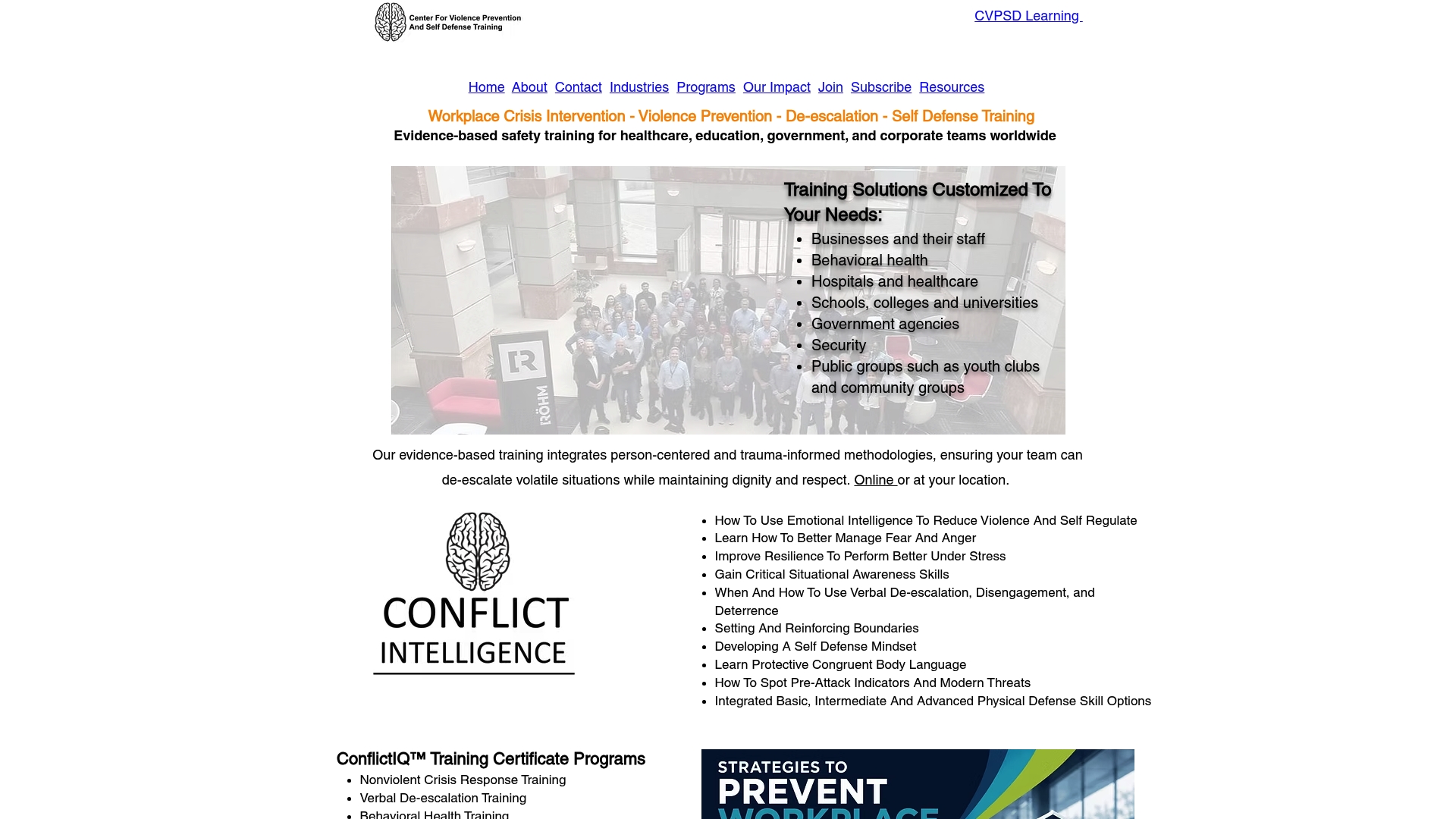
The ConflictIQ™ series covers roles from Pre-K12 behavioral settings through advanced levels, and each program is customizable to your organization’s specific compliance requirements and risk profile. Healthcare systems, schools, and government agencies can use modules like these to build individualized crisis plans, run scenario drills, and generate documentation expected by regulatory surveyors. For teams that want hands-on practice beyond the ConflictIQ tracks, customized verbal de-escalation training delivers in-person or virtual sessions built around your unit’s actual patient population and incident history. Browse the full catalog, including a free self-paced conflict resolution course, and start building a training plan your compliance team can point to when the next audit comes.
Sources
Clinicians building or auditing a de-escalation program should keep these primary references on hand:
This article is general information, not a substitute for advice from a qualified doctor. Consult a qualified healthcare professional about your own circumstances before acting on anything here.
FAQ
How do you de-escalate a psychiatric patient?
Start with the verbal loop: listen to the patient’s concern, validate the emotion behind it without agreeing to unsafe demands, then state one clear, small request. Repeat the cycle as many times as needed, and adjust your tone, distance, and body language to stay calm and nonthreatening, per Project BETA’s consensus guidance.
What are the stages of escalation clinicians should watch for?
A common working model moves through calm, anxious, defensive, verbally aggressive, and physically aggressive. Each stage has distinct speech and motor signs, and the appropriate response shifts from routine engagement at baseline to team-based intervention once physical aggression appears.
What counts as a psychiatric emergency?
Common examples include acute suicidal or homicidal ideation with a plan, severe psychotic agitation, acute intoxication with aggressive behavior, and catatonia with medical instability. Each requires rapid risk assessment and, when possible, verbal de-escalation before any restrictive intervention is considered.
What are the five steps of de-escalation?
Versions vary by source, but a widely used sequence includes assessing safety, listening actively, validating the person’s feelings, offering choices, and stating a clear, limited request. This mirrors the loop structure Project BETA describes rather than a rigid five-step checklist.
Does verbal de-escalation actually work, or is restraint sometimes necessary?
Verbal and environmental techniques resolve most agitation episodes without physical intervention, often within minutes. Restraint and seclusion remain last-resort options under Joint Commission requirements, used only when de-escalation has failed and safety is immediately at risk.
Recommended


