
The Role of Empathy in Conflict Resolution and Crisis De-Escalation

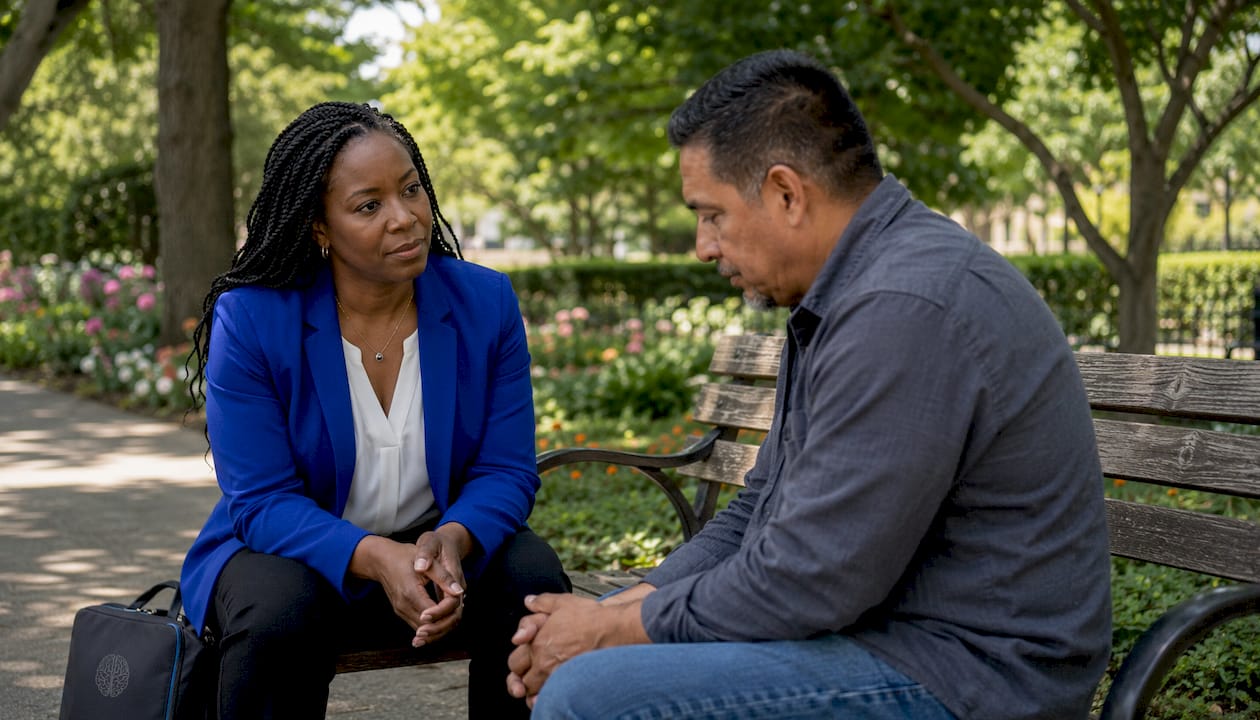
Empathy is the trained skill that lowers physiological arousal, signals safety, and creates the cognitive space needed for constructive problem solving in conflict and crisis situations. CVPSD’s evidence-based programs, developed under the guidance of Shawn Lebrock, treat empathy not as a personality trait but as a measurable professional competency—one that can be taught, practiced, and assessed. Research confirms that feeling heard reduces defensive posturing and down-regulates the fight-or-flight response, making de-escalation possible even in volatile encounters.
Empathy signals validation, which lowers sympathetic nervous system arousal and reduces aggression.
Cognitive empathy (perspective-taking) reveals the underlying needs driving a person’s behavior.
Affective empathy builds trust and signals good-faith intent to the other party.
Empathy combined with compassion motivates prosocial action, not just observation.
Empathy must be balanced with clear safety protocols and professional neutrality — it is a tool, not a stance.
Table of Contents
What is the difference between empathy, sympathy, and compassion?
Practical empathy techniques for de-escalation: what to say and do
How do you train and measure empathy skills in crisis programs?
How do you embed empathy into organizational policy and training systems?
CVPSD training programs for crisis de-escalation and empathy skills
What is the difference between empathy, sympathy, and compassion?
Practitioners who confuse these three concepts often undermine their own neutrality or burn out faster. The distinctions are operational, not academic.
Cognitive empathy is deliberate perspective-taking: understanding what another person thinks and feels without necessarily sharing that feeling. Affective empathy is emotional resonance — actually feeling some of what the other person feels. In crisis work, cognitive empathy is the safer default because it preserves the practitioner’s stability. Affective empathy adds warmth but carries higher risk of overidentification.
“Empathy provides the emotional bridge while compassion converts that understanding into prosocial action. Empathy alone is observation; compassion is what moves a practitioner to help.” — The Science of Empathy, PMC
Term | What it looks like in practice | When to use it |
Cognitive empathy | “I can see this situation feels completely unfair to you.” | De-escalation, mediation, negotiation |
Affective empathy | Genuine emotional resonance with a person’s distress | Rapport-building in lower-risk settings |
Sympathy | “I feel sorry for what you’re going through.” | Avoid in mediation — signals taking sides |
Compassion | Empathy that leads to a concrete helping action | Post-crisis support, referral, follow-through |
In mediation and ADR settings, empathy is a professional tool to probe emotional drivers without sympathizing — preserving neutrality while improving the odds of settlement. Empathic understanding does not mean agreeing with a party’s position.
How does empathy reduce escalation in a crisis?
When a person in crisis feels genuinely heard, their nervous system begins to down-regulate. That is not a soft claim — it is the mechanism that makes de-escalation possible.
The sympathetic nervous system drives fight-or-flight responses: elevated heart rate, narrowed attention, reduced capacity for rational thought. Empathic acknowledgment interrupts that cycle by signaling that the perceived threat (being dismissed, misunderstood, or disrespected) is no longer present. The result is lower arousal, broader cognitive processing, and greater receptivity to problem solving.
“In high-stakes crisis de-escalation, empathy signals safety and lowers autonomic arousal, increasing the other person’s cognitive bandwidth and receptivity to problem solving.” — Scientific American
Socially, empathy reduces perceived threat by demonstrating good-faith intent. Princeton research on peace summits links conveyed and relational empathy to measurable negotiation success, even in deeply entrenched conflicts. Trust builds when a person believes the practitioner is genuinely trying to understand — not manage or manipulate them.
Two distinct modes matter here. Transactional empathy surfaces interests for negotiation. Relational empathy rebuilds trust even when no immediate agreement is possible. Skilled practitioners select between them based on what the situation requires.
Practical empathy techniques for de-escalation: what to say and do
The highest-impact micro-skills, in order of immediacy:
Active listening — give full attention, eliminate distractions, and resist the urge to formulate a response while the person is still speaking.
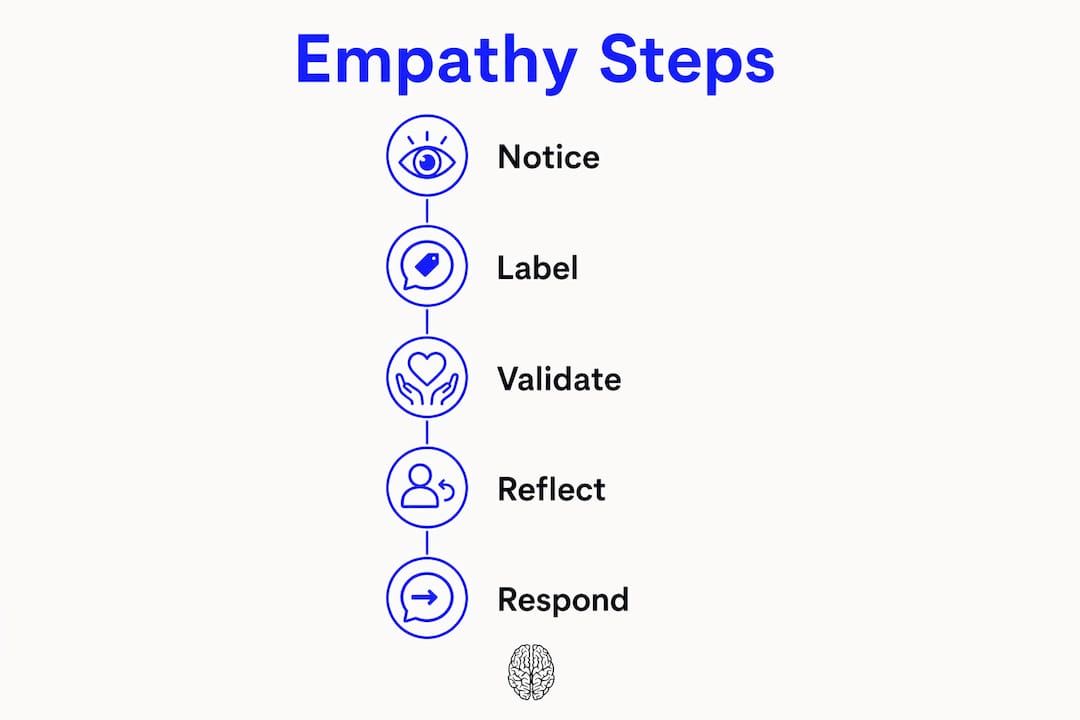
Labeling — name the emotion you observe: “It sounds like you’re feeling completely disrespected right now.”
Reflective mirroring — repeat the last 2–3 words the person said, slightly softened in tone, to invite them to continue.
Validation — acknowledge that the feeling makes sense given their experience, without endorsing harmful behavior.
Tone and pace control — slow your speech, lower your pitch. A calm, quiet voice carries more authority than an anxious torrent of instructions.
Do / Don’t language guide:
Do: “That sounds incredibly frustrating.” Don’t: “You shouldn’t feel that way.”
Do: “Help me understand what happened.” Don’t: “Calm down.”
Do: “I hear you.” Don’t: “I know exactly how you feel.”
Nonverbal technique matters as much as words. Keep an open posture (no crossed arms), position yourself at a slight angle rather than directly face-on, maintain soft eye contact without staring, and keep your hands visible and relaxed. Controlled breathing — slow exhale before you speak — cues your own nervous system and models calm for the other person. For communication mechanics that reinforce these skills, CVPSD’s resources on active listening and paraphrase are directly applicable.
Pro Tip: When you notice your own chest tightening or your thoughts racing during a high-intensity encounter, use a brief grounding anchor: press your feet firmly into the floor, take one slow exhale, and silently name what you observe (“They are scared”). This “attached yet detached” stance — staying present without absorbing the distress — is the key to preventing empathic burnout in frontline work.
How do you train and measure empathy skills in crisis programs?
Empathy must be trained with deliberate practice, structured feedback, and objective behavioral assessment — not assumed to exist because staff are caring people.
Suggested training sequence:
Conceptual foundation (half-day): define cognitive vs. affective empathy, distinguish from sympathy, introduce the nervous-system rationale.
Skill drills (one day): labeling, mirroring, and validation exercises in pairs with immediate coach feedback.
Scenario practice (one to two days): role-play using realistic crisis vignettes; video review where possible.
Supervised field hours: live observation with a structured checklist, followed by debrief.
Observable behavior | Assessment indicator | Scoring note |
Verbal labeling | Names the emotion accurately | Score 1–2 per interaction |
Paraphrase accuracy | Restates content without distortion | Score 1–2 per interaction |
Tone and pace | Speech slows; pitch lowers | Observed yes/no |
Body positioning | Open posture, non-confrontational angle | Observed yes/no |
Boundary maintenance | Stays in role; does not overidentify | Supervisor-rated |
Clinical literature confirms that empathy declines without targeted interventions — a finding that justifies quarterly refreshers, not just one-time training. Supervisor observation forms and anonymized scenario scoring keep skills measurable over time. CVPSD’s workforce training in Newark, NJ demonstrates what structured assessment looks like in a real program context.
What are the limits and risks of empathy in conflict work?
Empathy is powerful, but it is not without real risks. Practitioners who ignore these risks compromise both outcomes and their own well-being.
Primary risks:
In-group bias: Empathy flows more easily toward people who feel familiar. Without deliberate training, practitioners may unconsciously extend less empathy to perceived out-groups, reinforcing inequality rather than resolving it.
Empathic distress / compassion fatigue: Overidentifying with a person’s pain leads to emotional exhaustion and reduced effectiveness.
Loss of neutrality: Affective empathy, unchecked, can cause a mediator or responder to take sides — undermining the process entirely.
“Psychologists caution that empathy can be biased toward in-groups; effective curricula must train perspective-taking toward out-groups to avoid reinforcing inequality.” — HEC Conflict Resolution Resource
Cognitive empathy is the corrective for in-group bias: it requires deliberate effort to understand someone whose experience differs sharply from your own. Perspective-taking exercises — such as writing a day-in-the-life narrative from an unfamiliar viewpoint — have been shown to reduce implicit bias and increase relatedness to out-groups. How you view people before an encounter begins shapes whether empathy flows freely or gets blocked by bias.
When safety is at immediate risk, empathy must yield. Practitioners should communicate the shift clearly: “I want to keep talking with you, and right now I need to make sure everyone here is safe first.” That sentence preserves dignity while signaling a protocol change.
Pro Tip: After a high-intensity incident, rotate staff away from similar cases for at least 24 hours and schedule a structured debrief. Brief self-empathy routines — acknowledging your own emotional response without judgment — reduce the accumulation of empathic distress over time.
How do you embed empathy into organizational policy and training systems?
Organizational systems must enable and measure empathic practice through policy, supervision, and deliberate culture change — not rely on individual practitioners to sustain it alone.
Implementation checklist:
Include empathy-related behavioral indicators in hiring criteria and interview rubrics.
Build empathy skill drills into onboarding, not just annual refreshers.
Use supervisor observation forms with scored behavioral indicators at least quarterly.
Establish incident debrief templates that include an empathy review component.
Create escalation-trigger policies that define when empathy-based approaches must give way to safety protocols.
Social-psychology research confirms that empathy training has higher uptake and lasting change when embedded in organizational norms — not delivered as a standalone skills workshop. Culture carries the skill when individual memory fades.
Partnership type | Integration approach | Key agreement element |
Schools | Joint scenario exercises; shared de-escalation protocols | MOU defining role boundaries |
Nonprofits | Co-facilitated training; referral pathways | Data-sharing agreement |
First responders | Cross-training on empathy and safety handoffs | Joint debrief protocol |
Community organizations | Community-facing empathy norms modeling | Shared language and labeling tools |
For school-specific implementation, CVPSD’s guidance on de-escalation training in schools provides a practical framework. Organizations like Sozo Recovery Center demonstrate how community-based empathy-driven support programs can be structured through volunteer and partnership models.
Three scenarios showing empathy in action
Scenario 1: Street encounter A community safety officer approaches a visibly agitated man pacing outside a transit station. The officer uses transactional empathy — labeling the emotion (“You look like something’s really wrong right now”) and asking an open question (“What’s going on?”). Action steps: (1) slow approach, open hands visible; (2) label the observed emotion; (3) listen without interrupting for at least 30 seconds. Debrief indicator: reduction in pacing and eye contact established within two minutes.

Scenario 2: School disturbance A student is escalating in a hallway, shouting and refusing to move. A trained staff member uses relational empathy — not to resolve the dispute immediately, but to rebuild enough trust for the student to accept redirection. Action steps: (1) position at an angle, not blocking; (2) lower voice and slow speech; (3) validate without condoning (“I can hear you’re really upset — let’s find somewhere quieter to talk”). Debrief indicator: student agrees to move within three exchanges.
Scenario 3: Heated family dispute A mediator faces two family members who have stopped listening to each other entirely. The mediator applies cognitive empathy — paraphrasing each party’s position back to them accurately before allowing a response. Action steps: (1) establish a speaking turn structure; (2) paraphrase each statement before the other party responds; (3) name the shared underlying need (“It sounds like both of you want this resolved without losing the relationship”). Debrief indicator: both parties produce clearer problem statements by the end of the session.
Key Takeaways
Empathy is a trainable, measurable skill that lowers arousal, builds trust, and enables constructive dialogue in conflict and crisis settings when paired with clear safety protocols and supervision.
Point | Details |
Empathy signals safety | Labeling emotions and validating experience lowers fight-or-flight arousal and opens cognitive bandwidth. |
Distinguish the three terms | Cognitive empathy preserves neutrality; affective empathy builds rapport; compassion drives action. |
Train with deliberate practice | Scenario-based drills, behavioral scoring, and quarterly refreshers prevent skill decay over time. |
Manage the risks | In-group bias and empathic distress are real hazards; perspective-taking exercises and structured debriefs mitigate both. |
CVPSD delivers structured training | CVPSD’s evidence-based programs provide scenario practice, observable-behavior assessment, and organizational integration support. |
Why empathy is the skill most programs underestimate
Most conflict resolution curricula treat empathy as a soft skill — something practitioners either have or don’t. That framing is wrong, and it costs programs real outcomes.
Empathy is a cognitive and behavioral skill set. It can be broken into discrete components, practiced under pressure, scored against observable indicators, and improved with feedback. The practitioners who perform best in high-stakes de-escalation are not necessarily the most naturally empathetic people in the room. They are the ones who have drilled the micro-skills enough that labeling, mirroring, and validation happen automatically — even when their own nervous system is activated.
The other thing programs consistently underestimate is the organizational dimension. A practitioner who leaves a CVPSD training with strong empathy skills will lose those skills within months if the organization’s culture, supervision structure, and incident debrief process don’t reinforce them. The research on this is clear: skills embedded in social norms last; skills delivered in isolation fade. That is why CVPSD builds assessment and supervision components into every program, not just the initial training day.
CVPSD training programs for crisis de-escalation and empathy skills
CVPSD offers evidence-based empathy and de-escalation training that gives frontline staff and program managers a concrete, measurable skill set — not a one-day awareness session.
Programs are available in multiple formats: online self-paced modules, half-day workshops, full certification courses, and train-the-trainer programs for organizations that want to build internal capacity. Every format includes scenario-based practice, behavioral assessment, and customization options for your specific setting — schools, nonprofits, health and human services, first responder agencies, and community safety teams. CVPSD partners with public and private organizations across the United States, and all programs meet applicable state and local requirements.
To learn more or schedule training for your organization, visit CVPSD’s training programs and connect with the team directly.
Useful sources and further reading
The Science of Empathy (PMC) — Scholarly review distinguishing empathy, sympathy, and compassion; explains how empathy enables prosocial action.
Empathy (Stanford Encyclopedia of Philosophy) — Comprehensive philosophical and psychological history of the empathy concept and its role in moral agency.
The Power of Empathy (St. John’s Law Scholarship) — Research on how empathy enhances procedural justice and legitimacy in dispute resolution.
Being Empathetic Is Easier When Everyone’s Doing It (Scientific American) — Explains the nervous-system rationale for empathy in de-escalation.
Empathy in Mediation (Nationwide ADR Journal) — Practitioner perspective on empathy as a professional tool that preserves mediator neutrality.
Psychological Logic of Peace Summits (Princeton) — Links conveyed empathy to negotiation success in high-stakes international settings.
Empathic Distress and Regulation (QUT ePrints) — Practitioner research on preventing burnout through regulated boundaries and self-awareness.
Empathy (StatPearls / NCBI Bookshelf) — Clinical review linking empathic practice to better outcomes and warning of skill decay without refreshers.
Cultivating Empathy (APA Monitor) — Social-psychology evidence for embedding empathy in organizational norms rather than one-time training.
Conflict Resolution Resource (HEC) — Addresses in-group empathy bias and prescribes perspective-taking curricula.
FAQ
What is the role of empathy in conflict resolution?
Empathy lowers defensive arousal, signals that a person is heard, and creates the psychological safety needed for constructive dialogue. It is the mechanism that makes de-escalation possible before problem solving can begin.
How is empathy different from sympathy in mediation?
Empathy means understanding another person’s perspective and emotional state without taking their side; sympathy implies feeling sorry for them, which compromises a mediator’s neutrality. In ADR practice, empathy is a professional skill, not an emotional reaction.
Can empathy be trained and measured?
Yes. Observable behaviors — verbal labeling, paraphrase accuracy, body positioning, and boundary maintenance — can be scored during scenario-based exercises and supervisor observation, making empathy a measurable competency rather than an abstract quality.
What are the biggest risks of empathy in crisis work?
In-group bias, empathic distress, and loss of neutrality are the primary hazards. Perspective-taking exercises address bias; structured debriefs and staff rotation reduce burnout; clear safety protocols define when empathy must yield to immediate protective action.
How does CVPSD incorporate empathy into its training programs?
CVPSD integrates empathy as a core, assessed competency across its crisis intervention and de-escalation programs, using scenario-based practice, behavioral scoring rubrics, and organizational integration support to ensure skills persist beyond the training room.
Recommended


