
Reaction Time in Defense: What Training Managers Must Know

Reaction time, the chain of perceiving a threat, deciding how to respond, and acting on that decision, sets the outer limit on what any prevention or defense strategy can actually accomplish. When that chain compresses under stress, options narrow fast. The organizations that get better outcomes are not the ones who train people to move faster in the final second. They are the ones who build systems that create more seconds in the first place.
Three priorities follow directly from that reality:
Expand usable time. Situational awareness training and environmental controls (lighting, sightlines, choke points) buy seconds before a threat ever reaches its final phase.
Rehearse de‑escalation and directive communication. CISA’s De‑escalation Action Guide documents specific behaviors staff can practice, not just theory to absorb.
Run short, repeated scenario drills. These convert instinctive reflexes into usable, trained responses instead of leaving them uncontrolled.
Programs like those CVPSD delivers, along with the evaluation work behind the NIJ’s ICAT program, treat reaction time as the design constraint it is, not an afterthought bolted onto a lecture.
Key Takeaways
Reaction time limits what any defense response can accomplish, so the highest-value investment is expanding usable time through awareness and de‑escalation before drilling reflex speed.
Point | Details |
Decision load slows reaction | Fewer, rehearsed response options beat a long list of choices when stress compresses decision time. |
Time and distance beat speed | De‑escalation and environmental controls change outcomes more reliably than faster physical reactions alone. |
Dosage and repetition matter | Sessions under roughly eight hours often fail to produce durable behavior change, per the National Policing Institute. |
Reflex-compatible drills work | Reflex-based training measurably improved officers’ high-pressure performance, including converting flinch into tactical action. |
CVPSD offers assessment-first pilots | CVPSD builds reaction-time-aware programs starting with a site-specific assessment and measured pilot session. |
For further reading, consult the CISA De‑escalation Action Guide, the National Policing Institute’s evaluation of de‑escalation training, the NIJ/ICAT findings summary, and CVPSD’s situational awareness training series.
Table of Contents
Why the Role of Reaction Time in Defense Shapes Every Training Decision
Reaction time in this context is not a sports statistic or a soldier’s reflex score. It is the perceive, decide, act sequence that runs whenever a staff member notices a possible threat, weighs a response, and moves. Every training choice a safety coordinator makes, from curriculum to drill frequency, either respects that sequence or ignores it at the organization’s expense.
The decide phase is where most delay happens. Researchers studying mental chronometry describe this through Hick’s Law: the more response options a person must sort through, the longer the decision takes. A staff member facing five possible actions will almost always react slower than one trained on two clear, rehearsed choices.
Stress compounds the problem. Attention narrows, peripheral awareness drops, and once a reflexive action begins, people struggle to interrupt or redirect it mid-motion. Fatigue and distraction stretch this window even further, which is exactly why a tired security guard on hour ten of a shift reacts differently than the same guard at hour one.
Pro Tip: If your training only tests people when they’re alert and well-rested, you’re measuring a version of reaction time your staff will rarely have during a real incident.
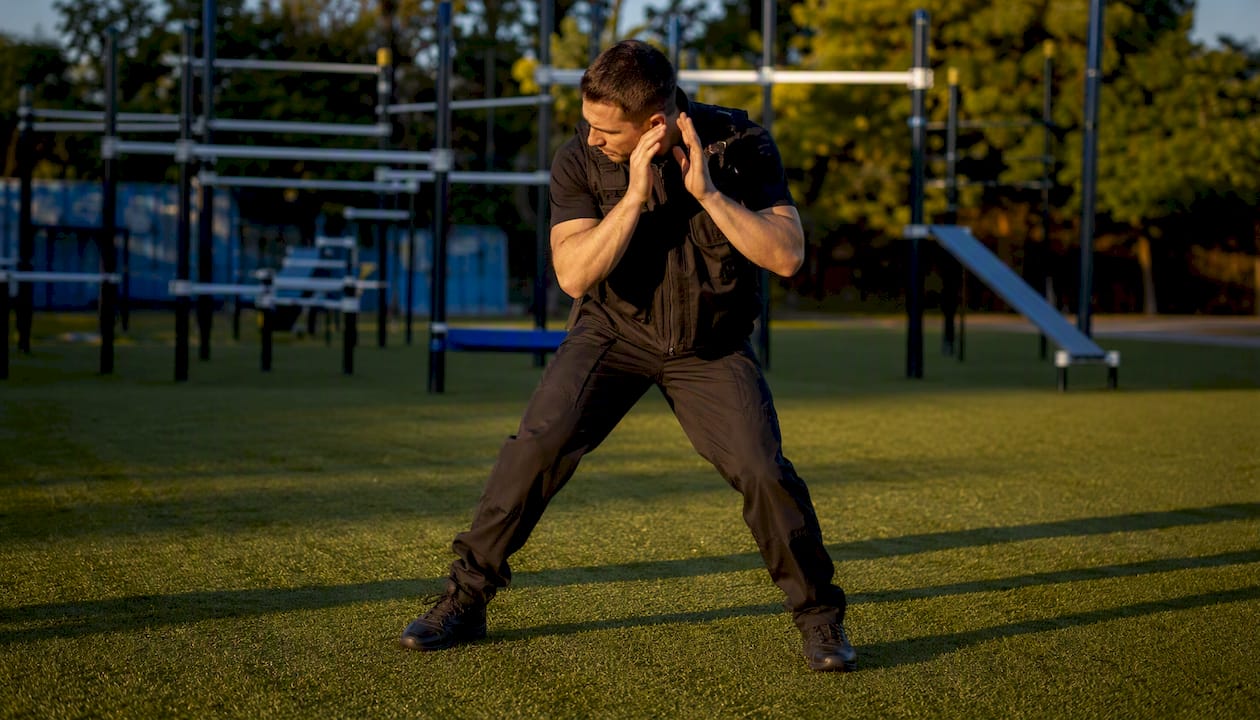
The policy implication is straightforward: when human reaction time is the bottleneck, the highest-leverage interventions are the ones that create distance and time, not the ones that try to make people twitch faster. A locked door, a clear reporting line, or an extra ten feet of separation changes outcomes more reliably than reflex speed alone.
How De‑Escalation and Awareness Buy Back Reaction Time
De‑escalation does not make people move faster. It changes the situation so speed matters less. CISA’s guidance frames de‑escalation as using communication, distance, and purposeful behavior to slow or reduce the intensity of a potentially violent encounter, which is precisely what expands the decision window a stressed brain needs.
Specific, trainable behaviors from that guidance include:
Recognizing warning signs early, before a situation becomes acute.
Acting with purpose rather than hesitating or freezing.
Changing the physical setting when it is safe to do so.
Respecting personal space to reduce perceived threat.
Practicing active listening instead of interrupting.
Communicating with empathy rather than commands alone.
Monitoring body language for shifts in tension.
Situational awareness training reinforces this by teaching staff to notice pre-incident indicators well before a confrontation starts. Earlier detection means a longer runway to choose a safer response, whether that is redirecting a conversation or reading the signals that matter before body language escalates further.
Be candid with your staff about limits. When a threat is immediate, there may be no time to de‑escalate, and the appropriate response shifts to disengagement or emergency protocols.
What Training Methods Actually Improve Reaction Time Under Stress
Lectures build knowledge. They rarely build usable skill. Active learning, defined by deliberate practice, feedback, and realistic scenarios, converts information into responses people can execute under pressure. That distinction should drive every curriculum decision a training manager makes.
A study on reflex-based self-defense training found officers who trained this way showed measurable gains in communication, situational awareness, and their ability to convert an involuntary flinch into a controlled tactical movement. That last point matters enormously for organizational training: you cannot train a flinch response out of someone, but you can train what happens right after it.
Practical formats worth building into a curriculum:
Micro-simulations (10–30 minutes). Short, high-repetition drills targeting one decision point.
Instructor-led role plays. Immediate feedback catches bad habits before they calcify.
Competitive or play-based drills. Research on sensomotor reaction training found competitive formats produced better complex reaction performance than rigidly structured exercises alone.
Multi-week awareness programs. Baseline habits need repetition, not a single seminar.
A sample micro-session: five minutes of scenario setup, fifteen minutes of repeated decision drills, ten minutes of debrief. A full 90 to 120 minute session might open with 20 minutes of awareness review, move into 45 minutes of de‑escalation role play, and close with 30 minutes of reflex-compatible scenario work.
Pro Tip: Design drills that assume the flinch will happen. Instead of training people to suppress it, build the first controlled movement to start right where the flinch leaves off, so instinct and tactic connect instead of competing.
How to Build a Program Around Reaction Time as a Constraint
Treating reaction time as a fixed constraint, rather than something willpower can overcome, changes how a program gets built. Start with an implementation checklist:
Secure stakeholder buy-in from leadership and supervisors, not just the training department.
Map organizational risk by role, location, and shift pattern.
Define who is expected to act, and how, in each scenario type.
Set clear rules for learner safety during scenario drills.
Establish escalation thresholds so staff know when to disengage versus intervene.
Build reporting and after-action processes that feed back into curriculum updates.
The National Policing Institute notes that sessions under roughly eight hours often fail to produce durable behavior change. Cadence matters as much as content.
Cadence Element | Recommended Approach |
Initial training block | One multi-hour session covering awareness, communication, and scenario basics |
Ongoing refreshers | Quarterly micro-sessions to maintain skill retention |
Full recertification | Annual, with updated scenarios reflecting real incidents |
Reinforcement | Supervisor-led check-ins between formal sessions |
Instructor-to-trainee ratios matter for scenario work: smaller groups allow more individualized feedback per repetition. Align every policy touchpoint, including duty-to-intervene language and use-of-force guidance, with what the training actually teaches. A workplace violence prevention framework that contradicts your training curriculum undermines both.
How Do You Measure Reaction Time Performance in Training?
Measurement does not require lab equipment. It requires consistent drills and honest data.
Track these metrics across sessions:
Detection rate of pre-incident indicators during scenario drills.
Time to complete a full perceive, decide, act cycle in a simple test scenario.
Correct de‑escalation behaviors used, matched against the CISA framework.
Use-of-force incidents and near-miss reports over time.
Trainee confidence and self-efficacy ratings before and after training.
A simple test drill: run a scripted scenario, start a timer at the first warning cue, and record three timestamps: when the trainee notices the cue, when they commit to a response, and when they act. Note the decision made, the action taken, and an instructor rating of appropriateness.
Run the drill with a baseline group before training.
Repeat the identical drill after training completion.
Compare timestamps and instructor ratings, not just pass/fail outcomes.
Feed results into after-action review, asking what cue was missed and why the decision took as long as it did.
Small-sample improvements are useful for justifying continued investment, but resist overinterpreting rare-event statistics like annual use-of-force counts, which fluctuate too much on their own to prove or disprove a program’s value.
What Mistakes and Legal Risks Should Training Managers Avoid?
The most common failure is treating training as a one-time event. A single seminar rarely survives contact with a real incident months later.
Watch for these pitfalls:
Short, one-off sessions with no reinforcement plan.
Overloading staff with too many awareness concepts in a single sitting.
Failing to align drills with your actual use-of-force and reporting policy.
Skipping medical and psychological safeguards for learners during physical scenario work.
Consider two scenario types side by side: a verbal disagreement with a frustrated visitor calls for de‑escalation, distance, and active listening. An active threat with a weapon calls for immediate disengagement and emergency response, not a de‑escalation script. Training that blurs this line puts staff at risk.
This guidance is not legal advice. Any change to force-related policy or response protocols should go through legal counsel and your organization’s policy leads before rollout.
Neurological Foundations of Reaction Time in Defensive Situations
Reaction time is not a personality trait. It is a measurable neurological process, and understanding its mechanics helps training managers set realistic expectations for staff performance.
The perceive phase runs through sensory processing and pattern recognition, comparing incoming stimuli against learned templates. Someone who has never been trained to recognize pre-incident behavioral cues has no template to match against, which slows this stage considerably. The decide phase engages executive function, and under acute stress, the body’s sympathetic nervous system response, elevated heart rate, tunnel vision, reduced fine motor control, actively competes with clear decision-making. This is the biological reason a calm training room performance rarely predicts real-world performance without stress inoculation built into the curriculum.
The act phase draws on motor pathways that, with enough repetition, become more automatic and less dependent on conscious processing. Sensomotor reaction research shows that different training formats develop different parts of this pathway. Repetitive drills build motor automaticity. Scenario-based cue recognition builds decision speed. A curriculum that only offers one format develops only part of the chain.
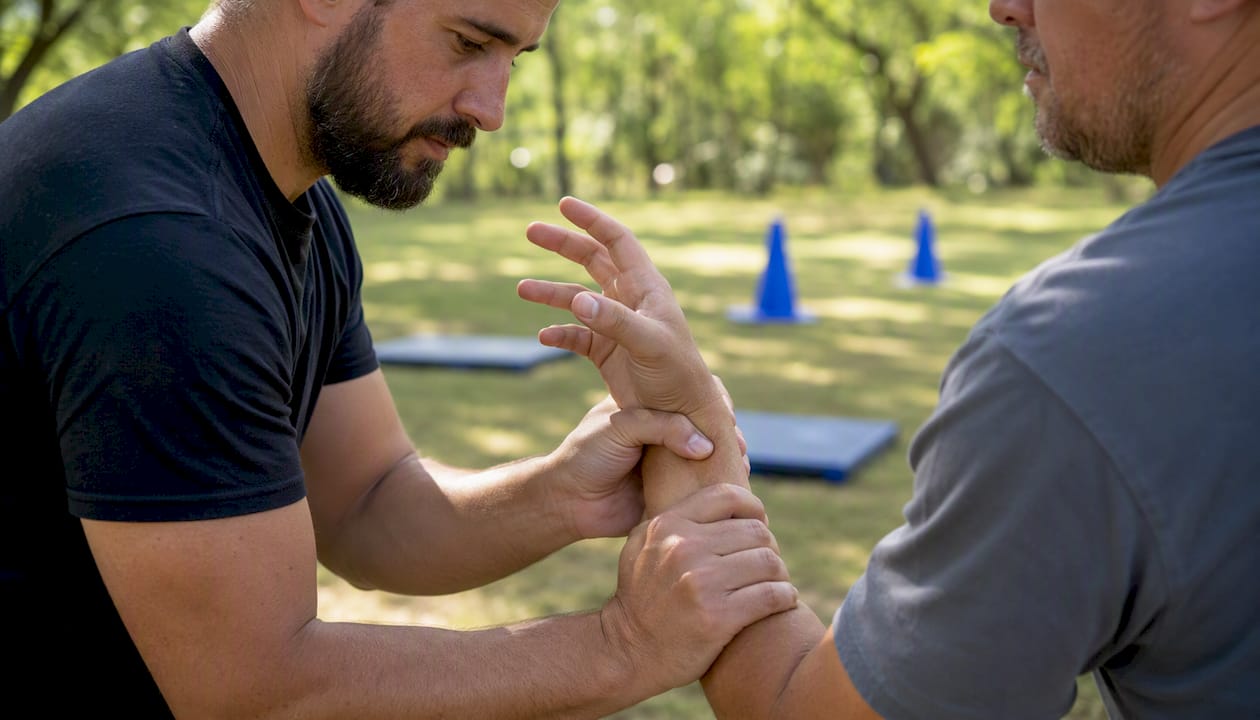
Organizations that understand this build training around the whole sequence rather than isolating physical technique from the perception and decision stages that precede it. A staff member with excellent physical technique but poor threat recognition still reacts too late, because the delay happened before the body ever moved.
Where Delays Happen and What They Cost
The most consequential mistakes in real encounters rarely happen in the final second. They happen minutes earlier, when a warning sign gets noticed but not acted on.
Freezing is the most common failure mode. When a person cannot immediately categorize a threat, the brain sometimes defaults to inaction rather than error, a phenomenon well documented in behavioral research on ambiguous threat response. Staff without rehearsed scripts default to hesitation precisely when clarity matters most.
Misjudging the decision window is a close second. Someone who correctly identifies a threat but waits to gather more information before acting can lose the entire margin that early detection created. This is where conflict escalation pathways matter: incidents rarely explode instantly, they climb, and each rung of that climb is a missed opportunity to intervene earlier and more safely.
Choice overload compounds both problems. A staff member trained on a dozen possible responses, with no clear priority order, burns critical seconds sorting through options that should have been narrowed in advance. Fatigue and distraction, whether from a long shift, a crowded environment, or a preoccupied mind, stretch every one of these delays further. The consequence is rarely dramatic in the moment. It shows up later as a report that reads, “staff noticed something felt wrong but weren’t sure what to do.”
Publisher Perspective: Building Reaction-Time Awareness Into Training
At CVPSD, we design every scenario around the assumption that staff will have less time than they expect and more stress than they’ve rehearsed for. The goal is not to make people faster. It’s to make the decision simpler before the moment arrives, so hesitation has less room to take hold. Our assessment and pilot workshops build directly from this: shorter decision menus, earlier cue recognition, and scenario drills that put the reflex to work instead of fighting it.
How CVPSD Can Help You Build a Reaction-Time-Aware Program
If your organization is ready to see where your current training creates time, and where it quietly loses it, CVPSD offers a site-specific reaction-time assessment built around your actual roles, spaces, and risk profile.
Unlike a generic annual seminar, this starts with a pilot: one scenario-based session, measured against the same drills and timestamps outlined earlier in this guide, so you see real before-and-after data rather than a satisfaction survey. We’ll provide a sample drill and measurement template as part of that pilot, giving your team a starting point that’s already built to CISA and NIJ-informed standards rather than something assembled from scratch. Visit CVPSD’s training programs to request an assessment and see what a reaction-time-aware pilot looks like for your organization.
Sources
FAQ
What Is the Role of Reaction Time in Defense?
Reaction time, the perceive, decide, act sequence, determines which prevention and response options are realistically available under stress, which is why organizations should prioritize expanding usable time over training raw speed.
How Long Should De‑Escalation Training Sessions Be?
Research from the National Policing Institute suggests sessions under about eight hours are often insufficient for durable behavior change, and ongoing scenario practice matters more than a single long session.
Can Reflex Responses Be Trained for Better Defense Outcomes?
Yes. Studies on reflex-based training found officers improved situational awareness and communication, and learned to convert an involuntary flinch into a controlled tactical movement rather than suppressing it.
How Often Should Organizations Refresh Reaction-Time Training?
A common cadence pairs an initial multi-hour training block with quarterly micro-sessions and annual full recertification, reinforced by supervisor check-ins between formal sessions.
Does CVPSD Offer Assessments for Organizational Training Programs?
CVPSD offers site-specific reaction-time assessments and pilot workshops that measure baseline performance and provide a sample drill and measurement template for organizations getting started.
Recommended


