
Self-Defense Skills to Protect Your Loved Ones

Updated: Jul 9

Self-defense skills give you the confidence and ability to actively protect your loved ones from harm. In the field of personal safety, this is formally called personal protection training, a discipline that combines situational awareness, de-escalation, and physical techniques into one practical system. Research from Utah State University in 2026 confirms that training increases assertiveness, confidence, and perceived control while reducing anxiety and helplessness. That finding matters because it means self-defense training for families is not just about fighting back. It is about feeling prepared, staying calm, and making better decisions when it counts most.
What are the core self-defense skills to protect your loved ones?
Situational awareness and intuition are the most critical personal defense skills, surpassing physical techniques in real-world effectiveness. Your brain processes subtle environmental cues before you consciously notice them. Trusting that instinct, the feeling that something is wrong before you can explain why, is your first and most reliable line of defense. Confidence and assertiveness also reduce risk. Predatory behavior targets hesitation and distraction, so projecting calm authority changes how you are perceived.
Physical techniques matter, but they work best when built on a foundation of awareness. The most practical moves for protecting family members focus on creating distance and escaping, not winning a fight.
Wrist escapes: Rotate your wrist toward the attacker’s thumb and pull sharply. This breaks most grips without requiring strength.
Palm strike: Drive the heel of your open hand into an attacker’s nose or chin. It is safer than a closed fist and equally effective.
Targeting vulnerable areas: The eyes, throat, and knees are effective targets regardless of size difference. A strike to any of these areas creates enough time to escape.
Verbal assertiveness: A loud, clear “Stop” or “Back off” signals confidence and can deter an attacker before physical contact occurs.
De-escalation language: Calm, direct speech reduces tension in confrontations that have not yet turned physical. Phrases like “I don’t want any trouble” while moving toward an exit are effective.
Pro Tip: Master non-physical skills first. Awareness and de-escalation prevent the majority of threats before they require a physical response. Physical techniques are the last resort, not the first tool.
The benefits of self-defense classes extend well beyond the physical. Participants consistently report feeling more in control of their environment, which reduces daily anxiety and improves decision-making under pressure.

How do you build a layered safety plan for your family?
A layered safety plan means no single measure carries all the weight. Physical defense, home security, digital safety, and communication protocols work together. When one layer fails, another holds.
Start with the physical environment of your home.
Designate a safe room. Choose a room with a solid door, a lock, and a phone. Every family member should know exactly where it is and how to get there quickly.
Install door reinforcement hardware. Standard door frames fail under minimal force. Door jamb reinforcement kits and strike plate upgrades are inexpensive and effective.
Use alarms and motion lighting. Visible deterrents reduce the likelihood of a break-in before it starts. Dogs also serve as effective early warning systems.
Secure firearms properly. Quick-access firearm safes open in under 2 seconds using biometric or digital codes, balancing rapid response with child safety. If a firearm is part of your plan, professional firearm instruction is not optional.
Rehearse your plan. Run through your family safety plan at least twice a year, the same way schools conduct fire drills.
Digital safety belongs in every family defense plan. Layered digital security tools that cover multiple household members simultaneously are the current best practice. Coordinating protection across at least five household members closes gaps that individual solutions miss.
Safety layer | Primary tool | Key benefit |
Physical home | Door reinforcement, alarms | Deters and delays entry |
Digital security | Coordinated family security software | Protects all members at once |
Communication | Emergency codewords, callback rules | Counters scams and pressure tactics |
Physical defense | Training and rehearsed drills | Builds calm response under stress |
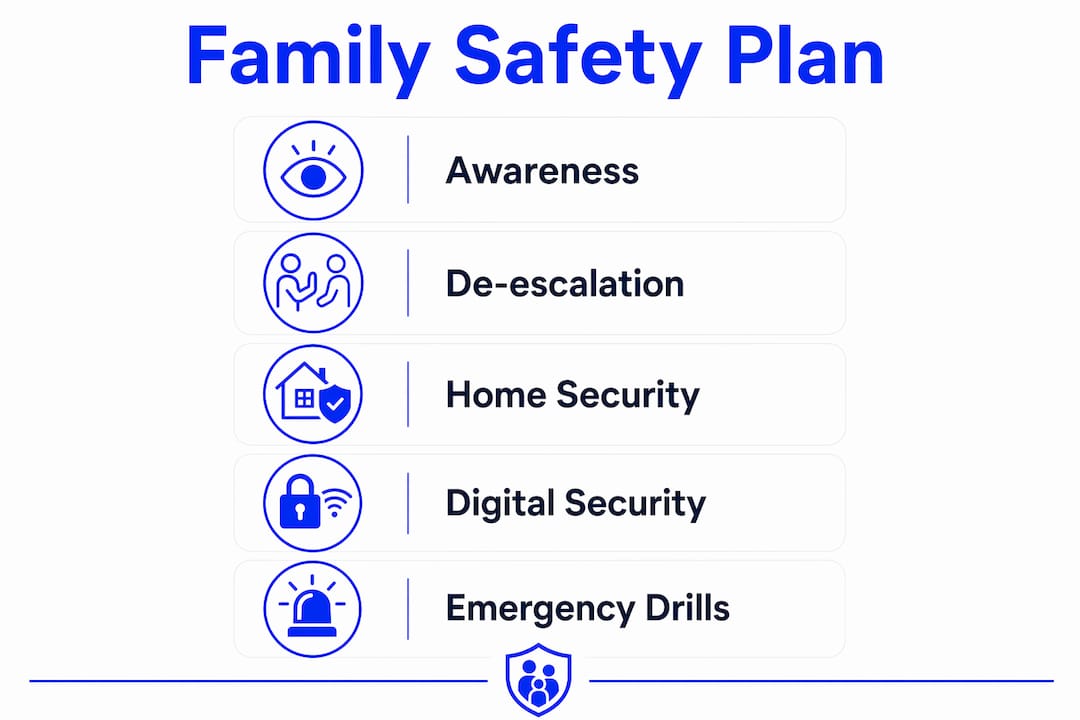
Emergency codewords and callback rules effectively counter urgency scams and manipulative pressure tactics. Agreeing on a family verification phrase before a crisis occurs means no one acts rashly under manufactured pressure.
Pro Tip: Treat your family safety plan like a fire drill. Rehearsal under low-stakes conditions builds the muscle memory and calm that shows up when conditions are anything but low-stakes.
What are the most common mistakes in self-defense preparation?
The most damaging mistake is assuming awareness alone is enough without rehearsing a response. Knowing what to do and being able to do it under stress are two different things. Repeated low-stakes drills build nervous system resilience, which directly reduces the freeze response during a real crisis. Annual practice is more protective than any single piece of security equipment.
Several other patterns consistently undermine family safety:
Overreliance on physical skills without situational awareness. Physical techniques fail when you are caught off guard. Awareness prevents most situations from reaching that point.
Children without clear protocols. Children who know a calm, pre-decided response to a home threat, such as going directly to the safe room, locking the door, and calling 911, reduce chaos and improve outcomes. Children who search for parents during a crisis create additional danger for everyone.
Politeness over instinct. Social pressure to not seem rude or paranoid causes people to ignore warning signs. Trusting your instincts is not overreacting. It is the skill that prevents most incidents.
Inconsistent practice. A safety plan that exists only on paper provides no real protection. Skills and protocols degrade without regular reinforcement.
Treating digital threats as separate from physical safety. Fraud and scams exploit the same psychological vulnerabilities as physical threats. Urgency, fear, and pressure are manipulation tools in both contexts.
Family security is a team effort built on habits, routines, and open communication rather than technical combat skills alone. The families who handle crises best are the ones who have talked about them before they happen.
Which tools and resources support your self-defense skill development?
The right resources make the difference between a plan that works and one that falls apart under pressure. Start with structured training before investing in equipment.
Nonprofit self-defense programs: Organizations like Cvpsd offer evidence-based training that covers crisis intervention, de-escalation, and physical defense. Cvpsd’s nationwide training network partners with schools, community groups, and government agencies to reach families at every skill level.
Family-focused classes: Programs designed for parents and children together build shared language and shared skills. A mother-daughter self-defense class is one example of how training can become a family activity rather than an individual one.
Digital security tools: Coordinated family security software that covers all household members addresses phishing, scams, and identity theft simultaneously.
Firearm safety training: If a firearm is part of your home defense plan, professional instruction on safe storage, handling, and legal use is a prerequisite, not an afterthought.
Community resources: Local law enforcement agencies, community centers, and nonprofit organizations frequently offer free or low-cost personal safety workshops.
What constitutes effective self-defense training depends on your goals, your family’s composition, and the specific threats most relevant to your environment. A parent of young children has different priorities than a senior living alone, and good programs account for that difference.
Pro Tip: When evaluating any training program, ask whether it covers awareness and de-escalation alongside physical techniques. Programs that skip the non-physical skills produce graduates who are less prepared, not more.
Key Takeaways
Effective family protection combines situational awareness, rehearsed safety plans, and consistent training, not physical strength or equipment alone.
Point | Details |
Awareness is the primary skill | Situational awareness and intuition prevent most threats before physical defense is needed. |
Layered plans outperform single measures | Combine home security, digital protection, and physical training for reliable family safety. |
Rehearsal reduces freeze response | Regular low-stakes drills build the calm and muscle memory that hold up under real stress. |
Children need clear protocols | Pre-decided, calm responses for children improve outcomes and reduce chaos during incidents. |
Training builds lasting confidence | Self-defense education increases assertiveness and reduces anxiety, with benefits confirmed by research. |
What I’ve learned from years of teaching family self-defense
The families who walk away from training most prepared are not the ones who learned the most techniques. They are the ones who had the most honest conversations before they arrived.
What I have observed repeatedly is that preparation is less about physical capability and more about psychological readiness. A parent who has talked with their children about what to do if someone breaks in, who has walked them to the safe room and practiced the steps, is far better protected than someone who has memorized a dozen strikes but never rehearsed a response. The nervous system responds to what it has practiced. That is not a theory. It is how human stress physiology works.
The other thing I have come to believe strongly is that awareness and living without fear are not opposites. Families sometimes resist safety planning because they do not want to live in a state of anxiety. The reality is the opposite. Preparation reduces anxiety. Knowing what you would do if something happened frees you from the low-level worry that comes from feeling unprepared. Open conversations about safety, held calmly and regularly, build resilience rather than fear.
Self-defense for families is a shared practice, not a solo skill. When every member of a household understands the plan, knows the codewords, and has rehearsed the response, the whole family is stronger than any individual could be alone.
Cvpsd’s training programs for family safety
Cvpsd is a 501©(3) nonprofit dedicated to protecting at-risk communities through evidence-based education and life-saving training. Programs cover crisis intervention, de-escalation, behavior analysis, and physical self-defense for all ages and skill levels.
Whether you are a parent looking to build confidence, a caregiver protecting vulnerable family members, or an individual starting from scratch, Cvpsd connects you with qualified instructors and structured programs that meet state and local laws. Classes are available online and in person through a growing network of local partners across the country. Visit cvpsd.org to find classes, access free resources, and connect with a training program built for real families facing real risks.
FAQ
What are the most important self-defense skills for protecting family members?
Situational awareness and de-escalation are the most critical skills, as they prevent most threats before physical contact occurs. Physical techniques like wrist escapes and palm strikes are effective secondary tools when avoidance is no longer possible.
How does self-defense training benefit the whole family?
Research confirms that self-defense training increases confidence, assertiveness, and perceived control while reducing anxiety across all participants. These psychological benefits apply to adults and children alike.
How often should families rehearse their safety plans?
Rehearsing a family safety plan at least twice a year, similar to a fire drill, builds the nervous system resilience needed to respond calmly during a real crisis. Frequency matters more than complexity.
How can families protect against digital threats as part of their safety plan?
Using coordinated digital security tools that cover all household members simultaneously addresses phishing, scams, and identity fraud. Establishing emergency codewords and callback rules also counters urgency-based manipulation tactics.
At what age should children learn self-defense and safety protocols?
Children can learn age-appropriate safety protocols, such as going to a safe room and calling 911, from early elementary school age. Teaching calm, pre-decided responses reduces panic and improves outcomes during home emergencies.
Recommended


