
The Role of Government in Violence Prevention: A Policy Guide

Updated: Jul 30

Government is the primary architect of violence prevention, responsible for coordinating law enforcement, public health, education, and community organizations into a unified response to a preventable public health crisis. The role of government in violence prevention extends far beyond policing. It includes setting legal mandates, funding community programs, brokering data-sharing agreements, and training frontline workers. In 2025, 22 U.S. states invested over $497 million in community violence intervention efforts. That figure reflects a fundamental shift: governments now treat violence as a systemic risk factor to be managed, not an inevitability to be endured.
What is the role of government in violence prevention?
Government’s core function in violence prevention is to treat violence as a preventable public health issue, not a criminal justice problem alone. This shift reframes the entire response. Instead of reacting after violence occurs, government agencies identify and address the root causes: trauma, economic instability, housing insecurity, and social isolation.
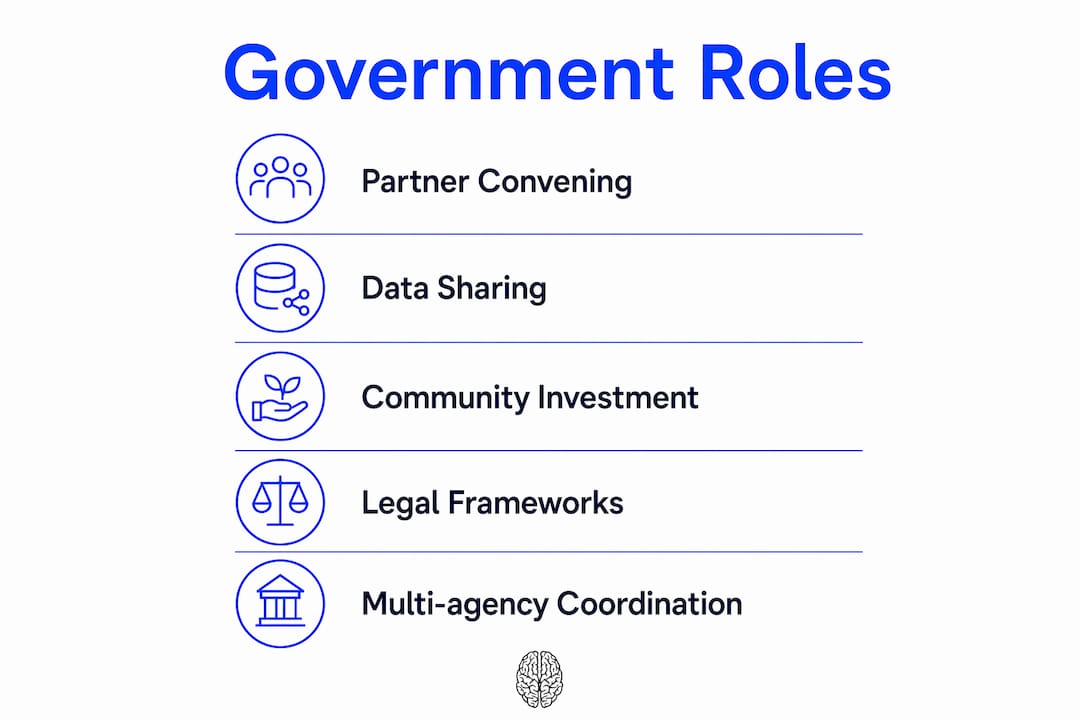
This public health model assigns government four distinct functions. First, it convenes partners across sectors that would otherwise operate in isolation. Second, it enforces laws and legal mandates that compel agencies to collaborate. Third, it funds targeted programs where violence risk is highest. Fourth, it collects and shares data to measure what works and redirect resources accordingly.
The UK’s Violence Reduction Units and the U.S. White House Office of Gun Violence Prevention both reflect this model in practice. These bodies do not simply write checks. They set strategy, define accountability, and hold partner agencies to shared outcomes. Policymakers who understand these four functions are better positioned to build programs that last beyond a single budget cycle.
How does government coordinate multi-agency violence prevention?
Multi-agency coordination is the defining challenge of government violence prevention work. Police, hospitals, schools, social services, and community groups each hold a piece of the picture. Without a convening authority, they rarely share it.

The UK’s Serious Violence Duty addresses this directly. It mandates 43 police areas to collaborate with health services, fire departments, education providers, and probation services to design joint prevention strategies. The mandate removes the option of inaction. Agencies must define their roles, share data, and report on progress.
Violence Reduction Units (VRUs) have evolved from grant funders into strategic conveners that broker data-sharing agreements among police, schools, and social services. This evolution matters because funding alone does not change behavior. Convening authority does. When a VRU facilitates a joint needs assessment, it forces agencies to look at the same data and agree on priorities.
Successful multi-agency collaboration produces three measurable benefits:
Reduced duplication: Agencies stop running parallel programs targeting the same population.
Faster referrals: Shared data systems allow a school counselor to flag a student and trigger a social services response within hours, not weeks.
Clearer accountability: Joint strategy documents assign ownership of each intervention, so no agency can claim the problem belongs to someone else.
Pro Tip: When building a multi-agency table, assign a named lead agency to each intervention type. Shared ownership without named leads defaults to no ownership.
How do governments invest in community violence intervention programs?
Government investment in community violence intervention (CVI) is growing, but the quality of that investment matters as much as the quantity. The White House Office of Gun Violence Prevention helped channel nearly $42 billion in federal funds toward community violence interventions and mental health infrastructure. That scale of funding creates real capacity, but only when it reaches evidence-based programs with trained practitioners.
Trauma-informed approaches form the backbone of effective CVI programs. Frontline workers who understand how chronic stress and adverse childhood experiences drive violent behavior can engage at-risk individuals in ways that enforcement alone cannot. Government agencies now fund training in these approaches for community leaders, hospital workers, and school staff. The Council on Governmental Affairs, for example, offers free specialized training for professionals on tools including Extreme Risk Protection Orders (ERPO) and Domestic Violence Lethality Assessment Protocols (LAP).
Two specialized tools deserve particular attention from policymakers:
Tool | Function | Best Use Case |
Extreme Risk Protection Order (ERPO) | Temporarily removes firearm access from individuals in crisis | Domestic violence situations, mental health crises |
Lethality Assessment Protocol (LAP) | Screens domestic violence victims for homicide risk | Law enforcement first response, hospital intake |
Programs are most effective when they target reachable moments immediately after violent incidents, such as emergency room visits or custody suite contacts. Waiting for self-referrals produces low engagement. Meeting people at their point of crisis produces results.
Pro Tip: Build referral pathways into hospital discharge protocols. A patient leaving the ER after a violent injury is one of the highest-value intervention moments available to any CVI program.
For community leaders building these programs from the ground up, CVPSD’s guide on secondary violence prevention outlines the government frameworks and community collaboration models that support this work.
What legal frameworks drive government intervention in violence?
Legal mandates are the structural backbone of government violence prevention. Without statutory authority, collaboration remains voluntary and fragile. With it, agencies have clear obligations and defined consequences for inaction.
The 2023 UK Serious Violence Duty created a legislative backbone that compels sectors to define roles and coordinate efforts, reducing duplication and improving accountability. In the United States, legislative initiatives at the state level have produced similar results, with states enacting red flag laws, mandatory reporting requirements, and funding formulas tied to evidence-based program delivery.
Key policy tools available to government agencies include:
Restraining orders and firearm regulations: These create legal barriers between high-risk individuals and potential victims.
Mandatory data-sharing agreements: These compel agencies to pool information rather than guard it.
Funding conditionality: Governments attach evidence-based practice requirements to grants, ensuring money flows to programs that work.
Statutory needs assessments: These require agencies to document local violence drivers before designing responses.
Policy Tool | Primary Effect | Accountability Mechanism |
Serious Violence Duty (UK) | Mandates multi-agency strategy | Annual reporting to Home Office |
Red Flag / ERPO Laws (US) | Restricts firearm access in crisis | Court oversight, law enforcement enforcement |
CVI Grant Conditionality | Funds evidence-based programs only | Program evaluation and reporting requirements |
Legislation also shapes resource allocation. When a law requires a needs assessment before funding is released, agencies must prioritize the highest-risk populations rather than the most politically convenient ones. That discipline is difficult to maintain without a legal mandate behind it.
How does data sharing improve government violence prevention outcomes?
Data sharing is the mechanism that turns multi-agency collaboration from a concept into a practice. Without shared data, each agency sees only its own slice of the problem. A school sees truancy. A hospital sees injuries. Police see arrests. None of them sees the full picture of a young person at risk.
Government-led data-sharing agreements connect these datasets. When a Violence Reduction Unit brokers an agreement between a police department and a hospital, both agencies can identify individuals who appear in both systems and prioritize them for outreach. This targeting is far more precise than broad awareness campaigns.
California’s approach illustrates the strategic planning dimension. The state’s 2026 plan outlines 74 recommendations across 18 focus areas that could reduce firearm homicides by 30–50% within five years. Each recommendation is tied to a specific data source and a measurable outcome. That structure allows the state to monitor progress and reallocate resources when a tactic underperforms.
The Vera Institute recommends establishing “Public Safety Anchor Institutions” to centralize violence prevention, alternative first response, and trauma recovery under government leadership. This model makes prevention a permanent government function rather than a grant-funded experiment. Policymakers who recognize early warning signs of violence in their data can act before incidents occur rather than after.
Strategic needs assessments are the starting point for any data-driven plan. They identify which neighborhoods carry the highest risk, which demographics are most affected, and which risk factors are most prevalent. Without this baseline, funding decisions default to political pressure rather than evidence.
Key Takeaways
Government violence prevention works best when it combines legal mandates, multi-agency coordination, data-driven targeting, and sustained community investment rather than relying on enforcement alone.
Point | Details |
Public health framing | Treating violence as preventable shifts government focus from punishment to root cause reduction. |
Legal mandates drive collaboration | Statutory duties like the Serious Violence Duty compel agencies to coordinate and define accountability. |
Data sharing enables precision | Joint data agreements allow agencies to identify and reach high-risk individuals before violence occurs. |
Reachable moments matter | Intervening at crisis points like emergency rooms produces far higher engagement than self-referral models. |
Sustained funding is non-negotiable | Short-term grants produce short-term results; embedded budget commitments build lasting prevention capacity. |
Why government must lead, not just fund
The most important shift I have seen in violence prevention work is the move from government as funder to government as convenor. Funding matters, but money without coordination produces fragmented programs that serve overlapping populations and measure incompatible outcomes.
The persistent failure mode is siloed enforcement. Agencies default to what they know: arrests, prosecutions, and reactive response. These tactics have their place, but they do not address the conditions that produce violence in the first place. Embedding dedicated budget commitments for evidence-based programs is the only way to break that cycle.
What I find most underused is the concept of reachable moments. Governments spend significant resources on awareness campaigns and voluntary referral pathways. These reach the people who are already motivated to change. The people at highest risk rarely self-refer. They show up in emergency rooms, custody suites, and school discipline offices. Meeting them there, with trained workers and clear referral pathways, is where government investment produces the highest return.
The other gap I see consistently is the absence of community voice in strategy design. Governments convene agencies well. They convene residents poorly. The people most affected by violence hold knowledge about local dynamics that no dataset captures. Embedding lived experience into needs assessments and program design is not a courtesy. It is a quality control measure.
The future of government leadership in violence prevention looks like the Vera Institute’s Public Safety Anchor Institution model: a permanent, well-resourced government body that owns the coordination function, holds agencies accountable, and keeps community voices at the table. That is not a distant aspiration. Several jurisdictions are building it now.-- Will
CVPSD’s role in supporting violence prevention efforts
CVPSD works directly with government agencies, community organizations, and schools to deliver the training and tools that make violence prevention strategies work on the ground.
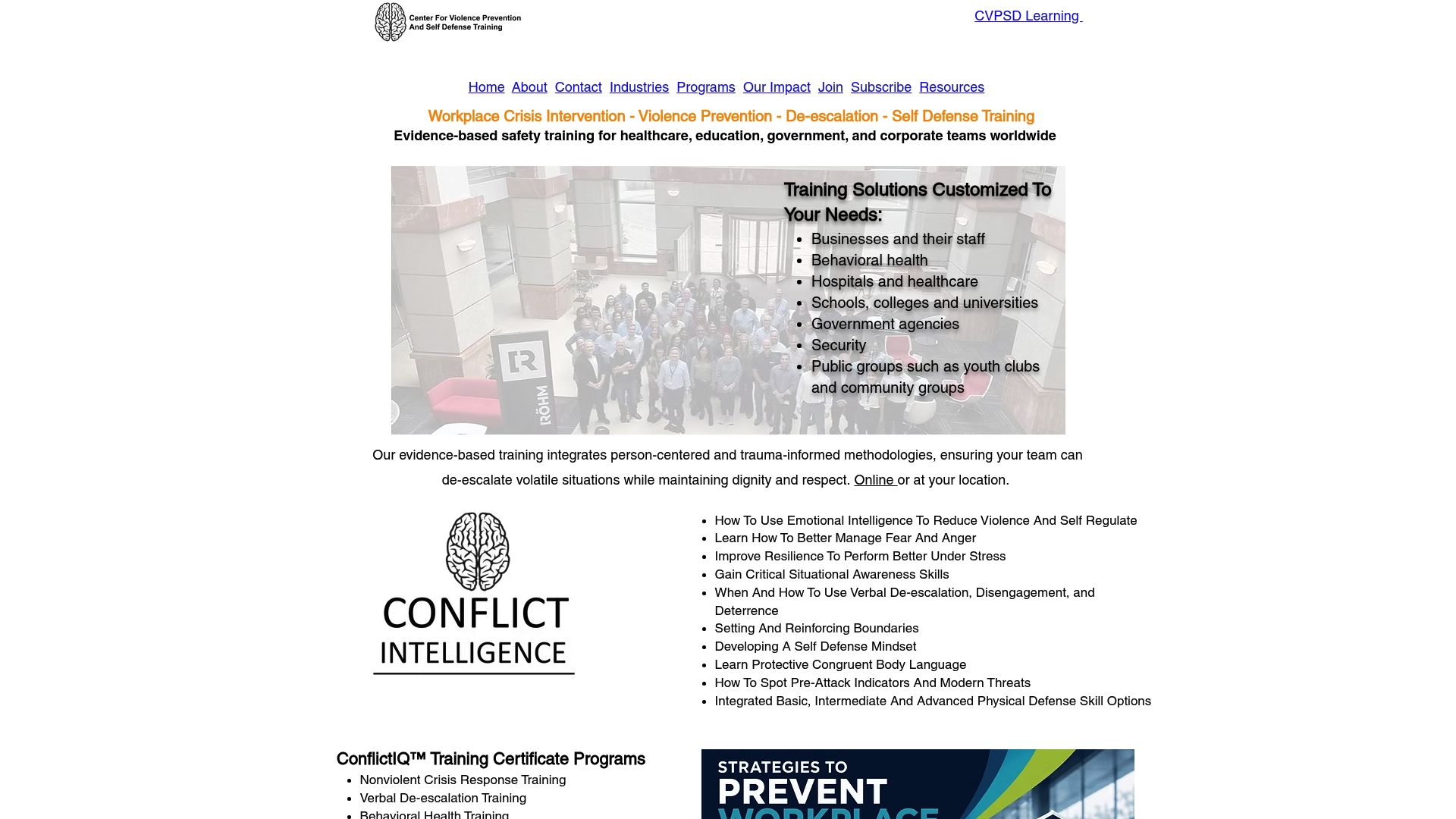
CVPSD’s programs cover Crisis Intervention Techniques, De-escalation Solutions, Behavior Analysis, and Physical Self-Defense, all grounded in evidence-based research. For policymakers and community leaders building or strengthening local prevention programs, CVPSD offers both in-person and online training that meets state and local legal standards. Whether you are implementing a new CVI initiative or training staff on conflict prevention best practices, CVPSD provides the expertise to support your work. Visit CVPSD’s full resource library to explore partnership and training opportunities.
FAQ
What is the government’s primary role in violence prevention?
Government’s primary role is to coordinate multi-sector responses that treat violence as a preventable public health issue. This includes setting legal mandates, funding evidence-based programs, and brokering data-sharing agreements across agencies.
How does legislation reduce violence?
Legislation like the Serious Violence Duty compels agencies to collaborate, define roles, and share data, reducing duplication and improving accountability across police, health, education, and social services.
What are the best violence prevention tools for government agencies?
The most effective tools include Extreme Risk Protection Orders (ERPO), Lethality Assessment Protocols (LAP), statutory data-sharing agreements, and trauma-informed CVI programs delivered at reachable moments such as emergency room contacts.
How does government funding support community violence intervention?
In 2025, 22 U.S. states invested over $497 million in community violence intervention efforts. Federal channels have directed nearly $42 billion toward CVI programs and mental health infrastructure, funding frontline worker training and place-based interventions.
Why is data sharing critical to government violence prevention strategies?
Shared data allows agencies to identify individuals who appear across multiple systems, such as police records and hospital visits, and target outreach before violence reoccurs. Without shared data, each agency addresses only its own portion of the risk.
Recommended


