
L&D Teams: Train the Trainer with Auditions, Video Reviews, and Rubrics

The most reliable train-the-trainer programs treat trainer development as a multi-phase cycle, not a single workshop: selective recruiting, design anchored in adult learning principles, deliberate practice with recorded feedback, and evaluation tied to real business outcomes. Programs built on this cycle, and grounded in frameworks like the ATD facilitation model and the Kirkpatrick evaluation levels, produce trainers who deliver consistent, measurable results long after the launch session ends.
Executive Summary
Effective train-the-trainer programs rely on a multi-phase cycle of recruitment, deliberate practice, and evaluation linked to real business results, not just a single workshop.
Selection should include auditions, scored micro-teachings, and competency-based rubrics, since technical expertise alone does not predict facilitation success.
Training design must incorporate adult learning principles, including clear observable objectives, relevance, teach-backs, and version-controlled reusable artifacts for consistency.
Facilitation focuses on engaging questions, participant examples, energy management, and accessible materials, rather than just delivering content through lectures.
Ongoing practice, peer coaching, and regular refreshers based on structured feedback are essential to maintaining trainer quality over time.
Table of Contents
How Do You Choose the Right Trainers?
Subject-matter expertise gets people nominated for trainer roles. It rarely predicts whether they can hold a room, read resistance, or adjust on the fly. A veteran nurse who knows de-escalation protocols cold can still freeze in front of twenty skeptical colleagues. Selection has to weigh facilitation skill and presence as heavily as technical knowledge, if not more.
A weighted competency model helps standardize this judgment instead of leaving it to gut feel. Weight technical knowledge, facilitation ability, influence and credibility with peers, and availability separately, then score every candidate against the same rubric during an audition or micro-teach. This keeps selection defensible when a well-liked SME doesn’t make the cut.
Build the selection process around these steps:
Open nominations to managers and peers, not just self-application, since strong trainers often don’t volunteer.
Require a short audition or micro-teach on a real topic, scored by at least two observers.
Use a written trainer role description that spells out expected delivery hours per quarter.
Set prep-time expectations up front. Plan for 2 to 4 hours of preparation for every hour of live delivery, and protect that time in the trainer’s actual workload.
Put the agreement in writing: role scope, time allocation, certification requirements, and a review date.
Skipping the audition step is the most common failure point. Organizations that promote based on résumé alone end up with technically sound trainers who can’t manage a room, and the fix costs far more later than a two-hour audition would have upfront.
Designing Training Around Adult Learning Principles
A train-the-trainer curriculum only works if trainers can deliver it the same way twice. That consistency starts with how the content gets designed, not how it gets delivered.
Write objectives around observable behavior, not knowledge recall. “Explain the three-step de-escalation model” is weak. “Demonstrate the three-step model with a scripted, agitated scenario and correct posture within two coaching cues” gives trainers and learners something to measure.
Build sessions around adult learning principles. Adults need relevance before retention. Anchor every module in a real workplace scenario, front-load the “why this matters to your shift” before the “how,” and space practice across the session rather than clustering it at the end. ATD’s facilitation training frames this as designing learner-centered facilitation plans rather than lecture scripts.
Design for teach-backs. Have trainers explain a concept back to a small group mid-session. This surfaces gaps in understanding before the trainer ever faces a live audience, a technique GAAP Dynamics identifies as one of the more effective habits of durable train-the-trainer programs.
Produce a matched set of reusable artifacts. A facilitator guide with timing and talking points, a participant guide, physical or digital job aids, and a short quick-check rubric all need to exist as one version-controlled package.
Track versions deliberately. Date every guide, log what changed and why, and retire outdated scenario examples before they undercut a trainer’s credibility mid-session.
Instructional design that skips straight from SME knowledge to slide deck almost always produces inconsistent delivery, since translating expert knowledge into teachable modules requires objectives and assessments the SME never had to think about.
What Separates Facilitation From Presentation?
Presenting delivers content. Facilitating draws it out of the room. A trainer who lectures for ninety minutes has covered the material; a trainer who asks “what would you do in the first ten seconds of that scenario?” has actually tested whether the group can apply it.
The shift from one to the other comes down to a handful of concrete moves:
Ask open-ended questions before giving answers, and wait a full five seconds before rescuing a silent room.
Elicit examples from participants’ own work instead of relying solely on prepared case studies.
Watch for the quiet disengagement, not just the loud disruption, and redirect with a direct question to that person.
For virtual sessions, moderate chat actively and call out contributions by name to keep remote participants from going passive.
For hybrid sessions, choreograph camera angles and microphone handoffs before the session starts, not during it.
Build in accessibility checks: captioning, screen-reader-friendly materials, and alternate ways to participate for learners who process information differently. A practical guide to neurodiversity in learning design is worth reviewing when building out these accommodations.
Timebox every activity and build a five-minute buffer into each hour, since discussions always run long.
Pro Tip: Warm up your voice and posture before any session the same way a performer would before walking onstage. A calm, quiet voice carries more authority than an anxious torrent of instructions, and slouched shoulders read as low confidence even when the content is strong.
Energy management matters as much as content mastery. A trainer who tracks the room’s energy and inserts a two-minute movement break at the right moment will outperform one who plows through a dense module on schedule but loses the group by minute forty.
How Do Trainers Practice and Get Feedback?
Skill builds through repetition with correction, not through watching someone else do it once. The most effective development pathway follows a clear sequence: new trainers observe a master trainer live, then co-facilitate a session alongside an experienced partner, then deliver solo with a coach watching, then record that delivery for structured review.
Recorded practice paired with structured feedback speeds up skill acquisition because it makes the feedback specific and repeatable instead of vague. “You lost the room around minute twenty” is far less useful than “at 20:14, you turned to the slide instead of the group, and three people put their phones out within ninety seconds.”
A practice cycle that actually works includes:
Observation of a master trainer, with a structured note sheet, not just passive watching.
Co-facilitation on a live cohort, splitting modules so the new trainer owns discrete sections.
A solo delivery with an observer scoring against a fixed rubric with named bands, such as developing, proficient, and exemplary.
Video review against that same rubric, since a recording catches habits a live observer misses in the moment.
A written action plan with one or two specific behaviors to change before the next observed session.
Feedback should always be behavior-specific and tied to what the observer actually saw or heard, never a general impression like “good energy.” That specificity is what turns a rubric score into something a trainer can act on before their next session.
How Do You Measure Trainer Readiness and Training Impact?
Evaluation only earns its keep when it ties trainer skill to something the business actually cares about. The Kirkpatrick model gives four levels to work through, and each one needs a different measurement tool.
Reaction. Collect post-session surveys on clarity, pacing, and relevance immediately after delivery, while the experience is still fresh.
Learning. Run a short pre-test and post-test to confirm the group actually absorbed the material, not just enjoyed the session.
Behavior. Observe learners on the job weeks later, or run a spot-check scenario, to see whether the skill actually transferred to real work.
Results. Track a business indicator the training was meant to move, such as incident reports, complaint resolution time, or compliance audit scores.
Keep the KPI set short: certification pass rate, observed delivery score from the rubric, a learner application check at 30 to 60 days, and one top-line performance measure tied to the training’s original purpose. A one-page impact map that links each training activity to its intended outcome and the metric that proves it makes this concrete for stakeholders and forces clarity on why each session exists in the first place, a practice TrainingPros recommends specifically to win budget conversations.
Keeping Trainer Quality Consistent Over Time
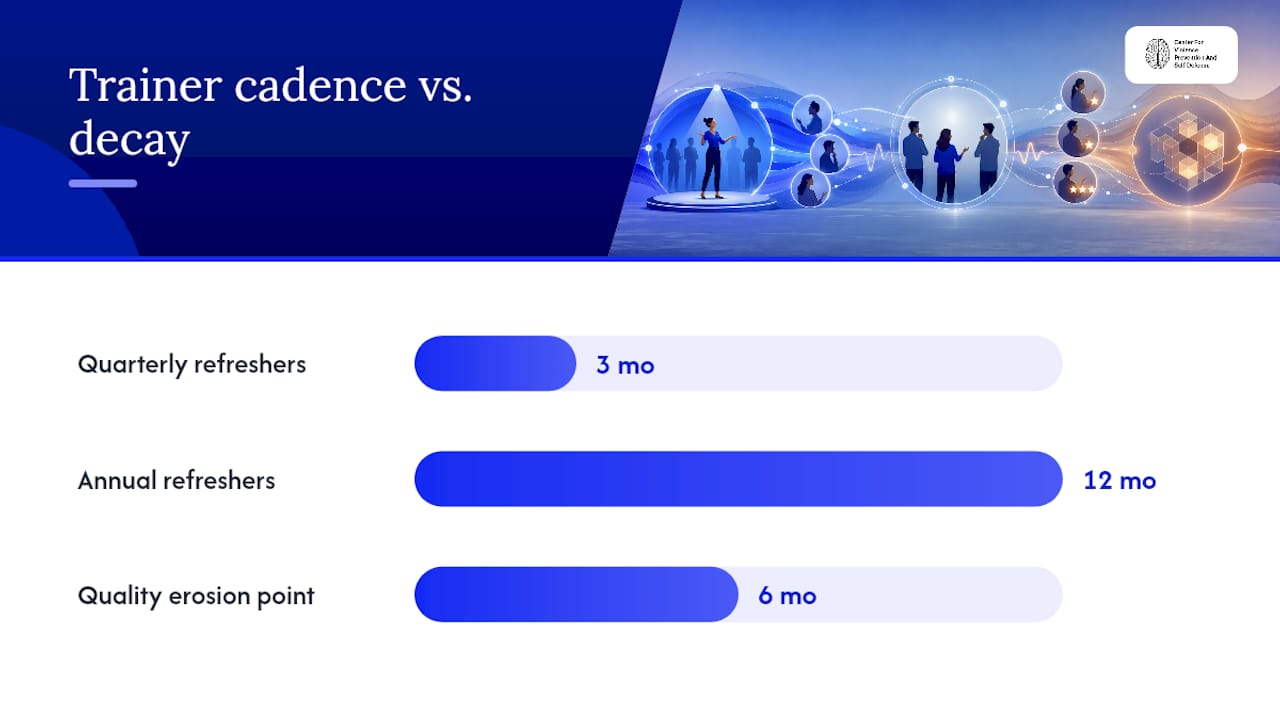
A train-the-trainer launch fades fast without deliberate upkeep. Skills decay, materials go stale, and the trainer who carried institutional memory eventually leaves.
Communities of practice are the most durable fix. Regular check-ins, peer coaching pairs, and a shared library of scenarios and job aids keep trainers connected instead of isolated in their own departments.
Schedule quarterly refreshers, not annual ones, for high-stakes skills like de-escalation.
Maintain an observation checklist that every certified trainer gets re-scored against on a set cadence.
Recognize strong trainers publicly. Recognition programs cost little and measurably reduce turnover in volunteer or part-time trainer pools.
Build a handoff protocol for departing trainers: materials, notes, and a scheduled shadow session for the replacement.
Version-control every asset centrally so a refresher doesn’t accidentally use an outdated scenario script.
Treating trainer development as a cohort journey with ongoing mentorship, rather than a one-time event, is what keeps a program’s quality from eroding six months after the initial rollout.
Why Scenario-Based Practice Anchors CVPSD’s Trainer Model
CVPSD builds its trainer certification path on the same cycle this guide describes: selective recruiting, scenario-based practice, and observed delivery scored against a consistency-focused rubric. Scenario rehearsal and realistic simulation improve transfer of learning, especially for safety and de-escalation skills where hesitation carries real consequences. CVPSD’s in-service safety training and nonviolent crisis intervention program both run on this model, aligned with state and local requirements. Organizations building or auditing an internal program are welcome to request a sample syllabus to see the structure firsthand.
— Shawn Lebrock
Bring a Certified Train-the-Trainer Pilot to Your Organization
CVPSD is the practical route to a train-the-trainer program built on scenario-based practice instead of generic slide decks. Where a homegrown program often stalls at the design stage, CVPSD arrives with certified trainers, compliance-aligned curriculum, and a practice cycle already built around observation, co-facilitation, and rubric scoring.
Its virtual delivery model, detailed in how CVPSD expanded its Teams and Zoom-based training, means a pilot can launch for distributed teams without flying trainers to a single site. Programs are tailored for healthcare, education, behavioral health, corporate, and government settings, and every seminar is built to meet state and local law.
Start with a discovery call to scope your team’s current trainer pool and readiness gaps, or request a sample syllabus to review the scenario-based curriculum before committing to a full pilot. Visit CVPSD to schedule either step.
Sources
FAQ
Is Train-the-Trainer Certification Worth It?
Yes, when the program includes observed practice and a real evaluation cycle. Certification without an audition, coaching, and review process produces trainers who technically qualify but can’t consistently hold a room.
What Is the Train-the-Trainer Method?
It’s a model where an organization develops internal staff to deliver training to their peers, using a structured cycle of design, practice, feedback, and certification rather than a single one-off session.
What Are Some Effective Training Techniques for Trainers?
Teach-backs, scenario-based role-play, video-recorded practice reviewed against a rubric, and co-facilitation with an experienced partner all build reliable delivery skill faster than lecture-based prep alone.
What Are the Steps to Effective Training Design?
Start by defining measurable, behavior-based objectives, then select trainers using a weighted competency model, build materials around adult learning principles, run deliberate practice cycles with feedback, and close the loop with Kirkpatrick-level evaluation tied to business outcomes.
Recommended
About the Author: William DeMuth is the Director of Training at the Center for Violence Prevention and Self Defense (CVPSD) in Freehold, NJ. With over 35 years of research in violence dynamics and personal safety, William specializes in evidence-based training that bridges the gap between compliance and real-world conflict resolution. The architect of the ConflictIQ™ program, he holds advanced certifications and has trained under diverse industry leaders. Today, he actively trains civilians, hea


