
Evidence Based Steps for Employers: 4 Types of Workplace Violence

Workplace violence falls into four recognized categories established by NIOSH: criminal intent, customer or patient violence, worker-on-worker violence, and personal relationship violence that follows someone into work. Some frameworks add a fifth category for ideologically motivated violence. Behavior across all four ranges from verbal threats to homicide, and understanding which type you’re dealing with shapes how you prevent and respond to it.
Executive Summary
Preventive measures for Type 1 workplace violence include improving lighting, installing barriers, and requiring two-person staffing during high-risk hours, especially for cash handlers working alone at night.
Conflict de-escalation training and safe environment redesigns are essential for managing Type 2 violence from clients, patients, or visitors, with a focus on verbal skills and clear exit routes.
Addressing Type 3 violence involves prompt documentation, investigation, discipline protocols, and follow-up to prevent escalation from bullying and threats to physical violence among coworkers.
For Type 4 violence, organizations should create safety plans, offer escorts, and set clear no-contact instructions to protect employees targeted by domestic or intimate partner abuse at work.
Building trust through effective reporting paths is crucial to prevention, as a culture of fear hampers the effectiveness of physical security measures and training programs.
Table of Contents
What Is Type 1 Workplace Violence? Criminal Intent Explained
Type 1 violence involves a perpetrator who has no legitimate business relationship with the workplace. The person is typically there to commit a crime, robbery being the most common, and violence occurs incidentally to that crime rather than as its purpose.
This is the type most people picture when they hear “workplace violence.” Late-night convenience store robberies, attacks on cash-handling employees, and assaults tied to shoplifting confrontations all fall here. Taxi and rideshare drivers, delivery workers, and solo retail clerks working overnight shifts carry the highest exposure, largely because they combine cash handling with isolation.
Prevention tends to be environmental rather than interpersonal:
Improve lighting in parking areas and entrances
Install physical barriers or drop safes to limit cash exposure
Require two-person staffing during high-risk hours
Install visible alarm systems and camera coverage
Pro Tip: Cash-reduction policies (frequent drops, exact-change signage) cut robbery incentive more reliably than adding security cameras alone.
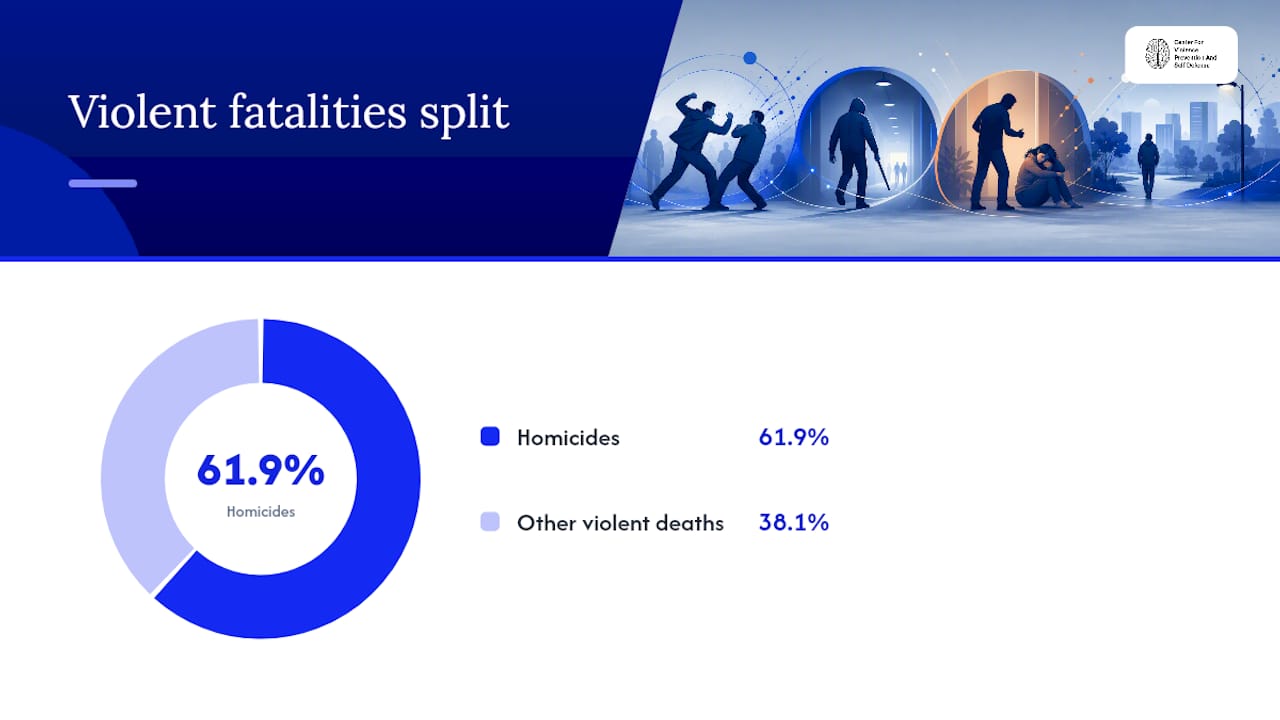
Violent acts caused 740 of the 5,283 fatal workplace injuries recorded in 2023, and homicides made up 61.9% of those violent fatalities, underscoring how often Type 1 scenarios turn lethal.
Type 2: Violence From Customers, Clients, or Patients
Type 2 violence comes from someone the organization serves, a customer, client, patient, or visitor, and it is the type most concentrated in healthcare and social services. NIOSH’s classification places this squarely as client-on-worker violence, distinct from the outside criminal actor in Type 1.
Examples include a psychiatric patient striking a nurse during a restraint procedure, a frustrated retail customer shoving an employee over a return dispute, or a visitor threatening staff in an emergency department waiting room. Common triggers include substance intoxication, untreated mental health crises, denial of service, and long wait times that boil over into confrontation.
Train staff in verbal de-escalation before physical intervention is ever needed
Redesign waiting areas and exam rooms with clear exit paths
Establish behavior agreements or “no tolerance” protocols with documented follow-through
Use safe patient-handling procedures that reduce physical struggle
Pro Tip: Lowering your voice and slowing your speech during a tense encounter often does more to de-escalate a patient or customer than any script. A calm, quiet voice carries more authority than an anxious torrent of instructions.
Type 3: Worker-on-Worker Violence and Bullying
Type 3 covers violence between people who work together, coworker to coworker or supervisor to employee, and it includes far more than physical attacks. Threats, intimidation, and sustained bullying all count, and this type is chronically underreported because victims often fear retaliation or doubt anyone will act on a complaint.
The warning signs are usually visible well before anything physical happens. Repeated verbal abuse, exclusion tactics, and a broader culture where managers tolerate hostility toward certain employees are the early markers organizations miss. The FBI’s analysis of workplace violence frames this as a behavioral continuum, not an isolated event, meaning bullying today can escalate to physical aggression later if nothing interrupts it.
Employers have a specific sequence to follow when Type 3 surfaces:
Document the complaint immediately and in writing
Separate the parties involved while the investigation proceeds
Investigate promptly using a consistent, documented protocol
Apply discipline or mediation based on findings, not office politics
Follow up with both parties to confirm the behavior has stopped
Type 4: When Personal Relationship Violence Follows Someone to Work
Type 4 violence originates outside the workplace, usually in a domestic or intimate relationship, but the workplace becomes the stage where it plays out. A perpetrator shows up at the victim’s job because it’s a predictable location, and coworkers can end up caught in the crossfire.
Warning signs are often subtle until they aren’t: unfamiliar callers or visitors asking pointed questions about someone’s schedule, a coworker with unexplained bruising or sudden anxiety about leaving the building alone, or a pattern of an ex-partner “happening” to be in the parking lot. Because the perpetrator is frequently known to someone in the organization, early behavioral cues are usually easier to spot here than in Type 1 scenarios.
Create a documented safety plan with the affected employee, not for them
Offer security escorts to and from parking areas
Issue clear no-contact instructions to front-desk and security staff
Refer the employee to domestic violence advocacy resources
Pro Tip: Ask the employee directly what would make them feel safer. Safety plans built without their input frequently miss the details that matter most, like which entrance they actually use.
Does Ideological Violence Count as a Fifth Type?
Some organizations add ideological or politically motivated violence as a separate category, covering attacks tied to extremist beliefs, terrorism, or targeted activism against an employer’s mission. It overlaps heavily with the existing framework rather than replacing it: an ideologically driven attacker is often a Type 1 outsider or a Type 2 visitor posing as a client.
Whether or not you track it separately, the practical response is the same:
Conduct a formal threat assessment when concerning statements or online activity surface
Coordinate with law enforcement early rather than waiting for an incident
Treat specific, credible threats with the same urgency regardless of motive
Which Industries and Roles Carry the Highest Risk?
A handful of risk factors show up again and again across incident data: exchanging cash, working alone, working in a mobile or field-based role, contact with people who are volatile or in crisis, late-night hours, and chronic understaffing. NIOSH’s risk-factor research ties these conditions directly to elevated incident rates across sectors.
Sector or role | Primary risk factor | Most common type |
Healthcare and social services | Contact with patients in crisis | Type 2 |
Late-night retail | Cash handling, working alone | Type 1 |
Taxi, rideshare, and delivery | Mobile workplace, isolation | Type 1 |
Correctional facilities | Contact with volatile individuals | Type 2 |
Emergency services (EMS, police) | Unpredictable scene conditions | Type 2 |
Use this table as a starting point for a workplace risk assessment: match your own roles and shifts against these factors, then prioritize prevention spending where the overlap is heaviest.
Building a Prevention Program and Responding After an Incident
A workable prevention program rests on four pillars: a documented hazard assessment, a multidisciplinary committee that includes frontline staff and not just management, ongoing training, and a mix of engineering controls (barriers, alarms, layout changes) and administrative controls (staffing ratios, scheduling, protocols). OSHA’s healthcare-specific guidance flags the exclusion of labor or employee representatives from that committee as one of the most common gaps in real programs.
When an incident happens, sequence matters:
Secure the immediate scene and separate the people involved
Call 911 if there’s active danger or injury
Notify internal security and management right away
Document what happened while details are fresh, and preserve any physical evidence
Review the incident with the safety committee within days, not months
Update policies based on what the review reveals
Offer support resources to affected employees and refresh training as needed
Pro Tip: Treat the incident review as a systems question, not a blame exercise. Ask what the environment or protocol failed to catch, not just what the individual did wrong.
With 740 workplace violence fatalities recorded in a single year, a documented response protocol isn’t paperwork, it’s the difference between an isolated incident and a pattern nobody catches until it’s too late.
What OSHA Requires and When to Report an Incident
OSHA has no single standard written specifically for workplace violence. Instead, it enforces prevention through the General Duty Clause, which requires employers to keep the workplace free of recognized hazards, including violence, once they’re on notice of the risk.
That “on notice” standard matters. If an employer knows about prior incidents or complaints and does nothing, OSHA can inspect or cite that employer after a subsequent incident. Practical guidance:
Contact local law enforcement immediately for any active threat or crime in progress
Contact OSHA when a pattern of hazard exposure exists and internal reporting has failed to produce action
Document every incident, even minor ones, since documentation is what establishes “notice” later
Keep records separate from routine HR files so they’re available if OSHA or legal counsel needs them
How CVPSD Trains Organizations to Recognize and Respond to Violence
CVPSD is a 501©(3) nonprofit built around one goal: giving organizations the skills to recognize danger early and respond with calm, evidence-based technique rather than panic. Training covers crisis intervention, de-escalation, behavior analysis, and physical self-defense, and it’s tailored to the sectors where Type 2 and Type 3 risks run highest, healthcare, EMS, education, and other frontline environments.
A typical engagement includes:
On-site or online instructor-led sessions built around your actual risk profile
Train-the-trainer certification so internal staff can sustain the program
Trauma-informed frameworks that connect staff safety to patient and client care quality
What organizations gain | Why it matters |
Staff trained to de-escalate before force is needed | Fewer incidents reach physical violence |
Documented, repeatable protocols | Supports General Duty Clause compliance |
Internal certified trainers | Program sustains itself without ongoing outside cost |
Organizations that want a structured next step can review CVPSD’s violence prevention training programs directly.
Where to Find Authoritative Data and Guidance
For deeper reading beyond this overview, four sources anchor most credible workplace violence guidance:
OSHA’s workplace violence overview for risk factors and enforcement
BLS Census of Fatal Occupational Injuries for fatality statistics
The FBI’s workplace violence analysis for behavioral continuum research
Why Employers Keep Getting This Framework Half Right
Most organizations that adopt the NIOSH framework stop at classification. They can tell you which type an incident fits after it happens, but that’s a filing exercise, not prevention. The real value of Type 1 through Type 4 is diagnostic: each type points to a different intervention, and treating them all with the same generic “zero tolerance” poster misses the point entirely.
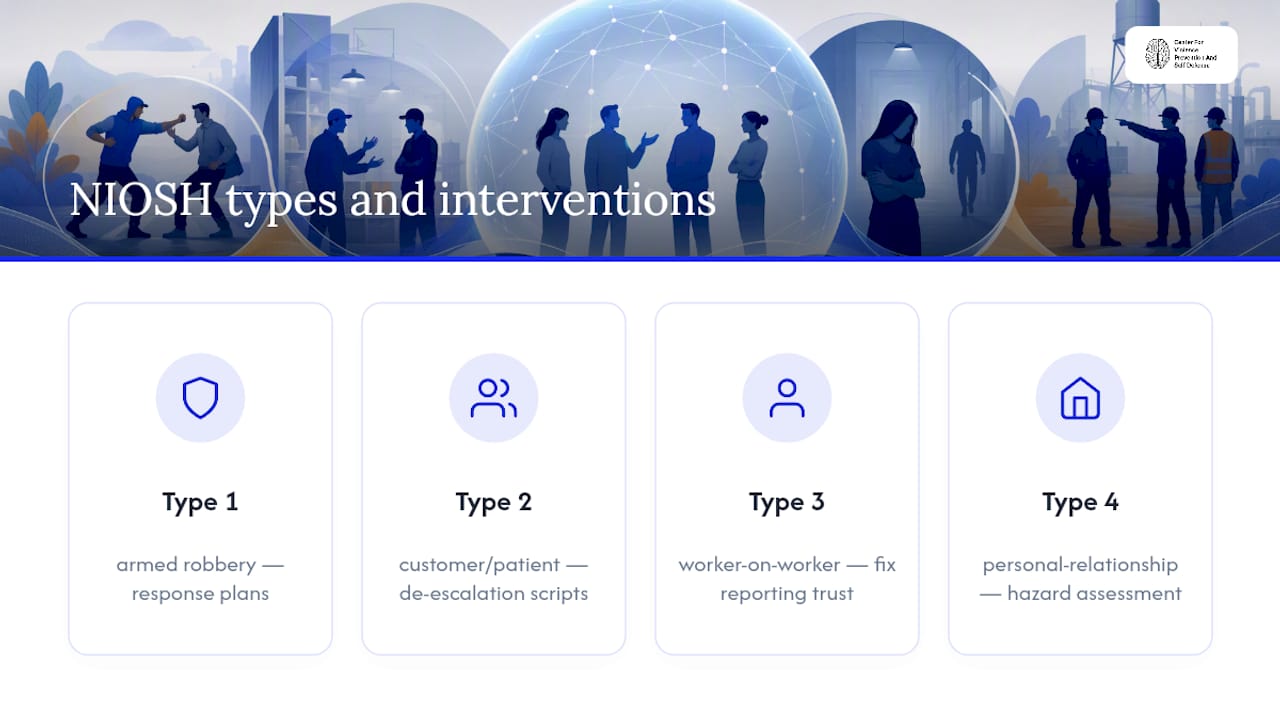
The biggest blind spot is Type 3. Companies build elaborate response plans for armed robbery (Type 1) while ignoring the supervisor who’s been berating the same employee for six months. That’s backwards. The behavioral continuum research is clear that bullying and harassment are the most observable, most preventable warning signs available to any organization, and they’re the ones most often waved off as a personality conflict.
If there’s one priority to take from this, it’s structural: build a reporting path people actually trust before you build a training binder. A hazard assessment and a well-designed prevention curriculum accomplish nothing if employees still believe reporting a threat will cost them their job. Fix the trust problem first. Everything else, the drills, the de-escalation scripts, the physical security upgrades, works far better once people believe someone will actually act on what they report.
Shawn Lebrock
Sources
FAQ
What are the four types of workplace violence?
The four types are Type 1 (criminal intent from someone unaffiliated with the workplace), Type 2 (violence from a customer, client, or patient), Type 3 (worker-on-worker violence, including bullying and threats), and Type 4 (violence from a personal relationship that follows the victim to work), as classified by NIOSH.
What are five examples of workplace violence?
Five examples spanning the types include an armed robbery at a late-night store (Type 1), a patient assaulting a nurse (Type 2), a supervisor bullying a subordinate (Type 3), an ex-partner confronting an employee in the parking lot (Type 4), and a coworker making repeated verbal threats after a dispute (Type 3).
What are the differences between Type 1 and Type 2 workplace violence?
Type 1 involves a perpetrator with no legitimate connection to the workplace, usually committing a crime like robbery. Type 2 involves someone the organization actually serves, such as a patient, client, or customer, and is far more common in healthcare and service industries.
What is Type 3 workplace violence?
Type 3 is violence between people who work together, coworker to coworker or supervisor to employee, and it includes verbal threats and bullying as well as physical attacks. It’s chronically underreported because victims often fear retaliation.
Recommended
About the Author: William DeMuth is the Director of Training at the Center for Violence Prevention and Self Defense (CVPSD) in Freehold, NJ. With over 35 years of research in violence dynamics and personal safety, William specializes in evidence-based training that bridges the gap between compliance and real-world conflict resolution. The architect of the ConflictIQ™ program, he holds advanced certifications and has trained under diverse industry leaders. Today, he actively trains civilians, hea


