
Defensible ROI for Violence Prevention Training: Phillips, ICAT, CVPSD

Updated: 5 days ago
Violence prevention training ROI is achievable, and it is measurable, when organizations tie training to specific outcomes and evaluate them with a real cost-benefit model instead of counting completion certificates. A stepped-wedge trial of ICAT de-escalation training found use-of-force incidents fell significantly after training, alongside drops in injuries. The rest of this guide shows the model, the evidence, and a worked example your finance team will accept.
Table of Contents
What Is the Phillips ROI Model for Training?
The Phillips ROI model answers the question every finance director eventually asks: “What did we get back?” It builds on Kirkpatrick’s four levels of training evaluation, then adds a fifth: converting business impact into dollars, subtracting program costs, and reporting the result as a ratio leadership can compare against other investments.
Key metrics include ROI percentage, Benefit-Cost Ratio (BCR), and payback period, which help communicate the financial impact of training.
Total costs need to include more than the invoice. Facilitator fees, materials, and facility rental are the obvious direct costs. The indirect costs, paid staff time away from their posts, travel, backfill labor, and program administration, are where most calculations quietly understate cost and inflate ROI. Leaving those out is the most common source of an unrealistic ROI figure.

Which Outcomes Should You Track After Training?
The strongest ROI cases rest on outcomes your organization already tracks, not new metrics invented for the study. Value metrics, incidents avoided, turnover reduced, absenteeism cut, carry weight with a finance team in a way completion rates never will, since activity metrics measure effort while value metrics measure results.
Prioritize outcomes in this order:
Use-of-force incidents, injuries, and workers’ compensation claims. These carry a direct dollar cost per event and are usually already logged.
Absenteeism and turnover among affected staff. Replacement cost per departed employee is often already calculated by HR.
Productivity losses tied to disruption, evacuation, or post-incident recovery time.
Pro Tip: Multiply your average incidents per year by your fully loaded cost per incident, including claims, lost time, and replacement hiring, to get a defensible baseline before training even starts.
Pick two or three outcomes that map to KPIs your board already reviews quarterly. A tight, credible case beats a sprawling one that tries to claim credit for everything.
How Do You Isolate the Effect of Training From Other Factors?
Incidents drop for lots of reasons, staffing changes, seasonal patterns, a policy shift. Isolating training’s share of that drop is what separates a defensible ROI from a guess.
Four practical designs work at organizational scale:
Control or comparison groups, where one site or shift trains first and another serves as a benchmark.
Phased or stepped-wedge rollout, training different units on a staggered schedule so each becomes its own before-and-after comparison.
Trend-line projection, extending the pre-training incident trend forward and measuring the gap against actual post-training results.
Manager and participant attribution, asking supervisors what share of the improvement they’d credit to training, then applying a confidence discount to that estimate.
SHRM’s guidance on training ROI recommends documenting every assumption and running the numbers at a conservative and optimistic range rather than presenting one point estimate.
Track training dosage and fidelity, who actually attended, how much content was delivered as designed, alongside administrative records and post-training surveys. The National Policing Institute’s review of de-escalation evaluation methods points to multi-source data, records plus surveys plus direct observation where feasible, as the difference between a credible claim and a hopeful one.
Pro Tip: List every plausible confounder, a hiring freeze, a policy change, a leadership transition, before you calculate ROI, and note how each one might have moved the numbers independent of training.
What Does the Research Say About Training Effectiveness?
Does de-escalation training work? The best available evidence says yes, under real-world conditions, not just in a classroom. A stepped-wedge randomized controlled trial of ICAT de-escalation training found statistically significant drops in use-of-force incidents, citizen injuries, and officer injuries, with effects appearing immediately after training and holding steady afterward.
Broader economic evidence supports the pattern, with real caveats:
A systematic review of violence-prevention economic evaluations found multiple interventions reported positive benefit-cost ratios, though the pool of rigorous studies remains small and methods vary enough to make cross-study comparison difficult.
Cost-benefit simulations of hospital-based violence intervention programs projected positive net savings over a five-year window under reasonable assumptions about how much violence the program actually prevented.
Treat ICAT’s effect sizes as a plausible upper bound rather than a guarantee for every setting, since high-quality trials of de-escalation training are still scarce, and your own de-escalation program’s incident data will land somewhere on that spectrum depending on baseline risk and delivery quality.
How Do You Calculate Training ROI Step by Step?
Here’s a worked example using a mid-sized organization running a single cohort through a de-escalation program.
Assumed inputs:
40 participants, average fully loaded wage $32/hour, 8 training hours each = $10,240 in staff time.
Facilitator and materials fees: $6,500.
Baseline incidents: 20 per year, average fully loaded cost per incident (claims, lost time, replacement labor): $4,200.
Attribution factor: 50% of any improvement credited to training, discounted for confounders.
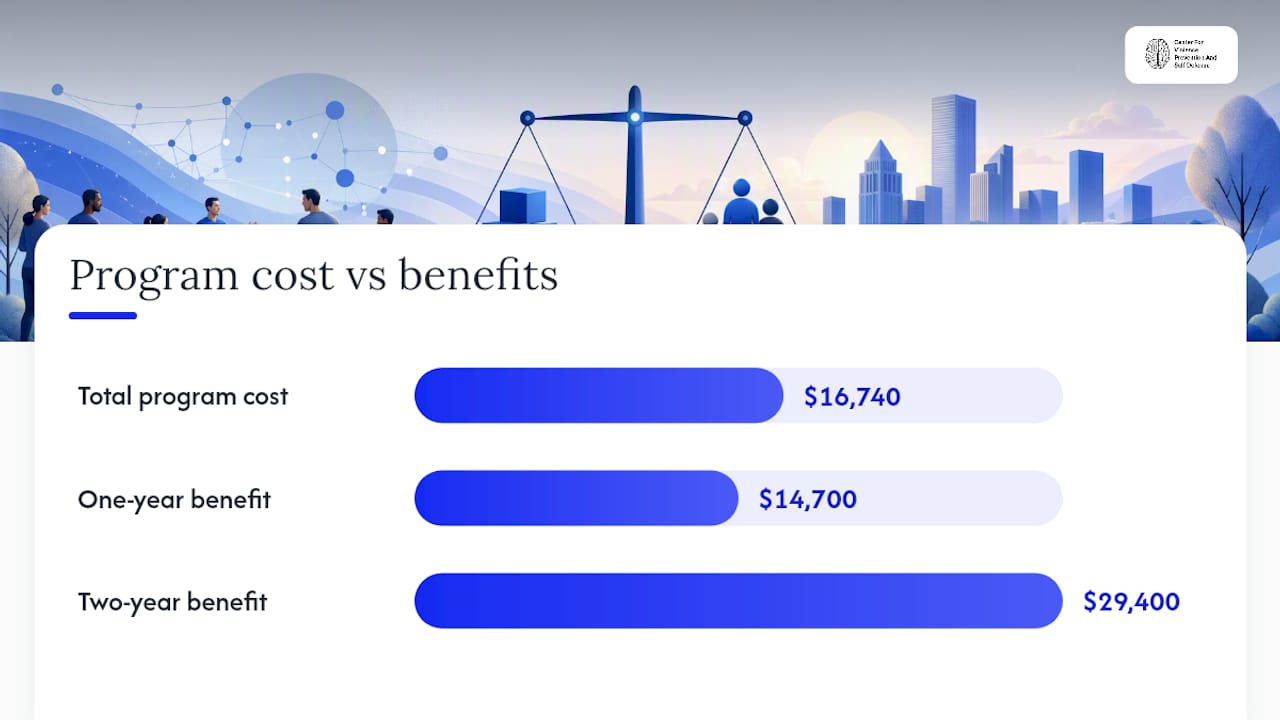
Total program cost: $10,240 + $6,500 = $16,740.
Post-training result: Incidents drop to 13 per year, a reduction of 7. Applying the 50% attribution factor credits training with 3.5 avoided incidents.
Total benefit: 3.5 × $4,200 = $14,700.
That single year already nearly breaks even. Since avoided incidents recur every year the improvement holds, running the math over two years puts benefit at $29,400 against the same one-time $16,740 cost.
Run the same math at a 30% attribution factor (BCR 1.05) and a 70% factor (BCR 2.47) so leadership sees the honest range, not a single flattering number.
How Do You Present ROI Results to Leadership?
A one-page scorecard converts a spreadsheet into a decision. Lead with the headline ROI, BCR, and payback period, then back it with two or three supporting KPIs, incidents avoided, turnover change, absenteeism trend, and state your key assumptions plainly: attribution factor, training fidelity, and time horizon.
Element | What to include |
Headline metrics | ROI%, BCR, payback period |
Supporting KPIs | 2-3 outcomes tied to existing business tracking |
Assumptions | Attribution factor, cost basis, time horizon |
Sensitivity range | Conservative and optimistic BCR side by side |
Speak to finance in ratios and payback periods; speak to operations in incident counts and staffing impact. Pre-answer the three objections every leadership team raises:
“How do you know it was the training?” Show your attribution method and discount factor upfront.
“Will this hold next year?” Reference dosage and fidelity tracking, not just year-one results.
“What’s the ongoing cost?” Separate one-time development costs from recurring delivery costs so the payback period isn’t overstated.
What Proof Points Support CVPSD’s Training Approach?
This nonprofit is built around evidence-based crisis intervention, de-escalation, and self-defense instruction, not generic soft-skills workshops. The organization completed a New Jersey workforce training cohort in January 2026 and published an internal report on the economics of workplace violence prevention, laying out how proactive training reduces downstream costs for employers.
CVPSD’s in-person work with educators at Hartford’s American Institute Adult Education School shows the same principle in practice, real cohorts, tracked outcomes, and follow-through on fidelity. For organizations building their own ROI case, CVPSD’s implementation guidance covers the data structures and fidelity checkpoints needed to make an ROI calculation defensible rather than aspirational.
Full ROI Versus Lightweight Measurement: When Each Makes Sense
Run a full Level-5 ROI when the program is expensive, covers a large headcount, or executives are already asking for a dollar figure. For mandatory, low-cost compliance training, a lighter Kirkpatrick Level 3 or 4 check, behavior change and incident trend, is usually sufficient and far less burdensome to sustain.
Build evidence incrementally. A modest ROI estimate from one cohort, repeated across three or four training cycles, becomes a far stronger case than one ambitious calculation nobody can replicate.- Shawn Lebrock
How CVPSD Helps You Build a Defensible ROI Case
Some organizations seek training outcomes they can actually take to a budget meeting, not just a certificate of completion. The ConflictIQ™ program series, from ConflictIQ™ 100 through ConflictIQ™ 700, gives healthcare, education, corporate, and government teams role-specific curricula that map directly to the outcome metrics finance teams want to see: incident counts, injury rates, and behavior change.
If your organization needs a program built around your own risk profile and reporting requirements rather than a one-size course, CVPSD’s customized training service works directly with your team to define baseline metrics before the first session runs. For organizations exploring a lower-commitment starting point, the self-paced online training catalog offers a way to pilot the approach with one team before scaling further. Reach out to CVPSD to scope a pilot cohort and a matching measurement plan for your next training cycle.
Sources
Integrating Communications, Assessment, and Tactics (ICAT) de-escalation training — CrimeSolutions
Systematic review of violence prevention economic evaluations — PMC
HVIP cost-benefit simulation — American Journal of Preventive Medicine (2015)
Are you measuring activity or business value? — Training Industry
FAQ
Does Violence Prevention Training Actually Reduce Incidents?
Evidence from a randomized controlled trial of ICAT de-escalation training showed a 28.1% drop in use-of-force incidents and a 26.3% drop in citizen injuries following training. Results vary by setting and program fidelity, so treat these figures as a strong signal rather than a universal guarantee.
How Long Does It Take to See a Return on Training Investment?
Payback periods roughly around one year or slightly longer are common when training targets high-cost outcomes like incidents and injuries, based on typical cost-per-incident savings. Programs measuring only compliance or awareness, without a monetized outcome, won’t produce a payback period at all since there’s no dollar benefit to compare against cost.
What’s the Difference Between ROI Percentage and Benefit-Cost Ratio?
ROI percentage shows net benefit as a percentage of cost, useful for comparing training against other budget line items. Benefit-cost ratio (BCR) shows total benefit relative to total cost as a simple multiple, which many finance teams find easier to communicate in a single meeting.
Can Small Organizations Justify a Full ROI Calculation?
Full Level-5 ROI calculations make the most sense for expensive, large-scale, or executive-visible programs. Smaller organizations with mandatory, lower-cost training often get more practical value from tracking incident trends and completion fidelity instead of building a complete monetary model.
Does CVPSD Offer Training Priced for Smaller Teams?
CVPSD’s Violence Prevention - Conflict Resolution Training online self-paced course is available in English at no cost. Pricing for the ConflictIQ™ program series and customized training engagements is available directly through CVPSD’s program pages.
Recommended


