
Clinch Position: Train Safely with Plum, Underhooks and CVPSD Drills

A clinch position is a standing grappling hold where two fighters grip each other at close range to control posture, limit strikes, or set up knees, elbows, and throws. It shows up in Muay Thai, boxing, wrestling, judo, and MMA, but the rules governing it, and what a fighter is allowed to do inside it, change sharply from one sport to the next.
Basic Understanding Of The Clinch Position
The effectiveness of a clinch depends heavily on low hips, strong posture, and proper timing, rather than solely arm strength.
Different sports prioritize clinch control for striking, takedowns, or escape, so techniques and legality vary significantly between Muay Thai, boxing, wrestling, and MMA.
Offensive options from the clinch include knee strikes, elbows, short punches, and setup for trips or takedowns, requiring control of the opponent’s hips and posture.
Beginners should focus on posture, hand-fighting, and maintaining a stable base, while advanced training incorporates resistance, rule-specific drills, and conditioning.
Safe clinch training involves gradual progression, controlled resistance, strict safety protocols, and understanding the limits of physical capability, especially for vulnerable populations.
Table of Contents
What Makes a Position a Clinch?
A clinch isn’t just two fighters bumping into each other. It’s a deliberate hold, sustained over time, with a clear intent to control the opponent’s posture, balance, or striking range. The Cambridge Dictionary defines a clinch simply as the position two people are in when holding each other tightly with their arms, whether fighting or embracing, but the combat-sport version adds structure and purpose to that grip.
Four things separate a real clinch from a scramble or a brief tie-up:
Grips: hands, forearms, or arms locked onto the head, neck, arms, or torso with enough tension to affect the other fighter’s movement.
Sustained contact: the hold lasts long enough to matter tactically, not just a half-second graze during an exchange.
Intent to control: the fighter applying the grip is trying to break posture, create an angle, or set up a follow-up technique.
Anchored base: hips dropped, feet wide, weight low enough that the grip doesn’t collapse the moment the opponent pushes back.
The anatomy of clinch control runs from the top down. Head and neck control (grabbing behind the skull or across the collarbone) dictates where the opponent’s chin and eyes point, which in turn dictates their balance. Arm placement, inside or outside the opponent’s arms, decides who gets first access to strikes or throws. And underneath all of it, hip and leg positioning determines whether either fighter can actually move the other.
You’ll hear specific vocabulary around this: pummelling describes the constant arm exchange fighters use to win inside position, usually meaning underhooks (an arm threaded under the opponent’s armpit) instead of overhooks (an arm draped over the opponent’s arm and shoulder). A collar tie grips behind the neck. A body lock wraps around the opponent’s torso. Every clinch exchange, at its core, is a fight over these four or five grips, repeated over and over until one fighter gains a decisive advantage.
What Are the Most Common Clinch Grips and Positions?
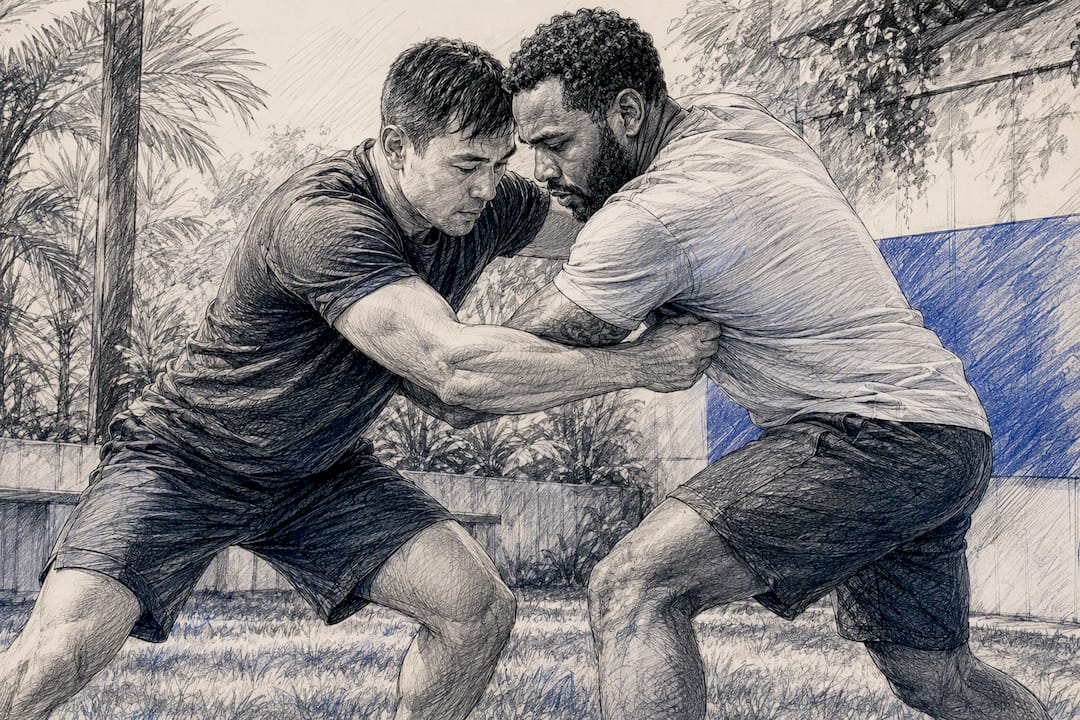
Every clinch position exists to accomplish one of two things: control the opponent’s head and posture, or control their hips and base. Once you can categorize a grip by which of those two jobs it does, the whole taxonomy gets easier to remember.
Double collar tie (the plum): Both hands lock behind the opponent’s neck, elbows pinned tight to their own body, pulling the head downward. This is the signature Muay Thai clinch position, built almost entirely to set up knee strikes to the head or body.
Double underhooks: Both arms thread under the opponent’s armpits, hands locked or gripping the back. This is a dominant control position in wrestling and MMA because it gives the fighter holding it the leverage to lift, drive, or off-balance the opponent for a takedown.
Overhook (whizzer): One arm wraps over the opponent’s arm and shoulder. It’s often a defensive answer to an underhook attempt, though a skilled fighter can convert it into a throw.
Single collar tie: One hand behind the neck, the other hand free to strike or fight for a second grip. Common in Muay Thai and MMA as a transitional hold rather than a finishing position.
Seatbelt grip: One arm over the shoulder, one arm under the armpit, hands clasped across the opponent’s back. It’s a staple wrestling control used heavily from the back or in scrambles.
Body lock: Both arms wrapped fully around the opponent’s torso, hands locked, used to control the hips directly rather than the upper body. This is where most trips and dumps originate.
50/50 clinch (double collar or double underhook standoff): Neither fighter has a clear advantage. Whoever wins the next pummelling exchange usually dictates what happens next.
Framing clinch: Forearms pressed against the opponent’s chest or collarbone, creating a rigid barrier rather than a grip. This is more defensive than offensive, built to create space instead of control.
Pro Tip: Watch the elbows, not the hands, when you’re learning to read a clinch. Whoever keeps their elbows tucked tight to their own ribs almost always wins the pummelling exchange, because flared elbows give the opponent room to slide an arm underneath.
The standard framing clinch deserves special mention because it’s the one grip built purely to create distance instead of close it. Placing a forearm across the opponent’s upper chest or collarbone gives a fighter a rigid structure to push off, which matters enormously for anyone using clinch skills for self-defense rather than sport competition, where the goal is often escape, not domination.
How Do Different Combat Sports Use the Clinch Differently?
The clinch is context-dependent. What’s a legal, central strategy in one sport is a stalling tactic penalized in another. Wikipedia’s overview of clinch fighting frames this well: the clinch functions as an offensive engine in some sports, a defensive pause in others, and a bridge to an entirely different phase of combat in a third group.
Muay Thai treats the clinch as one of the sport’s core weapons. Fighters actively seek the plum to unload knees to the body and head, and judges score clinch dominance the same way they score striking exchanges.
Boxing allows only brief clinch windows before a referee steps in to separate fighters. A clinch in boxing happens when a fighter wraps up an opponent’s arms to stop punches from landing, usually as a defensive reset after taking damage, not as an offensive tool.
Wrestling and judo use the clinch (called a “tie-up” in wrestling, “kumi-kata” in judo) purely as an entry point to throws and takedowns. In judo’s gi-based grips, sleeve and collar control changes the throw options entirely compared to the no-gi tie-ups common in wrestling.
MMA blends all of the above. Fighters use the cage to pin an opponent and control posture, mix in “dirty boxing” (short punches thrown from clinch range), and transition freely between striking and throws. Rule sets vary by promotion, but strikes to the back of the head and small joint manipulation from the clinch are commonly illegal across major organizations.
The practical lesson: a technique that works beautifully in one clinch ruleset can get you a warning, a point deduction, or a stalling penalty in another. Know the rules of the sport you’re training for before you build habits around a specific grip.
What Can You Do Offensively From the Clinch?
Clinch control only matters if it leads somewhere. Once you’ve secured a dominant grip, whether that’s the plum, a body lock, or double underhooks, you have a menu of offensive options that depend entirely on distance, posture, and which limbs you control.
Knees: The plum’s entire purpose is setting up knee strikes. Body knees work best when the hips are square and close; head knees require pulling the opponent’s posture down first, which is why collar-tie strength matters so much.
Elbows and short strikes: Once inside arm’s length, full punching power disappears, but elbows and short hooks (dirty boxing) still land with real force. These work best off a single collar tie or overhook, where one hand is free.
Sweeps, trips, and takedowns: A body lock or double underhooks gives you the leverage to off-balance an opponent sideways (a trip) or backward (a takedown). The fundamentals of clinch leverage come down to whoever controls the hips usually controlling where the fight goes next, standing or on the ground.
Combining strikes with off-balancing: The highest-level clinch fighters rarely throw a strike in isolation. A knee that lands also breaks posture, which sets up the next takedown attempt or strike.
Overhooks and underhooks aren’t just control positions. They’re the doorway to back control in MMA and grappling contexts, since a strong underhook often lets a fighter circle around to the opponent’s back once the takedown lands. That transition is worth studying on its own, because how underhooks lead to back control explains a sequence that shows up constantly in both wrestling and MMA.
How Do You Defend and Escape a Clinch?
Good clinch defense isn’t about muscling out of a hold. It’s about structure, angles, and knowing when a hold has become a liability worth escaping rather than fighting through.
Build a frame first. Forearms pressed against the opponent’s chest or collarbone create a physical barrier that keeps their head and hips at a distance, buying you time to think instead of just reacting to pressure.
Pummel toward underhooks. If an opponent has you in a weaker position, like an overhook or a single collar tie, fight to get at least one arm underneath theirs. Winning that inside position is usually the fastest route out of trouble.
Shift your hips, not just your hands. Turning your hips away from an opponent’s pull reduces the leverage they have over your posture far more than trying to peel off their grip with your arms alone.
Create an angle and disengage. Once you’ve neutralized the immediate threat, step off at 45 degrees rather than straight back. Straight-line retreats are easy to chase; angled ones aren’t.
Pro Tip: Hand-fighting starts before the clinch does. Fighters who win the reach for the first grip almost always dictate the terms of the exchange that follows, so treat the split second before contact as part of the fight, not a pause before it.
Know when to bail entirely. In a self-defense context, a clinch that’s going badly, especially against a larger or stronger opponent, isn’t something to grind through for pride. Clinch fighting concepts adapted for self-defense emphasize creating an exit and getting away over trying to “win” a grappling exchange against an unknown threat.
How Do You Practice Clinch Safely as a Beginner?
Clinch training carries real physical risk if it’s rushed. Building the skill safely means starting slow, adding resistance gradually, and never letting ego dictate the pace of a drill.
Warm up joints and set ground rules first. Necks, shoulders, and wrists take the brunt of clinch pressure, so a proper warm-up and a clear agreement on pressure level (light, medium, full) before you touch gloves matters more than any technique.
Run pummelling ladders. Partners take turns fighting for underhooks in a controlled, continuous exchange, typically for 30 to 60 second rounds, focusing purely on winning inside position rather than striking.
Hold light-pressure clinch rounds. Once grips feel comfortable, add rounds where both partners simply maintain posture and control without attempting to finish anything, training the isometric strength clinch work demands.
Add controlled strikes to pads. Once posture and grips are solid, drill knees or elbows into a pad held by the partner instead of live target, then practice disengaging cleanly afterward.
Posture matters through every step of this progression, not just the striking phase. A collapsed spine or a head dropped too low undoes even a perfect grip, which is why protective stances and body posture deserve attention before a beginner ever attempts live clinch rounds. The physical demands here are real, too. Clinch work leans heavily on grip endurance and isometric strength, and grip strength testing and training guidance can help a beginner understand what baseline conditioning actually supports this kind of holding, pulling, and framing.
How Does CVPSD Approach Clinch Safety and Training?
CVPSD is a 501©(3) nonprofit built around evidence-based training, and that principle shapes how it treats physical skills like the clinch. Physical technique is only one piece of a complete response to a threat. CVPSD teaches clinch and grappling concepts inside a broader framework that starts with de-escalation and situational awareness, because avoiding a physical confrontation is always the better outcome when it’s possible.
That framework matters even more when a program serves vulnerable populations, like students, healthcare staff, or older adults, where drills need to be adapted for lower risk tolerance and different physical capabilities.
A few standards worth expecting from any clinch or self-defense instructor, not just CVPSD’s own programs:
Verified certification and documented teaching experience, not just competition credentials.
A visible emphasis on safety protocols during live or resistance drills.
Awareness of state and local legal standards around use-of-force and self-defense training.
A clear point at which training stops and a participant is referred to medical evaluation, particularly after any strike to the head or neck.
If a drill partner reports dizziness, blurred vision, or lingering neck pain, stop immediately and get medical attention rather than pushing through it.
Where Did the Clinch Position Come From?
Close-range grappling as a fight-ending or fight-controlling tool predates modern combat sports by centuries. Ancient wrestling traditions in Greece, Egypt, and Mongolia all built systems around tying up an opponent’s upper body before a throw, and those principles carried forward largely unchanged into today’s freestyle and Greco-Roman wrestling.
Muay Thai’s version of the clinch developed along a separate track, shaped by the sport’s rules allowing elbows and knees. Because a fighter standing at close range can’t generate full punching power but can still drive a knee upward with devastating force, Thai fighters spent generations refining the plum specifically as a delivery system for that strike. That’s why Muay Thai’s clinch game looks so different from a wrestler’s tie-up: it was built for a completely different toolkit of strikes.
Boxing’s clinch took the opposite path. As the sport formalized rules against holding in the 19th and 20th centuries, the clinch shifted from a legitimate tactic into something referees actively police, treated more as a stalling risk than a technique worth teaching.
Modern MMA, born in the 1990s, forced these separate traditions back into contact with each other. A wrestler’s double-leg entry, a Thai boxer’s plum, and a boxer’s defensive tie-up all had to coexist under one rule set, which is part of why MMA’s clinch game today borrows heavily and openly from all three lineages rather than representing one clean tradition of its own.
What Body Mechanics Make a Clinch Actually Work?
Grip strength gets most of the attention in clinch discussions, but arms alone rarely win a clinch exchange. The decisive factor is almost always what’s happening below the waist.
Hip and leg engagement anchors the entire structure. A fighter who tries to control an opponent’s posture using only arm strength will get walked backward or spun off balance the moment real pressure arrives, because arms fatigue fast under sustained isometric load. Hips dropped low, knees bent, and feet positioned wide enough to resist a push create the base that lets the upper-body grips actually function.
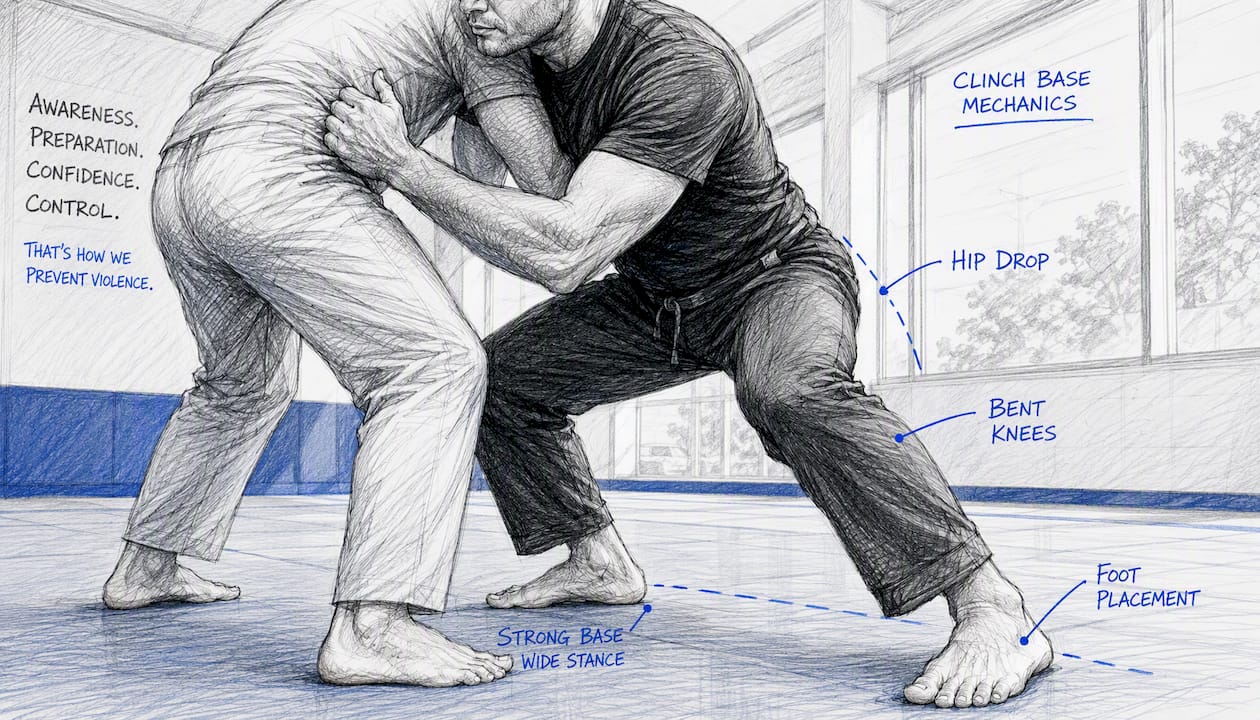
Posture is the second pillar. Keeping the spine upright and the chin tucked prevents an opponent’s collar tie or overhook from generating leverage over your balance. The moment your head drops or your back rounds, even a weak grip from your opponent starts to feel powerful, simply because you’ve given them a lever to work with.
The third piece is timing the transfer of force. Clinch fighters describe the position as a kind of tactical pause, one that quietly drains energy through sustained tension even when nothing visible seems to be happening. That’s why elite clinch fighters conserve energy between exchanges rather than gripping at full intensity the entire time, saving explosive effort for the moment an opening actually appears.
Coaches who understand this teach anchoring drills built around knee drive and hip bracing long before they introduce complex grip sequences, because a fighter with poor base will lose every clinch exchange regardless of hand skill.
What Mistakes Do Beginners Make in the Clinch?
Most clinch mistakes trace back to one root cause: relying on arm strength while ignoring hips, posture, and pacing. Recognizing these patterns early saves months of frustration.
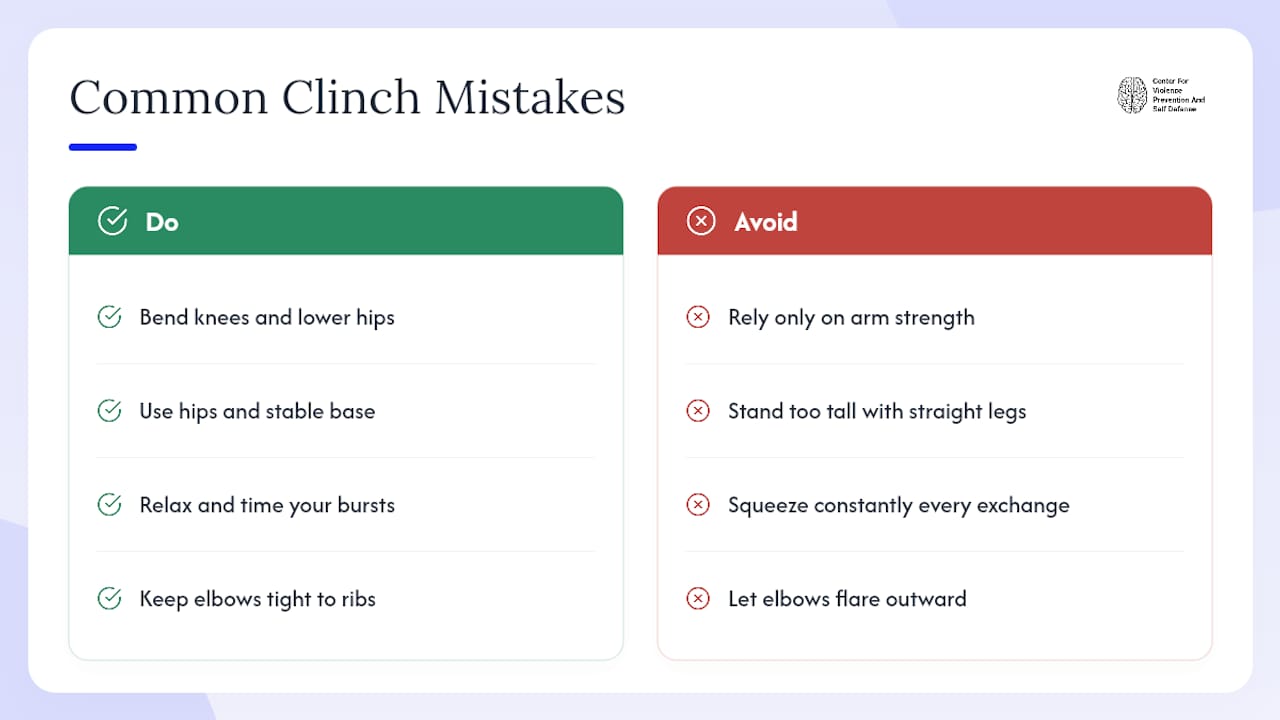
Standing too tall. A high posture with straight legs gives an opponent’s collar tie or overhook enormous leverage. Bending the knees and lowering the hips is uncomfortable at first but nonneutralizes most incoming pressure.
Squeezing constantly instead of timing effort. Gripping at full intensity the entire exchange burns out your forearms and shoulders within a minute. Winning clinch fighters relax between exchanges and explode only when an opening appears.
Flared elbows. Letting elbows drift away from the ribs opens a direct lane for an opponent to slide in an underhook, handing away the inside position for free.
Chasing a grip instead of hand-fighting for it. Reaching for a collar tie without first controlling the opponent’s hands usually ends with the other fighter winning the position instead.
Ignoring the legs entirely. Beginners fixate on arms and forget that hips and feet decide most clinch exchanges. Without a stable base, no grip holds up under real pressure.
Staying in a losing clinch too long. Whether in competition or a self-defense scenario, refusing to disengage from a clearly losing position, out of pride or panic, wastes energy and increases injury risk. Recognizing that moment and creating an exit is a skill in itself.
How Should Clinch Training Progress From Beginner to Advanced?
Clinch skill builds in layers, and skipping a layer to chase advanced technique almost always shows up as a weakness later.
Beginners should spend their first several weeks purely on posture and hand-fighting: learning to keep the spine upright, hips low, and hands active without yet worrying about finishing any specific technique. Pummelling drills at this stage should run at low resistance, focused entirely on recognizing grips rather than winning them.
Intermediate practitioners start layering in resistance and consequence. This is where live pummelling rounds, controlled takedown attempts from underhooks, and light knee strikes into pads enter the picture. The goal shifts from recognizing positions to reacting to them under mild pressure, ideally with a coach correcting posture breakdowns in real time.
Advanced training adds sport-specific rule constraints and live sparring. A Muay Thai practitioner starts drilling plum entries against a resisting partner who’s also trying to counter; an MMA athlete starts mixing clinch entries with actual takedown attempts and cage work. At this stage, understanding how weight and size differences change clinch tactics becomes essential, since managing larger or stronger opponents in the clinch requires different strategy than facing an evenly matched partner. Combat-specific strength and conditioning work supports this stage heavily, since clinch endurance under live resistance depends on conditioning that pad work alone doesn’t build.
When Is Clinch Training Actually Worth Prioritizing?
Clinch training earns its place in a training plan when your goals involve competition in a clinch-heavy sport like Muay Thai, wrestling, or MMA, or when you’re preparing for realistic close-quarters self-defense scenarios where distance simply won’t exist. For a striker training purely for boxing, clinch work matters far less since the sport treats it as a brief interruption rather than a core skill.
For most self-defense learners, the honest answer is balance: enough striking to create distance and enough clinch skill to survive the moments when distance disappears, which happens more often in real altercations than sport analogies suggest. Organizations and community groups looking to build this balance responsibly should pursue supervised, evidence-based programs rather than piecing together technique from unverified sources.
— Shawn Lebrock
Ready to Train Clinch Skills the Right Way?
CVPSD is the alternative to piecing together self-defense technique from scattered online clips: a 501©(3) nonprofit delivering evidence-based, instructor-led clinch and physical self-defense training built around de-escalation first and physical technique second, with programs designed to meet state and local legal standards rather than generic one-size-fits-all curriculum.

Whether you’re a school, healthcare organization, corporate team, or community group, CVPSD builds workshops around your specific population, adapting drills for staff safety, student vulnerability, or organizational risk profiles instead of handing every group the same routine. Programs run both online and in person, with train-the-trainer certification available for organizations that want to build internal capacity over time.
If your organization is ready to bring structured, safety-first self-defense and de-escalation training to your staff or community, request a workshop through CVPSD to start the conversation.
Sources
For deeper technique breakdowns, see Wikipedia’s clinch fighting overview, the Fight Encyclopedia’s framing clinch guide, and sport-specific rulebooks for Muay Thai, boxing, and MMA.
FAQ
Is Clinch Illegal in Boxing?
No, but it’s tightly restricted. Boxing allows brief clinch windows to limit punching, but referees actively break clinches because prolonged holding is treated as stalling rather than legitimate technique.
What Is the Difference Between a Clinch and a Grapple?
A clinch specifically refers to standing, close-range grip fighting, while “grapple” is a broader term covering all forms of controlling an opponent, standing or on the ground. Every clinch is a form of grappling, but not every grappling exchange is a clinch.
How Do You Perform a Clinch?
Secure a grip such as a collar tie, underhook, or body lock while keeping your hips low, spine upright, and elbows tucked to your ribs for a stable base. From there, fight for better position through pummelling before attempting a strike, sweep, or takedown.
Can You Punch During a Clinch?
Yes, in sports and rule sets that allow it, particularly MMA, where short “dirty boxing” punches thrown at close range are a standard offensive tool. Boxing restricts this heavily since referees separate fighters almost as soon as a clinch forms.
What Does Clinch Position Mean in MMA Specifically?
In MMA, a clinch position means using cage control, underhooks, or a collar tie to limit an opponent’s strikes while setting up knees, dirty boxing, or a takedown. Rules vary by promotion, but strikes to the back of the head are commonly restricted across major organizations.
Recommended


