
What Is a Crisis Safety Plan? Your 2026 Guide

Updated: Aug 13

A crisis safety plan is defined as a prioritized, written guide that helps individuals and organizations respond effectively when emotional distress or emergency conditions impair clear thinking. The plan lists warning signs, coping strategies, trusted contacts, and professional resources, ordered from least to most intensive intervention.
Recognized as best practice by the VA, SAMHSA, and the Joint Commission, properly implemented Safety Planning Interventions reduce suicide attempts by approximately 45%. That figure reflects how much structured preparation matters when judgment is compromised. CVPSD works with organizations and communities to build exactly this kind of preparedness, grounded in evidence and real-world application.
What key components make up an effective crisis safety plan?
An effective crisis safety plan is a prioritized, written guide listing warning signs, coping strategies, support contacts, and professional resources, ordered from least to most intensive. Each component serves a specific function, and skipping any one of them weakens the whole structure.
The core elements of a well-built plan include:
Early warning signs: Physical, emotional, or behavioral signals that a crisis is developing. Examples include racing thoughts, withdrawal from others, or increased agitation.
Internal coping strategies: Actions a person or team can take independently, without outside help. Deep breathing, grounding exercises, or reviewing a pre-written checklist all qualify.
Trusted social contacts: Friends, family members, or colleagues who can provide support and distraction before professional help is needed.
Professional and emergency resources: Therapists, crisis hotlines (such as the 988 Suicide and Crisis Lifeline), emergency contacts, and organizational safety officers.
Means restriction: Removing or limiting access to items that could cause harm during a crisis. This step is often overlooked but critical for reducing risk.
Escalation order: Interventions listed from least to most intensive, so the person in crisis follows a clear sequence rather than guessing.
The table below summarizes how each component functions within the plan.
Component | Purpose |
Warning signs | Trigger early awareness before crisis peaks |
Internal coping | Provide immediate, self-directed relief |
Social contacts | Offer human connection and distraction |
Professional resources | Deliver expert intervention when needed |
Means restriction | Reduce access to harm during high-risk moments |
Pro Tip: Write warning signs in the first person and in plain language. “I start isolating myself” is more useful than “social withdrawal” when you are reading under stress.
The ordering principle is what separates a safety plan from a simple contact list. A person in crisis does not have the mental bandwidth to evaluate options. The plan does that evaluation in advance, during a calm period, so the distressed self only has to follow steps.
How is a crisis safety plan developed and personalized?
A safety plan created during a stable period is far more effective than one written in the middle of a crisis. Clear thinking produces clearer plans. The process of creating a safety plan empowers individuals by encouraging reflection on personal triggers and protective factors before distress clouds judgment.
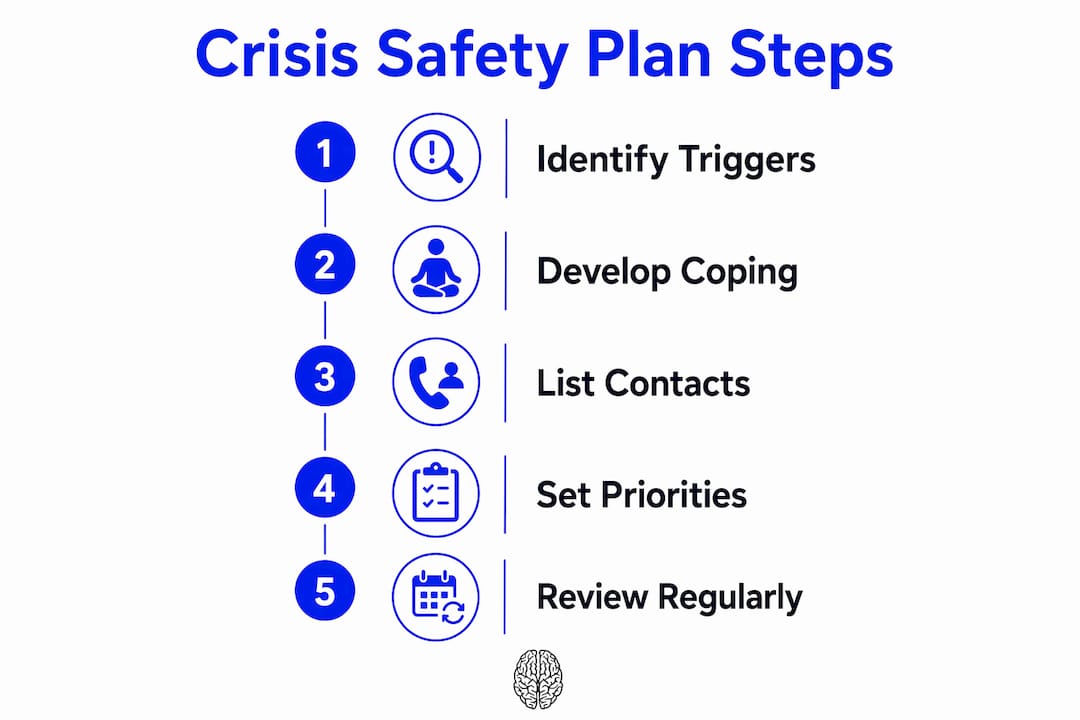
Personalization is not optional. Generic or last-minute plans reduce effectiveness significantly. A plan that does not reflect the individual’s actual triggers, relationships, and coping preferences will be ignored when it matters most.
Follow these steps to build a plan that holds up under pressure:
Identify personal triggers. List specific situations, environments, or thought patterns that have preceded past crises. Be concrete. “Conflict with my supervisor” is more useful than “stress at work.”
List coping strategies that have worked before. Pull from real experience, not theory. If a ten-minute walk has helped in the past, it belongs on the list.
Name specific support contacts. Generic entries like “a friend” do not work. Write full names and phone numbers. Confirm with those people that they are willing to be contacted.
Compile professional resources. Include your therapist’s number, your organization’s Employee Assistance Program, and relevant crisis lines. Verify that numbers are current.
Address means restriction. Identify items in your environment that pose risk and decide, in advance, how to limit access to them.
Involve a trusted professional or colleague. The Safety Planning Intervention model, developed and validated with Veterans at risk for suicide, is built on collaboration. A trained clinician or crisis counselor guides the process, not just a worksheet.
Set a review schedule. Plans must be reviewed every six months or after any significant life change to stay relevant.
Pro Tip: Treat the first draft as a starting point, not a finished product. The plan improves with each review cycle as you learn more about your own patterns.
Organizations developing crisis management strategies for staff or community members should apply the same personalization logic. A workplace safety plan for a healthcare team looks different from one designed for a school counselor. CVPSD’s crisis intervention training helps organizations build plans that fit their specific context and population.

What are the best practices and pitfalls in crisis safety planning?
The most common mistake in crisis safety planning is confusing a safety plan with a no-suicide contract. Safety plans differ fundamentally from no-suicide contracts by offering concrete, collaborative steps rather than placing the entire burden of responsibility on the individual through a promise. Contracts create guilt without providing tools. Plans provide tools without requiring perfection.
A safety plan gives your ‘crisis self’ a roadmap when emotional distress has already impaired your judgment. The plan does the thinking so you don’t have to.
Several other pitfalls consistently undermine plan effectiveness:
Skipping means restriction. Removing access to dangerous items is one of the most evidence-backed risk reduction steps available. Many plans omit it because the conversation feels uncomfortable. That discomfort is worth working through.
Storing the plan only in one place. A plan locked in a filing cabinet or buried in an email folder is useless during a crisis. The plan must be physically accessible.
Treating the plan as finished. Life changes. Contacts move. Coping strategies stop working. A static plan becomes irrelevant.
Creating the plan alone. Collaboration produces better plans. A trusted colleague, clinician, or crisis counselor brings perspective that the individual cannot provide for themselves.
Using vague language. “Call someone” is not a step. “Call Maria at 555-0147” is a step.
The planning process itself carries real value, separate from the document it produces. Working through triggers, coping strategies, and support networks builds self-awareness and a sense of control. That collaborative planning process is empowering in its own right, not just preparatory.
Organizations can review how this plays out in practice through CVPSD’s health and human services case study, which documents how structured crisis planning improved staff confidence and response quality in a real organizational setting.
How do you use and maintain a crisis safety plan in real emergencies?
A safety plan only works if you can find it and follow it when distress is high. Storing the plan accessibly on your phone, in your wallet, or on your bedside table ensures it is available exactly when you need it. Accessibility is not a minor detail. It is a core design requirement.
When a crisis begins, the plan functions as an external guide for a mind that is no longer thinking clearly. The sequence matters. Start at the top of the list and work down. Do not skip to professional contacts before trying internal coping strategies, unless the situation is immediately dangerous.
Practical habits that keep a plan functional over time include:
Review the plan every six months, even when life feels stable. Contacts change, coping strategies evolve, and triggers shift.
Update after any significant life event. A job change, a move, a loss, or a new relationship all affect what the plan should say.
Share the plan with key contacts. The people listed as support contacts should know they are on the plan and understand what that means.
Practice using the plan before a crisis occurs. Reading through it during a calm moment builds familiarity so the steps feel natural under pressure.
Integrate the plan into organizational emergency response frameworks. For teams and institutions, individual safety plans should connect to broader disruptive event management protocols so that personal and organizational responses align.
Pro Tip: Set a recurring calendar reminder every six months labeled “Review safety plan.” Treat it like a fire drill. The review takes 20 minutes and keeps the plan current.
The role of a safety plan in reducing impulsive behavior is well established. When a person in crisis has a written sequence to follow, the plan interrupts the automatic escalation toward harmful action. That interruption creates space for better decisions. For organizations, the same logic applies: a written emergency response plan reduces the likelihood that staff will improvise under pressure in ways that increase risk.
Key takeaways
A crisis safety plan is the single most effective tool for guiding individuals and organizations through high-risk moments, because it replaces impaired judgment with pre-made, personalized decisions.
Point | Details |
Definition and purpose | A crisis safety plan is a prioritized, written guide listing warning signs, coping steps, and contacts ordered from least to most intensive. |
Core components | Effective plans include warning signs, internal coping, social contacts, professional resources, and means restriction. |
Personalization is required | Generic or rushed plans fail; effective plans reflect real triggers, real contacts, and real coping strategies. |
Plans are living documents | Review every six months or after major life changes to keep contacts, strategies, and resources current. |
Accessibility determines use | Store the plan on your phone, in your wallet, or at your bedside so it is available during a crisis. |
Why I think most crisis plans fail before they are ever needed
Most crisis safety plans fail not because the concept is flawed, but because they are created once and never touched again. I have seen organizations invest real effort in developing a plan, file it away, and then discover during an actual crisis that the contact numbers are outdated, the coping strategies no longer fit, and the person in distress has no memory of where the plan is stored.
The planning process is where the real value lives. Sitting with someone and working through their specific triggers, their actual support network, and the concrete steps they will take builds something that a generic worksheet cannot: genuine familiarity with the plan. That familiarity is what makes the plan usable under pressure.
The other pattern I see consistently is the avoidance of means restriction. People know it matters. They skip it anyway because the conversation is uncomfortable. That discomfort is exactly why it needs to happen in a calm, structured setting rather than in the middle of a crisis. Addressing it in advance is an act of care, not an accusation.
For organizations, the integration gap is the biggest problem. Individual safety plans exist in isolation from broader emergency response frameworks. When those two systems connect, the result is a coordinated response that is far more effective than either one alone. CVPSD’s work with schools, nonprofits, and government agencies consistently shows that connected systems outperform siloed ones.
How CVPSD supports crisis safety planning
CVPSD provides evidence-based crisis intervention training for individuals, organizations, schools, and government agencies across the United States.
CVPSD’s programs cover the full arc of crisis preparedness, from identifying early warning signs to building personalized safety plans and integrating them into organizational emergency response frameworks. Training is available in person and online, and every program is designed to meet state and local requirements. Whether you are an individual building your first safety plan or an organization developing workplace violence prevention protocols for your staff, CVPSD offers structured, practical guidance grounded in real-world application. Visit CVPSD’s training programs to learn more about available workshops and resources.
FAQ
What is a crisis safety plan used for?
A crisis safety plan is a written, personalized guide used to help individuals and organizations respond effectively when distress or emergency conditions impair clear thinking. It lists warning signs, coping strategies, support contacts, and professional resources in a prioritized sequence.
How long does it take to create a safety plan?
A thorough safety plan typically takes one to two hours to develop collaboratively with a trained professional. Rushing the process reduces effectiveness, since personalization and genuine buy-in are what make the plan work.
Who should be involved in developing a safety plan?
The individual or team the plan is designed for should lead the process, with support from a trained clinician, crisis counselor, or safety professional. The Safety Planning Intervention model is built on this collaborative approach.
How often should a safety plan be updated?
Safety plans should be reviewed every six months or after any significant life or organizational change. Contacts move, coping strategies evolve, and triggers shift, so a static plan loses relevance over time.
What is the difference between a safety plan and a no-suicide contract?
A safety plan provides concrete, collaborative steps and coping tools. A no-suicide contract relies on a promise alone, without providing actionable guidance. Research consistently supports safety plans as the more effective approach.
Recommended
Navigating the 2026 Shift: Hospital Security and Joint Commission Standards
Crisis De-escalation Guide: Recognizing Behavior Levels and the Right Staff Response at Each Stage
Staff Safety Training - Regulatory And Compliance Crisis Protection For Workplace Teams
Case Study: Enhancing Staff Safety and Confidence in Crisis Management In Health and Human Services


