
What Is a Safe Haven Program for Organizations?

A safe haven program is a structured, organization-wide violence-prevention initiative that pairs a written policy with designated refuge spaces, trained staff, and defined crisis-response procedures. It is not a public shelter service or an infant-surrender law. For a hospital unit, school, or corporate site, the goal is straightforward: reduce the chance of a violent incident, and if one happens anyway, make sure every person on staff knows exactly what to do. The Occupational Safety and Health Administration frames this as a core piece of workplace safety programming, and organizations like CVPSD operationalize it through structured curricula such as START: Skills for Threat Awareness and Risk Reduction Training.
A functioning program produces four immediate outcomes:
A designated refuge approach, where safe spaces work alongside trained personnel rather than as a substitute for them
Staff who can recognize warning signs and de-escalate before a situation turns physical
Written procedures that spell out roles during prevention, response, and recovery
Post-incident support that treats staff well-being as part of the safety outcome, not an afterthought
Key Takeaways
A safe haven program works when written policy, trained staff, and clear crisis procedures operate together, not as three separate initiatives.
Point | Details |
Definition matters | A safe haven program is organizational: policy, hazard analysis, and trained staff, not a public shelter service. |
Staff make the space work | Designated safe rooms only function when paired with trained personnel who know when and how to use them. |
Training needs a cadence | Cornell’s TCIS model recommends initial certification, semiannual drills, and annual checks to prevent skill decay. |
Compliance starts with OSHA | The five WVPP elements, commitment, analysis, controls, training, recordkeeping, form the compliance baseline. |
CVPSD offers a structured path | CVPSD’s START program applies the prevention-preparedness-response-recovery model through assessment and pilot training. |
Table of Contents
Core Components Every Safe Haven Program Needs
A safe haven program is only as strong as its weakest building block. The Joint Commission’s workplace violence prevention guidance describes it as an initiative that integrates policy, multidisciplinary teams, hazard analysis, and staff training into one system. Skip any piece, and the rest weakens.
Start with a written workplace violence prevention policy that names who is accountable and carries visible sign-off from leadership. Without that, staff treat the program as optional.
Designated safe spaces matter, but they only work as part of a behavioral ecosystem. A locked room means little if the people inside it were never trained to recognize when to use it or how to calm a tense situation before it escalates.

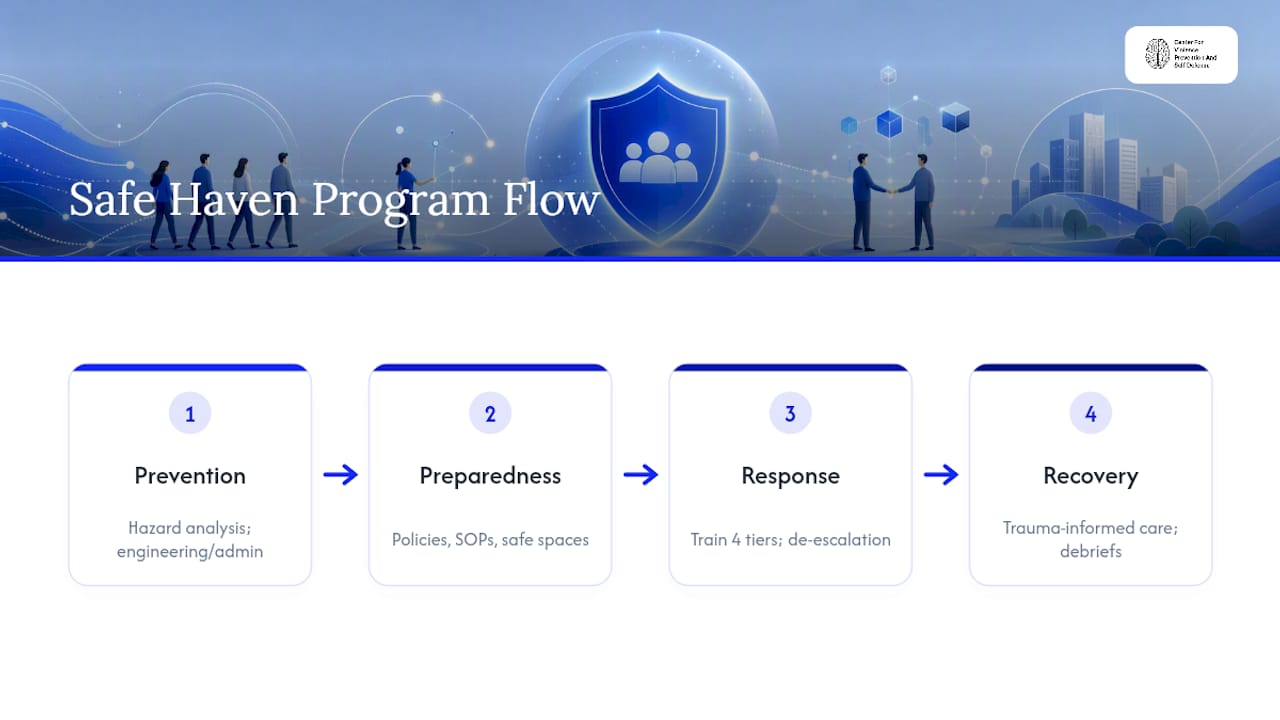
A worksite hazard analysis, walking the physical space and reviewing incident history, tells you where to add engineering controls (locks, sightlines, alarm buttons) and administrative controls (staffing ratios, visitor check-in). From there, build standard operating procedures covering prevention, preparedness, response, and recovery, and train staff across four tiers: general awareness, verbal de-escalation, formal crisis intervention, and, where roles require it, hands-on safety techniques.
Post-incident care closes the loop. Trauma-informed counseling and structured debriefs after an incident protect both the person involved and the colleagues who witnessed it.
Pro Tip: Walk your facility with someone who has never worked there. Fresh eyes catch blind spots, unmonitored entry points, dead-end hallways, that staff have stopped noticing.
Why Does a Safe Haven Program Matter?
Prevention-first framing beats reactive framing every time. Instead of waiting for an incident and then scrambling to respond, a mature program uses incident data and hazard analysis to reduce the conditions that lead to violence in the first place. That shift shows up in fewer incidents, higher staff confidence, and cleaner alignment with regulatory expectations.
Cornell’s TCIS guidance points to a specific failure pattern worth calling out directly: programs that skip leadership involvement and treat training as a single annual event, rather than a coaching process, see faster skill decay and inconsistent response during real incidents. Physical safe rooms without trained staff to use them create a false sense of security. The room does nothing on its own.
How Do You Implement a Safe Haven Program?
Effective programs move through four phases, each with its own deliverables. Research on multi-phase crisis protocols shows that clear role delineation across these phases prevents the diffusion of responsibility that undermines response during an actual crisis.
Prevention. Conduct a worksite hazard analysis covering physical layout, staffing patterns, and past incident reports. Update your written policy based on what you find, and make the fixes that don’t require training, better lighting, controlled entry points, clearer sightlines at reception desks.
Preparedness. Designate your safe spaces and assign specific roles: who activates the response, who communicates with outside emergency services, who checks on affected staff afterward. Set your communication channels (radio, intercom, mass text alert) before you need them, and run your first round of foundational training across all staff.
Response. Define clear activation triggers, what behavior or event starts the response protocol, and map the de-escalation flow step by step. Include safe handoffs to behavioral health specialists or security personnel when a situation exceeds what frontline staff should handle alone. This is where verbal de-escalation techniques do their heaviest lifting: a calm, quiet voice carries more authority than an anxious torrent of instructions.
Recovery. Run an after-action review within days of any incident, not weeks. Offer trauma-informed support to everyone involved, including witnesses. Feed what you learned back into your written policy, and schedule refresher training based on what the incident revealed about gaps in the original plan.
Pro Tip: Build your after-action review template before your first incident, not after. Trying to design a review process while still processing a crisis produces weaker documentation and misses details that matter.
Who Runs the Program, and How Often Should Staff Train?
A safe haven program needs a single point of accountability. A program coordinator with clear authority avoids the confusion that comes from three departments each assuming someone else is handling it. Pair that coordinator with a multidisciplinary steering group, HR, facilities, security, clinical or academic leadership depending on your sector, that owns policy updates and program evaluation.
Trainers themselves need qualification, not just enthusiasm. A train-the-trainer model, where a small group receives advanced certification and then trains their own colleagues, scales faster than bringing in outside instructors for every session, but that model only works if the trainers renew their certification on schedule.
Cornell’s TCIS framework recommends a specific training cadence: initial certification for all staff, semiannual hands-on skill drills, annual knowledge checks, and one-on-one coaching after any real incident. Without that rhythm, skill application decays substantially within six to 12 months, especially for high-risk, patient-facing, or public-facing roles.
Every staff member needs the foundational tier: recognizing warning signs and basic verbal de-escalation. Specialized roles, security, behavioral health staff, front-desk personnel in high-traffic areas, need advanced modules layered on top. Skipping the foundational tier for “low-risk” staff is a common shortcut that backfires the first time an incident happens outside a predictable location.
Aligning Your Program With Legal and Compliance Requirements
OSHA’s model workplace violence prevention program outlines five core elements: management commitment, worksite analysis, hazard prevention and control, training, and recordkeeping. Building your safe haven program around these five elements gives you a defensible structure if your practices are ever reviewed.
Some states go further. Cal/OSHA’s model plan specifies additional detail, naming who implements the plan, requiring employee involvement, and setting record retention periods. Verify your own state and sector requirements before finalizing your policy language.
A few practices protect you regardless of jurisdiction:
Document every incident, near miss, and corrective action, not just the serious ones
Keep investigation records separate from disciplinary files to avoid chilling reporting
Build anti-retaliation language into your policy so staff report incidents without fear
Loop in legal counsel or risk management before finalizing policy language tied to termination or law enforcement involvement
Measuring Whether the Program Is Actually Working
Numbers tell part of the story. Track incident counts and severity over time, training completion rates, drill performance, and response times from activation to resolution. A program with high training completion but declining drill performance usually points to a coaching gap, not a training gap.
Qualitative signals matter just as much. Staff confidence surveys, run before and after training cycles, and post-incident feedback surface problems that raw counts miss entirely. A location with zero reported incidents might have excellent prevention, or it might have a reporting culture that discourages disclosure.
After-action reviews should feed a root-cause process, not just a checklist. When an incident happens, ask what condition (staffing, layout, missed warning sign) allowed it, and update your written policy accordingly. Guidance for healthcare and social-service settings treats program evaluation as a required, recurring element, not a one-time audit.
Track incident counts, severity, and response time as your quantitative baseline
Run pre- and post-training confidence surveys to catch what numbers miss
Feed every after-action review into a policy update, not a filing cabinet
How CVPSD Applies the Safe Haven Model in Practice
CVPSD built START: Skills for Threat Awareness and Risk Reduction Training around the same four-phase structure this guide describes: prevention, preparedness, response, and recovery. As a 501©(3) nonprofit, CVPSD’s mission centers on evidence-based education rather than product sales, which shapes how the curriculum gets built and revised.
One recommendation worth repeating from Cornell’s TCIS research: including leadership in hands-on training creates shared risk and keeps programs from quietly lapsing after year one. Recurring drills and post-incident coaching, not a single kickoff seminar, are what sustain a program’s effectiveness over time.
Ready to Assess Your Organization’s Safe Haven Readiness?
CVPSD is the training partner for organizations that want a program built on evidence, not a generic slide deck. Before reaching out, gather three things: your key stakeholders (safety, HR, facilities, leadership), any existing violence-prevention policy, and your incident logs from the past year, even informal ones.
A CVPSD engagement typically starts with a facility and policy assessment, moves into pilot training for a designated group of staff, and closes with an evaluation that shapes your ongoing training calendar. If your safe spaces need basic first-aid supplies as part of the setup, organizations sourcing donated medical supplies can often equip these areas at lower cost than a full retail purchase. For a curriculum that already maps to the workplace violence prevention plan structure your organization needs, contact CVPSD to schedule an initial assessment.
Sources
Workplace violence prevention program (Joint Commission resource)
Multi-phase crisis protocols for educational and social service organizations (PMC article)
Workplace violence - Overview | Occupational Safety and Health Administration
TCIS system guidance for trauma-informed crisis intervention (Cornell RCCP)
FAQ
What Is a Safe Haven Program in Simple Terms?
It is an organizational violence-prevention system combining written policy, designated safe spaces, and staff trained in de-escalation and crisis response, distinct from social-service shelter programs.
How Often Should Staff Retrain on Safe Haven Procedures?
Cornell’s TCIS guidance recommends initial certification followed by semiannual skill drills and annual knowledge checks, with additional coaching after any real incident.
Who Should Be on a Safe Haven Program Team?
A single program coordinator with clear authority, paired with a multidisciplinary steering group covering HR, facilities, security, and leadership, prevents diffusion of responsibility during a crisis.
Does OSHA Require a Written Workplace Violence Policy?
OSHA recommends a written policy as part of its model program, covering management commitment, hazard analysis, controls, training, and recordkeeping, though specific state requirements like Cal/OSHA’s may add detail.
How Does CVPSD’s START Program Fit Into a Safe Haven Model?
CVPSD’s START program is built around the same prevention, preparedness, response, and recovery structure this guide describes, delivered through assessment, pilot training, and ongoing evaluation.
Recommended


