
What Is Conflict Resolution? Principles and Techniques


Conflict resolution is defined as an episodic process in which parties identify a dispute, apply structured methods such as negotiation or mediation, and secure commitment to a mutually acceptable outcome. This definition, recognized by the Harvard Program on Negotiation and organizational psychology researchers alike, separates true resolution from simply reducing tension. Reducing tension means the conflict quiets down. Resolution means the relationship can move forward. Understanding conflict resolution at this level gives you a practical foundation for managing disagreements in personal, workplace, and community settings with calm authority and clear purpose.
What is conflict resolution, and why does it matter?
Conflict resolution is the structured process of ending a dispute so that all parties can commit to a new direction. The key word is “commit.” Without genuine commitment from everyone involved, a resolved conflict is just a paused one. The three core components are identifying the conflict clearly, applying a method suited to the situation, and reaching an agreement all parties accept.
Most people treat conflict as something to survive rather than something to solve. That instinct leads to avoidance, which organizational psychology research consistently links to poorer outcomes for both relationships and performance. Effective conflict management requires a different mindset: conflict is a solvable problem, not a personal attack. When you approach it that way, the process becomes far less threatening.
The stakes are real. Unresolved interpersonal disputes erode trust, reduce productivity, and create cycles of resentment. Resolved ones, handled well, often produce stronger relationships than existed before the disagreement. That is the core argument for investing in conflict resolution skills.

What are the main methods of conflict resolution?
Three primary formal methods structure most dispute resolution processes: negotiation, mediation, and arbitration. They differ most significantly in how much control the disputing parties retain over the outcome.
Method | Control level | Key feature | Typical use |
Negotiation | Highest | Direct, flexible dialogue between parties | Everyday disputes, contracts, workplace issues |
Mediation | Moderate | Neutral facilitator guides the process | Family, workplace, community disputes |
Arbitration | Lowest | Neutral party issues a binding decision | Legal, labor, commercial disputes |
Negotiation is the most common starting point. Parties speak directly, propose solutions, and adjust positions without outside involvement. Its flexibility makes it the preferred first step in most interpersonal and professional conflicts.
Mediation brings in a neutral third party who facilitates dialogue but does not decide the outcome. The mediator’s role is to help each side hear the other clearly and identify shared interests. This method works well when direct communication has broken down but both parties still want a voluntary resolution.
Arbitration functions more like a private court. A neutral arbitrator hears both sides and issues a binding decision. Parties give up control of the outcome in exchange for a definitive resolution. This method suits disputes where voluntary agreement has failed and a final answer is needed.
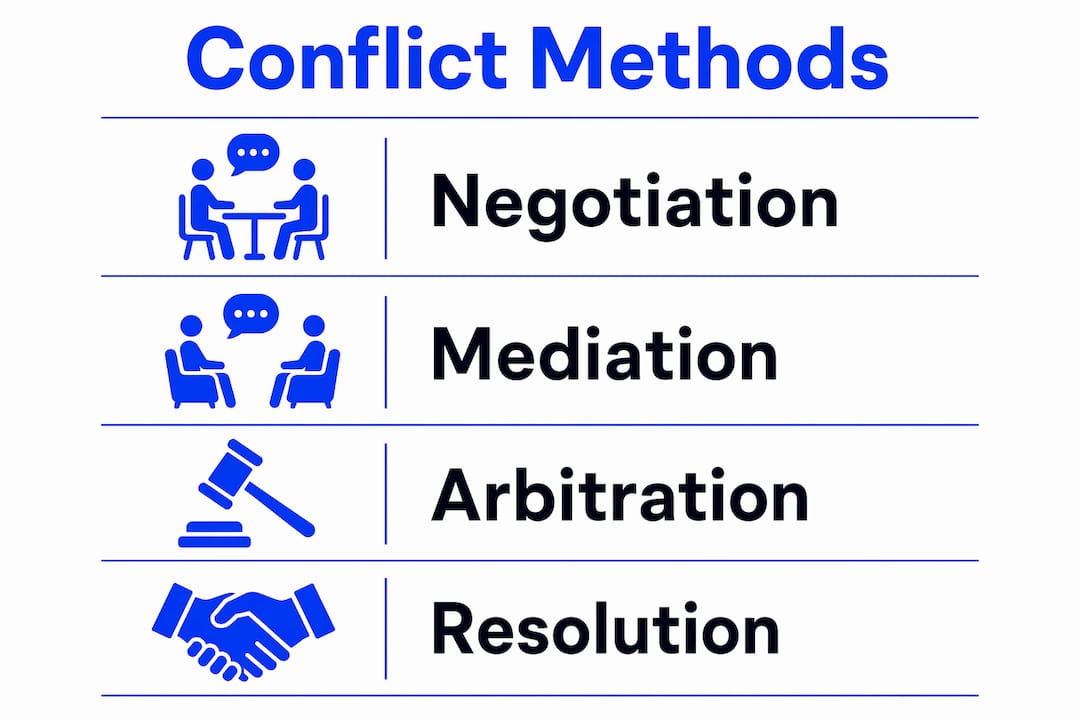
Pro Tip: Try negotiation first. Move to mediation only when direct dialogue stalls. Reserve arbitration for situations where a binding decision is the only path forward.
What are common conflict management styles?
Conflict management styles describe how individuals habitually respond to disagreement. Organizational psychology identifies five primary styles: problem solving, avoiding, competing, accommodating, and compromising.
Problem solving (also called collaborating): Both parties work together to find a solution that fully meets everyone’s needs. Research links this style to the highest employee performance outcomes.
Avoiding: One or both parties withdraw from the conflict without resolution. This style consistently correlates with poorer outcomes and unresolved tension.
Competing (also called forcing): One party pursues their own goals at the expense of the other. It can resolve disputes quickly but damages relationships.
Accommodating (also called yielding): One party gives in to preserve the relationship. Useful occasionally, but chronic accommodation erodes self-respect and breeds resentment.
Compromising: Both parties give up something to reach a middle ground. It is faster than problem solving but produces less durable outcomes because neither party’s core needs are fully met.
Problem solving yields more enduring outcomes than compromising because it integrates both sides’ needs rather than splitting the difference. Compromising requires mutual sacrifice. Problem solving requires mutual creativity.
No single style fits every situation. A skilled conflict manager reads the context and adjusts. Competing may be appropriate when a quick, firm decision protects safety. Accommodating may be right when the relationship matters more than the specific outcome. The goal is strategic flexibility, not rigid consistency.
Pro Tip: Identify your default conflict style before a dispute arises. Most people default to avoiding or competing under stress. Knowing your pattern lets you choose a more effective response deliberately.
What psychological principles underpin effective conflict resolution?
Effective conflict resolution depends as much on psychology as on process. Three principles shape nearly every successful resolution.
Manage egocentrism. Fairness is subjective, shaped by each person’s perspective and cognitive biases. Each party genuinely believes their position is the fair one. Arguing about who is objectively right escalates disagreement. Focusing instead on each party’s perceived constraints and interests moves the conversation toward resolution.
Practice active listening. Successful negotiators focus on the interests beneath stated positions, not just the demands themselves. A coworker who insists on a specific schedule may actually need predictability for childcare. A neighbor who objects to noise may actually need to feel respected. Active listening uncovers those underlying needs. When people feel genuinely heard, their defensiveness drops and problem solving becomes possible. You can build this capacity through relationships and rapport long before a conflict erupts.
Regulate your emotions. Emotional self-regulation and stress management are foundational skills for managing conflict effectively. Maintaining calm and reading nonverbal cues builds trust and keeps the conversation focused on the real issues. When emotions spike, the brain’s fight-or-flight response takes over and rational problem solving shuts down.
“Managing emotions and reading nonverbal signals are as important as verbal negotiation skills in conflict resolution. A calm, steady presence communicates safety and invites the other person to lower their guard.”
A fourth principle worth adding: know your BATNA. BATNA awareness, your Best Alternative to a Negotiated Agreement, gives you a clear reference point for evaluating any proposed solution. When you know what you will do if no agreement is reached, you make less emotional decisions at the table. You can assess whether a proposed deal is actually better than your alternative, rather than accepting poor terms out of anxiety.
How can you apply conflict resolution strategies every day?
Conflict resolution techniques are not reserved for formal disputes or legal proceedings. They apply directly to workplace disagreements, family tensions, neighbor conflicts, and community friction. The following steps translate the principles above into practical action.
Define the conflict clearly before engaging. Write down what the actual disagreement is, separate from your emotional reaction to it. Vague conflicts produce vague conversations. A specific, defined problem is solvable.
Choose the right moment. Attempting resolution when either party is highly stressed or emotionally flooded rarely works. Remaining calm under pressure is a skill you can practice, and timing your conversation for a calmer moment dramatically improves outcomes.
State your interests, not your position. Say “I need reliable communication about schedule changes” rather than “You always cancel at the last minute.” Interests invite problem solving. Positions invite argument.
Look for shared interests. Most conflicts contain at least one goal both parties share. Finding it creates common ground and shifts the dynamic from adversarial to collaborative.
Stay flexible on outcomes. The solution you imagined at the start may not be the best one. Openness to creative alternatives is what separates problem solving from competing.
Know when to bring in a third party. If direct dialogue has stalled after genuine effort, mediation is not a sign of failure. It is a practical tool. Avoiding power struggles sometimes means recognizing when you need outside help.
Pro Tip: Before any difficult conversation, spend two minutes writing down what the other person’s perspective might be. This single habit activates empathy and reduces the instinct to correct rather than understand.
The most common mistake in conflict is trying to correct the other’s thinking instead of understanding their underlying interests. Correction triggers defensiveness. Understanding opens dialogue. That shift in approach is where most conflict resolution success or failure is decided.
Key Takeaways
Conflict resolution succeeds when parties identify the dispute clearly, apply the right method, and commit to a solution that addresses each side’s underlying interests.
Point | Details |
Resolution requires commitment | A paused conflict is not a resolved one; all parties must genuinely agree to move forward. |
Match method to situation | Use negotiation first, mediation when dialogue stalls, and arbitration only when a binding decision is necessary. |
Problem solving outperforms compromise | Integrating both sides’ needs produces more durable outcomes than splitting the difference. |
Egocentrism distorts fairness | Focus on each party’s perceived interests rather than debating who is objectively right. |
BATNA grounds your decisions | Knowing your best alternative prevents emotional concessions and clarifies the real value of any proposed deal. |
Conflict as a skill, not a crisis
I have spent years working alongside people who treat conflict as proof that something has gone wrong. The truth I keep returning to is the opposite. Conflict is proof that two people or groups care enough about something to push back. The problem is never the conflict itself. The problem is the absence of skill to work through it.
Conflict-intelligent leaders see disagreement as a source of better decisions and genuine innovation, not just a problem to eliminate. I have watched that perspective transform teams. When people know their leader will handle conflict with fairness and calm, they raise concerns earlier, before small tensions become serious ruptures.
The hardest part is emotional regulation. Not because it is complicated, but because it requires practice under pressure. Reading nonverbal cues, staying grounded when someone raises their voice, and resisting the urge to win the argument rather than solve the problem. These are learnable skills. How you view people in conflict shapes every outcome before a single word is spoken. Approach others as adversaries and the conversation becomes a contest. Approach them as people with legitimate needs and the conversation becomes solvable.
The most effective conflict managers I know are not the ones who never get angry. They are the ones who know what to do with that anger before it runs the conversation.
Cvpsd training for real-world conflict resolution
Cvpsd, the Center for Violence Prevention and Self-Defense, is a 501©(3) non-profit that delivers evidence-based training in de-escalation, crisis intervention, and conflict management to individuals, schools, nonprofits, and government agencies.
Cvpsd’s programs combine online and in-person formats, giving you practical conflict resolution skills you can apply immediately in personal and professional settings. Training covers behavior analysis, de-escalation techniques, and limit-setting strategies grounded in current research. Whether you are managing interpersonal disputes at work or supporting a community organization, Cvpsd provides the structured skill development that makes a measurable difference. Visit Cvpsd’s training programs to learn more and find a program suited to your needs.
FAQ
What is conflict resolution in simple terms?
Conflict resolution is the process of ending a disagreement by identifying the issue, applying a structured method such as negotiation or mediation, and reaching an outcome all parties commit to.
What are the three main conflict resolution techniques?
The three primary techniques are negotiation, mediation, and arbitration. They differ in how much control the parties retain, with negotiation offering the most and arbitration the least.
What are conflict resolution skills?
Conflict resolution skills include active listening, emotional self-regulation, identifying underlying interests, and knowing when to involve a neutral third party. These skills apply across personal, workplace, and community disputes.
Which conflict management style is most effective?
Problem solving is the most effective style for long-term outcomes. It integrates both parties’ needs and produces more durable agreements than compromising, avoiding, or competing.
What is BATNA and why does it matter in conflict resolution?
BATNA stands for Best Alternative to a Negotiated Agreement. Knowing your BATNA helps you evaluate proposed solutions clearly and avoid accepting unfavorable terms out of pressure or anxiety.
Recommended

About the Author: William DeMuth is the Director of Training at the Center for Violence Prevention and Self Defense (CVPSD) in Freehold, NJ. With over 35 years of research in violence dynamics and personal safety, William specializes in evidence-based training that bridges the gap between compliance and real-world conflict resolution. The architect of the ConflictIQ™ program, he holds advanced certifications and has trained under diverse industry leaders. Today, he actively trains civilians, healthcare workers, and corporate teams in situational awareness, threat assessment, behavior analysis, de-escalation strategies, and physical tactics.


