
Why Violence Prevention Education Matters for Communities


Violence prevention education is defined as a structured approach that equips individuals with the knowledge, skills, and awareness to recognize, reduce, and respond to violent behavior before it escalates. The importance of violence prevention reaches far beyond individual safety. 58% of children in the Americas experience abuse annually, totaling 99 million children. That scale confirms violence is a public health crisis, not a personal failing. Educators, parents, and community leaders who understand this reality are positioned to act on it. Cvpsd, a 501©(3) non-profit, delivers evidence-based training that translates this understanding into life-saving skills for at-risk communities across the country.
Why violence prevention education matters for reducing violent behavior
Education directly reduces violence. Each additional year of schooling reduces violent crime conviction rates by 10% in Sweden, and a 10% increase in per-pupil spending in the U.S. cuts youth arrests by 7.4 per 1,000 for ages 15–19. These numbers show that investing in education is investing in public safety.
The public health field frames violence prevention through three levels: primary prevention stops violence before it starts, secondary prevention targets those at elevated risk, and tertiary prevention supports survivors and reduces repeat harm. This tripartite model treats violence the way medicine treats disease: with layered, proactive intervention rather than reactive punishment alone. That shift in framing changes what educators and community leaders prioritize.
School-based programs produce measurable results at the secondary level. A meta-analysis of 13 studies confirms that school-based educational interventions reduce adolescent dating violence significantly. Healthy relationship curricula and bystander training teach students to interrupt harmful patterns before they become habits. High-quality early childhood education also reduces the risk of serious fighting in adolescence and early adulthood, with documented intergenerational benefits among Black and Hispanic/Latino males. Early investment compounds over time.
School-based bystander training reduces peer violence by teaching students to intervene safely.
Healthy relationship curricula address dating violence before patterns solidify.
Early childhood programs interrupt cycles of violence across generations.
Increased per-pupil spending correlates with measurable drops in youth arrests.
Pro Tip: When advocating for violence prevention programs in your school or organization, cite the per-pupil spending data from UNESCO. Budget conversations shift when decision-makers see a direct link between education funding and reduced arrest rates.
What are the key components of effective violence prevention programs?
Effective violence prevention programs share a common architecture. They combine social-emotional learning (SEL), conflict resolution training, trauma-informed discipline, and continuous staff development. No single element works in isolation.

SEL teaches students to identify emotions, manage reactions, and build healthy relationships. These are not soft skills. They are the cognitive tools that prevent conflict from escalating into violence. Conflict resolution training gives students a structured process for disagreement, reducing the likelihood that frustration becomes physical harm.
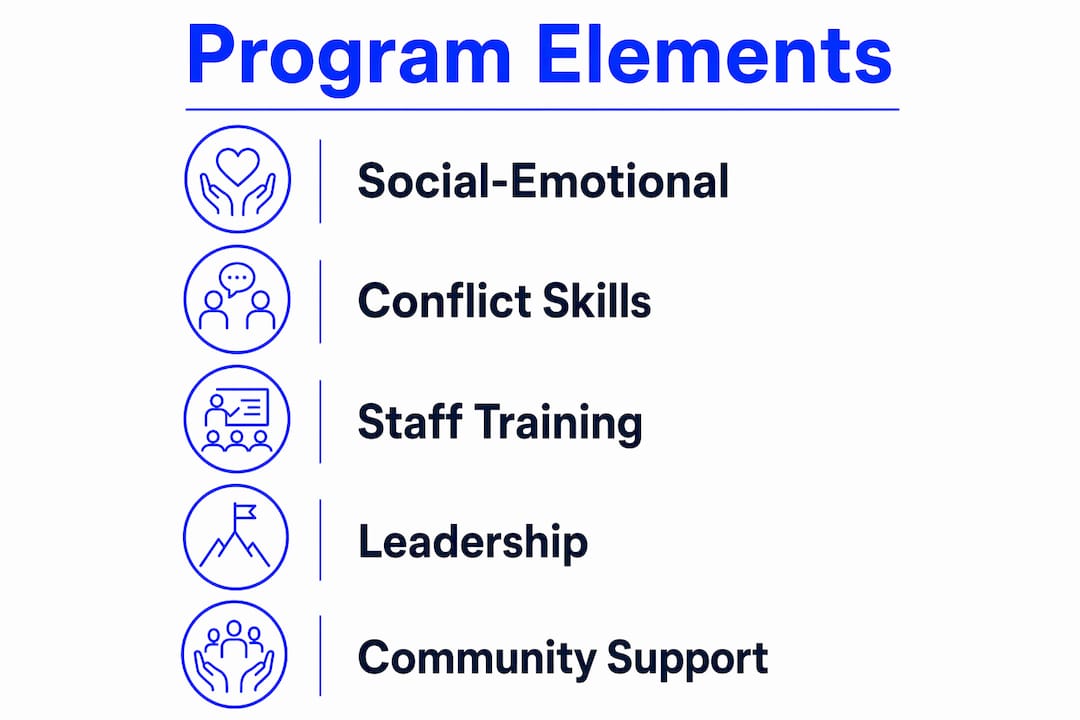
Trauma-informed interventions, such as predictable routines and reduced exclusionary discipline, positively impact school violence outcomes and overall student well-being. Exclusionary discipline, including suspensions and expulsions, removes students from the protective environment of school and increases their exposure to risk. Replacing punitive responses with restorative practices keeps students connected to supportive adults and structured learning.
Effective programs follow a clear sequence:
Assess the school climate. Identify existing risk factors, student needs, and staff readiness before selecting a curriculum.
Integrate SEL into daily instruction. Embed conflict resolution and emotional regulation skills across subjects, not just in dedicated lessons.
Train all staff, not just counselors. Teachers, administrators, and support staff all need shared language and consistent responses.
Implement trauma-informed discipline policies. Replace zero-tolerance rules with graduated, restorative responses.
Evaluate and adjust continuously. Use student data and staff feedback to refine the program each semester.
Staff training is the element most often underinvested. Ongoing refreshers, policy support, and leadership commitment are essential for effective violence prevention education. A one-time training session does not build a safety culture. Sustained coaching does.
Pro Tip: Ask your school or organization’s leadership to schedule quarterly violence prevention refreshers, not just annual ones. Behavior change requires repetition, and staff confidence grows with each practice session.
How does violence in educational settings affect learning and well-being?
Violence in schools does not stay at the door of the classroom. It enters with every student and educator who has experienced or witnessed it. Approximately 80% of teachers report some form of violence experience. That figure reframes teacher retention as a violence prevention issue.
Students exposed to violence show reduced concentration, higher absenteeism, and lower academic achievement. The connection is physiological. Chronic stress activates the fight-or-flight response, which redirects cognitive resources away from learning and toward survival. A student who does not feel safe cannot focus on reading or math.
Impact Area | Effect of Violence Exposure |
Student concentration | Reduced attention span and working memory |
Attendance | Higher absenteeism and school avoidance |
Academic outcomes | Lower test scores and graduation rates |
Teacher well-being | Increased burnout, anxiety, and turnover |
School climate | Erosion of trust between students and staff |
“All forms of violence in education negatively affect learning outcomes, attendance, and teacher well-being. Safe school environments are not a luxury. They are the foundation on which all academic success is built.”
Teacher well-being and student safety are inseparable. When educators feel unsafe, they disengage, reduce risk-taking in their instruction, and eventually leave the profession. Schools that invest in violence prevention training retain staff longer and maintain more consistent learning environments for students.
What role do parents and community leaders play in violence prevention?
Parents and community leaders are not supplementary to violence prevention education. They are central to it. Programs designed without community input tend to miss the cultural context that makes training relevant and trusted. Co-production with communities, rather than top-down imposition, produces programs that people actually use.
Structural factors such as inequality and toxic cultural norms must be addressed alongside educational efforts to successfully reduce violence. A school program cannot fully counteract the effects of poverty, housing instability, or community-level trauma without broader support. Community leaders who address these root causes amplify the impact of school-based efforts.
Practical strategies for parents and community leaders include:
Attend school board meetings and advocate for SEL curriculum adoption.
Participate in parent training sessions on recognizing early warning signs of violence.
Partner with local healthcare providers and social services to create referral pathways for at-risk families.
Support community outreach programs that address inequality and provide economic opportunity.
Champion restorative justice initiatives that keep young people connected to school and community.
Community partnerships outside schools, including healthcare and social services, improve early recognition and prevention of violence in at-risk populations. Scotland’s public health approach demonstrated this clearly. Nearly two thirds of all violence there concentrated in 1% of the population, with poverty, unstable families, and lack of education as primary risk factors. Integrating schools, healthcare, and social services into a unified prevention network produced results that no single institution could achieve alone.
Understanding underserved victims in at-risk communities also helps community leaders design outreach that reaches those most often overlooked by standard programs.
Pro Tip: If you lead a community organization, map your local service providers before launching a violence prevention initiative. Knowing who offers mental health support, housing assistance, and legal aid lets you build referral networks that extend your program’s reach without duplicating effort.
Key Takeaways
Violence prevention education reduces violent behavior, protects learning environments, and strengthens communities when it combines evidence-based curricula, trauma-informed practices, sustained staff training, and genuine community involvement.
Point | Details |
Education reduces crime | Each additional year of schooling cuts violent crime conviction rates by 10%, per UNESCO data. |
Trauma-informed practices work | Predictable routines and restorative discipline improve school safety and student well-being. |
Teacher exposure is widespread | 80% of teachers report experiencing violence, making staff training a retention and safety priority. |
Community involvement is essential | Programs co-designed with communities outperform top-down interventions in reach and effectiveness. |
Training must be ongoing | One-time sessions do not build safety culture; quarterly refreshers and leadership support are required. |
Violence prevention education requires more than good intentions
I have worked alongside educators, social workers, and community leaders long enough to know the most common mistake in violence prevention: treating it as an event rather than a culture. A school brings in a trainer for a Friday afternoon session, checks the box, and moves on. Six months later, staff cannot recall the key de-escalation steps, and the school climate has not changed.
The programs that actually work share one quality. Leadership treats violence prevention as a permanent operating standard, not a response to a recent incident. That means budget lines for annual refreshers, clear policies that back up trained staff when they use de-escalation instead of punitive force, and administrators who model the calm, non-threatening communication they ask of their teachers.
Reaching vulnerable populations requires cultural humility. A curriculum designed for one community may land poorly in another. The language, the examples, the facilitators themselves all carry weight. Cvpsd’s approach to workforce violence prevention reflects this. Training is adapted to the specific environment, whether that is a school, a healthcare facility, or a social services office.
The educators and community leaders who champion trauma-informed approaches are not just preventing individual incidents. They are shifting the conditions that allow violence to persist. That is harder work than a single training day. It is also the only work that lasts.
Cvpsd’s violence prevention training programs for schools and communities
Cvpsd delivers evidence-based violence prevention education to schools, nonprofits, healthcare organizations, and government agencies across New Jersey, New York, and Pennsylvania. Programs cover Crisis Intervention Techniques, De-escalation Solutions, Behavior Analysis, and Physical Self-Defense, all adapted to the specific environment and population being served.
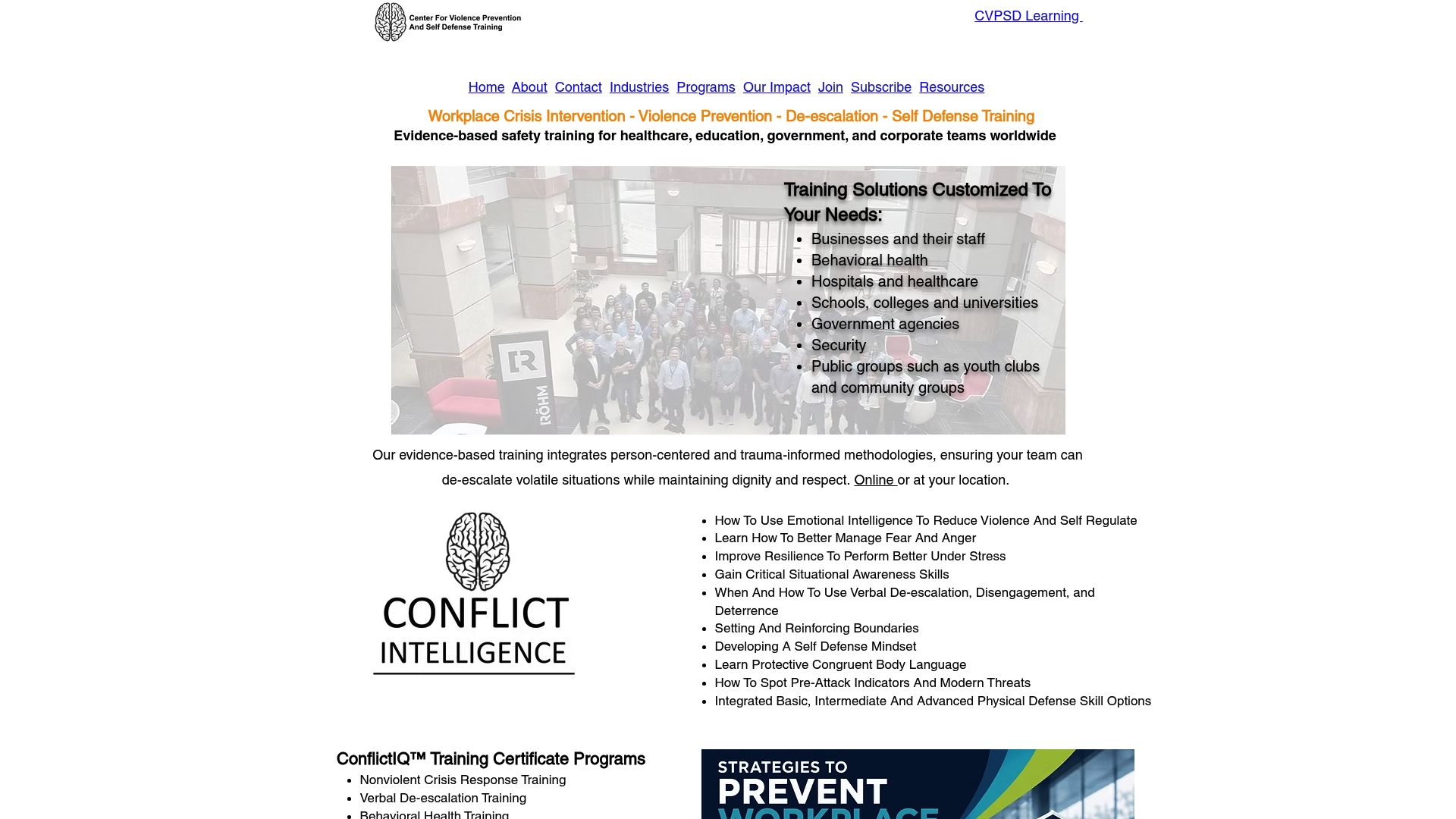
Staff who complete Cvpsd’s violence prevention certificate program gain practical skills they can apply immediately, along with the confidence to manage escalating situations safely. Certification also signals organizational commitment to safety, which supports staff retention and community trust. Cvpsd’s training meets state and local legal requirements and is available in both online and in-person formats. Visit cvpsd.org to review current programs and request training for your school or organization.
FAQ
What is violence prevention education?
Violence prevention education is a structured program that teaches individuals to recognize, avoid, and respond to violent behavior through skills like de-escalation, conflict resolution, and social-emotional learning. It operates across primary, secondary, and tertiary prevention levels.
How effective are school-based violence prevention programs?
School-based programs are well-supported by research. A meta-analysis of 13 studies confirms they reduce adolescent dating violence significantly, and each additional year of schooling reduces violent crime conviction rates by 10%.
Why does violence prevention certification matter for staff?
Certification trains staff to recognize early warning signs of behavioral escalation and respond safely, reducing injuries and building a consistent safety culture across an organization.
How can parents support violence prevention in schools?
Parents can attend school board meetings to advocate for SEL curricula, participate in parent training sessions, and connect with local healthcare and social services to build support networks for at-risk families.
What makes a violence prevention program trauma-informed?
A trauma-informed program replaces punitive discipline with restorative practices, uses predictable routines to create psychological safety, and trains all staff to recognize how trauma affects student behavior and learning.
Recommended

About the Author: William DeMuth is the Director of Training at the Center for Violence Prevention and Self Defense (CVPSD) in Freehold, NJ. With over 35 years of research in violence dynamics and personal safety, William specializes in evidence-based training that bridges the gap between compliance and real-world conflict resolution. The architect of the ConflictIQ™ program, he holds advanced certifications and has trained under diverse industry leaders. Today, he actively trains civilians, healthcare workers, and corporate teams in situational awareness, threat assessment, behavior analysis, de-escalation strategies, and physical tactics.


