
Why Workplace Self-Defense Training Matters

Updated: Jul 30

Workplace self-defense training is the proactive development of skills and knowledge that enables employees to recognize threats, de-escalate conflict, and respond effectively to violence in their work environment. Why workplace self-defense training matters becomes clear when you consider that workplace violence costs the U.S. economy approximately $121 billion annually. That figure, tracked by the National Institute for Occupational Safety and Health (NIOSH), reflects lost productivity, medical costs, legal fees, and turnover. OSHA classifies workplace violence as a recognized occupational hazard, and CVPSD delivers evidence-based programs that address it directly through Crisis Intervention Techniques, De-escalation Solutions, and Physical Self-Defense skills.
Why workplace self-defense training matters for employees and employers
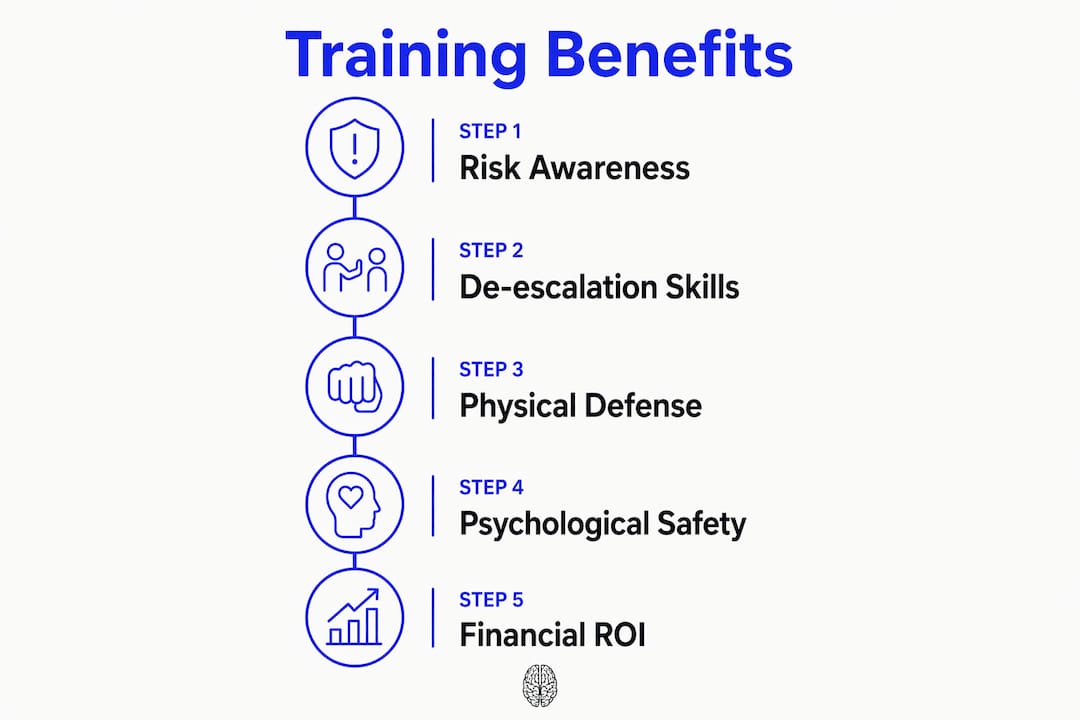
The benefits of workplace safety training extend well beyond physical protection. Employees who complete structured self-defense programs gain situational awareness, conflict de-escalation skills, and the confidence to act calmly under pressure. These are not abstract qualities. They translate into measurable outcomes for individuals and organizations alike.
Psychological safety is one of the most underappreciated returns. Employees working in psychologically safe environments are 72% more motivated than those who feel less secure at work. Higher motivation connects directly to lower absenteeism, stronger team cohesion, and better customer interactions. When employees know their organization has invested in their protection, trust in leadership increases.

The financial case is equally strong. Proactive safety programs return $4 to $6 for every $1 spent through reduced workers’ compensation and insurance costs. Preventable workplace injuries cost U.S. employers $181.4 billion annually. Training that prevents even a single serious incident can offset its cost many times over.
Key benefits of self-defense programs at work include:
Situational awareness: Employees learn to identify pre-attack indicators and environmental risk factors before a situation escalates.
De-escalation skills: Verbal and non-verbal techniques reduce the likelihood of physical confrontation.
Physical response capability: When de-escalation fails, employees have practiced, proportionate responses.
Reduced attrition: Improved safety culture drops attrition risk from 12% to under 3%.
Legal preparedness: Documented training participation strengthens an organization’s legal standing after an incident.
Pro Tip: Pair self-defense training with a clear incident reporting policy. Employees who know how to report threats early create a feedback loop that prevents escalation before physical skills are ever needed.
How does effective training differ from generic safety programs?
Generic safety programs fail in two predictable ways. They cover too much ground without depth, and they lack legal defensibility. A one-size-fits-all online module on “workplace safety” does not prepare a hospital receptionist for an agitated patient the same way a tailored program does. Effective workplace self-defense requires training that addresses specific organizational environments and is legally informed.
Customization starts with local incident data. A retail environment faces different threat profiles than a government office or a school. Employers should prioritize program customization based on that data and on the actual needs of their workforce. Off-the-shelf programs cannot account for shift patterns, physical layout, or the specific populations employees interact with daily.
Legal defensibility is a separate but equally important concern. Documented training participation strengthens legal standing in self-defense incidents by demonstrating that the organization acted responsibly. Courts look at whether training was specific, documented, and proportionate to the known risk. Generic programs rarely meet that standard.
Effective training also combines three distinct elements:
Knowledge acquisition: Understanding legal use of force, threat recognition, and organizational policy.
Skill development: Practicing de-escalation scripts, physical techniques, and emergency protocols in realistic scenarios.
Regular reinforcement: Repeating training at intervals to maintain proficiency and update content as threats evolve.
Pro Tip: Ask any training provider for a sample curriculum and a list of the legal standards their program references. If they cannot produce both, the program is not ready for your workplace.
What practical steps can employers take to implement self-defense programs?
Implementation works best when it follows a structured sequence. Skipping steps, particularly the assessment phase, leads to programs that feel disconnected from real workplace conditions.
Conduct a formal risk assessment. Identify high-risk locations, shifts, and employee roles. Use incident logs, near-miss reports, and employee surveys to build an accurate threat picture.
Establish confidential reporting channels. Employees will not report early warning signs if they fear retaliation or embarrassment. Anonymous reporting systems increase the volume and quality of threat intelligence.
Select qualified trainers. Look for instructors with backgrounds in law enforcement, crisis intervention, or occupational safety. Verify that their curriculum meets state and local legal standards. CVPSD’s workplace violence prevention training for frontline workers is one example of a program built around these criteria.
Customize the curriculum. Map training content to your specific environment, workforce demographics, and incident history. A hospital, a school, and a corporate office each need different scenarios and response protocols.
Reinforce training through communication. OSHA’s Safety Champions Program identifies ongoing communication as a core safety element. Monthly briefings, posted reminders, and manager check-ins keep skills active between formal sessions.
Measure outcomes. Track incident rates, near-miss reports, employee confidence scores, and workers’ compensation claims before and after training. These metrics demonstrate ROI and guide future curriculum adjustments.
California’s workplace violence prevention law, effective since july 2024, mandates risk assessments, confidential reporting, and documented follow-up as legal requirements. Other states are moving in the same direction. Building these steps into your program now positions your organization ahead of regulatory change.
Implementation step | Primary outcome |
Formal risk assessment | Identifies specific threats and high-risk roles |
Confidential reporting system | Increases early warning intelligence |
Qualified trainer selection | Ensures legal compliance and skill accuracy |
Curriculum customization | Aligns training with actual workplace conditions |
Ongoing communication | Maintains skill retention between formal sessions |
Outcome measurement | Demonstrates ROI and guides program improvement |
What are common misconceptions about workplace self-defense training?
The most persistent misconception is that self-defense training is primarily about fighting. Physical response is the last resort in any well-designed program. The majority of training time covers threat recognition, situational awareness, verbal de-escalation, and safe exit strategies. Physical techniques occupy a small portion of a complete curriculum.
A second misconception is that realistic training will traumatize employees. Employers should avoid gratuitously graphic content while still delivering specific, effective preparation. The goal is realism without unnecessary distress. Scenario-based exercises can be calibrated to the audience. A group of healthcare workers needs different scenarios than a group of security personnel, and skilled instructors adjust accordingly.
The third misconception concerns legal liability. Some employers fear that training employees in physical self-defense increases their exposure to lawsuits. The opposite is true. Documented training creates a record of responsible action. Courts consistently view documented, proportionate training as evidence of duty of care, not as an admission of anticipated violence.
“Workplace violence requires the same sustained, proactive attention as slip-and-fall prevention. Treating it as a rare or unpredictable event, rather than a structural feature of modern workplaces, is the most dangerous misconception of all. Organizations that wait for an incident to occur before investing in training pay a far higher price, in human and financial terms, than those that prepare in advance.”
Finally, “see something, say something” campaigns are not a substitute for structured training. General awareness messaging raises consciousness but does not build the specific skills employees need to act effectively under stress. Workplace violence is a structural feature of modern labor markets. It requires sustained, proactive training, not reactive messaging.
Key Takeaways
Workplace self-defense training reduces violence risk, improves psychological safety, and delivers measurable financial returns when programs are tailored, legally informed, and consistently reinforced.
Point | Details |
Financial ROI is proven | Safety programs return $4–$6 for every $1 spent through reduced compensation and insurance costs. |
Psychological safety drives motivation | Employees in safe environments are 72% more motivated, reducing turnover and improving performance. |
Customization is non-negotiable | Generic programs lack legal defensibility; training must match the specific environment and workforce. |
Legal documentation protects employers | Recorded training participation demonstrates duty of care and strengthens legal standing after incidents. |
Ongoing reinforcement sustains skills | One-time training fades; scheduled refreshers and communication keep response skills active and current. |
The shift I’ve seen that changes everything
I have watched workplace violence move from a fringe concern to a front-page reality over the past decade. When I started working in this field, most organizations treated it the way they once treated ergonomics: something to address after someone got hurt. That mindset is no longer defensible, practically or legally.
What I find most striking is how often organizations invest in physical security, cameras, access control, and badge systems, while leaving their people completely unprepared for the moment those systems fail. Technology does not de-escalate an agitated coworker. A trained employee does.
The organizations that get this right share one trait: they treat self-defense training as a cultural commitment, not a compliance checkbox. They run government and organizational safety programs that blend mental preparedness, physical skill, and legal awareness into a single, coherent curriculum. They revisit training annually, update it when their workforce or environment changes, and measure outcomes with the same rigor they apply to financial performance.
Generic programs are not just ineffective. They create a false sense of security that can be more dangerous than no training at all. The standard worth holding yourself to is specific, documented, legally sound, and built for your people in your environment.-- Will
CVPSD’s approach to workplace self-defense training
CVPSD is a 501©(3) non-profit that designs and delivers workplace self-defense programs for public agencies, private organizations, schools, and community groups across the country.
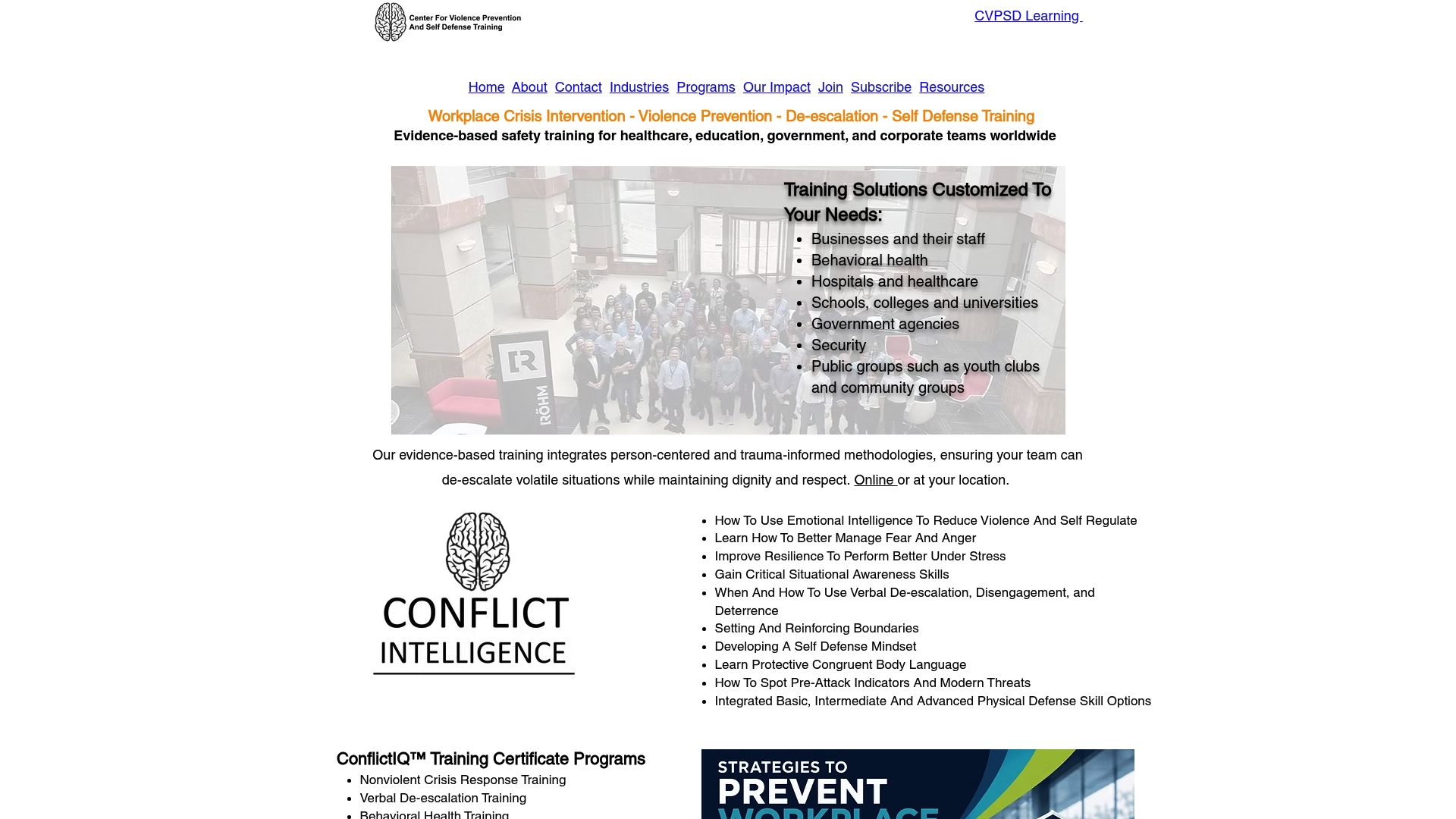
Every CVPSD program combines Crisis Intervention Techniques, De-escalation Solutions, Behavior Analysis, and Physical Self-Defense skills into a curriculum built for the specific environment and workforce it serves. Programs meet state and local legal standards, and training participation is fully documented to support your organization’s legal preparedness. Whether you are building a program from the ground up or strengthening an existing one, CVPSD’s team brings the expertise to make it work. Visit CVPSD’s training programs to learn what a tailored workplace safety program looks like for your team.
FAQ
What is workplace self-defense training?
Workplace self-defense training is structured education that teaches employees to recognize threats, de-escalate conflict, and respond physically when necessary. Programs typically cover situational awareness, verbal de-escalation, and proportionate physical response techniques.
Is self-defense training necessary for all workplaces?
Workplace violence costs the U.S. economy approximately $121 billion annually, making preparedness relevant across industries. NIOSH and OSHA both classify workplace violence as a recognized occupational hazard that requires proactive prevention measures.
How does self-defense training benefit employers financially?
Proactive safety programs return $4 to $6 for every $1 spent through reduced workers’ compensation claims, lower insurance costs, and decreased employee turnover. Organizations with strong safety cultures also see attrition risk drop from 12% to under 3%.
What makes a self-defense program legally defensible?
Documented employee participation in a curriculum that is specific to the workplace environment and aligned with state and local legal standards creates the strongest legal position. Generic, undocumented training rarely meets the duty-of-care standard courts apply.
How often should workplace self-defense training be repeated?
Effective training combines initial skill development with regular reinforcement at scheduled intervals. Annual refreshers at minimum, supplemented by ongoing communication and scenario practice, maintain the proficiency employees need to respond effectively under stress.
Recommended


