
Legally Defensible Workplace Violence Drills for Safety Managers

An effective workplace violence drill program runs regular tabletop and functional exercises, assigns clear roles before anything happens, coordinates with local police and EMS ahead of time, and closes every drill with a written after-action report and dated corrective actions. CISA, FEMA’s IS-907.A course, and OSHA all set the baseline for this work, and CVPSD builds programs around that same foundation. Start now: schedule a tabletop exercise soon and put a full functional drill on the calendar for later this year.
Table of Contents
Why Workplace Violence Drills Matter and What They Should Accomplish
Speed decides outcomes in a violent incident. Active shooter events are typically over within 10 to 15 minutes, often before police arrive on scene. That window is why waiting for a real event to test your plan is not a strategy. Drills compress that same 10 to 15 minutes into a controlled setting, so your team’s first reactions are trained reflexes instead of guesses made under panic.
Good drills also serve two distinct purposes, and confusing them is a common planning mistake. Knowledge goals build awareness, teaching staff to recognize warning signs and understand escape routes. Performance goals measure whether people can actually act on that knowledge under time pressure. A team that scores well on a quiz, but freezes during a simulated lockdown has a performance gap, not a knowledge gap, and the fix for each looks different.
Set objectives you can actually measure, not just intentions you hope pan out:
Time from first alert to full building notification, tracked in minutes and seconds.
Percentage of staff who have completed Run/Hide/Fight awareness training recently.
Percentage of floor wardens who can correctly identify their assigned evacuation route.
Time to account for all employees after a simulated evacuation exercise.
These numbers give you something concrete to report to leadership and something to compare drill over drill. Without them, “we ran a drill” tells nobody whether the organization actually got safer.
Building the Policy and Assigning Drill Roles
A drill without a written policy behind it tends to drift, skip steps, or expose the organization to avoidable liability. Your policy should spell out the purpose and scope of drills, how often they occur, who has authority to halt an exercise if it goes sideways, how you handle employee privacy and accommodations, and how much advance notice staff receive before a drill.
Roles need names attached, not just job titles on an org chart nobody reads until the day of the exercise.
Incident commander owns overall decision-making during the drill and has final say on stopping it.
Safety officer monitors physical risk throughout and has independent authority to pause the exercise, separate from the incident commander.
Floor wardens guide evacuation or lockdown procedures on their assigned area and report headcounts.
HR and employee support staff manage accommodations, watch for signs of distress, and handle post-drill follow-up.
Security liaison coordinates with building security systems, badge access, and any contracted security personnel.
Communications lead manages internal alerts, external messaging if needed, and the official drill timeline log.
A few legal and HR realities shape all of this. Union contracts sometimes require advance notice or bargaining before mandatory drills; check yours before scheduling. Disciplinary action for how an employee performs during a drill is rarely appropriate and can backfire legally. Privacy laws limit what medical or trauma-related accommodations you can require employees to disclose. On the training side, OSHA expects employers to provide appropriate training when workers face recognized hazards, and workplace violence drills are one of the clearest ways to document that you met that expectation.
For a deeper walkthrough of the policy document itself, see CVPSD’s guide on building a workplace violence prevention plan.
Which Drill Format Fits Your Organization?
Not every drill needs sirens and role players. Matching the format to your goal saves budget and avoids putting staff through more realism than the objective requires.
Tabletop exercises are discussion based, run 45 to 90 minutes, and gather your response team around a table to talk through a scenario step by step rather than physically act it out. A study of 22 threat management teams found that tabletop exercises improved both the teams’ ability to assess threat levels and the comprehensiveness of their overall response. They are the lowest-cost, lowest-risk way to find holes in a written policy before you ever put staff through a physical drill.
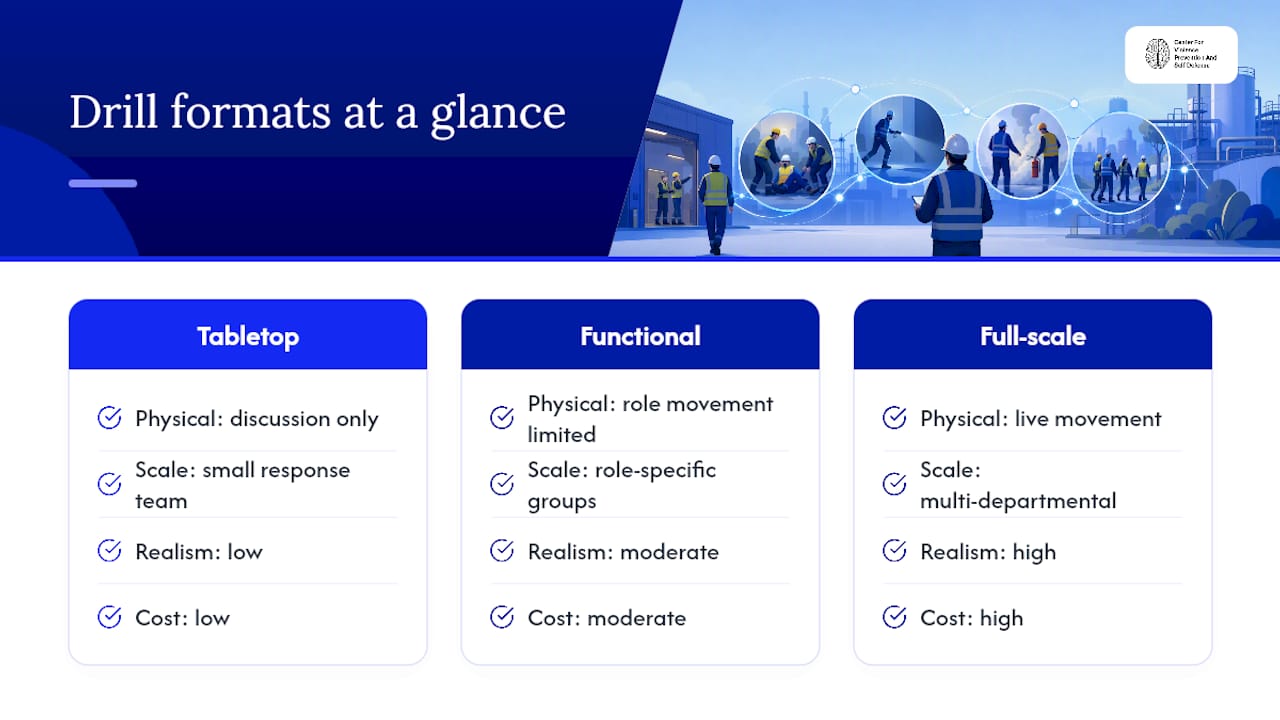
Functional exercises test specific systems in near real time. Instead of full evacuation, you might test only your mass-notification system or only your radio communications between floor wardens and the incident commander, with people moving through their actual roles but on a limited scale.
Full-scale exercises involve live movement, multiple departments, and sometimes outside agencies acting in real time. Reserve these for critical facilities, high-risk industries like healthcare, or organizations with a documented history of incidents. They cost more in staff hours and carry more logistical risk, so they belong on an annual or biennial cycle rather than monthly.
Active shooter drills deserve their own set of guardrails. Keep messaging anchored in Run, Hide, Fight principles, the same framework taught in FEMA’s IS-907.A course and in the FBI’s ASAPP training. Limit realism deliberately. Loud noises, simulated weapons, and unannounced drills can retraumatize employees with prior exposure to violence, and that risk usually outweighs any added training value.
Pro Tip: Announce active shooter drills at least a week in advance and give employees with a documented history of trauma an alternative way to participate, such as observing the debrief rather than the live exercise.
How Do You Plan a Workplace Violence Drill?
Planning happens weeks before the exercise itself, and skipping steps here is where most drills go wrong on the day.
Identify stakeholders early. Bring in facilities, HR, IT or communications, security, and a representative from leadership before you write the scenario, not after.
Design a realistic trigger. Base the scenario on plausible threats specific to your site, not generic templates pulled from another industry.
Build in interjects. Unplanned complications, such as a blocked exit or a phone system failure, force your team to adapt rather than follow a script from memory.
Screen for retraumatization risk. Review the scenario with HR to flag anything that could disproportionately affect staff with prior exposure to violence, and build a lower-intensity fallback lane for anyone who opts out.
Secure permissions and legal signoff. Get sign-off from legal or compliance, confirm union notification requirements, and document accessibility accommodations for staff with disabilities.
Set a notification cadence. Decide who gets advance notice, who gets a same-day heads up, and who gets none, and document the reasoning.
Line up logistics. Confirm site maps, staging areas, radios, first-aid stations, and any observer credentials needed for outside responders.
A realistic timeline looks something like four weeks out for stakeholder briefings, two weeks out for scenario finalization and legal review, one week out for staff notification, and drill day itself with a same-day hot wash. Keeping a resource checklist, maps, radios, sign-in sheets, medical kits, and a printed role roster, prevents the scramble that undermines an otherwise well-designed exercise.
Executing the Drill: Timeline and Safety Controls
The day of the drill runs on a tighter script than the planning phase, and safety controls matter more here than anywhere else in the process.
Before anything starts, brief the safety officer separately from the general team so they know exactly what authority they hold to stop the exercise. Confirm any role players or actors know their scripts, station medical standby if the scenario involves physical movement, and test your communication channels live, not just on paper.
During execution, keep a clear line between controllers, the people running the scenario, and players, the staff responding to it. Controllers should never let a drill interfere with a genuine emergency; every drill needs a stated protocol for immediately halting the exercise if a real incident occurs. Time-stamp every inject and every major decision point as it happens.
Log the time of the first notification and the time full evacuation or lockdown was confirmed.
Record communications gaps, radio dead zones, or notification failures as they occur, not from memory afterward.
Note any employee who appears distressed and flag them for HR follow-up.
Capture witness observations from floor wardens immediately, before recollections drift.
Hold the hot wash, an informal group debrief, within the hour while details are still fresh. This is not the formal report. It is the raw material for one.
Pro Tip: Assign one person whose only job during the drill is documentation. Everyone else is too busy responding to write anything down accurately.
Coordinating With Police, EMS, and Outside Responders
Bringing local law enforcement and EMS into your planning process, not just your drill day, changes how effective your plan actually is. Including police early in planning helps confirm your evacuation routes and staging areas actually align with how officers will approach the building, rather than conflicting with it once real responders show up.
Practical coordination steps include:
Establish a single point of contact at your local police department or fire district before you schedule anything.
Put expectations in writing through a memorandum of understanding covering observer roles, liability, and information sharing.
Invite a responder to observe, not just participate, so they can validate your assumptions from outside the exercise.
Complete any waivers or paperwork the agency requires for participation in a private drill.
Watch specifically for staging conflicts, such as police vehicles blocking the ambulance access point your plan assumed would stay clear. These mismatches rarely show up in a written policy review. They show up when you walk the actual site with the people who will respond.
Turning Drill Results Into Lasting Fixes
A drill that ends without a documented follow-up plan is a wasted afternoon. The sequence that actually produces improvement runs from the informal hot wash, to a formal written after-action report built on your timestamped data, to a corrective action plan with a named owner and a due date for every item.
Tabletop exercises reveal specific knowledge gaps and procedural bottlenecks that a structured debrief can convert into a prioritized list of corrective actions, rather than a vague sense that “communication needs work.”
Track a small set of metrics across every drill so you can see whether you are actually improving, not just repeating the exercise:
Time-to-evacuate, compared drill over drill.
Communications system uptime during the exercise.
Closure rate for corrective actions from the prior drill, tracked by due date.
Percentage of flagged issues resolved before the next scheduled drill.
The same CDC-summarized study behind that quote found tabletop exercises improved response comprehensiveness across 22 threat management teams, which is the kind of evidence worth citing when you ask leadership for time and budget to keep running these.
CVPSD’s Field Notes on What Actually Works
Programs can be designed to be evidence-based and customizable to specific roles and regulatory requirements, pairing behavior analysis and de-escalation skills with the physical and verbal response tactics staff need for a real threat. A few field-tested adjustments make drills sharper regardless of who runs them.
Vary your interjects by setting. A healthcare facility needs scenarios that account for patients and visitors who cannot self-evacuate. A school needs age-appropriate messaging and tighter trauma safeguards. A corporate office can usually tolerate more realism in its functional exercises.
Document everything as you go, not after the fact. Compliance reviewers and insurers increasingly want evidence of training frequency and observed skill checks, not just a policy binder. Building train-the-trainer capacity internally, so your own safety team can run and refine future drills without starting from scratch each year, is what keeps a program alive past its first successful exercise.
What the Evidence Actually Supports
The federal guidance and the tabletop study cited throughout this piece point to a conclusion that gets lost in a lot of generic safety advice: realism is not the goal, adaptability is. Organizations spend a disproportionate amount of energy chasing full-scale, high-drama drills when a well-run tabletop exercise, done quarterly instead of once a year, produces more measurable improvement per hour invested.
The conventional advice to “make it feel real” also deserves pushback. Unannounced high-intensity active shooter drills carry a genuine psychological cost, and the safety gain from that extra realism rarely justifies it. Trauma-sensitive design is not a soft add-on. It is what keeps a program legally and ethically defensible over years, not just after one successful exercise.
If there is one place to start, it is the after-action report, not the drill itself. A program that runs flashy exercises but never closes the loop on corrective actions is theater. A program that runs modest tabletop sessions and rigorously tracks fixes will outperform it every time. --Shawn Lebrock
Build a Drill Program That Holds Up Under Scrutiny
Designing a defensible drill program from scratch, on top of an already full safety calendar, is where most organizations stall out. This gap can be addressed with structured, evidence-based programming instead of a generic template pulled off the internet. The ConflictIQ™ training modules map directly to the roles your drill program needs covered, from de-escalation and co-regulation for education and behavioral health settings to broader crisis response for corporate teams, and each module comes with the kind of observed skills assessment and documentation compliance reviewers actually ask to see.
If your organization needs something built around a specific facility, workforce, or risk profile, CVPSD’s customized training programs are designed around that exact scenario rather than a one-size template. Browse the full catalog of training programs or reach out directly to request a consultation and talk through a sample tabletop scenario built for your setting.
Where to Go for Federal Guidance and Training
CISA’s active shooter preparedness resources offer planning toolkits and current guidance for building an emergency action plan around active assailant threats. FEMA’s IS-907.A course gives non-law enforcement staff a free, self-paced introduction to recognizing warning signs and applying Run, Hide, Fight principles.
OSHA’s training and outreach programs outline what employers are expected to provide when workers face recognized workplace hazards, including violence. The tabletop exercise study summarized by CDC/NIOSH remains one of the clearest pieces of published evidence that structured drills measurably improve threat response. The FBI’s ASAPP resources round out the set with scenario-based training built around the same core principles.
Sources
FAQ
What Are Some Ways to Prevent Workplace Violence?
Prevention starts with a written violence prevention plan, regular training on recognizing warning signs, clear reporting channels, and consistent drills that test whether staff can act on that training under pressure. Coordinating with local law enforcement during planning, not just during an actual incident, also closes gaps that a policy document alone cannot catch. CVPSD’s ConflictIQ™ programs build these elements into ongoing training rather than a one-time session.
What Are Five Examples of Workplace Violence?
Common categories include physical assault by a coworker, threats or intimidation from a client or customer, violence from a domestic partner that follows an employee into the workplace, armed intrusion by a former employee, and verbal abuse or harassment that escalates over time. Each type calls for a different response protocol, which is why a single generic drill rarely covers every scenario an organization might face.
What Are the 5 E’s of Workplace Safety?
Definitions of the “5 E’s” vary across safety programs and industries, so there is no single federally recognized standard version specific to workplace violence. Rather than force-fitting an unofficial framework, most safety managers get better results building their program around the documented steps covered here: policy, training, drills, responder coordination, and after-action review.
What Are 10 Ways to Prevent Workplace Violence?
A strong prevention program combines a written policy, manager and staff training, a confidential reporting system, background checks where legally appropriate, physical security controls like badge access, threat assessment teams, regular drills, coordination with local police, an employee assistance program, and a documented after-action process following any incident or drill. No single measure covers every risk; they work as a layered system.
How Often Should Organizations Run Workplace Violence Drills?
Most safety programs run tabletop exercises quarterly and reserve full-scale or functional drills for once or twice a year, depending on facility risk level. High-risk settings like healthcare or education often benefit from more frequent tabletop sessions since they carry lower cost and disruption than full-scale exercises.
Recommended
About the Author: William DeMuth is the Director of Training at the Center for Violence Prevention and Self Defense (CVPSD) in Freehold, NJ. With over 35 years of research in violence dynamics and personal safety, William specializes in evidence-based training that bridges the gap between compliance and real-world conflict resolution.


