
Workplace Violence Prevention Explained for HR and Safety Pros


What is workplace violence prevention, and why does it matter?
Workplace violence prevention is the structured process of identifying, assessing, and controlling risks of violence, harassment, intimidation, or threatening behavior before they cause harm. It is not simply a policy document sitting in a filing cabinet. It is an active, ongoing commitment to protecting every person who walks through your doors.
The scope is broader than most HR professionals initially expect. Workplace violence encompasses any act or threat of physical violence, harassment, intimidation, or other disruptive behavior at the work site, ranging from verbal abuse to homicide. That continuum matters because programs that focus only on physical assaults miss the behaviors that typically precede them.
The scale of the problem makes prevention non-optional:
Nearly 2 million American workers report workplace violence victimization annually, with many more cases going unreported.
According to the Bureau of Labor Statistics, of the 5,283 fatal workplace injuries in the United States in 2023, 740 were due to violent acts, with homicides accounting for 61.9% of those violent fatalities.
Homicide is the fourth leading cause of fatal occupational injuries in the country.
Both the Occupational Safety and Health Administration (OSHA) and the Equal Employment Opportunity Commission (EEOC) provide federal guidance that shapes what an effective prevention program must include. Understanding that guidance, and building a program around it, is where workplace violence prevention explained becomes practical rather than theoretical.
Who faces the highest risk, and what conditions drive it?
Not every worker carries equal risk. Certain roles and environments create conditions where violence is measurably more likely, and recognizing those conditions is the first step toward targeted prevention.
Workers with elevated exposure include:
Employees who exchange money with the public, such as retail clerks, cashiers, and bank tellers
Delivery and taxi or rideshare drivers
Healthcare professionals and social assistance workers
Public service workers and customer service agents
Law enforcement personnel
Workers in isolated settings or those who work alone during late-night hours
Employees serving populations with volatile or unstable behavior, including substance use or mental health crises
The physical environment amplifies risk. Working alone, operating in high-crime areas, and serving alcohol are all documented risk factors. Healthcare and social assistance workers face the highest rates of nonfatal violence resulting in days away from work, while workers in sales, protective services, and transportation carry greater risk of fatal violence.
Pro Tip: Don’t wait for an incident to identify your highest-risk roles. Map your workforce against these risk categories annually, and use employee surveys to surface concerns that formal assessments might miss. The FBI notes that detecting and managing threats early is often more critical than responding to physical assaults after the fact.

Understanding risk factors enables you to allocate prevention resources where they will have the greatest effect, rather than applying a uniform approach across every department.
What does an effective prevention program actually include?
OSHA and the EEOC have reached clear consensus on the four core elements every workplace violence prevention program must contain. These are not suggestions. They are the foundation against which your program will be measured if an incident occurs and liability is assessed.
Management commitment and employee involvement: Leadership must demonstrate genuine concern for employee safety through a written program, visible participation, and consistent messaging. A signed policy alone does not satisfy this requirement.
Worksite analysis: A step-by-step review of the workplace to identify existing or potential hazards, covering physical layout, workflow, staffing patterns, and incident history.
Hazard prevention and control: Engineering controls, administrative procedures, and work practice changes that reduce identified risks before they escalate.
Regular, interactive training: Ongoing education for all employees, supervisors, and managers that goes beyond a one-time orientation.
Beyond these four pillars, effective programs must address the full spectrum of behaviors, from verbal abuse and bullying to stalking and physical assault. Programs that treat only overt physical violence as the target will consistently fail to prevent incidents, because most violent events are preceded by lower-level behaviors that were either undetected or ignored.
Accessible reporting channels, fair disciplinary procedures, and continuous hazard monitoring complete the picture. A comprehensive prevention program integrates all of these elements rather than treating them as separate initiatives.
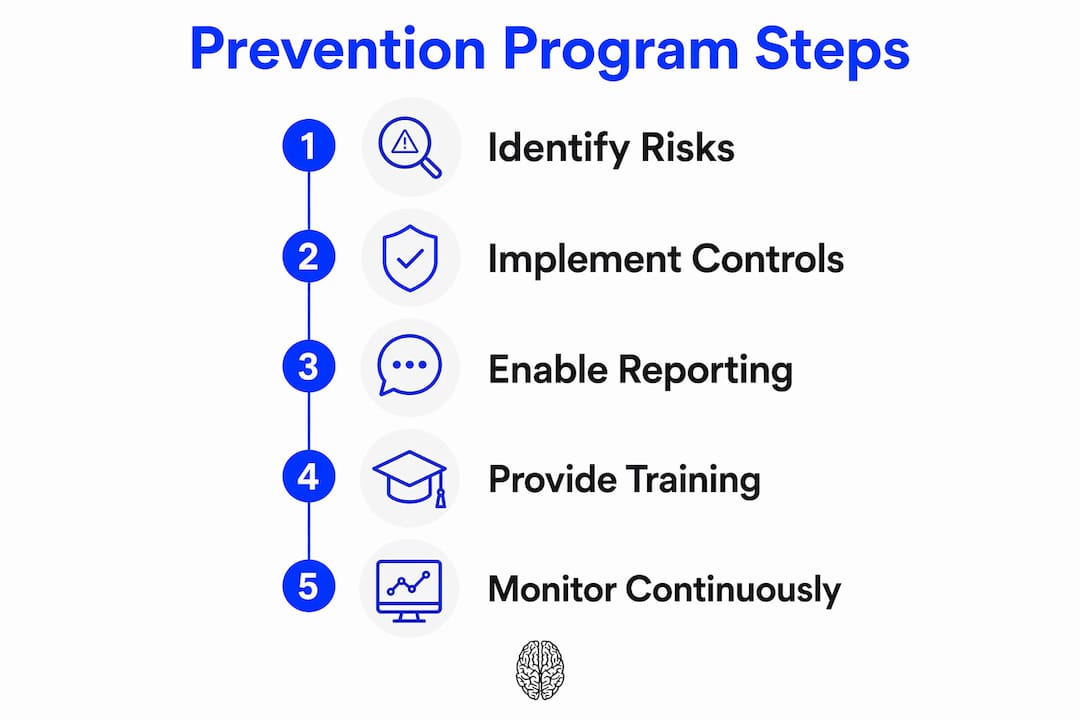
Practical strategies you can implement to reduce workplace violence
Prevention requires action, not just planning. The most effective organizations layer multiple strategies across physical security, behavioral detection, and cultural reinforcement.
Security and environmental controls:
Install access control systems, security cameras, and adequate lighting in parking areas and building entrances.
Design workspaces to reduce isolation, improve sightlines, and create natural barriers between employees and volatile members of the public.
Establish panic alarms and emergency notification systems in high-risk areas.
Screening and assessment:
Conduct pre-employment screening that includes background checks appropriate to the role and risk level.
Use employee surveys at regular intervals to identify risk factors and confirm whether security measures are working. The FBI recommends repeating surveys when operations change or after an incident occurs.
Threat detection and management:
Detecting threats early is where prevention programs either succeed or fail. Dealing with threats and threatening behavior — detecting them, evaluating them, and finding a way to address them — may be the single most important key to preventing violence. A threat that is veiled or specific, spoken or unspoken, still requires a structured response.
Designate a threat assessment team with clear authority, defined roles, and trained members. Well-structured teams improve crisis management and communication during incidents. The team should respond to all reports of violence, threats, harassment, or disturbing behavior, not only to events that have already escalated.

Strategy category | Reactive approach | Proactive approach |
Threat detection | Respond after assault occurs | Monitor behavior patterns, act on early warning signs |
Reporting | Wait for formal complaints | Encourage early, informal reporting with no-retaliation protection |
Training | One-time orientation | Regular, scenario-based training for all staff levels |
Hazard control | Address after incident | Ongoing worksite analysis and engineering controls |
Post-incident | Investigate and close | Investigate, identify patterns, and update prevention measures |
Pro Tip: Build a workplace culture where reporting a concern is treated as a professional responsibility, not a personal accusation. Employees who fear retaliation or ridicule will stay silent, and silence is where preventable incidents grow.
CVPSD’s violence prevention training programs are built around exactly this layered approach, combining behavioral awareness with practical response skills.
What training should your prevention program include?
Training is the mechanism that turns policy into behavior. Without it, even the most carefully written prevention program stays on paper.
Regular, tailored training for all employees, supervisors, and managers improves recognition, prevention, and response to workplace violence. The EEOC identifies training as one of the five core principles of effective harassment and violence prevention, alongside committed leadership, demonstrated accountability, strong policies, and accessible complaint procedures.
Effective training for all employees covers, including resources for those managing volunteers in your organization, effective training for all employees covers:
Descriptions of prohibited conduct and behaviors that, if left unchecked, may escalate to violence
How to recognize early warning signs in coworkers or members of the public
The organization’s reporting process and available reporting channels
Assurance that reporting is protected and retaliation is prohibited
Bystander intervention techniques that allow employees to safely de-escalate or redirect situations
Supervisor and manager training goes deeper. It includes how to identify risk factors specific to their teams, how to stop and report concerning behavior, and how to respond to disclosures from employees without dismissing or minimizing them.
Training must be customized to the organization and the audience. A healthcare team working with patients in crisis faces different scenarios than a retail team managing cash transactions. Generic, off-the-shelf content rarely produces the behavioral change that protects people. CVPSD’s frontline worker training programs address this directly by tailoring content to the specific risks each workforce encounters.
What are your legal responsibilities as an employer?
Employer liability for workplace violence and harassment is not theoretical. The EEOC is direct: employers are automatically liable for harassment by a supervisor that results in a negative employment action. When a supervisor’s conduct creates a hostile work environment, an employer can avoid liability only by proving it reasonably tried to prevent and promptly correct the behavior, and that the employee unreasonably failed to use available preventive or corrective opportunities.
For harassment by non-supervisory employees or non-employees, liability attaches when the employer knew or should have known about the conduct and failed to act. That standard places a clear duty on HR and safety professionals to maintain active awareness, not passive availability.
Your enforcement responsibilities include:
Establishing a clear, written anti-harassment and violence policy that is communicated to all employees, not just distributed once at onboarding
Providing multiple, accessible reporting channels so employees are never left with only one option
Responding promptly and impartially to every report, regardless of the seniority of the person named
Protecting complainants and witnesses from retaliation throughout and after the investigation process
Applying discipline that is prompt, consistent, and proportionate to the severity of the conduct
Employees need to trust that reporting systems work and that they will not be punished for using them. Without that trust, reporting drops, incidents go undetected, and liability grows. Consistency in how you handle reports, across departments and seniority levels, is what builds that trust over time.
Expert insights on building a systemic prevention culture
Compliance gets you to the baseline. Culture is what actually keeps people safe.
Organizations that deploy systemic violence prevention strategies — including trend monitoring, consistent action on low-level incidents, and psychological safety — outperform those that respond only to formal complaints. The difference is not in the policies they have written. It is in how consistently those policies are lived.
What systemic prevention looks like in practice:
Trend monitoring: Track all reports, including informal ones, to identify patterns by location, shift, supervisor, or team. A single complaint may be isolated. Three complaints from the same department over six months are a pattern that demands intervention.
Early intervention on low-level conduct: Verbal abuse, persistent rudeness, and intimidating body language are not minor HR nuisances. They are the early stages of a continuum that can end in physical violence. Address them with the same seriousness as formal complaints.
Psychological safety: True management commitment goes beyond policy endorsement. It means creating an environment where employees report early warning signs without fear of being dismissed, labeled as troublemakers, or subjected to informal retaliation.
Bystander intervention: Fostering a culture of civility through bystander intervention training stops escalation before behaviors become unlawful. Employees who know how to safely intervene, redirect, or report become an active layer of prevention.
Visible leadership: Managers who model respectful behavior, acknowledge reports seriously, and follow through on corrective action send a message that no written policy can replicate.
A systemic, ongoing approach that includes trend monitoring and consistent action outperforms episodic, complaint-driven methods. The organizations that understand this treat prevention as an operational discipline, not an annual training checkbox.
Legal and regulatory requirements you need to know
The legal framework for workplace violence prevention in the United States draws from multiple federal sources, and understanding each one helps you build a program that is both compliant and defensible.
OSHA’s General Duty Clause requires employers to provide a workplace free from recognized hazards that are causing or likely to cause death or serious physical harm. While OSHA has no specific standard dedicated exclusively to workplace violence, it enforces the General Duty Clause in cases where violence risks are foreseeable and preventable. OSHA strongly recommends that employers establish and maintain a violence prevention program as part of their overall safety and health program.
EEOC-enforced laws cover harassment and violence rooted in protected characteristics. Title VII of the Civil Rights Act of 1964, the Age Discrimination in Employment Act of 1967, and the Americans with Disabilities Act of 1990 all prohibit harassment based on race, color, religion, sex, national origin, age, disability, and genetic information. When harassment rises to the level of a hostile work environment, or when it results in a tangible employment action, employer liability is triggered.
State-level requirements vary considerably. California, for example, requires employers to develop a written harassment prevention policy, distribute it to employees, and provide mandatory sexual harassment prevention training on a defined schedule. HR professionals operating across multiple states must track each jurisdiction’s specific obligations.
Documentation and recordkeeping are a legal protection in themselves. Maintaining records of all reports, investigations, corrective actions, and training completion creates the evidence base you need if a claim is ever filed. OSHA’s recordkeeping standards apply to workplace violence injuries just as they do to other occupational injuries.
How to assess and identify workplace violence risks
Risk assessment is not a one-time event. It is a recurring process that should be built into your annual safety calendar and triggered whenever operations, staffing, or the physical environment changes significantly.
Worksite analysis methods:
Walk-through surveys of the physical environment, examining lighting, access points, sightlines, and areas where employees work alone or with limited supervision
Review of incident logs, near-miss reports, and workers’ compensation claims to identify patterns
Employee surveys that ask directly about perceived safety risks, witnessed behaviors, and barriers to reporting
Analysis of job tasks and workflows to identify roles with elevated exposure to volatile individuals or cash handling
Threat assessment tools and techniques:
Threat assessment has two components: evaluating the threat itself (its credibility and specificity) and evaluating the person making it. Together, these evaluations support a judgment about whether someone is making a threat versus actually posing one. That distinction drives the appropriate intervention, from a formal counseling conversation to immediate law enforcement contact.
Your threat assessment team should use structured protocols that place each reported threat on a hierarchy of seriousness. An immediate, specific threat (“I have a weapon and I will use it”) demands an immediate police response. A vague, non-specific expression of frustration may call for a counseling referral and documented monitoring. Most threats fall somewhere between these poles and require careful, documented assessment.
Pro Tip: Centralize all incident reports, even informal ones, in a single tracking system. Documented case tracking lets you identify high-risk patterns that would be invisible if reports stayed siloed in individual managers’ inboxes.
CVPSD’s approach to systemic prevention emphasizes this kind of centralized, pattern-aware assessment as the foundation of any credible prevention program.
Post-incident procedures: investigation, support, and recovery
When an incident occurs, your response in the hours and days that follow shapes both the immediate outcome and the long-term health of your workplace culture.
Immediate response:
Secure the scene and address any immediate safety needs, including medical attention for anyone injured.
Notify appropriate personnel, including HR, legal counsel, and senior leadership, according to your established emergency response plan.
Preserve evidence: physical materials, electronic communications, surveillance footage, and witness accounts.
Investigation:
A prompt, impartial, and thorough investigation is both a legal obligation and a practical necessity. Begin as soon as feasible. Delay allows evidence to degrade, witnesses’ memories to fade, and affected employees to lose confidence that the organization takes the matter seriously. Interview all relevant parties, including the complainant, the alleged perpetrator, and any witnesses, with care to protect each person’s privacy to the greatest extent possible.
Document every step. The investigation record is your primary defense if the matter is later reviewed by a regulatory agency or in litigation.
Corrective action:
Corrective action must be proportionate to the severity of the conduct and applied consistently. Options range from informal counseling and mandatory training to suspension, demotion, or termination. Reviewing how similar situations were handled in the past helps avoid claims of discriminatory or arbitrary discipline.
Recovery and workplace restoration:
Post-incident recovery is often underestimated. Employees who witnessed or were affected by a violent incident may experience lasting psychological effects. Make Employee Assistance Programs (EAPs) accessible to all affected staff, not only those directly involved. Communicate clearly and repeatedly that the organization is committed to a safe environment, and follow through with visible action.
Workplace investigations serve a proactive prevention role when they are documented and analyzed for patterns, rather than closed and filed away. Each investigation is an opportunity to identify systemic vulnerabilities and strengthen your prevention program before the next incident occurs.
Take the next step with CVPSD
CVPSD is a 501©(3) non-profit that delivers evidence-based violence prevention training to organizations across the United States. Programs cover crisis intervention, de-escalation, behavior analysis, and physical self-defense, tailored to your workforce and compliant with state and local requirements. Whether you are building a prevention program from the ground up or strengthening an existing one, CVPSD partners with public and private organizations, schools, nonprofits, and government agencies to create safer workplaces.
Learn more about building a resilient workplace or explore CVPSD’s full training catalog at cvpsd.org.
Key Takeaways
Effective workplace violence prevention requires a proactive, systemic program built on OSHA and EEOC standards, not a reactive response to isolated incidents.
Point | Details |
Define the full scope | Workplace violence includes verbal abuse, harassment, threats, and physical assault, not just overt physical attacks. |
Know who is at risk | Frontline workers, healthcare staff, isolated employees, and those handling cash face the highest documented risk. |
Build on four core elements | OSHA’s framework requires management commitment, worksite analysis, hazard control, and regular interactive training. |
Enforce employer liability standards | EEOC holds employers automatically liable for supervisor harassment that causes a negative employment action without a proven prevention response. |
Treat investigations as prevention | Centralized, documented case tracking identifies patterns and systemic vulnerabilities before they escalate to serious incidents. |
Recommended


