
Behavior Classes for Organizations: Procurement and Pilot Guide


HR directors, school administrators, healthcare managers, and nonprofit or government program leads should buy a tailored, evidence-based behavior class pilot from a provider like CVPSD. Start with a one-day session for a single high-risk unit, set three measurable objectives (pre/post confidence scores, incident reports, near-miss tracking), and request vendor alignment with OSHA’s Workplace Violence Prevention Program guidelines. OSHA recommends annual training with more frequent refreshers in high-risk settings, so ask vendors how their program aligns with this schedule before signing any contract. Research confirms that training improves staff confidence and can reduce lost workdays, but only when embedded in a broader organizational program. Here is how to scope, buy, and implement that program.
Your immediate next steps:
Identify your highest-risk unit or department and define a one-day pilot scope.
Request vendor proposals that name OSHA/NIOSH/CDC alignment explicitly.
Require a written evaluation plan (pre/post assessment, incident data) before signing.
Key Takeaways
Evidence-based behavior classes reduce staff risk and build organizational resilience, but only when training is embedded in a written Workplace Violence Prevention Program with evaluation, reporting, and management accountability built in.
Point | Details |
Start with a scoped pilot | Run a one-day session for one high-risk unit with pre/post confidence scores and incident tracking. |
Require OSHA/NIOSH alignment | Ask vendors for written documentation mapping their curriculum to federal guidance before contracting. |
Prioritize simulation over lecture | Meta-analytic evidence shows simulation and repeated practice produce larger confidence gains than lecture-only formats. |
Pair training with system changes | A systematic review of 26 studies found multicomponent interventions are more likely to reduce incident rates than training alone. |
CVPSD as recommended provider | CVPSD offers tailored, evidence-based crisis intervention and de-escalation programs with train-the-trainer options for U.S. organizations. |
Table of Contents
What do behavior classes for organizations actually cover?
The term “behavior classes” is informal. The recognized industry term is workplace violence prevention and crisis intervention training, and it covers far more than a single skill. A complete program includes these core modules:
Verbal de-escalation: Tone, pacing, empathic acknowledgment, and de-escalation scripts for high-tension interactions.
Non-verbal communication: Reading body language, managing personal space, and controlling your own posture and facial expression.
Crisis intervention: Structured response protocols for acute behavioral crises, including trauma-informed approaches.
Behavior analysis basics: Recognizing antecedents, triggers, and escalation patterns before a situation peaks.
Safe physical interventions: Hands-on techniques for situations where verbal approaches have not resolved the risk, with clear policy boundaries.
Documentation and reporting: Incident forms, near-miss logs, and chain-of-custody for restraint records.
Supervisor and management modules: Debriefing staff, reviewing incidents, and driving program improvement.
Delivery modality matters as much as content. Meta-analytic evidence shows simulation and repeated practice produce larger confidence gains than lecture-only formats. Role-play and scenario drills belong in every module where staff must perform a skill under pressure, not just understand it conceptually.
Pro Tip: Non-verbal communication training is consistently undertrained. A cluster randomized trial in acute psychiatric wards found that a program integrating both verbal and non-verbal techniques reduced the number and severity of aggressive incidents. Ask vendors specifically how much time their curriculum dedicates to non-verbal awareness and crisis communication skills.
Who needs behavior training programs, and how does content differ by setting?
Not every staff member needs the same program. The table below maps common organizational settings to recommended attendees and priority modules.
Setting | Recommended Attendees | Priority Modules |
Acute care / ED | Nurses, techs, security, charge nurses | De-escalation, physical interventions, trauma-informed response |
Long-term care | CNAs, social workers, supervisors | Behavior analysis, non-verbal communication, elder-specific protocols |
Behavioral health | Clinicians, case managers, security | Crisis intervention, restraint documentation, supervisor debriefing |
K-12 schools | Teachers, counselors, administrators | Verbal de-escalation, positive behavior interventions, reporting |
Corporate / frontline | Customer-facing staff, HR, security | De-escalation, non-violent communication, incident reporting |
Government / nonprofit | Program staff, outreach workers | Behavior analysis, community resilience, documentation |
Emergency department staff need more hands-on physical intervention practice and faster de-escalation scripts than school counselors, who benefit more from positive behavior interventions and trauma-informed communication. Research on emergency care settings shows consistent gains in nurse self-efficacy after de-escalation training, though reductions in incident frequency depend heavily on staffing levels and environmental factors.
Per OSHA guidance, training plans should include contractors, visiting staff, and part-time workers in high-risk units, not just full-time employees. A contractor who cannot de-escalate a crisis is a gap in your program, regardless of their employment status.
How do you evaluate vendors and class proposals?
A structured procurement process protects your organization and surfaces the right provider quickly. Work through this checklist before shortlisting any vendor.
Procurement checklist:
Evidence base: Does the vendor cite peer-reviewed research or alignment with OSHA/NIOSH/CDC guidance?
Customization: Will they adapt content to your setting, population, and existing policies?
Trainer qualifications: Are trainers credentialed, background-checked, and experienced in your sector?
Hands-on practice: Does the proposal include simulation, role-play, or skills lab components?
Evaluation plan: Is there a written pre/post assessment and a follow-up data-collection schedule?
Pricing and scalability: Is the model fee-for-service, per-seat, or contract-based? Can it scale to multiple sites?
Insurance and liability: Does the vendor carry appropriate liability coverage for physical intervention training?
Red flags to watch for:
No hands-on practice component in a program that claims to teach physical skills.
Generic off-the-shelf curriculum with no sector-specific tailoring.
No references, case studies, or outcome data from comparable organizations.
Conflating de-escalation with self-defense without clear policy boundaries between the two.
Missing documentation standards for restraint use.
What does a realistic rollout look like?
Delivery model selection shapes your timeline and budget more than any other decision.
In-person intensive: Highest fidelity for physical skills; requires coverage planning but produces the strongest skill transfer.
Virtual instructor-led: Accessible for distributed teams; works well for cognitive modules but cannot replace hands-on practice.
Blended: The most practical model for most organizations, pairing online pre-work with in-person skills labs.
Train-the-trainer: Cost-effective at scale; requires a quality assurance plan to maintain fidelity over time.
A manageable rollout follows three phases:
Pilot (Month 1): One-day session for one high-risk unit. Collect baseline confidence scores and incident data. Debrief trainers and participants.
Rollout (Months 2-4): Expand to additional units using pilot findings to refine content. Schedule sessions around shift coverage, maintaining minimum staffing for high-risk areas during training.
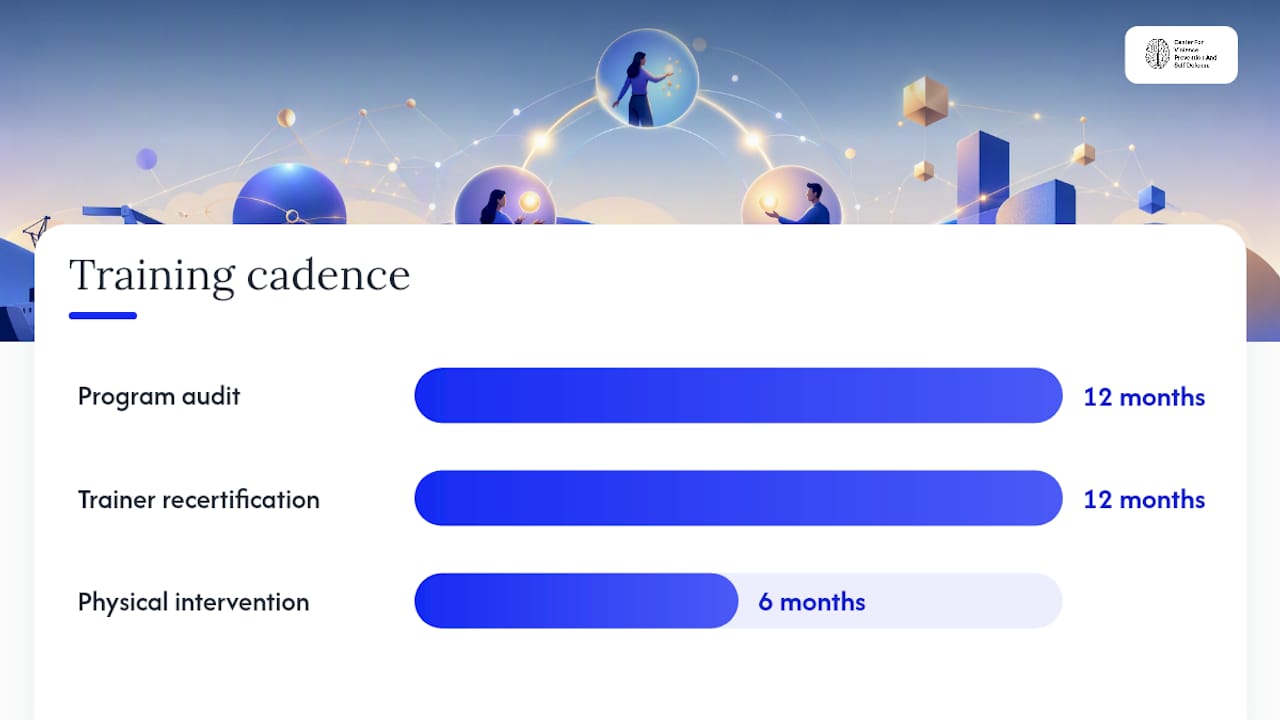
Sustainment (Months 5-12): Quarterly refreshers for high-risk roles, annual full-program review, and train-the-trainer certification for internal champions.
For staffing coverage, schedule training in cohorts of no more than 25% of a unit at one time, and confirm contingency coverage before any session begins.
How do you measure training impact and justify the budget?
Finance and procurement teams need specific metrics, not anecdotes. Use this evaluation framework.
Metric | Measurement Tool | Assessment Schedule |
Staff confidence | Validated pre/post survey (e.g., Confidence in Coping with Patient Aggression scale) | Baseline, post-training, 3-month follow-up |
Skill performance | Observed simulation checklist scored by trainer | Post-training, 12-month recertification |
Incident frequency | Incident report database | Monthly, 12-month trend review |
Lost workdays | HR records | Quarterly |
Near-miss reporting | Near-miss log | Monthly |
Participant satisfaction | Post-session survey | Immediately post-training |
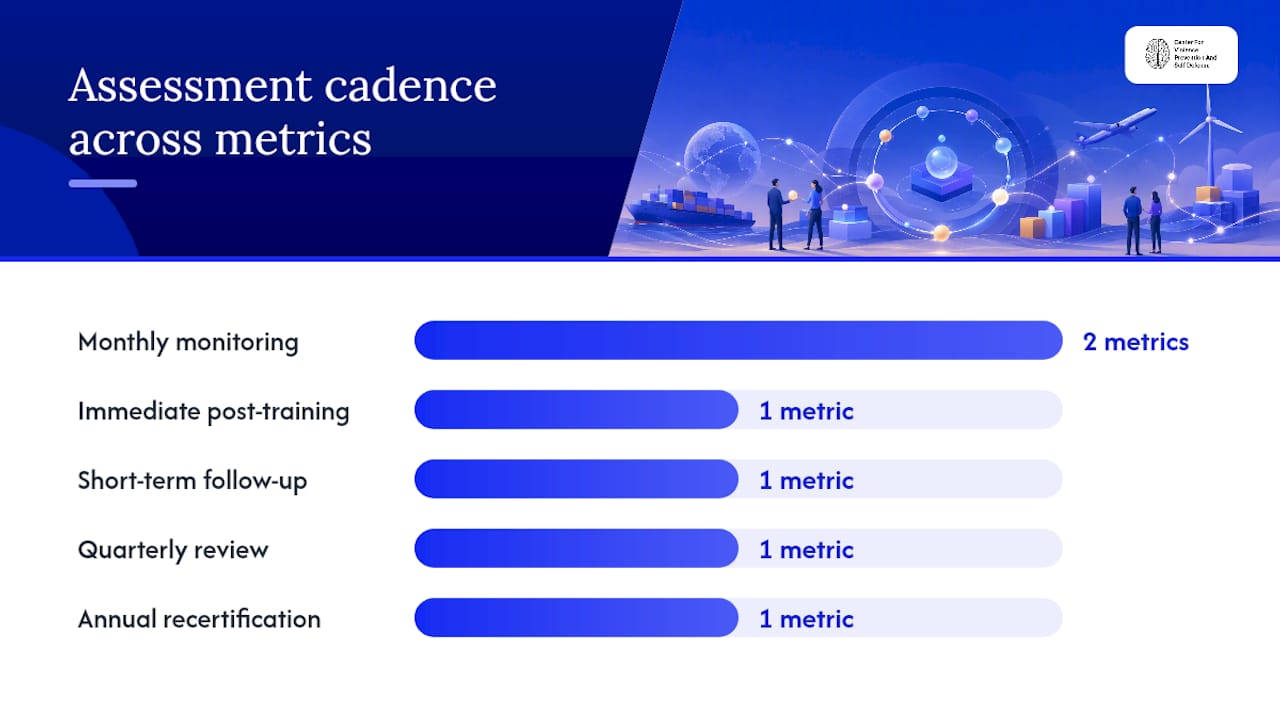
RAND’s evidence assessment found de-escalation training can reduce lost workdays and associated costs, but cautions that training alone rarely reduces incident rates. Pair your program with reporting system improvements, environment redesign where feasible, and management accountability. A systematic review of 26 studies confirmed that multicomponent interventions, combining training with organizational changes, are more likely to affect overall incident prevalence than training alone.
What policies and compliance requirements apply?
Before contracting any vendor, confirm these program elements are in place or in development.
Written Workplace Violence Prevention Program (WVPP): A documented policy signed by leadership.
Worksite analysis: A documented hazard assessment for each unit or location.
Hazard controls: Physical and administrative controls identified and implemented.
Training records: Attendance logs, assessment scores, and trainer credentials on file.
Incident reporting and recordkeeping: OSHA 300 log entries and internal near-miss tracking.
Program evaluation: Annual review of training outcomes and incident data.
CDC/NIOSH’s workplace violence prevention course covers definitions, risk factors, prevention strategies, and post-event response, and can help you align vendor curricula with federal guidance. Request that vendors provide written documentation showing how their curriculum maps to OSHA and NIOSH standards. Any vendor unable to produce that mapping is not ready for a serious procurement conversation.
How do you scale training cost-effectively over time?
A train-the-trainer model is the most sustainable path for organizations with 100 or more staff. Internal trainers reduce per-head cost significantly, but quality assurance is non-negotiable.
Internal trainer certification should include:
Observed delivery assessment by an external master trainer before independent certification.
Mentored co-delivery for at least two sessions before solo delivery.
Annual recertification with a skills observation component.
Access to updated curriculum materials and a refresher cadence tied to incident data.
Keep external trainers involved for complex clinical units, annual program audits, and any scenario requiring advanced physical intervention skills. Internal trainers handle routine refreshers; external experts handle edge cases and program fidelity reviews.
Pro Tip: It is recommended to schedule a program audit annually using incident data and near-miss logs to identify which modules need refreshing. Skill decay is fastest in physical intervention techniques, so those components warrant a 6-month refresher cycle for high-risk roles.
What the evidence tells us about choosing the right program
Most organizations underestimate how much the quality of a behavior training program depends on what happens after the training day. The research is consistent: confidence improves reliably with well-designed training, but incident rates only shift when the organization also changes its reporting culture, staffing patterns, and management accountability. Buying a training program and expecting it to solve a systemic problem is a common and costly mistake.
The other pattern worth naming is the gap between programs that teach de-escalation and programs that teach it well. Non-verbal communication, in particular, receives far less attention than verbal scripting in most off-the-shelf curricula, even though the evidence points to its importance. A calm, quiet voice carries more authority than an anxious torrent of instructions, and that skill requires practice, not just explanation. When evaluating vendors, ask to see a sample simulation scenario and watch how much time it dedicates to body language, proxemics, and self-regulation, not just what words to say.
CVPSD offers evidence-based behavior training built for organizations
CVPSD delivers crisis intervention and de-escalation programs that are tailored to your setting, aligned with OSHA/NIOSH/CDC guidance, and available in both in-person and online formats. Unlike generic off-the-shelf courses, CVPSD’s programs are customized for healthcare, education, behavioral health, corporate, and government organizations, with hands-on simulation, documented evaluation, and train-the-trainer certification options.
A one-day pilot can be scoped for a single unit with clear pre/post metrics, giving your leadership team the data needed to approve a full rollout. Annual training with more frequent refreshers in high-risk settings is recommended by OSHA guidelines, so plan for ongoing sessions beyond the initial pilot. Fee-for-service and scalable contract models are available. Contact CVPSD to request a pilot proposal, review case studies, and confirm trainer credentials for your sector.
Sources
Guidelines for Preventing Workplace Violence for Healthcare and Social Service Workers
Reviewing the Evidence Base for De-escalation Training: A Rapid Evidence Assessment | RAND
Impact of de-escalation training on nurses in emergency care (PubMed)
Workplace Violence Prevention for Nurses (WB4525) | CDC/NIOSH
FAQ
What core topics should behavior classes for staff include?
A complete program covers verbal de-escalation, non-verbal communication, crisis intervention, behavior analysis, safe physical interventions, documentation, and supervisor modules. Hands-on simulation should be included for any skill staff must perform under pressure.
How long does a typical behavior training program take to roll out?
A one-day pilot for a single unit is a practical starting point. A full organizational rollout typically spans 3 months, with a 12-month sustainment model including quarterly refreshers for high-risk roles. OSHA guidelines recommend annual training for all staff, with more frequent refreshers in high-risk settings.
Does training alone reduce workplace violence incidents?
Training reliably improves staff confidence, but a systematic review of 26 studies found that incident rates are more likely to decrease when training is combined with organizational changes such as reporting systems, environment redesign, and management accountability.
What should you require from a vendor before signing a contract?
Require written OSHA/NIOSH/CDC curriculum alignment, trainer credentials and background check documentation, a hands-on simulation component, a written evaluation plan, and references or case studies from comparable organizations.
Can CVPSD provide training for both healthcare and school settings?
Yes. CVPSD tailors its crisis intervention, de-escalation, and behavior analysis programs for healthcare, education, behavioral health, corporate, and government organizations, with both in-person and online delivery options available.
Recommended


