
Make Policy Into Practice: Behavior Observation for Safety Leaders

Behavior observation for safety is a structured, observable-based process that trains staff to spot escalation cues, document them factually, and channel those reports into a multidisciplinary threat-assessment and response process to prevent violence. It is not profiling, and it is not guesswork. The single most important next step for any organization is simple: give every staff member a clear, role-appropriate reporting pathway before an incident happens, not after. Early, well-documented reporting allows teams to intervene with less force and fewer injuries on all sides.
Table of Contents
What Does Behavior Observation for Safety Actually Involve?
Behavior observation for safety works because it stays anchored to what someone is doing, not who they are or what they might be thinking. That distinction protects both dignity and legal defensibility. A person pacing, raising their voice, and referencing a weapon is exhibiting observable behavior. Guessing at someone’s mental state based on appearance or history is profiling, and it has no place in a sound safety program.
The Behavioral Threat Assessment and Management (BTAM) framework formalizes this idea. BTAM emphasizes early identification of observable behaviors, assessed in context, and reviewed by a multidisciplinary team rather than a single gatekeeper. Trauma-informed principles sit underneath all of it: staff are trained to recognize that agitation or defensiveness often stems from prior trauma, and responses should stay non-coercive and collaborative wherever possible.
Every observer, regardless of title, has three low-effort responsibilities:
Watch for changes from a person’s baseline behavior, not isolated moments.
Record what was seen and heard, in plain language, without diagnosing intent.
Route the report through the organization’s defined channel, every time, even for “minor” incidents.
What Warning Signs Should Staff Document?
Escalation rarely arrives without warning. Staff who know what to watch for catch it early enough to act with words instead of physical intervention. Priority observable signs include escalating or pressured speech, fixation on a specific person or grievance, verbal “leakage” of intent (references to violence, even indirect), pacing or restless agitation, referencing or displaying a weapon, direct or implied threats, and sudden shifts from a person’s normal demeanor.
Good documentation follows a consistent structure so a threat-assessment team can act on it without chasing down missing details:
Who was observed, and who else witnessed it.
What was said or done, described in observable terms, not interpretation.
When it happened, including time and duration.
Where the incident occurred.
What happened next — did the person leave, calm down, escalate further?
Reports should stay factual. Avoid clinical language, diagnostic labels, or motive statements. A defensible documentation practice records only observable facts with a timestamp and named witnesses, then routes into a secure case-management system that only the threat-assessment team can access.
Pro Tip: Train staff to write reports the way a security camera “sees” events. If a camera couldn’t have captured the detail, it belongs in a separate conversation with a supervisor, not the incident report.
Confidentiality matters as much as accuracy. Reports should be stored in a restricted system, shared only with people who have a defined role in the response, and retained according to your organization’s records policy and applicable state and federal law.
How Do You Build a Program Around These Observations?
Observation without a receiving structure goes nowhere. Organizations frequently collect concerning reports and then have no defined channel or empowered team to act on them, which quietly defeats the entire point of training staff to notice warning signs in the first place.
A working program needs three components:
Policy essentials: written protections against retaliation for good-faith reporting, clear role definitions for who observes and who assesses, defined recordkeeping standards, and a zero-tolerance stance on violence and credible threats.
Reporting architecture: a known gatekeeper (a supervisor, security desk, or hotline), an anonymous option for sensitive situations, and tiered escalation so a minor concern and an imminent threat don’t travel the same slow path.
A standing threat-assessment or response team: a BTAM team or Behavioral Emergency Response Team (BERT), with defined membership, explicit activation criteria, and a handoff protocol so a report becomes an action within hours, not weeks.
BTAM’s inquiry, assessment, and management steps give this structure a proven shape rather than forcing every organization to build one from scratch. The team should include representation from clinical, security, HR, and leadership roles, so no single perspective drives the response.
How Should Training Be Structured to Actually Work?
Training only holds up under pressure if it’s built for pressure. Federal guidance recommends a tiered structure that maps directly to job function, so a receptionist and a security officer aren’t sitting through the same curriculum.
Level I — Awareness: every employee learns to recognize escalation cues and knows exactly how to report them.
Level II — Observational and verbal de-escalation: frontline staff and supervisors practice calm-authority communication and structured documentation.
Level III — Personal safety: staff in higher-risk roles learn safe positioning, exit strategies, and non-restraint self-protection.
Level IV — Therapeutic containment: a smaller group trained in physical intervention as a genuine last resort, used only when de-escalation has failed and safety is immediately at risk.
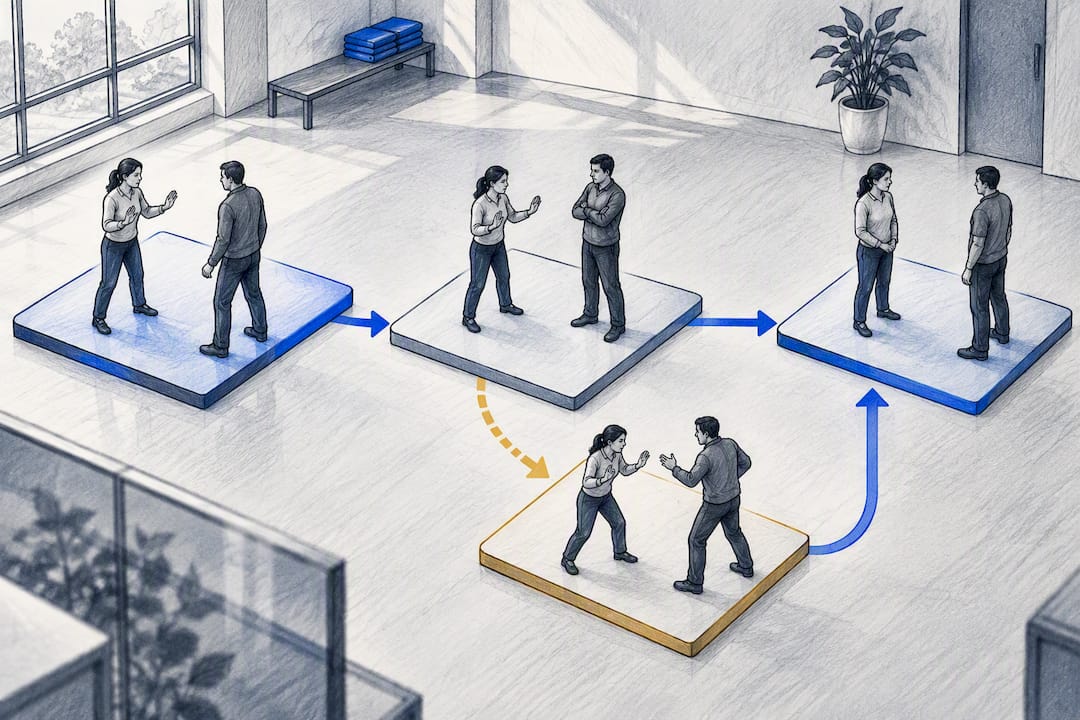
Lecture-based refreshers do not build the reflexes this work demands. Simulation and repeated, scenario-based practice are what actually build muscle memory, because a person under real stress performs the way they trained, not the way they intended to.
Pro Tip: Run at least one simulation per team per year that intentionally goes wrong, so staff practice recovering from a stalled de-escalation rather than only ever rehearsing the smooth version.
Competency should be checked, not assumed. Consider baseline retraining at intervals and full face-to-face retraining periodically, and document every pass rate for compliance and program review.
When Should Teams Escalate to Direct Intervention?
A specialized response team should activate on a defined combination of signals, not a supervisor’s gut feeling in the moment. Practical activation criteria combine observable escalation cues, such as verbal threats or fixation on a target, with staff concern or a pattern of repeated reports about the same individual.
Once a team activates, choreography matters as much as intent:
A clinical or behavioral lead directs the interaction and communicates with the individual.
Security stays present but positioned to de-escalate first, intervene physically only as a last resort.
The primary caregiver or supervisor provides context and continuity.
A designated recorder documents the sequence in real time for later review.
After any intervention, document what happened, review it with the full team, and connect the person involved with medical, legal, or trauma-informed follow-up as appropriate. Restraint use should always be the last option exhausted, never the first one reached for.
How Do You Know if Your Program Is Working?
A program only improves if someone is actually measuring it. Track the number of behavioral reports filed, response times from report to team activation, restraint or use-of-force incidents, staff injury rates, and training competency pass rates.
Number of behavioral reports filed per month or quarter
Average response time from report to team activation
Restraint and use-of-force incident counts
Staff injury rates tied to behavioral events
Training competency pass rates by role and tier
Program evaluation guidance recommends structured after-action reviews tied directly to remedial training, reviewed at least annually and more often for high-risk units. Pair the numbers with qualitative case review; a spike in reports with flat response times tells a very different story than a spike in reports with fast, effective interventions.
What Do Organizations Consistently Get Wrong?
Most organizations treat training as a one-time compliance box rather than a skill that decays without practice. That’s the gap CVPSD sees most often: staff who sat through a single lecture eighteen months ago and now have no functional recall of how to de-escalate a real, adrenaline-charged encounter.
The fix is not more content. It’s repetition, under realistic stress, with trauma-informed principles built into every scenario rather than bolted on afterward. Legally defensible reporting matters just as much as physical technique. If a report can’t survive scrutiny in an investigation or a courtroom, the observation program has a hole in it regardless of how good the training looked on paper.
If your organization hasn’t run a simulation-based tabletop in the last year, that’s the honest place to start. Not a new policy binder. A live test of whether your people actually know what to do. -Shawn Lebrock
Where CVPSD Fits Into Your Behavior Observation Program
CVPSD builds the training layer that turns a written policy into a team that actually knows what to do when a behavioral report lands. The ConflictIQ™ program series maps directly to the tiered approach outlined above, with role-specific modules from frontline awareness through advanced de-escalation and physical safety, including ConflictIQ™ 300 for managing challenging behaviors in Pre-K12 settings through co-regulation and sensory strategies.
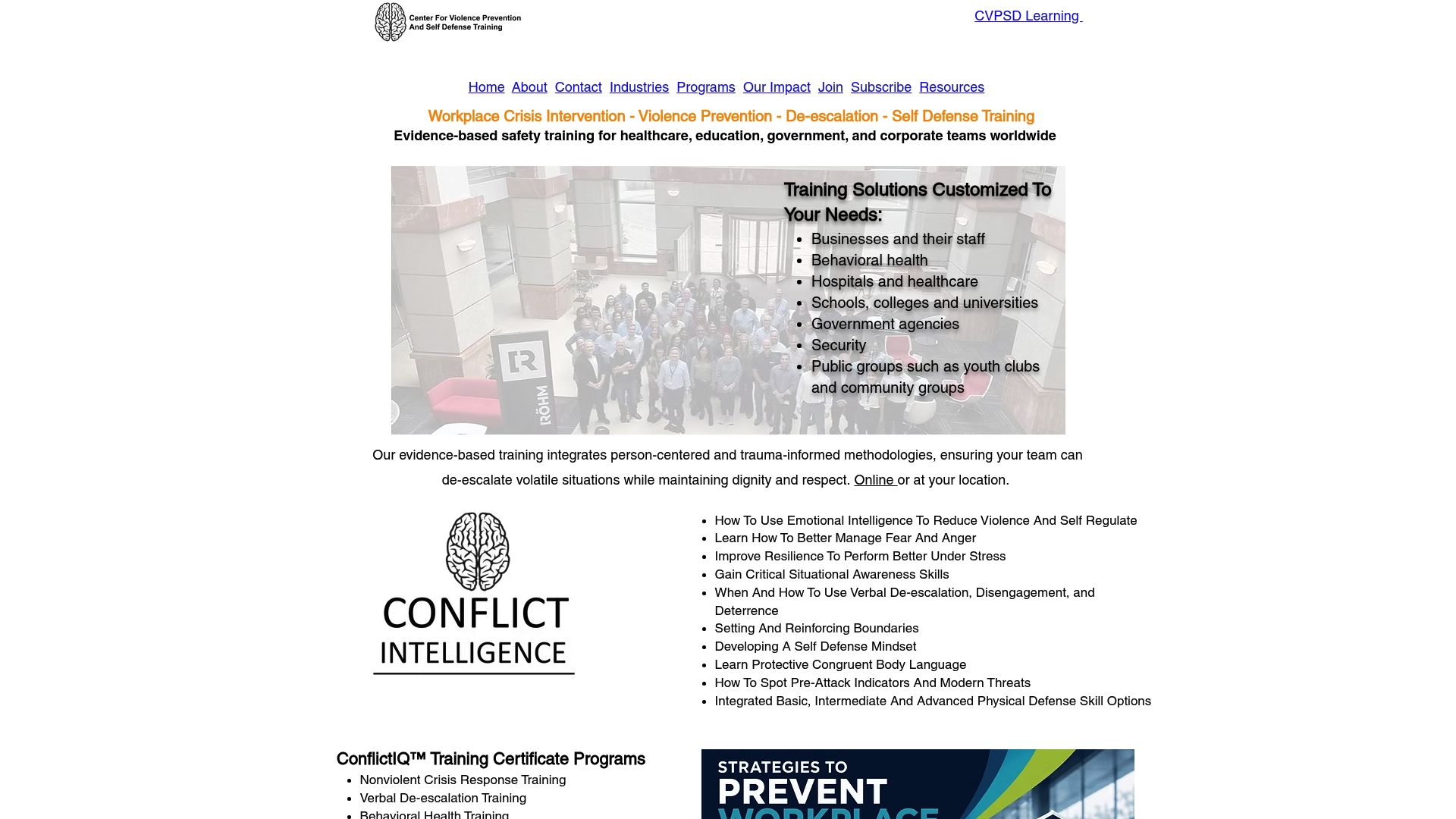
Organizations that need something built around their own risk profile can request customized training, including train-the-trainer certification and on-site simulation design. Teams that want a scalable starting point can begin with the online self-paced conflict resolution course. Programs include observed skills assessment and compliance documentation, so organizations walk away with proof of competency, not just a certificate of attendance. Reach out through the ConflictIQ™ program page to scope a session for your team.
Where to Go for the Underlying Standards
Every policy decision in this article traces back to a small set of primary documents worth keeping on hand. OSHA’s Preventing Workplace Violence roadmap lays out training and documentation expectations for healthcare facilities. The AHA BTAM resource compendium is the deepest single reference for building a threat-assessment team. CISA’s Violence in the Federal Workplace guide offers program templates federal and public-sector agencies can adapt directly.
Sources
FAQ
What Is the Difference Between Behavior Observation and Profiling?
Behavior observation focuses only on what a person is actually doing, such as pacing, raised speech, or referencing a weapon, assessed in the context of a specific situation. Profiling assumes intent based on identity or appearance, which is neither accurate nor legally defensible, and BTAM frameworks explicitly reject it.
Who Should Be on a Behavioral Emergency Response Team?
A BERT typically includes a clinical or behavioral lead, security personnel, a supervisor or primary caregiver familiar with the individual, and a recorder to document the encounter. Team-based activation criteria help the team respond consistently rather than reactively.
How Often Should Staff Retrain on De-Escalation Skills?
A reasonable baseline is competency checks at least every two years, with full face-to-face retraining every four years, though high-risk units may need more frequent refreshers and simulation practice. Lecture-only refreshers do not build the same retention as scenario-based drills.
What Should Go Into a Behavior Observation Report?
A defensible report records who was observed, what was said or done in plain observable terms, when and where it happened, and what occurred afterward. It should avoid diagnostic language or motive statements and route into a secure, access-restricted system.
Does CVPSD Offer Training Specific to Behavior Observation?
Yes. CVPSD’s ConflictIQ™ tiered programs cover role-specific observation, verbal de-escalation, and physical safety skills, along with customized on-site training and consulting for organizations building a full threat-assessment program. Current pricing details for programs are available on the organization’s website.
Recommended


