
Caregivers: Prioritize Relationship First in Self Defense

Defensive action by a caregiver is ethically acceptable only when a threat is immediate, less-harmful options have run out, and the response matches the size of the danger. Necessity and proportionality are the two tests that decide this, every time. Before that point, the ethical path always runs through de-escalation, repositioning, or exiting the room, followed by a call to 911 if the danger continues. Three questions settle most situations in the moment: Is the threat immediate? Have less-harmful options been exhausted? Is my response proportionate to the risk?
Table of Contents
Core Ethical Principles Behind Caregiver Self-Defense Ethics
Legal Considerations in Caregiver Self-Defense: Calling 911, Documenting, and Reporting
De-Escalation and Communication Techniques for Caregiving Situations
Physical Safety and Ergonomics: Preventing Injuries Before They Start
Setting Boundaries Without Breaking the Caregiving Relationship
Minimizing Trauma to the Care Recipient While Protecting Yourself
A Caregiver’s Perspective: Guilt, Boundaries, and Practical Self-Care
How CVPSD Supports Ethical, Evidence-Based Caregiver Training
Core Ethical Principles Behind Caregiver Self-Defense Ethics
Caregiver self-defense ethics rest on two ideas borrowed from medical and legal tradition: necessity and proportionality. Necessity asks whether force is genuinely required right now, not whether it would be convenient or satisfying. Proportionality asks whether the response matches the actual threat, not the caregiver’s fear or frustration in the moment.
Consider the difference between breaking free from a wrist grab and striking someone who grabbed you. A resident with dementia who grips your arm during a bath is not usually an attacker. Rotating your wrist against the thumb, the weakest point of any grip, gets you free without hurting anyone. That is proportionate. Delivering a strike in response to a grip is not, because the grip alone rarely threatens serious harm, and a strike escalates a moment that de-escalation could have closed.
Duty of care complicates this further. Caregivers owe the person in their charge a higher standard of restraint than a stranger would owe another stranger on the street. A home health aide who overreacts to a confused patient’s swinging arm isn’t just risking a lawsuit. They’re breaking the basic promise of the caregiving relationship: that the stronger, clearer-headed person in the room will absorb some risk rather than transfer harm downward. This is why clinical ethics research on antipsychotics and restraint use treats caregiver self-protection as a narrow exception, not a general permission. The literature ties any defensive intervention to liability, necessity, and proportionality conditions that must all be met, not just one.
A workable decision checklist, run silently in a few seconds, covers most real situations:
Is there an immediate risk of injury to me or someone else in the room?
Have I tried verbal de-escalation, distance, or removing the trigger?
Can I exit or reposition instead of engaging?
If I must act, is this the least harmful option available?
Will I document this within the hour, regardless of outcome?
Pro Tip: Practice the checklist out loud during a calm moment, not during a crisis. Caregivers who rehearse the sequence in advance report reaching for it automatically under stress, the same way emergency responders drill protocols until they become reflex.
Legal Considerations in Caregiver Self-Defense: Calling 911, Documenting, and Reporting
Not every incident needs a 911 call, but every incident needs a decision about whether it does. Call emergency services when there’s a weapon, a serious injury risk, a lock-in situation, or aggression that verbal and physical de-escalation have already failed to resolve. Internal escalation, meaning notifying a supervisor, case manager, or family member, is the right first step for lower-level aggression: shouting, resistance to care tasks, or confusion-driven pushing that stops once you create distance.
Documentation is the single most protective habit a caregiver can build, and it takes less than five minutes. Good documentation includes:
The time and date, written down immediately rather than reconstructed later.
What happened in plain, observable language (“resident grabbed my wrist and pulled”) rather than interpretation (“resident attacked me”).
Any witnesses present, by name.
What you did in response and why.
Any injury to either party, however minor.
Objective language matters more than most caregivers realize. “The patient became agitated” holds up in a review. “The patient tried to hurt me” invites questions you may not be able to answer later. CVPSD’s guidance on handling aggression safely reinforces the same pattern: a written record made in the moment protects both the caregiver and the person receiving care, because memory fades and disputes rarely wait a convenient length of time.
Privacy adds one more layer. HIPAA guidance for individuals makes clear that health information can be shared with supervisors, law enforcement, and emergency responders when safety is at stake, but casual disclosure to family friends or on social media is not covered by that exception. When in doubt, share the facts needed to keep everyone safe with the people whose job is to act on them, and route anything beyond that through your employer’s formal reporting channel. Independent caregivers without an employer should still keep a written log, since it becomes the record a court, adult protective services, or a family dispute will eventually ask for.
De-Escalation and Communication Techniques for Caregiving Situations
Most confrontations in caregiving never require physical response at all, because they get resolved with voice, distance, and timing. A calm, quiet voice carries more authority than an anxious torrent of instructions, and it signals to an agitated person that the room is not, in fact, an emergency.
Four habits do most of the work:
Lower and slow your voice. Rising pitch and speed read as threat or panic to someone already dysregulated, even when your words are reassuring.
Use “I” statements instead of commands. “I need a minute before we continue” lands differently than “Stop that right now,” which can read as confrontation to someone already on edge.
Adjust the environment before you adjust the person. Dimming harsh lights, turning off a blaring television, or simply stepping back three feet often resolves agitation faster than any verbal script.
Remove the specific trigger when you can identify it. If bathing time consistently produces resistance, changing the time of day or the person doing the task solves more than any de-escalation phrase will.
Rehearsal turns these habits into reflex. NIOSH’s trainer guidance for caregiving safety recommends stepwise problem solving and rehearsed scripts for difficult conversations, precisely because caregivers who plan a transfer or a hard conversation in advance make fewer panicked decisions when things get tense. Planning also gives you a natural point to loop in a supervisor, family member, or case manager: the moment a pattern of resistance or aggression repeats itself is the moment to ask for another set of eyes, not the fifth or sixth time it happens.
Pro Tip: Role-play the hardest conversation you expect to have this month with a colleague or family member before you have it for real. CVPSD’s de-escalation training builds on the same principle: rehearsed responses reduce the panic that leads to disproportionate reactions.
Physical Safety and Ergonomics: Preventing Injuries Before They Start
Most caregiver injuries have nothing to do with aggression and everything to do with lifting, bending, and transferring incorrectly. That distinction matters for self-defense ethics too, because a caregiver with a strained back or a fresh injury has fewer safe options when a real threat does appear.
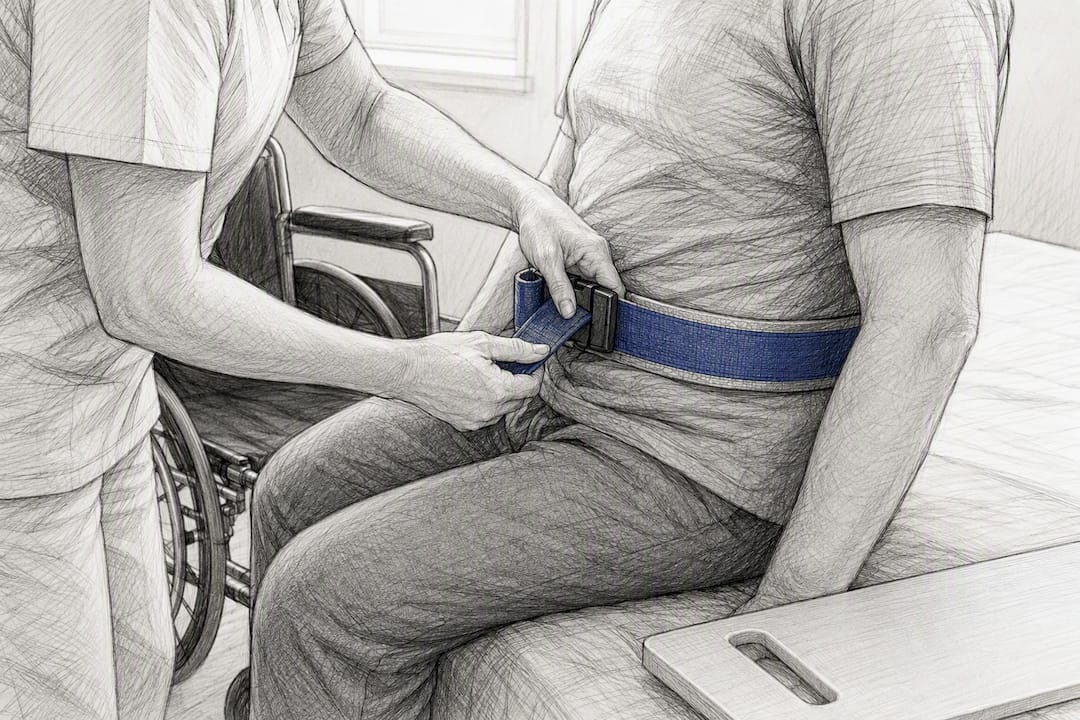
Basic body mechanics prevent most of this. Bend at the knees, not the waist. Keep the load, whether it’s a person, a laundry basket, or a wheelchair, close to your body rather than extended at arm’s length. Pivot with your feet instead of twisting your spine. NIOSH’s safe patient handling guidance recommends assistive devices, including slide boards, transfer belts, and mechanical lifts, for any transfer that strains these limits, and treats manual-only lifting of another adult body as a preventable risk rather than a normal job hazard.
Environmental fixes reduce confrontation risk as a side effect of reducing fall risk. Mayo Clinic’s fall-prevention guidance points to clutter removal, grab bars, adequate lighting, and non-slip flooring as the highest-value changes in most homes. A cluttered hallway that causes a stumble is also the kind of moment that triggers fear, confusion, and sometimes aggression in a person with cognitive decline.
A short list of hazards worth checking this week:
Loose rugs or cords in walking paths.
Poor lighting in bathrooms and stairwells.
Furniture placed too close together for a walker or wheelchair to pass safely.
Missing grab bars near the toilet and tub.
Know when to stop. If a transfer requires more strength than you safely have, if you’re alone for a two-person task, or if you feel your own fatigue compromising your judgment, the ethical and safe choice is to pause and get help, not push through.
Special Cases: Dementia, Restraints, and Medication
Cognitive impairment changes the moral weight of aggressive behavior. A person with advanced dementia who strikes out during a diaper change usually isn’t acting with intent, and the ethical response shifts from something like punishment or retaliation toward harm minimization and prevention. This distinction matters because it changes what caregivers are ethically permitted to do in response.
Clinical literature on this exact question is narrower than most caregivers expect. Peer-reviewed ethical analysis of antipsychotic and restraint use by care staff concludes that self-protective use of these interventions can be ethically defensible only in a restricted set of cases, and only when liability, necessity, and proportionality conditions are all satisfied simultaneously, not as a general fallback for difficult behavior.
The moral responsibility of a person whose aggression stems from cognitive impairment differs from the responsibility of someone acting with intent. This shifts the caregiver’s obligation from defending against a threat to preventing and de-escalating a symptom, and documenting the antecedents that triggered it becomes part of the ethical response, not just an administrative afterthought.
Practical alternatives to restraint exist and should be tried first, in most non-emergency situations:
Behavior plans that identify specific triggers, such as time of day, task type, or unfamiliar caregivers, and adjust scheduling around them.
Adequate staffing so that no single caregiver is forced into a rushed, high-friction task alone.
Clear escalation protocols that specify exactly when a supervisor or clinician gets called in.
Nonpharmacologic alternatives, including music, familiar objects, and routine consistency, tried before medication is considered.
The pattern across this research is consistent: restraint and antipsychotic use are last resorts bounded by strict conditions, never a default management tool for difficult behavior.
What Reputable Caregiver Safety Training Actually Covers
Ethical self-defense for caregivers depends heavily on training quality, and not all training is built the same way. The line to watch for is the difference between breakaway techniques, which create safe distance without injuring anyone, and pain-based restraint, which relies on discomfort to control behavior. The first fits caregiving ethics. The second rarely does, outside tightly supervised clinical settings.
Programs worth requesting or verifying should include:
Verbal de-escalation built around real caregiving scenarios, not generic workplace conflict.
Crisis intervention that covers behavior analysis, not just physical response.
Safe physical management and passive holding techniques that prioritize disengagement over control.
Documentation and reporting protocols built into the training itself.
CVPSD structures its specialized training in verbal de-escalation and safe physical management around exactly this distinction. Ask your employer what training you’ve received, request documentation of it, and if none exists, that gap is worth raising directly with a supervisor or HR contact.
Setting Boundaries Without Breaking the Caregiving Relationship
A boundary isn’t a threat to the caregiving relationship. It’s what keeps that relationship intact long enough to matter. Caregivers who never state limits, whether about physical contact, verbal abuse, or unsafe task demands, tend to burn out faster and, ironically, become less effective at the job they’re trying to protect.
Stating a boundary works best when it’s specific and calm: “I can help you with this once you let go of my arm” communicates both the limit and the path back to cooperation. That phrasing preserves dignity for the care recipient while protecting the caregiver’s physical safety.
Enforcing a boundary sometimes means stepping away temporarily rather than continuing to negotiate in the moment. A short pause, returning to the task five minutes later, often resolves what direct confrontation would have escalated. Family caregivers in particular tend to feel guilty about this kind of pause, as if leaving the room means failing the person they love. It doesn’t. It’s what allows the relationship to continue past today.
Consistency matters more than firmness. A boundary enforced sometimes and ignored other times teaches the care recipient, especially one with cognitive impairment, that testing the limit eventually works. Consistent, calm boundaries, applied the same way every time, actually reduce the frequency of the behavior they’re meant to address.
Minimizing Trauma to the Care Recipient While Protecting Yourself
Self-defense that injures a confused, frightened, or medically fragile person carries a cost that outlasts the incident itself. Even a technically justified response can leave a resident afraid of bathing, afraid of a specific caregiver, or afraid of care in general, and that fear often creates more resistance down the line, not less.
This is where necessity and proportionality do double duty. They aren’t only about protecting the caregiver from unnecessary force. They’re about protecting the care recipient from the trauma of an interaction that spiraled further than it needed to. A breakaway technique that ends the contact without pain does both jobs at once.
Timing shapes trauma as much as technique does. Ending a confrontation quickly, even if that means abandoning a task mid-stream, usually produces a better outcome than pushing through to finish. Coming back later, after both parties have settled, protects the relationship far more than powering through in the moment.
Care recipients with dementia or significant cognitive impairment often can’t process what happened the way a caregiver can. They may not remember the specific incident, but they can retain a general sense of fear or distrust toward a room, a task, or a person. That residue is worth weighing before any response, not just after.
A Real-Time Decision Framework for Self-Defense Situations
Ethical decision-making in caregiving works best as a layered process: an immediate crisis checklist first, followed by review and documentation afterward, so both the caregiver and the care recipient stay protected.
In the moment, the sequence is simple: assess the immediacy of the threat, exhaust nonviolent options, and match any response to the actual level of danger, never to your fear or frustration. This is the same necessity and proportionality test from earlier, applied under time pressure.
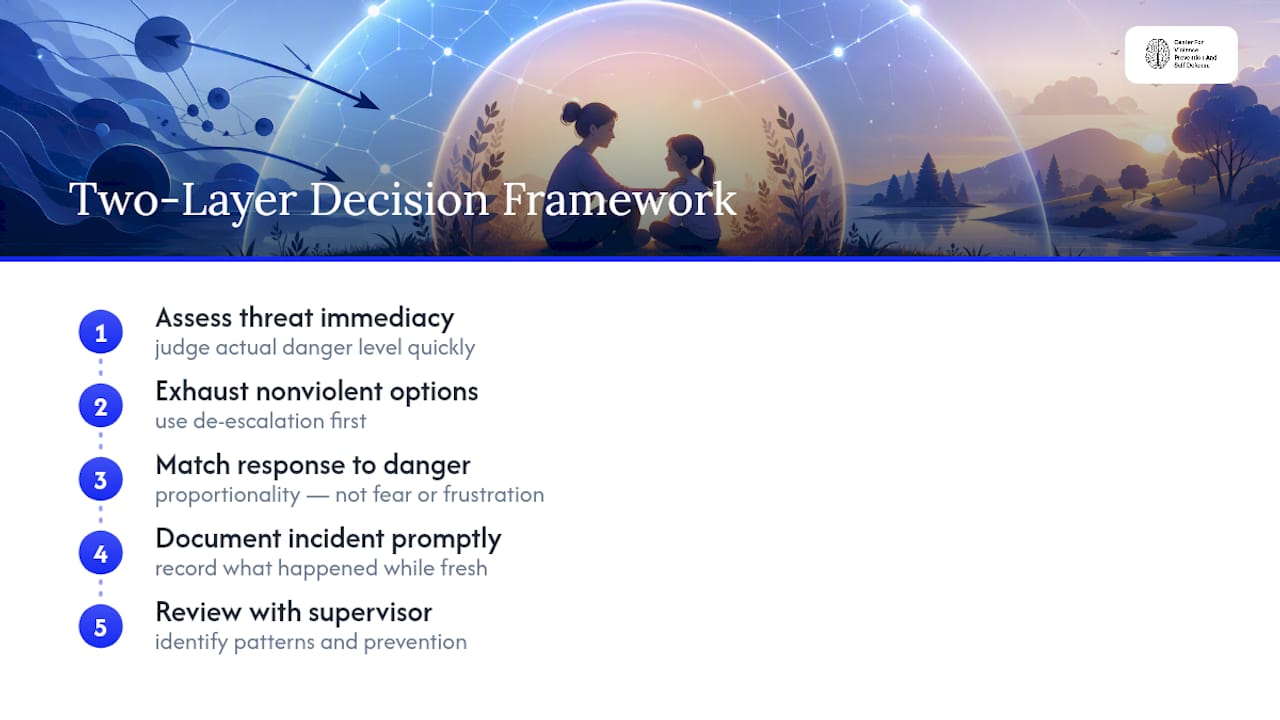
After the moment passes, the second layer takes over. Document what happened while it’s fresh, then review it with a supervisor, case manager, or trusted colleague. This isn’t about assigning blame. It’s about catching patterns a single caregiver, working alone, can’t always see. A resident who resists bathing every Tuesday might have a scheduling conflict with a specific staff member, a medication timing issue, or a sensory trigger that only becomes visible in aggregate.
The two layers work together. Skip the first, and you risk a disproportionate response in the moment. Skip the second, and you lose the chance to prevent the same situation from happening again next week.
Non-Physical Self-Defense Tools Permissible for Caregivers
Physical technique is the last layer of caregiver safety, not the first. Personal safety alarms, worn on a lanyard or clipped to clothing, let a caregiver summon help instantly without engaging physically at all, and many home health agencies now issue them as standard equipment for solo visits.
Pepper spray and similar deterrents occupy murkier ground. Legal allowances vary significantly by state and by setting, and use against a confused or cognitively impaired care recipient raises the same proportionality problems as any other force response, usually a disproportionate one given the person’s diminished capacity for intent. These tools make far more sense for caregivers facing threats from outside the care relationship, such as a home health aide traveling alone between visits in an unfamiliar neighborhood, than for de-escalating a resident’s own agitation.
Door alarms, motion sensors, and check-in apps that alert a supervisor or family member solve a different problem: they shorten the time between an incident starting and help arriving. For caregivers working alone, whether in a private home or a facility on an understaffed shift, that response time gap is often the real safety issue, more than any single confrontation.
Before carrying any deterrent tool, check your state’s specific statutes and your employer’s policy. What’s legal to carry and what’s appropriate to use against the person in your care are two separate questions, and the second one is almost always more restrictive.
A Caregiver’s Perspective: Guilt, Boundaries, and Practical Self-Care
Guilt shows up in predictable ways: replaying an incident for days, apologizing to a resident who won’t remember the moment, or feeling like enforcing a boundary was somehow a failure of compassion. None of that guilt means you did something wrong. It usually means you’re taking the responsibility seriously, which is exactly the caregiver a vulnerable person needs.
Left unaddressed, that same weight can compound into something heavier. Caregivers exposed repeatedly to aggression, unpredictable crises, or the fear of injury sometimes develop symptoms that mirror post-traumatic stress: intrusive memories of an incident, hypervigilance during routine tasks, or dread before a shift that used to feel manageable.
Rest blocks, peer support, and a standing habit of talking through hard shifts with someone who understands the work all reduce that risk over time. If dread, intrusive memories, or physical symptoms persist for more than a few weeks, that’s the signal to ask for a referral to a therapist who works with caregivers specifically.
Setting a boundary, taking a break, or asking for help is not a failure of duty. It’s the maintenance that lets you keep doing this work well.-- Shawn Lebrock
How CVPSD Supports Ethical, Evidence-Based Caregiver Training
Reading about breakaway technique and de-escalation is a start. Building the reflex under real supervision is what actually holds up during a bad shift. CVPSD, a 501©(3) nonprofit, runs training built specifically around the ethical line this article has walked through: safe disengagement over pain-based control, and preserved relationships over quick fixes.
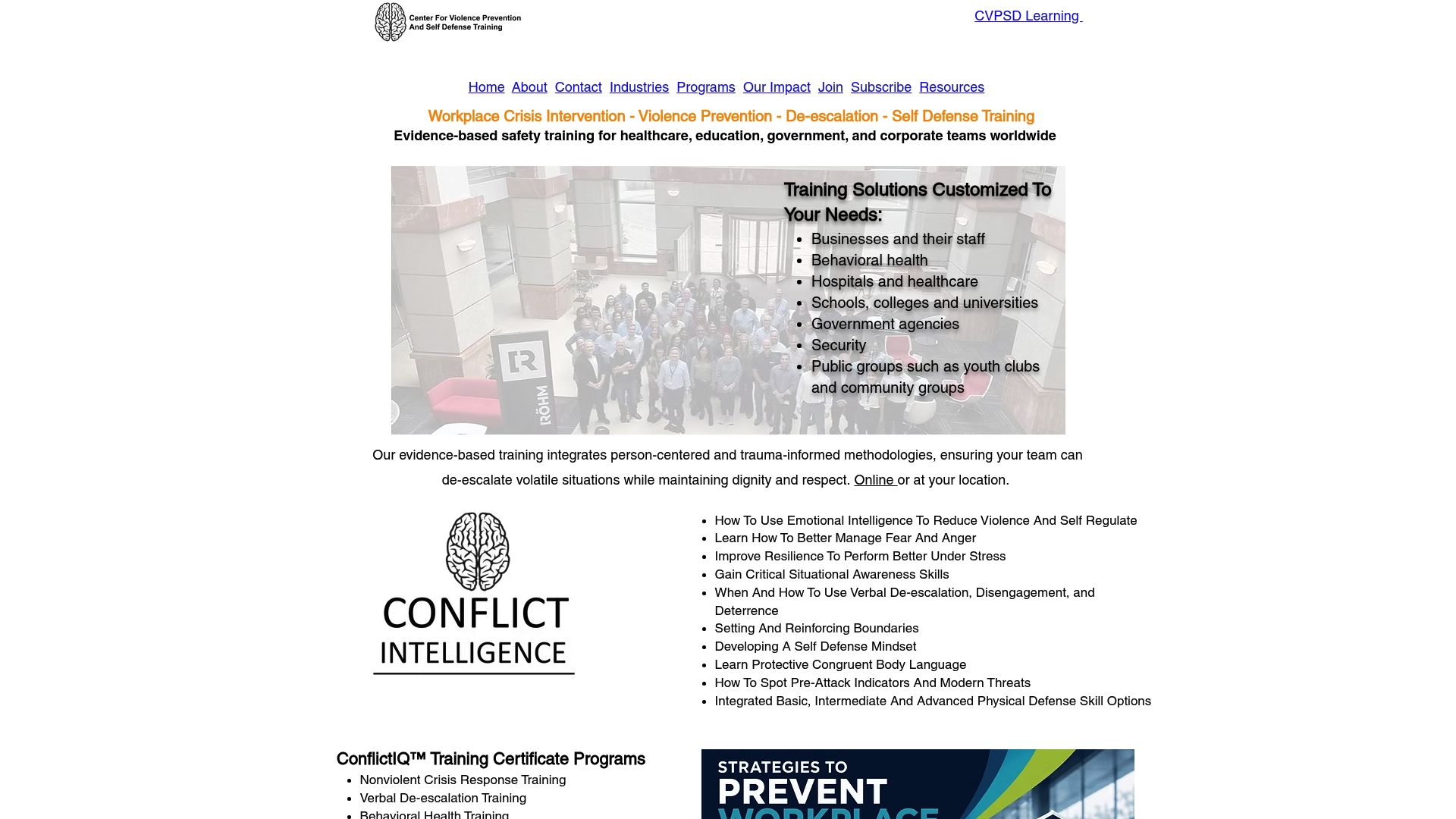
Programs cover verbal de-escalation, crisis intervention, behavior analysis, and safe physical management, delivered online or in person for healthcare teams, schools, behavioral health providers, and individual organizations, including nonprofits focused on caregiver-safety programs through Monstrous Media Group’s specialized services. Sessions are built around real caregiving scenarios rather than generic workplace conflict, which is the same distinction that separates ethical breakaway technique from restraint in the clinical literature cited earlier.
If your current training doesn’t cover documentation, escalation protocols, or nonpainful disengagement specifically, that’s a real gap worth raising with a supervisor or HR contact. Organizations looking to close that gap, whether a single facility or a multi-site healthcare system, can review CVPSD’s training programs and request a consultation to find the right fit for their staff and compliance needs.
Sources
FAQ
What Is the Caregiver Code of Ethics?
There’s no single universal document by that name, but caregiving ethics generally center on necessity, proportionality, duty of care, and preserving the dignity of the person receiving care, principles reflected in clinical ethics research on defensive interventions.
What Are the Signs of Caregiver Guilt?
Common signs include replaying incidents repeatedly, apologizing excessively, feeling responsible for a care recipient’s aggression, and struggling to accept that setting a boundary was appropriate rather than unkind.
Can Caregiving Lead to PTSD?
Repeated exposure to aggression, crisis, or fear of injury can produce trauma symptoms similar to PTSD, including intrusive memories and hypervigilance, which is why persistent dread or physical symptoms lasting several weeks warrant a referral to a therapist familiar with caregiver stress.
What Are the Symptoms of Caregiver Syndrome?
Caregiver syndrome, often described as caregiver burnout, typically includes chronic exhaustion, irritability, sleep disruption, and a diminished sense of effectiveness, and it tends to worsen when boundaries and rest are consistently neglected.
When Should a Caregiver Call 911 Instead of Handling It Internally?
Call 911 whenever a weapon is present, an injury has occurred, someone is trapped or blocked from exiting, or verbal and physical de-escalation have already failed to resolve the danger.
Recommended
About the Author: William DeMuth is the Director of Training at the Center for Violence Prevention and Self Defense (CVPSD) in Freehold, NJ. With over 35 years of research in violence dynamics and personal safety, William specializes in evidence-based training that bridges the gap between compliance and real-world conflict resolution. The architect of the ConflictIQ™ program, he holds advanced certifications and has trained under diverse industry leaders. Today, he actively trains civilians, hea


