
CMS vs Joint Commission: Roles, Surveys, and What's at Stake

CMS is the federal regulator. It sets Conditions of Participation (CoPs) that hospitals must meet to bill Medicare and Medicaid, and violating them carries legal weight. The Joint Commission is a private, voluntary accrediting body that CMS has authorized, or “deemed,” to survey hospitals on its behalf. That distinction shapes everything else in this comparison, from who shows up unannounced to what happens if a hospital fails a survey.
Here’s what that means for your compliance calendar:
CMS enforcement is non-negotiable. Falling below a Condition of Participation puts Medicare and Medicaid payment at risk.
The Joint Commission accreditation is optional, but roughly four out of five U.S. hospitals carry it anyway because it substitutes for a routine CMS survey.
Losing Joint Commission accreditation doesn’t just cost prestige. It hands survey authority back to your state CMS agency and starts a clock on Medicare participation.
Both bodies inspect similar ground, but they inspect it differently, and knowing the difference determines how you prepare.
Key Takeaways
CMS enforces legally binding Conditions of Participation tied to Medicare and Medicaid payment, while The Joint Commission provides voluntary accreditation that CMS deems as meeting those same requirements.
Point | Details |
Know the legal hierarchy | CMS sets enforceable federal rules; Joint Commission accreditation is voluntary but substitutes for a CMS survey through deeming. |
Track the deeming term | Current CMS approval of Joint Commission hospital accreditation runs through July 15, 2030. |
Use Elements of Performance as your roadmap | Joint Commission standards are usually more prescriptive than the CMS outcome they map to. |
Prepare for different survey styles | CMS surveys are complaint-driven and documentation-focused; Joint Commission uses unannounced tracer methodology. |
Protect deemed status year-round | A lapse in accreditation shifts survey jurisdiction to the state and puts Medicare participation at risk. |
Table of Contents
CMS vs Joint Commission: Roles, Authority, and Scope
CMS derives its authority from federal law. The Conditions of Participation it enforces are not suggestions; they are the legal floor a hospital must clear to bill Medicare or Medicaid at all. When a state surveyor finds a hospital out of compliance with a CoP, that finding carries the weight of federal regulation, documented through the CMS State Operations Manual, Appendix A, the rulebook state agencies use to evaluate hospitals.
The Joint Commission operates on a different premise entirely. It’s a private, nonprofit accreditor, and no hospital is legally required to seek its seal. But CMS has granted The Joint Commission “deeming authority,” meaning a hospital that earns Joint Commission accreditation is treated as having already met the CoPs, without a separate CMS survey. That arrangement was just renewed: a Federal Register final notice confirms CMS approval of The Joint Commission’s hospital accreditation program runs from July 15, 2025, through July 15, 2030.
Deeming doesn’t mean CMS steps back entirely. CMS retains validation survey rights, meaning it can still show up at a deemed hospital to check whether Joint Commission surveys are catching real problems.
Where the two differ on scope:
The Joint Commission accredits across the full continuum of care, including hospitals, ambulatory surgery centers, behavioral health, home care, and assisted living.
CMS regulates Medicare and Medicaid-participating providers directly, with CoPs tailored to each setting.
Joint Commission accreditation cycles typically run three years (two years for laboratories), while CMS oversight is continuous and complaint-driven.
For most hospitals, deemed status is the whole game: it converts a mandatory federal inspection into a voluntary accreditation survey conducted by a body they can actually plan around.
How CMS and Joint Commission Standards Line Up
Compliance teams often ask which Joint Commission standard “counts” as proof of meeting a specific CMS Condition of Participation. The honest answer is that most Joint Commission standards go further than the CoP they map to. CoPs describe outcomes a hospital must achieve; Joint Commission standards typically prescribe the process, documentation, and leadership accountability required to get there, according to a legal analysis of deeming authority.
That gap is useful. Rather than treating CoPs and Joint Commission standards as two separate checklists, most compliance officers use Joint Commission’s more granular Elements of Performance as their implementation roadmap for satisfying the broader federal requirement.
Four areas show this pattern most clearly:
Life safety and environment of care: CMS requires a safe physical environment; Joint Commission specifies fire drills, equipment testing intervals, and documentation formats.
Infection prevention: CMS sets an outcome standard; Joint Commission details surveillance systems, hand hygiene audits, and reporting chains.
Emergency management: CMS requires an emergency plan; Joint Commission mandates a hazard vulnerability analysis and specific exercise frequency.
Performance improvement: CMS expects ongoing quality assessment; Joint Commission ties this to its ORYX performance measurement program and continuous survey readiness.
CMS Condition of Participation Area | Joint Commission Approach |
Environment of care (outcome: safe facility) | Prescribes drill frequency, equipment logs, documentation formats |
Infection prevention (outcome: reduced infection risk) | Prescribes surveillance systems, audit cadence, reporting structure |
Emergency preparedness (outcome: functional emergency plan) | Requires hazard vulnerability analysis and set exercise schedule |
Performance improvement (outcome: ongoing quality review) | Ties measurement to ORYX data submission requirements |
The mapping isn’t static. The Joint Commission’s Accreditation 360 initiative reorganized large sections of its standards manual. The underlying CoP obligations didn’t change, but the structure compliance teams use to demonstrate them did, which means a crosswalk document built even a year ago may already be outdated.
What to Expect During a CMS or Joint Commission Survey
The two surveys feel almost nothing alike, and knowing the difference changes how you prepare staff.
A state CMS survey is usually triggered by a complaint, a reported adverse event, or a routine cycle for non-deemed facilities. Surveyors work from the CMS State Operations Manual and document findings on Form CMS-2567, the Statement of Deficiencies. A CoP-level finding can trigger a required plan of correction with a hard deadline, and repeated or severe deficiencies can escalate toward termination of Medicare participation.
A Joint Commission survey works differently, built around tracer methodology:
Surveyors arrive unannounced, typically within the accreditation cycle window rather than on a published schedule.
A surveyor selects an individual patient’s chart and physically follows that patient’s care path across every department involved, from admission to discharge.
Staff are interviewed in real time along that path, and how clearly they can explain a process often matters as much as the paperwork itself.
Findings are scored against specific Elements of Performance, not the broader outcome language CMS uses.
Staff who understand why a tracer surveyor is asking a particular question tend to answer with more confidence, and confident, consistent answers shorten the depth of a tracer review.
Pro Tip: Run your own mock tracer twice a year. Pick a random patient chart and walk it through every department exactly as a Joint Commission surveyor would. The gaps you find in a mock tracer are almost always the same gaps a real surveyor would find.
Priorities for Staying Ahead of Both CMS and Joint Commission
Compliance teams that treat CMS and Joint Commission requirements as one integrated system, rather than two parallel obligations, spend less time on duplicate paperwork and catch gaps earlier.
Start with these priorities:
Document outcomes, not just activities. A CoP finding cares about the result; make sure every process log ties back to the outcome it’s supposed to demonstrate.
Use Joint Commission Elements of Performance as your build plan. They’re more specific than CoP language, so meeting them usually satisfies the federal requirement automatically.
Fold OSHA requirements into your Joint Commission documentation. OSHA’s own comparison materials show significant overlap between safety and health management system elements and Joint Commission standards, and duplicating that paperwork wastes staff hours.
Track your accreditation renewal date like a deadline, not a calendar note. A lapse in deemed status means an immediate return to state CMS survey jurisdiction.
Draft plans of correction before you need one. Facilities that already have a Form CMS-2567 response template lose less time when a real deficiency notice arrives.
Nearly four out of five U.S. hospitals carry Joint Commission accreditation specifically to avoid the unpredictability of state CMS survey scheduling. That number reflects how much operational value hospitals place on staying inside the deemed status system rather than outside it.
How CVPSD Training Supports Joint Commission and CMS Expectations
Survey findings frequently come down to whether staff can demonstrate competency, not just whether a policy exists on paper. That’s where structured training closes a gap that written policy alone can’t.
CVPSD’s programs are built around the same documentation and evidence trail that tracer surveyors look for:
Crisis intervention and de-escalation training that supports restraint and seclusion documentation requirements in behavioral health settings.
Trauma-informed care instruction built to align with both CMS and Joint Commission expectations simultaneously, rather than treating them as separate training tracks.
Workplace violence prevention programming designed to hold up as court-defensible documentation if a Joint Commission surveyor or CMS investigator asks for proof of staff competency.
Pro Tip: When a surveyor interviews staff during a tracer, the goal isn’t a perfect script. It’s staff who can calmly explain what they were trained to do and why. That calm, specific answer is often the difference between a passing note and a documented finding.
How CMS and The Joint Commission Came to Share Authority
The relationship between these two bodies goes back further than most compliance officers realize. The Joint Commission traces its roots to hospital standardization efforts from the early twentieth century, well before Medicare existed. When Congress created Medicare in 1965, lawmakers needed a fast way to determine which hospitals were safe enough to participate, and Joint Commission accreditation already existed as a working quality benchmark.
Rather than build a new federal inspection system from scratch, Congress granted Joint Commission-accredited hospitals “deemed status,” meaning accreditation would automatically satisfy the new Medicare Conditions of Participation. That decision, made decades ago, still shapes the entire structure you’re navigating today.
CMS itself evolved alongside this arrangement, first as the Health Care Financing Administration before being renamed in 2001. Throughout those changes, the core deeming relationship stayed intact: CMS periodically reviews and re-approves The Joint Commission’s authority, most recently through the Federal Register notice extending approval through July 15, 2030.
That history explains why the two systems feel so intertwined rather than competing. They were designed from the start to function as one pipeline, federal law setting the floor and a private accreditor doing the verification work.
Survey Frequency and Scheduling: What Actually Differs
Non-deemed hospitals face CMS surveys on a rolling, largely unpredictable schedule driven by complaints, reported incidents, or periodic state agency cycles. There’s no fixed three-year rhythm; a facility with a clean record might go years between full surveys, while one with recent complaints could see a surveyor within weeks.
Joint Commission accreditation runs on a defined cycle. Most organizations are surveyed roughly every three years, with laboratories on a two-year cycle, but the exact date within that window stays unannounced. A hospital knows its accreditation is due for renewal sometime in a given year, but not the specific week a surveyor walks through the door.
That unannounced element is deliberate. It’s meant to catch the hospital operating in its normal state rather than in survey-prep mode. Facilities that treat survey readiness as a continuous posture, rather than a pre-visit scramble, consistently perform better on both fronts because the systems being tested, staff knowledge, documentation habits, safety rounds, are the same ones running every other day of the year.
The practical scheduling difference comes down to certainty versus unpredictability: Joint Commission gives you a general window, CMS often gives you none at all unless a complaint triggers an unscheduled visit.
How Hospital Leaders View These Two Systems Differently
Ask a hospital administrator which body they worry about more, and the answer usually splits by role. Chief financial officers tend to focus on CMS, because CoP violations connect directly to Medicare and Medicaid reimbursement, the largest revenue stream for most hospitals. A serious CoP finding isn’t just a compliance headache; it’s a threat to the organization’s core funding model.
Quality and accreditation officers often see Joint Commission surveys as the more operationally demanding event. Tracer methodology touches nearly every department in a single visit, and preparing for it means coordinating dozens of teams around consistent documentation and staff readiness.
Frontline clinical staff generally experience Joint Commission surveys as more visible and personal. They’re the ones being interviewed mid-shift, asked to explain a process they perform daily but rarely have to articulate out loud. CMS surveys, by contrast, often happen in the background, involving chart review and administrative interviews that clinical staff may never directly witness.
Both perspectives are accurate reflections of where each body’s authority actually lands. CMS holds the financial leverage; The Joint Commission holds the operational microscope. A hospital that only prepares for one of those pressures is exposed on the other.
How Accreditation Status Affects Reimbursement and Funding
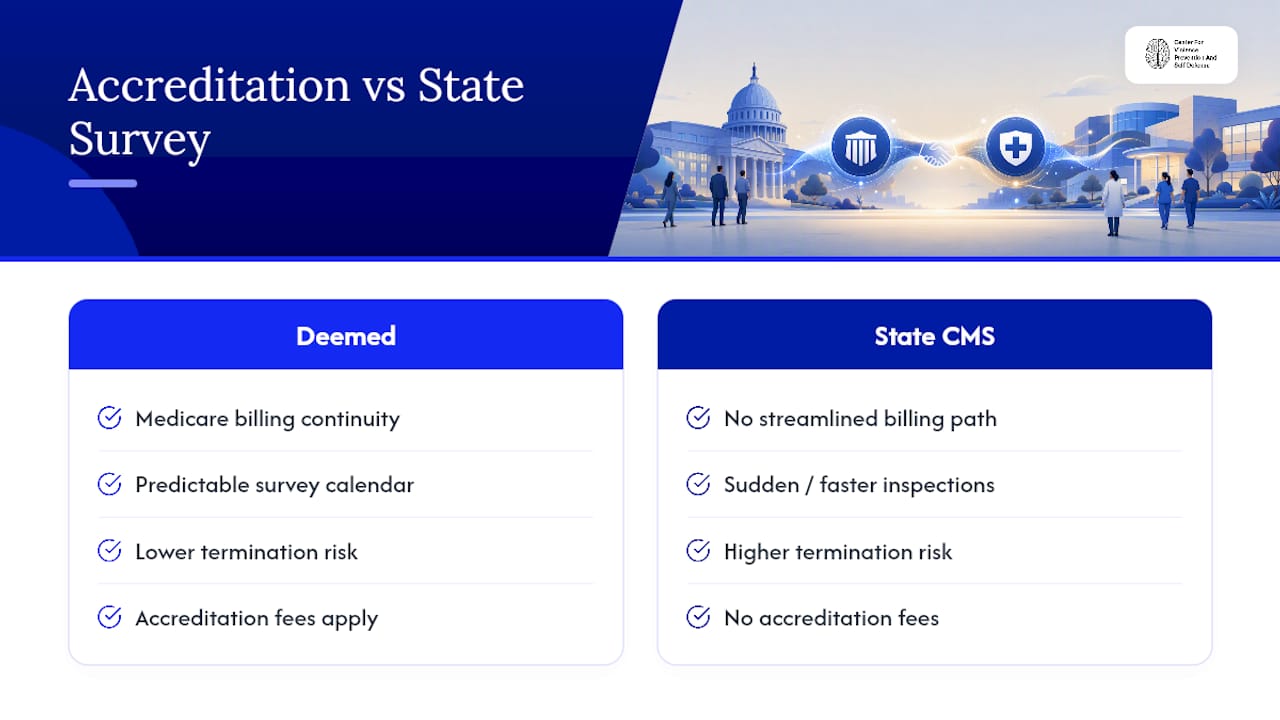
The clearest financial argument for maintaining Joint Commission accreditation isn’t prestige. It’s the direct line between deemed status and Medicare billing continuity. A hospital that loses accreditation doesn’t automatically lose Medicare participation, but it loses the streamlined path to proving CoP compliance, and the state survey agency immediately assumes jurisdiction for CMS monitoring.
That jurisdictional handoff has real consequences. State surveys move at a different pace than Joint Commission’s accreditation calendar, and a facility scrambling to demonstrate compliance under sudden state scrutiny can face a faster path toward termination from Medicare if remediation doesn’t succeed quickly, a scenario laid out in Joint Commission’s own guidance materials on what happens after accreditation is lost.
For most hospitals, Medicare and Medicaid represent the majority of patient revenue, which is why the financial stakes of losing deemed status extend well beyond the cost of the accreditation program itself. It’s not just about paying survey fees to Joint Commission versus dealing with a free state inspection. It’s about which path keeps reimbursement flowing without interruption.
Some smaller facilities weigh the cost of Joint Commission’s accreditation fees against the administrative burden of direct CMS survey participation. In most cases, the predictability and operational efficiency of deemed status wins out, which is part of why accreditation remains so widespread despite being entirely voluntary.
Deficiency Patterns: What Each Body Tends to Flag
CMS state surveys and Joint Commission tracer surveys don’t always catch the same problems, because they’re looking through different lenses.
CMS surveyors, working from the State Operations Manual, tend to flag CoP-level outcome failures: inadequate infection control outcomes, incomplete emergency preparedness plans, or documented instances where patient rights were violated. These findings land on Form CMS-2567 and often stem from a specific complaint or reported incident rather than a broad sweep.
Joint Commission tracer surveys, by contrast, tend to surface process and communication gaps that might never trigger a formal complaint but still represent real risk. A common example: a nurse who performs a safety check correctly but can’t articulate the reasoning behind the specific interval, revealing a training gap rather than a procedural failure. Documentation inconsistencies between departments, a chart that shows one story in nursing notes and another in physician notes, show up frequently in tracer reviews precisely because tracers follow one patient across every touchpoint.
The overlap matters too. Environment of care issues, like blocked fire exits or expired equipment certifications, show up in both survey types, because both organizations treat physical safety as a baseline. The difference tends to be depth: a CMS surveyor documents the violation, while a Joint Commission surveyor is more likely to probe why the process that should have caught it failed in the first place.
Recent Policy Changes Compliance Teams Need to Track
Two developments from the past year deserve a spot on every compliance calendar. First, the Federal Register’s June 2025 final notice formally renewed CMS approval of The Joint Commission’s hospital accreditation program through July 15, 2030, confirming the deeming relationship stays intact for the next several survey cycles.
Second, The Joint Commission’s Accreditation 360 restructuring reorganized how standards are grouped and presented across its manual. The underlying requirements tied to CMS Conditions of Participation didn’t disappear or loosen, but the framework compliance teams use to track them changed, which means internal crosswalk documents built against the old structure need a fresh review.
Neither change should surprise anyone who’s watched this relationship over time. Both bodies periodically update their frameworks, and the pattern is consistent: CMS renews or adjusts deeming terms on a multi-year cycle, while Joint Commission refines its standards more frequently in response to clinical practice shifts and survey data. What compliance teams should take from this is less about the specific changes and more about the cadence. Treat both CMS’s approval renewals and Joint Commission’s standard updates as recurring calendar events, not one-time news items, and assign someone specific ownership of monitoring each.
What Compliance Officers Get Wrong About This Comparison
Most articles on this topic treat CMS and The Joint Commission as competing systems, as if choosing one means avoiding the other. That framing misleads compliance teams into building two separate compliance tracks when the far more efficient approach is building one integrated system where Joint Commission’s Elements of Performance serve as the operational proof of CMS’s outcome requirements.
The bigger blind spot is training. Written policies satisfy an auditor’s checklist, but tracer surveyors are testing whether staff actually understand what they’re doing and why. A nurse who can explain the reasoning behind a de-escalation protocol, not just recite that one exists, is the difference between a smooth tracer interaction and a documented finding.
What I’d prioritize first, if I were advising a compliance team today, isn’t another policy binder. It’s structured, recurring staff training tied directly to the scenarios most likely to surface during a tracer: crisis response, restraint documentation, and workplace violence prevention. Those are exactly the areas where paper compliance and demonstrated competency diverge most sharply, and where a court, or a surveyor, will ask staff to show their work.
— Shawn Lebrock
Sources
FAQ
What Is the Difference Between CMS and Joint Commission?
CMS is the federal agency that enforces legally binding Conditions of Participation for Medicare and Medicaid; The Joint Commission is a private, voluntary accreditor that CMS has authorized to verify compliance with those same conditions.
Does The Joint Commission Work With CMS?
Yes. CMS grants The Joint Commission “deeming authority,” meaning Joint Commission accreditation substitutes for a routine CMS survey, an arrangement most recently renewed through July 15, 2030.
Who Competes With The Joint Commission?
Other CMS-approved accrediting organizations exist for specific facility types, but The Joint Commission remains the accreditor used by roughly four out of five U.S. hospitals, making it the dominant choice in the hospital sector.
Is Joint Commission Accreditation Only for Hospitals?
No. Joint Commission accreditation covers the full continuum of care, including ambulatory surgery centers, behavioral health facilities, home care agencies, and assisted living communities, not just hospitals.
Recommended


