
How to De-escalate Hostile Customer Interactions

Updated: Aug 13

To de-escalate hostile customer interactions in the first 60–120 seconds, use three steps: calm yourself first, validate the customer’s emotion, then offer one concrete next step. That sequence short-circuits the threat response before it peaks. Shawn Lebrock and the team at CVPSD (Center for Violence Prevention and Self-Defense) have built an evidence-based curriculum around exactly this progression, grounded in behavioral science and real-world crisis intervention.
Quick reference:
Say: “I hear how frustrated you are. Let’s figure this out together.”
Do: Drop your voice register, slow your pace, and keep your posture open and still.
Offer: One specific option, not a menu of five.
Exit rule: If a customer threatens violence, displays a weapon, or becomes physically aggressive, disengage immediately and contact security or law enforcement. No interaction is worth personal safety.
Table of Contents
What should you say in the first 60–120 seconds?
The fastest way to lower tension is to stop arguing and start acknowledging emotions. Scripts built around “I” statements and policy recitations tend to fail because they signal opposition. Partnership language signals collaboration.
Sample scripts by channel:
In-person or phone:Live chat or DM:When the customer interrupts or raises their voice: Notice the consistent use of “we,” “let’s,” and “together.” Partnership framing shifts the dynamic from adversarial to collaborative, which measurably reduces perceived threat. Avoid “calm down” entirely. Practitioners call that instruction the De-escalation Paradox: telling someone to calm down typically increases their emotional arousal rather than reducing it.
Nonverbally, drop your vocal register by roughly half an octave and speak about 20% slower than your normal pace. On a phone call, that slower cadence signals composure. In person, keep your hands visible, your posture open, and maintain a respectful physical distance.

Pro Tip: Before you respond to an escalating customer, take one slow breath, silently say a three-word anchor phrase (“I am calm”), then paraphrase what you just heard. That micro-routine takes under five seconds and resets your own nervous system before you speak.
Why do these tactics actually work?
When a person is enraged, the brain’s threat-detection system dominates and prefrontal logic processing is impaired. Presenting facts, policies, or logical rebuttals at that moment is largely ineffective because the part of the brain that processes reasoned argument is not fully online. The emotional centers are running the show.
Labeling an emotion out loud (“You sound really frustrated”) activates the prefrontal cortex and reduces amygdala activation. That is not intuitive, but it is well-supported in behavioral science. The act of naming the feeling gives the nervous system a signal that the threat is being acknowledged, which allows it to begin downshifting.
The De-escalation Paradox in practice: Validation is not agreement. Saying “I understand why you’re upset” does not mean the customer is right. It means you recognize their emotional state, which is the fastest path to restoring their capacity for rational conversation.
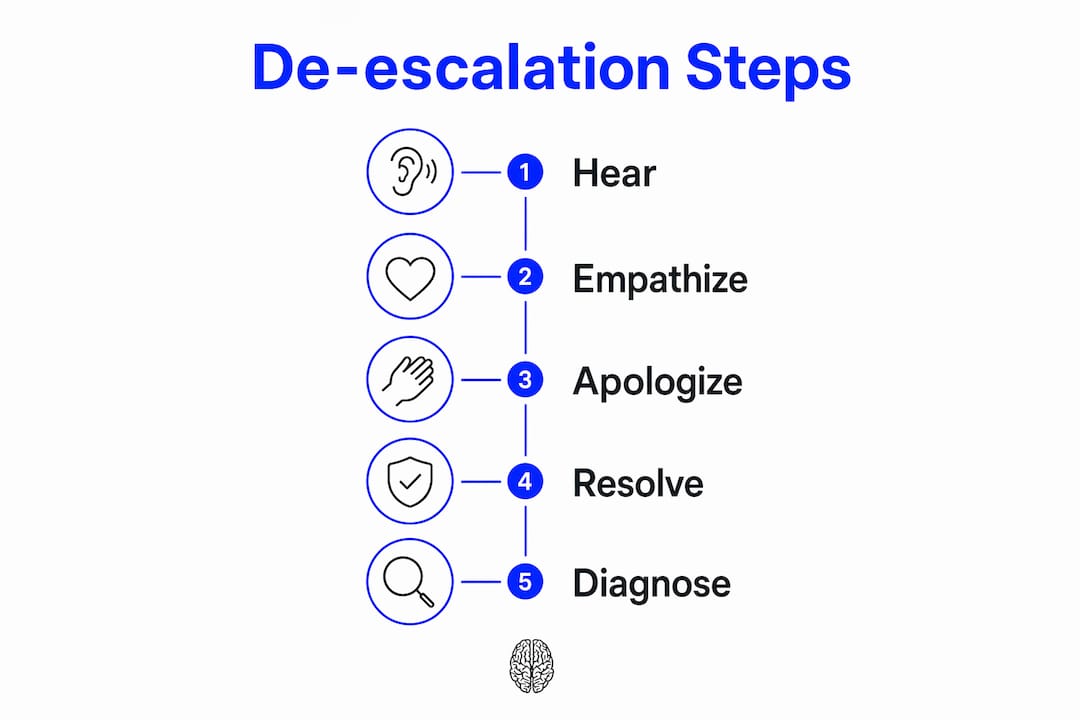
The HEARD framework (Hear, Empathize, Apologize, Resolve, Diagnose) operationalizes this sequence. It gives agents a repeatable structure: hear the full complaint, empathize without deflecting, apologize for the experience, resolve with a concrete step, then diagnose the root cause afterward. The framework works because it mirrors the neurological sequence the customer needs to move through.
When should you stop de-escalating and exit?
Some situations require disengagement, not continued engagement. Knowing the difference protects both staff and customers.
Red flags that require immediate disengagement:
Direct verbal threats of violence toward staff or others
Display or mention of a weapon
Physical aggression or invasion of personal space with intent to intimidate
Stalking behavior (following staff, repeated unwanted contact)
Severe intoxication that makes rational communication impossible
Safety checklist by channel:
Phone: State clearly, “I need to end this call now,” then disconnect. Document the call time, content, and any threats verbatim.
Live chat: Screenshot the conversation before closing the session. Escalate to a supervisor and flag the account.
In-person: Keep visual access to an exit. Signal a colleague if possible. Do not turn your back. Leave the area calmly and contact security.
After any incident, document consistently: record the date, time, channel, verbatim threats, and names of witnesses. That documentation supports HR decisions, legal review, and pattern analysis. Agents should have clear authority to escalate without fear of reprimand for “losing” the interaction.
How should organizations treat hostile interactions at a system level?
Individual tactics only go so far. Organizations that treat each hostile interaction as an isolated event miss the larger signal. Complaints are high-quality data about where processes are failing, and recurring hostility often points to a fixable system problem rather than a difficult customer.
Harvard negotiation experts advise moving beyond “the customer is always right” and training managers in interest-based negotiation: surface the underlying need driving the complaint, not just the surface demand. A customer who screams about a refund may actually need acknowledgment that their time was wasted. Addressing the real need resolves the interaction faster.
For recurring complaint patterns, use a 5 Whys root-cause session with frontline staff and cross-functional owners. Ask “why” five times until the process failure is visible, then assign a named owner and a due date.
Complaint type | Likely system fix | Owner role |
Repeated billing errors | Audit billing workflow; add confirmation step | Finance / Operations |
Long wait times | Staffing model review; callback option | Workforce Management |
Policy confusion | Rewrite customer-facing policy language | Communications / CX |
Unresolved prior complaints | Implement case-tracking with follow-up triggers | Customer Service Manager |
Empower frontline staff with defined decision authority: a goodwill gesture limit, a clear escalation path, and a simple incident log. When agents know exactly what they can offer and when to escalate, they handle difficult customers with more confidence and less stress.
How do you choose the right de-escalation training?
Not all programs are equal. Before committing, ask vendors these questions directly:
What are the instructors’ credentials and real-world crisis intervention experience?
Does the curriculum include scenario-based practice hours, not just lecture?
Is trauma-informed content included for staff who may themselves carry stress responses?
How is learning measured after training (assessments, observed role-plays, post-training metrics)?
Does the program align with state and local laws and your organization’s policies?
Modality considerations: In-person training with live scenario practice produces the strongest skill transfer for high-risk roles. Blended formats (online modules plus in-person simulation) work well for large organizations needing scalable rollout. Online-only programs suit refresher training and lower-risk roles.
High-quality programs combine didactic instruction with scenario role-plays, instructor coaching, and documented outcome measurement. A program that ends at the classroom door, with no follow-up evaluation, is not a complete training investment. Expect initial training to run several hours to a full day for frontline staff, with role-based refreshers every 6–12 months to maintain skill retention.
What does a strong de-escalation curriculum include?
A well-designed program covers more than scripted phrases. Look for these core modules and practice expectations:
Core curriculum modules:
Threat recognition and early warning signs of escalating hostility
Verbal de-escalation language: emotion labeling, partnership framing, active listening
Trauma-informed engagement for staff and customers
Safety protocols and physical positioning
Escalation procedures and documentation
Practice expectations:
Scenario role-plays with coached feedback
Video review of recorded practice for objective self-assessment
Live simulation with realistic customer personas
Expected learner outcomes:
Paraphrase a customer’s concern accurately before responding
Set and hold a boundary calmly without escalating the interaction
Recognize red flags and execute a safe disengagement
Complete an incident report with verbatim documentation
Measurement matters. Look for programs that use post-training assessments and observed role-play scoring, not just attendance records. The CVPSD verbal de-escalation series includes all of these elements and is built around evidence-based crisis intervention principles. For healthcare-specific contexts, de-escalation guidance for clinical staff addresses the additional complexity of patient-facing roles.
CVPSD offers evidence-based training for organizations ready to act
CVPSD is a 501©(3) non-profit that delivers crisis intervention and verbal de-escalation training to frontline staff, managers, clinical teams, and security personnel across the United States. Unlike generic customer service workshops, CVPSD’s programs are grounded in behavioral science, scenario-based practice, and measurable post-training outcomes.
Offerings relevant to hostile customer interactions include verbal de-escalation workshops, manager-level crisis response training, scenario simulations, and refresher modules. CVPSD partners with public agencies, private organizations, schools, nonprofits, and government bodies, and all programs are designed to meet state and local legal requirements.
The engagement path is straightforward: contact CVPSD for a needs assessment, run a pilot with a target team, then scale to a full organizational rollout with documented outcomes. To get started, visit CVPSD’s training programs and request an assessment for your organization.
Key Takeaways
Effective de-escalation combines immediate verbal tactics, neurological awareness, and organizational systems that treat complaints as data rather than disruptions.
Point | Details |
Validate before you explain | Lead with emotion acknowledgment; logical rebuttals fail when the amygdala is activated. |
Use partnership language | “We” and “let’s” reduce perceived threat and shift the dynamic to collaboration. |
Know your exit rule | Disengage immediately when threats, weapons, or physical aggression appear. |
Treat complaints as system data | Use 5 Whys and cross-functional review to fix root causes, not just individual incidents. |
Choose training with scenario hours | CVPSD’s evidence-based curriculum includes role-plays, coaching, and measurable outcomes. |
The case for treating de-escalation as a core organizational skill
Most organizations train customer service staff on product knowledge, systems, and scripts. Very few treat de-escalation as a foundational competency that requires the same rigor as any other professional skill. That gap is where preventable incidents happen.
The neuroscience is clear: an angry person cannot be reasoned with until their nervous system has downshifted. That means the first 60–120 seconds of a hostile interaction are not about solving the problem. They are about creating the neurological conditions in which problem-solving becomes possible. Staff who understand that distinction handle difficult customers differently. They stop defending and start acknowledging. They stop talking faster and start slowing down.
At the organizational level, the same principle applies. Treating every hostile interaction as a one-off coaching opportunity misses the pattern. When the same complaint type generates hostility repeatedly, that is a process failure, not a people failure. The organizations that reduce hostile interactions over time are the ones that run root-cause analysis on complaint patterns and fix the upstream conditions.
CVPSD’s approach connects both levels: individual skill-building through scenario practice and organizational prevention through evidence-based curriculum design. That combination is what separates training that changes behavior from training that fills a compliance checkbox.
Useful sources and further reading
For frontline staff:
The De-escalation Paradox: neuroscience of angry customers — explains why validation works and logic fails
HEARD framework and de-escalation phrases — practical scripting guide
Active listening and service recovery paradox — step-based response and loyalty recovery
How to handle aggressive customers — CVPSD tactical guide
De-escalation lines that work better than “calm down” — CVPSD language reference
Dealing with difficult conversations with aging adults — useful for staff in elder care or caregiving contexts
For managers and training decision-makers:
Interest-based negotiation for difficult customers — Harvard Program on Negotiation
5 Whys for customer complaint root-cause analysis — structured process guide
Turning complaints into system improvements — operational framing
Spotting root causes before complaints escalate — Customer Service Manager Magazine
CVPSD verbal de-escalation training series — curriculum overview and outcomes
FAQ
What are the first steps to de-escalate a hostile customer?
Validate the emotion first (“I hear how frustrated you are”), use partnership language (“let’s work through this together”), then offer one concrete next step. Avoid logical rebuttals until the customer’s nervous system has downshifted.
Why does telling someone to “calm down” make things worse?
Practitioners call this the De-escalation Paradox: the instruction to calm down typically increases emotional arousal rather than reducing it. Labeling the emotion instead (“You sound really upset”) activates the prefrontal cortex and helps the nervous system downshift.
When should a staff member stop trying to de-escalate?
Disengage immediately when a customer makes direct threats of violence, displays a weapon, becomes physically aggressive, or is severely intoxicated. Document the incident with verbatim notes and notify security or law enforcement as appropriate.
What should organizations look for in de-escalation training?
Look for programs with credentialed instructors, scenario-based practice hours, trauma-informed content, and documented post-training measurement. CVPSD’s evidence-based curriculum includes all of these elements and is designed to meet state and local legal requirements.
How often should de-escalation training be refreshed?
Role-based refreshers every 6–12 months help maintain skill retention, particularly for frontline staff in high-contact roles. Initial training should include live scenario practice, not just lecture, to build durable behavioral responses.
Recommended


