
Evidence Based Realistic De-Escalation Training Guide

EVIDENCE-BASED DE-ESCALATION TRAINING
COMPREHENSIVE COURSE GUIDE
Designed for Law Enforcement, Public Safety, and Professional Personnel
Managing Interpersonal Conflict in Dynamic, High-Stress Environments
Science-Based | Operationally Realistic | Behaviorally Grounded Grounded in human performance research to build practical skills in tactical decision-making, behavioral assessment, and professional communication. |
SECTION 1: PROGRAM OVERVIEW
1.1 Course Purpose and Philosophy
This Evidence-Based De-Escalation Training course is designed for law enforcement officers, public safety professionals, and personnel involved in managing interpersonal conflict. It delivers science-based strategies to recognize, assess, and respond effectively during dynamic, high-stress encounters.
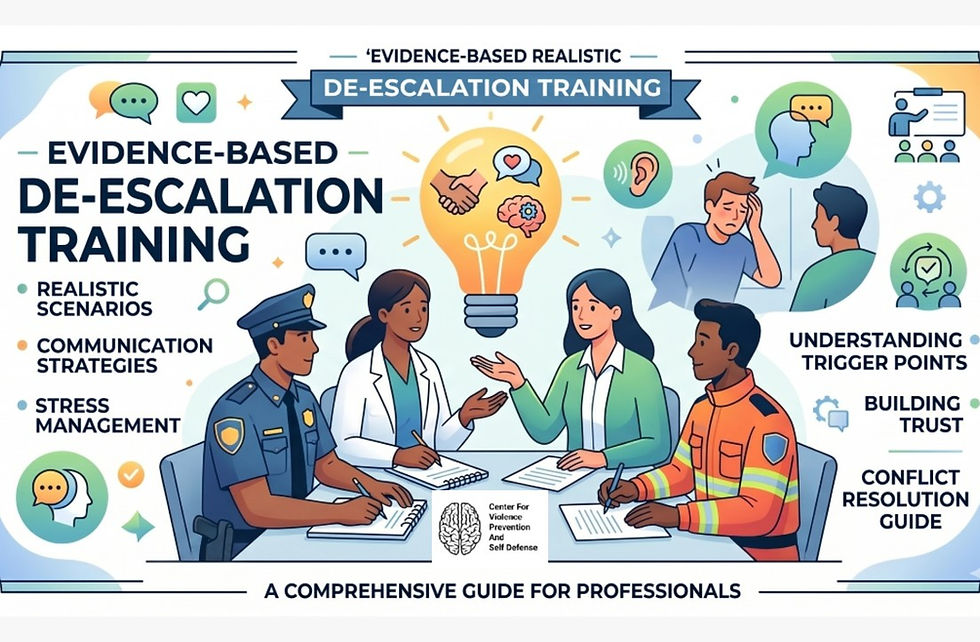
The program equips participants with the knowledge, skills, and evidence-based frameworks needed to apply, strengthen, and teach realistic de-escalation strategies across a wide range of operational environments. It is built on the conviction that effective de-escalation is not merely a soft skill it is a tactical competency grounded in behavioral science, decision-making psychology, and human performance under stress.
Core Program Promise |
• Grounded in behavioral science research on human performance under stress |
• Develops practical skills in tactical decision-making and rapid behavioral assessment |
• Builds professional communication competencies for high-stakes encounters |
• Teaches participants how to apply de-escalation principles while maintaining safety, authority, and operational effectiveness |
• Equips personnel to identify when de-escalation is and is not a viable option |
1.2 Target Audience
Audience | Role | Application |
Law Enforcement Officers | Patrol, investigations, special operations | Field encounters, crisis calls, arrest situations |
Public Safety Personnel | Corrections, security, transit, campus safety | Institutional conflicts, civilian interactions |
Supervisors & Commanders | Oversight, after-action review, policy | Evaluating force options, guiding subordinates |
Trainers & Instructors | Academy and in-service training | Curriculum delivery and scenario design |
Crisis Negotiators | Specialized crisis response teams | Barricade situations, mental health calls |
1.3 Learning Outcomes
Upon successful completion of this course, participants will be able to:
1. Define Realistic De-Escalation and identify when it is appropriate or inappropriate based on situational context.
2. Apply the Response-Ability Zone and the 9 T's Framework to assess risk, determine tactical options, and guide de-escalation strategy.
3. Use the Thought | Emotion | Behavior (TEB) Profile to assess subject behavior and select appropriate communication and persuasion techniques.
4. Examine how officer self-regulation and emotional control support rational decision-making and effective de-escalation.
5. Evaluate use-of-force encounters to determine whether de-escalation was a feasible option using behavioral and situational analysis.
6. Consider the risks and benefits of achieving cooperation versus forcing compliance while achieving lawful objectives.
7. Integrate human performance research into de-escalation tactics, communication, and situational decision-making.
SECTION 2: DEFINING REALISTIC DE-ESCALATION
2.1 What Is Realistic De-Escalation?
Realistic De-Escalation is defined as the deliberate use of communication, behavior, time, space, and tactical positioning to reduce the level of threat, agitation, or resistance in a subject when such an approach is situationally feasible and operationally safe.
The word "realistic" is intentional and critical. De-escalation is not a universal solution, nor is it a moral imperative that overrides officer safety or legal authority. It is a strategic tool one of many in the professional's repertoire to be applied with situational judgment.
2.2 The De-Escalation Spectrum
Level | Condition | De-Escalation Applicability | Primary Strategy |
1 | Compliant / cooperative subject | High – always appropriate | Maintain rapport, prevent escalation |
2 | Verbally agitated, non-threatening | High – optimal opportunity | Active listening, TEB profiling, strategic messaging |
3 | Escalating, potential threat indicators | Moderate – conditional | Tactical positioning, time management, verbal anchors |
4 | Active aggression, credible threat | Low – force likely required | Cover, containment, force continuum |
5 | Imminent deadly force threat | Not applicable | Defensive action, use of force |
2.3 When De-Escalation Is Appropriate
De-escalation is appropriate and should be actively pursued when:
• A meaningful human connection can be established with the subject.
• Time is available without increasing risk to officers, the subject, or bystanders.
• The subject's behavior is driven by emotion, mental state, or situational stress rather than predatory intent.
• Physical intervention would likely increase risk or fail to resolve the underlying driver of the behavior.
• Tactical conditions allow for safe positioning and verbal engagement.
• A clear, lawful objective can be achieved through communication and persuasion.
2.4 When De-Escalation Is Inappropriate
De-escalation is not a feasible option when:
Behavioral / Subject Factors | |
Subject is in active physical assault | Subject is in active psychosis with no contact |
Deadly weapon is deployed or imminent | Scene conditions are tactically untenable |
Time does not permit verbal engagement | Multiple uncontrolled threats present |
Subject has demonstrated predatory intent | De-escalation attempts have failed and threat escalated |
Bystanders face immediate danger | Command authority has directed immediate action |
Officer safety cannot be maintained during engagement | Legal exigency requires immediate force |
SECTION 3: OPERATIONAL FRAMEWORKS
3.1 The Response-Ability Zone
The Response-Ability Zone (RAZ) is a conceptual and tactical framework that defines the space physical, emotional, cognitive, and temporal within which a professional can effectively respond to a dynamic encounter. It represents the intersection of officer capability, situational awareness, and subject behavior.
Response-Ability Zone Three Dimensions |
• Physical Zone: Tactical distance, cover, angles, and spatial control that ensure officer safety while enabling communication. |
• Cognitive Zone: The officer's mental clarity, decision-making bandwidth, and situational assessment capacity under stress. |
• Relational Zone: The degree to which human connection and communication are possible with the subject at that moment. |
Officers operating outside their Response-Ability Zone whether due to proximity, cognitive overload, or emotional flooding are unable to effectively employ de-escalation, regardless of training. Maintaining and restoring the RAZ is itself a primary tactical objective.
3.2 The 9 T's Framework
The 9 T's provide a structured analytical tool for assessing any de-escalation scenario. Each "T" represents a critical variable that shapes the range of viable response options. Practitioners apply the 9 T's rapidly and dynamically throughout an encounter.
# | The "T" | Operational Question | Assessment Focus |
1 | Threat | What is the current level and type of threat? | Behavior, weapons, intent indicators |
2 | Time | Do we have time to engage verbally? | Urgency, subject trajectory, scene dynamics |
3 | Terrain | Does the physical environment support safe engagement? | Cover, egress, sight lines, bystanders |
4 | Tactics | What tactical options are available? | Positioning, resources, force options |
5 | Temperament | What is the subject's emotional and behavioral state? | TEB profile, agitation level, triggers |
6 | Talk | Is communication currently possible and productive? | Subject responsiveness, verbal access |
7 | Trust | What is the relational baseline with this subject? | Prior contact, perceived legitimacy, rapport |
8 | Team | What personnel and resources are available? | Backup, specialists, command support |
9 | Tools | What communication and force tools are available? | Less-lethal, negotiation assets, technology |
The 9 T's are not a checklist to be completed sequentially. They are dynamic lenses applied simultaneously and continuously updated as conditions change. An officer may cycle through all 9 T's in seconds during a rapidly evolving encounter.
3.3 Applying the Frameworks Together
Effective de-escalation decision-making integrates the Response-Ability Zone and 9 T's in real time:
8. Establish and maintain your Response-Ability Zone (physical, cognitive, relational).
9. Rapidly assess each of the 9 T's to determine the viability of de-escalation.
10. Apply the TEB Profile (Section 4) to understand subject behavior.
11. Select communication and persuasion tools appropriate to the assessment.
12. Continuously reassess as conditions evolve.
SECTION 4: THE TEB PROFILE THOUGHT | EMOTION | BEHAVIOR
4.1 Framework Overview
The Thought | Emotion | Behavior (TEB) Profile is a behavioral science-informed model used to rapidly assess a subject's internal state and predict likely behavioral trajectory. Derived from cognitive-behavioral theory and applied crisis intervention research, the TEB Profile enables practitioners to select the most effective communication strategy for each unique subject and situation.
The TEB Triad |
• THOUGHT: What cognitive processes are driving the subject's perception of the situation? Are they rational, distorted, paranoid, or emotionally overwhelmed? |
• EMOTION: What is the subject's dominant emotional state? Fear, anger, grief, confusion, shame, or a combination? What is the intensity level? |
• BEHAVIOR: What observable behaviors are indicating the subject's internal state? What trajectory is the behavior on escalating, stable, or de-escalating? |
4.2 TEB Profiles and Communication Strategies
TEB State | Observable Indicators | Likely Driver | Recommended Approach |
High Thought / Low Emotion | Calculating, deliberate, controlled speech | Strategic or predatory intent | Limit emotional appeals; use logic, consequences, options |
Low Thought / High Emotion | Impulsive, reactive, incoherent speech, physical agitation | Emotional flooding (fear, rage) | Slow pace, lower voice, empathic validation, reduce stimuli |
Distorted Thought | Paranoid ideation, responding to internal stimuli | Mental health crisis, substance intoxication | Non-confrontational tone, avoid arguing with beliefs, seek specialized resources |
Grief / Despair State | Withdrawal, hopelessness, self-harm ideation | Loss, trauma, crisis | Active listening, express concern, collaborative problem-solving |
Angry / Threatening | Verbal aggression, invasion of space, challenges to authority | Perceived disrespect, frustration, fear masked as aggression | Avoid power struggles; acknowledge frustration, redirect to outcomes |
4.3 Selecting Communication and Persuasion Techniques
Once a TEB Profile is established, practitioners select from a toolkit of communication and persuasion techniques calibrated to that profile. The wrong technique applied to a misread TEB state can accelerate rather than de-escalate a situation.
• Emotional Validation: Acknowledging the subject's emotional experience without endorsing their behavior.
• Cognitive Anchoring: Presenting clear, simple choices that engage rational thought and reduce emotional reactivity.
• Behavioral Mirroring: Controlled, intentional matching of pace and tone to build unconscious rapport.
• Strategic Silence: Using deliberate pauses to allow emotional intensity to dissipate.
• Reframing: Shifting the subject's narrative from adversarial to collaborative.
• Minimal Encouragers: Brief verbal and non-verbal cues that signal active listening and invite continued communication.
SECTION 5: OFFICER SELF-REGULATION & EMOTIONAL CONTROL
5.1 The Neuroscience of Stress and Decision-Making
Human performance under acute stress is mediated by the autonomic nervous system. When perceived threat activates the sympathetic nervous system the "fight, flight, or freeze" response cognitive bandwidth narrows, perceptual distortions occur, and fine motor skills degrade. These are biological realities, not individual failings.
Research on law enforcement performance under stress consistently demonstrates that officers who lack self-regulation training are more likely to experience decision-making impairment during critical incidents. The goal is not to eliminate stress arousal some activation enhances performance but to develop the regulation skills needed to maintain effective function within an optimal arousal window.
Key Research Findings on Officer Stress Response |
• Sympathetic activation above threshold impairs working memory and verbal fluency critical de-escalation tools. |
• Officers with higher baseline emotional intelligence demonstrate better de-escalation outcomes (Bishopp et al., 2020). |
• Tactical breathing and pre-incident mental rehearsal demonstrably reduce threat-induced cognitive impairment. |
• Tunnel vision and auditory exclusion common under acute stress can cause officers to miss critical behavioral cues. |
• Recovery time from acute stress arousal averages 20–60 minutes; officers must recognize post-incident cognitive impairment. |
5.2 Self-Regulation Skills for Practitioners
Tactical Breathing (Box Breathing)
A deliberate respiratory pattern 4 counts in, 4 counts hold, 4 counts out, 4 counts hold activates the parasympathetic nervous system, counteracting acute stress arousal. This technique is used pre-encounter, during encounters when feasible, and post-incident for recovery.
Attentional Control Training
Training officers to recognize when their attention has narrowed (threat fixation) and deliberately broaden situational awareness to include environmental, behavioral, and tactical information.
Pre-Incident Mental Rehearsal
Structured visualization of high-stress scenarios including de-escalation success and failure scenarios to build neural pathways for effective response under pressure. Research supports mental rehearsal as equivalent to physical repetition in building skill automaticity.
Post-Incident Debriefing Protocols
Structured after-action review processes that separate cognitive reconstruction (what happened) from emotional processing (how it felt), reducing secondary trauma and improving lesson extraction.
5.3 Emotional Control and Authority
A critical misconception is that emotional control requires emotional suppression. Research and field experience consistently demonstrate the opposite: officers who suppress emotional experience during encounters often "spike" unpredictably, express emotion through punitive compliance demands, and make poor force decisions driven by unacknowledged frustration or fear.
Effective emotional control means emotional awareness and regulation the ability to recognize one's internal state, understand its influence on perception and behavior, and consciously manage its expression while remaining fully present in the encounter.
SECTION 6: EVALUATING USE-OF-FORCE ENCOUNTERS
6.1 Retrospective Behavioral Analysis
A key competency developed in this course is the ability to evaluate post-incident whether de-escalation was a feasible option. This analysis is essential for after-action review, training development, policy evaluation, and professional accountability. It is NOT a tool for second-guessing officers without full situational context it is a systematic framework for organizational learning.
6.2 The De-Escalation Feasibility Analysis Framework
Analytical Dimension | Key Questions | Evidence Sources |
Threat Assessment | What was the objective threat level at each phase of the encounter? | Body camera, witness statements, physical evidence |
Time Analysis | At what points was time available for verbal engagement? | Timeline reconstruction, dispatch records |
TEB State | What was the subject's behavioral state? Was communication possible? | Video analysis, medical records, witness accounts |
Response-Ability Zone | Was the officer within a viable zone for de-escalation? | Spatial analysis, positioning review |
9 T's Assessment | Which of the 9 T's supported or precluded de-escalation? | Multi-source incident reconstruction |
Communication Attempts | What communication was attempted? Was it appropriate to the TEB state? | Audio/video review, officer account |
Alternatives Available | What tactical alternatives existed at each decision point? | Policy review, resource inventory |
6.3 Cooperation vs. Forced Compliance
One of the most consequential decisions in any encounter is the determination of when to seek cooperation versus compel compliance. Both are legitimate tactical objectives. Both carry distinct risk profiles. Neither is inherently superior.
SEEKING COOPERATION | COMPELLING COMPLIANCE |
Lower immediate injury risk to subject | Ensures lawful objectives are met when cooperation fails |
Builds long-term community legitimacy | Necessary when imminent safety requires action |
Reduces officer psychological burden | May increase immediate injury risk |
Preserves evidence and scene integrity | Can undermine procedural justice perception |
Creates conditions for voluntary compliance | Requires clear legal justification |
Requires time and relational conditions | May escalate future encounters with same subject |
SECTION 7: HUMAN PERFORMANCE RESEARCH INTEGRATION
7.1 Behavioral Science Foundations
This course is explicitly grounded in peer-reviewed research across behavioral science, cognitive psychology, communication science, and crisis intervention. The integration of human performance research into de-escalation tactics distinguishes evidence-based training from anecdote-driven instruction.
Research Domains Informing This Course |
• Cognitive Load Theory: How working memory limitations affect decision-making under stress. |
• Dual Process Theory (Kahneman): The interaction between fast, automatic (System 1) and slow, deliberate (System 2) thinking in high-stress encounters. |
• Social Influence Research: Cialdini's principles of influence and their application to voluntary compliance. |
• Crisis Intervention Best Practices: Evidence from mental health crisis response research. |
• Procedural Justice Research: The relationship between perceived fairness, officer authority, and subject compliance. |
• Trauma-Informed Response: How trauma histories shape subject behavior and officer interpretation. |
• Communication Science: Non-verbal behavior, paralanguage, and their disproportionate influence on encounter outcomes. |
7.2 Key Research Principles Applied
The Threat Appraisal Model
Research on threat appraisal demonstrates that subjects assess police encounters along two dimensions: threat magnitude (how dangerous is this?) and coping capacity (can I handle this?). Understanding this model enables officers to intervene at both levels reducing perceived threat and building the subject's sense of agency and control.
Social Identity and Compliance
Research consistently shows that subjects are more likely to voluntarily comply with authority figures they perceive as legitimate, fair, and respectful of their identity and dignity. Officers who understand and apply procedural justice principles voice, neutrality, respect, trustworthy motives demonstrably achieve higher voluntary compliance rates.
The Inverted-U Performance Model
Optimal performance occurs within a moderate range of arousal. Both under-arousal (complacency) and over-arousal (stress flooding) impair performance. Training should develop officers' ability to recognize their arousal state and modulate it toward the performance-optimal zone.
SECTION 8: PRE- AND POST-SUASION THE FIVE C'S
8.1 Pre-Suasion: Setting Conditions Before You Speak
Pre-Suasion, a concept developed from Robert Cialdini's research on social influence, refers to the deliberate structuring of conditions before a persuasion attempt to maximize receptivity. In law enforcement and public safety contexts, Pre-Suasion is the work done before verbal engagement begins tactical positioning, environmental control, internal preparation, and initial impression management.
Research demonstrates that approximately 80% of the outcome of a verbal encounter is determined by conditions established before the first substantive word is spoken. The officer who arrives dysregulated, poorly positioned, and without an intentional communication strategy has already compromised the encounter.
Pre-Suasion Principles for Practitioners |
• Attentional Anchoring: Direct the subject's attention toward a focal point that predisposes cooperation (e.g., a shared goal or common interest). |
• Environmental Staging: Control the physical space to reduce stimulation, increase privacy, and establish conversational conditions. |
• Credibility Establishment: Initial moments establish perceived authority, competence, and trustworthiness these impressions are difficult to reverse. |
• Internal Preparation: Officer's regulated emotional state and clear tactical intent are themselves suasive forces. |
• Framing: The lens through which the encounter is initially presented shapes all subsequent interpretation. |
8.2 Post-Suasion: Reinforcing Outcomes After the Encounter
Post-Suasion is the deliberate management of the period following a de-escalation intervention to reinforce cooperative behavior, prevent re-escalation, and build long-term legitimacy. Officers too often conclude the verbal engagement upon achieving initial compliance, failing to consolidate the relational and behavioral gains made.
• Acknowledge cooperative behavior explicitly and respectfully.
• Provide a clear, dignified explanation of the outcome and next steps.
• Avoid punitive or dismissive language after compliance is achieved.
• Leave the subject with a sense of procedural fairness and personal dignity intact.
• Document the de-escalation strategies used and outcomes achieved for after-action learning.
8.3 The Five C's Framework
The Five C's is an applied communication framework that organizes the essential elements of an effective de-escalation interaction. It functions as both a planning tool (pre-encounter) and a real-time self-monitoring framework (during encounter).
C | Component | Definition | Application |
C1 | Connection | Establishing relational contact and rapport with the subject | Use name, acknowledge their situation, express genuine concern for resolution |
C2 | Comprehension | Demonstrating understanding of the subject's perspective and emotional state | Active listening, reflective statements, validating emotional experience |
C3 | Communication | Deliberate, clear, and calibrated verbal and non-verbal messaging | Strategic messaging, tone control, body language alignment |
C4 | Collaboration | Engaging the subject as a participant in problem-solving rather than a target of control | Offering choices, seeking input, identifying shared goals |
C5 | Commitment | Securing a behavioral agreement and consolidating the de-escalation outcome | Clear, achievable asks; confirming understanding; following through on stated outcomes |
The Five C's are not a linear sequence skilled practitioners move fluidly between them as the encounter evolves. However, research supports the general principle that Connection and Comprehension must precede effective Communication, and that Collaboration significantly increases the durability of Commitment.
SECTION 9: STRATEGIC MESSAGING
9.1 Principles of Strategic Messaging in High-Stakes Encounters
Strategic Messaging is the intentional design and delivery of verbal communication to achieve a specific behavioral outcome in a subject. It contrasts with reactive, improvised, or command-oriented communication that often characterizes officer-subject encounters under stress.
Strategic messaging does not mean manipulation it means the deliberate and skillful use of language, framing, and delivery to guide a subject toward a safe, lawful, and voluntary outcome. It respects the subject's agency while exercising professional authority.
9.2 Message Architecture
Element | Purpose | Example |
Opening Frame | Establish tone and relational intent | "I want to understand what's happening for you right now." |
Acknowledgment Statement | Validate the subject's emotional experience | "I can see you're frustrated that makes sense given what you've described." |
Bridge Statement | Connect subject's goals to cooperative behavior | "Here's what I think can help us both get through this..." |
Clear Ask | State the specific behavioral request clearly | "I need you to take a step back so we can talk this through." |
Choice Architecture | Offer genuine options to preserve agency | "You can walk with me to the car, or we can talk here what works for you?" |
Outcome Statement | Describe what happens next clearly and honestly | "If we can work through this, I'll make sure your concerns are documented." |
9.3 Language Patterns to Avoid
Research in high-stress communication consistently identifies language patterns that reliably escalate rather than de-escalate encounters. Training provides extensive practice in recognizing and replacing these patterns:
AVOID Escalating Language | USE De-Escalating Language |
"Calm down" (invalidating command) | "Help me understand what's happening" |
"I don't care about that" (dismissive) | "Tell me more about that" |
"You need to listen to me" (power contest) | "Here's what I'm hearing from you..." |
"Last chance" (ultimatum without options) | "Here's what I can offer you..." |
"Why are you doing this?" (demands justification) | "What would help right now?" |
Commands stacked without pause for compliance | Single, clear request followed by processing time |
SECTION 10: COMMUNICATION TOOLS
10.1 The Communication Toolkit
Effective de-escalation practitioners develop and maintain a diverse toolkit of communication techniques. Mastery requires not only knowing these tools, but developing fluency in applying them with speed, naturalness, and situational accuracy under stress.
10.2 Core Verbal Communication Tools
Minimal Encouragers
Brief verbal and non-verbal signals that communicate active listening and invite continued engagement: "I hear you," "Go on," "Tell me more," nodding, maintaining appropriate eye contact. Minimal encouragers reduce subject perception of being dismissed or controlled.
Open-Ended Questions
Questions that cannot be answered with yes or no, which invite narrative, disclose information, and maintain engagement. "What's been going on today?" rather than "Were you upset?"
Paraphrasing and Reflection
Restating the subject's own words and meaning back to them in slightly modified form. This demonstrates comprehension, corrects misunderstandings in real time, and builds relational trust. It also slows the encounter, which itself has de-escalatory effect.
Verbal Pacing and Leading
Deliberately matching the subject's speech rate, volume, and energy level (pacing), then gradually shifting those parameters toward a calmer register (leading). The subject's nervous system tends to follow the communicative lead of a regulated, calm interlocutor.
Strategic Labeling
Naming the emotion the subject appears to be experiencing before they do "It sounds like you're feeling completely overwhelmed by this" invites confirmation, builds rapport, and demonstrates that the officer is attending to the subject as a whole person.
10.3 Non-Verbal Communication Tools
Non-Verbal Element | De-Escalatory Application | Common Error to Avoid |
Proxemics (distance) | Maintain appropriate distance; approach gradually with permission signals | Advancing during peak agitation, invasion of personal space |
Posture & Stance | Open, non-confrontational stance; blade away from direct confrontation | Squared shoulders, hands on hips, power posture |
Eye Contact | Engaged but not sustained/challenging; culture-responsive | Staring (perceived threat) or avoidance (perceived disrespect) |
Hand & Arm Positioning | Open palms, visible hands, calm gestures | Pointing, clenching, or repetitive gestures |
Facial Expression | Calm, engaged, concerned matched to verbal tone | Eye-rolling, smirking, displaying contempt |
Movement Pace | Deliberate, slow movements; signal before approaching | Sudden movements, advancing without cues |
SECTION 11: ACTIVE LISTENING
11.1 Active Listening as a Tactical Skill
Active Listening is not passive receptivity it is a demanding cognitive and behavioral practice that requires sustained attention, real-time processing, and deliberate response calibration. In de-escalation contexts, Active Listening is a tactical skill with the same operational significance as threat assessment or tactical positioning.
Research in crisis negotiation, motivational interviewing, and conflict resolution consistently identifies Active Listening as the single highest-leverage communication skill in reducing resistance and building voluntary compliance.
The HURIER Model of Active Listening |
• Hearing: The physiological reception of auditory information ensures the officer is physically attending to the subject. |
• Understanding: Processing the denotative content of what is said what the words mean. |
• Remembering: Retaining key information to demonstrate continuity of attention and build trust. |
• Interpreting: Understanding meaning in context, including non-verbal, emotional, and subtext layers. |
• Evaluating: Assessing the information against operational needs without premature judgment. |
• Responding: Providing feedback that demonstrates comprehension and invites continued engagement. |
11.2 Active Listening in Practice
The Listen-Acknowledge-Respond Cycle
Practitioners are trained to cycle through Listen → Acknowledge → Respond as the foundational interaction pattern. Most de-escalation failures occur when officers skip the Acknowledge step and move directly from listening (or waiting to speak) to responding with directives.
Barriers to Active Listening Under Stress
The course addresses the cognitive and environmental barriers that impair active listening in field encounters:
• Cognitive load from simultaneous threat assessment and communication demands.
• Stress-induced attentional narrowing that causes officers to focus on compliance rather than understanding.
• Confirmation bias hearing what confirms existing threat assessments and filtering out disconfirming information.
• Environmental noise, radio traffic, and bystander distraction.
• Officer's own emotional state (frustration, fear, contempt) creating interpretive filters.
11.3 Listening for What Is Not Said
Advanced active listening includes attention to omissions, inconsistencies, and behavioral signals that indicate the subject's true concerns are not being expressed directly. In many encounters, the presenting behavior masks an underlying need safety, dignity, acknowledgment, resolution of a practical problem that, once addressed, removes the driver of the conflict.
SECTION 12: EMOTIONAL AWARENESS & INFLUENCE
12.1 Emotional Awareness in the Field
Emotional Awareness is the ability to accurately identify, understand, and respond to both one's own emotional state and the emotional states of others in real time. In high-stakes encounters, emotional awareness is a force multiplier it enables practitioners to read escalation trajectories before they become dangerous, identify the emotional drivers of behavior, and select interventions with precision.
12.2 Reading Emotional States in Subjects
Emotional State | Behavioral Indicators | Physiological Signals | Influence Strategy |
Fear | Scanning, flight attempts, compliance followed by evasion | Pale/flushed skin, rapid breathing, trembling | Provide safety assurances, reduce threat cues, explain each step |
Anger/Rage | Verbal aggression, proximity violation, physical posturing | Reddened face, rapid speech, muscle tension | Validate frustration, avoid power contest, redirect to outcomes |
Grief/Depression | Withdrawal, flat affect, slowed movement | Hunched posture, quiet voice, minimal eye contact | Patient presence, open-ended inquiry, connection before direction |
Shame | Avoidance of eye contact, defensiveness, disproportionate anger | Flush, withdrawal, head down | Preserve dignity, avoid public correction, private conversation |
Confusion | Disorganized speech, apparent non-comprehension, erratic behavior | Unfocused gaze, inappropriate affect | Simple language, single instructions, verify comprehension |
12.3 Emotional Influence Ethical Application
Emotional influence is the deliberate use of communication to affect the emotional state of a subject in a manner that supports safe, voluntary resolution. This course establishes clear ethical parameters: emotional influence techniques are permissible when they are truthful, transparent in intent, and directed toward lawful, safe outcomes. Manipulation the deliberate creation of false beliefs or exploitation of emotional vulnerability for illicit advantage is antithetical to professional practice and is not taught or endorsed.
Evidence-Based Influence Principles
Drawing from Cialdini's foundational research on social influence, the course applies six principles in ethically constrained, operationally appropriate forms:
Reciprocity: Demonstrating respect and concern invites reciprocal compliance from subjects.
Consistency: Helping subjects articulate their own stated goals and values, then aligning cooperative behavior with those goals.
Social Proof: When applicable, referencing community standards or third-party perspectives.
Authority: Communicating competence, preparation, and clarity not coercion as the basis of authority.
Liking: Building interpersonal rapport through genuine interest and respectful engagement.
Scarcity: Clearly and honestly communicating the narrowing of options when appropriate.
SECTION 13: BEHAVIOR INFLUENCE & TEB MODELS
13.1 Behavior Change in Dynamic Encounters
Behavior influence in law enforcement contexts is the systematic application of communication, environmental, and relational strategies to shift a subject's behavior from threatening or resistant to compliant and cooperative. The TEB Model provides the organizing framework because behavior is the product of thought and emotion, the most effective behavioral interventions target the cognitive and emotional drivers upstream of the behavior itself.
13.2 The Behavior Trajectory Model
Every behavioral encounter has a trajectory a direction of travel across time. A critical competency is the ability to assess not just where the behavior is now, but where it is going. Officers who respond to the current behavioral state rather than the trajectory often find themselves continuously behind the encounter.
Trajectory | Indicators | Officer Response Goal |
Escalating | Increasing volume, closer proximity, more threatening language, tensing body | Interrupt trajectory; apply de-escalation; assess force options |
Stable / Plateau | Agitated but consistent; not getting worse | Maintain conditions; continue engagement; allow time to work |
De-escalating | Decreasing volume, body language opening, more coherent speech | Reinforce positive trajectory; do not over-respond; maintain safety |
Pseudo-Compliant | Apparent cooperation with underlying resistance indicators | Verify genuine compliance; do not prematurely disengage tactical awareness |
Re-escalating | Compliance achieved then reversed; renewed resistance | Reassess TEB profile; adapt strategy; prepare for force options |
13.3 TEB-Based Intervention Design
Interventions are designed backward from the desired behavioral outcome, through the emotional state that will support that behavior, to the thought patterns that will generate that emotional state:
Define the target behavior: What specific, observable behavior do I need from this subject?
Identify the emotion that supports that behavior: What emotional state makes that behavior most likely?
Identify the thoughts that generate that emotion: What does the subject need to believe or understand?
Design communication to create those thoughts: What do I say, and how do I say it?
Deliver and assess: Is the TEB trajectory moving in the desired direction? Adapt as needed.
SECTION 14: IDENTIFYING & MANAGING HIGH-DEMAND SUBJECT ARCHETYPES (HDSA)
14.1 What Are HDSAs?
High-Demand Subject Archetypes (HDSAs) are behavioral profiles that represent the highest-frequency, highest-risk de-escalation challenges in law enforcement and public safety. These are not clinical diagnoses they are operationally defined behavioral clusters that share recognizable characteristics and respond to consistent, evidence-informed engagement strategies.
Recognition of HDSAs does not substitute for individualized assessment. Every subject is an individual whose behavior must be assessed through the TEB framework. HDSA profiles are tools for rapid orientation and strategy selection, not labels that override observation.
14.2 Primary HDSA Profiles
HDSA Profile | Core Characteristics | De-Escalation Challenges | Recommended Approach |
Acute Mental Health Crisis | Disorganized thought, paranoid or delusional content, unpredictable affect | Communication access limited; behavior driven by internal stimuli; standard commands ineffective | Non-confrontational presence; specialized crisis resources; avoid arguing with delusions |
Substance-Altered Subject | Disinhibited behavior, impaired cognition, unpredictable response to commands | Limited rational communication; pain compliance unreliable; behavior unpredictable | Time, space, containment; simple clear messages; medical assessment |
Agitated Subject in Grief/Trauma | Emotional flooding, reactive anger, apparent irrationality | Emotion overwhelms reasoning; may misinterpret officer presence as threatening | Slow pace; validate pain; avoid commands until emotional intensity reduces |
Confrontational / Authority-Resistant | Challenges officer authority, argues legality, refuses commands, verbal aggression | Power contest dynamics; responding to command can escalate; ego investment in non-compliance | Avoid power struggle; acknowledge their perspective; shift to outcome focus |
Suicidal / Self-Harm Crisis | Expressive hopelessness, suicidal statements, self-harm behaviors | Compliance not the goal; safety requires connection; time pressure requires skill | Collaborative listening; build reasons for living; specialized crisis resources |
Domestic Violence Context | Emotional intensity, trauma bonding complexity, third-party dynamics | Victim-offender dynamics complicate communication; fear and shame present | Separate parties; trauma-informed approach; safety planning |
14.3 Managing HDSA Encounters
The management of HDSA encounters integrates all previously covered frameworks:
Establish and maintain the Response-Ability Zone before verbal engagement.
Apply the 9 T's to assess viability and select tactical approach.
Profile the HDSA to orient strategy and communication style.
Use TEB-informed communication to target the upstream drivers of behavior.
Engage the Five C's framework to structure the interaction.
Continuously reassess trajectory and adapt; be prepared to transition from de-escalation to force options when indicated.
Document HDSA profile and strategies applied for after-action learning.
SECTION 15: EMOTIONAL RESILIENCE
15.1 The Resilience Imperative
Emotional Resilience is the capacity to maintain psychological stability and effective professional function in the face of occupational stress, critical incidents, and cumulative exposure to trauma and conflict. In law enforcement and public safety, resilience is not optional it is a professional competency and a survival skill.
The de-escalation practitioner who lacks emotional resilience will eventually experience degraded performance: increased reactivity, reduced empathy, impaired decision-making, compassion fatigue, or burnout. Resilience training is therefore integral to, not separate from, de-escalation proficiency.
What Emotional Resilience Is NOT |
• It is NOT emotional toughness or suppression of distress suppression increases cumulative psychological burden. |
• It is NOT the absence of emotional impact resilient practitioners are affected; they recover effectively. |
• It is NOT individual willpower it is a skill set supported by organizational culture, peer relationships, and professional practice. |
• It is NOT immunity to trauma it is the capacity to process, integrate, and grow through adverse experience. |
15.2 Components of Professional Emotional Resilience
Stress Recovery Practices
The deliberate and regular use of evidence-supported recovery practices: tactical breathing, physical exercise, quality sleep, social connection, and structured decompression routines post-shift. The research base consistently supports these practices as the foundation of occupational resilience.
Meaning-Making and Purpose
Research on first responder resilience identifies coherent professional purpose a clear sense of why the work matters as a critical protective factor. Training supports practitioners in articulating and sustaining their professional purpose, particularly through encounters that challenge or strain that purpose.
Peer Support and Supervisory Culture
The organizational environment is a primary determinant of practitioner resilience. Cultures that stigmatize help-seeking, discourage emotional disclosure, or frame distress as weakness actively erode resilience. This course advocates for and supports peer support program development and supervisory practices that normalize psychological wellness.
Professional Debriefing and Processing
Structured after-action debriefing serves dual purposes: operational learning (what happened, what worked, what would we change?) and psychological processing (how did this affect me, what do I need to move forward?). Training develops skills in both facilitating and participating in effective debriefing.
Help-Seeking as Professional Strength
One of the most high-leverage cultural shifts this training advocates is the reframing of help-seeking from a sign of weakness to evidence of professional maturity and self-awareness. Officers who access support proactively recover faster, perform better, and demonstrate lower rates of secondary trauma and burnout.
15.3 Building Resilience Through Training
This course intentionally builds emotional resilience through its design:
Realistic scenario training that develops confidence and competence in high-stress encounters.
Structured processing of training scenarios not just operational review but emotional and cognitive debrief.
Normalization of emotional impact: participants learn that effective practitioners are affected by their work.
Building peer support relationships within the training cohort.
Development of personal resilience plans: individualized, evidence-based practices each participant commits to.
SECTION 16: TRAINING IMPLEMENTATION & DELIVERY
16.1 Instructional Design Philosophy
This course employs a deliberate practice model of instruction moving from concept acquisition through guided practice to independent application under increasingly realistic conditions. Research on skill acquisition in law enforcement contexts confirms that declarative knowledge alone does not transfer to performance under stress. Skills must be embedded through repetition, feedback, and scenario-based application.
Instructional Delivery Methods |
• Lecture and Discussion: Conceptual frameworks, research foundations, case analysis. |
• Scenario-Based Training: Realistic role-play scenarios designed to activate stress responses and require application of trained skills. |
• Video Analysis: Review of body-worn camera footage to apply analytical frameworks to real encounters. |
• Small Group Practice: Coached practice of specific communication skills with peer feedback. |
• Expert Panel Discussion: Practitioners and behavioral science experts discussing real-world application. |
• Personal Reflection and Planning: Guided development of individualized application plans. |
• After-Action Debriefing: Structured review of scenario performance with both operational and psychological dimensions. |
16.2 Evaluation and Competency Assessment
Competency Domain | Assessment Method | Proficiency Standard |
Conceptual Knowledge | Written assessment, scenario analysis | Demonstrate understanding of all core frameworks |
Behavioral Assessment | Video analysis exercise, scenario-based evaluation | Accurate TEB profiling in 3 of 4 scenarios |
Communication Skills | Observed role-play with structured rubric | Demonstrates 5+ active listening behaviors; avoids escalating language |
Tactical Decision-Making | 9 T's application in tabletop and scenario | Accurate situational assessment; appropriate strategy selection |
Self-Regulation | Physiological stress indicators; self-report; observed behavior | Demonstrates recovery skills; maintains communication quality under simulated stress |
HDSA Recognition | Scenario identification exercise | Accurate profile assignment in 4 of 5 presented scenarios |
SECTION 17: CONCLUSION
17.1 The Evidence-Based Practitioner
The goal of this course is the development of evidence-based practitioners professionals who bring the same rigor, curiosity, and commitment to continuous improvement to their communication skills that they bring to their physical and tactical training. De-escalation is not a soft alternative to professional policing it is one of its highest expressions.
The skills developed here behavioral assessment, emotional intelligence, strategic communication, self-regulation, and resilience are not skills for de-escalation alone. They are the skills of the complete professional: someone who makes better decisions, communicates more effectively, connects more genuinely, and recovers more completely than someone without this training.
Core Commitments of the Evidence-Based Practitioner |
I will continuously develop my knowledge of human behavior and communication science. |
I will apply de-escalation when it is genuinely feasible and serve public safety when it is not. |
I will maintain the emotional regulation needed to think clearly and communicate skillfully under stress. |
I will treat every subject's dignity as operationally significant because it is. |
I will honestly evaluate my own encounters and pursue improvement without defensiveness. |
I will contribute to a professional culture that supports both safety and humanity. |
I will take care of myself so that I can continue to take care of others. |
17.2 Ongoing Development
Completion of this course is a beginning, not an end. De-escalation proficiency is a living skill set that must be maintained through regular practice, continued education, peer engagement, and honest self-assessment. Participants are encouraged to:
Participate in quarterly scenario refreshers and annual recertification.
Engage in regular peer debrief of de-escalation encounters successful and unsuccessful.
Stay current with emerging research in behavioral science and crisis intervention.
Contribute to the field by documenting and sharing effective strategies within their organizations.
Seek out mentorship and offer mentorship to developing practitioners.
Evidence-Based De-Escalation Training
For Official Training Use Only | All rights reserved

About The Author
William DeMuth, Director of Training
William DeMuth is a recognized authority in violence dynamics and personal safety, with more than three decades of applied research and evidence-based instruction. He is the Co-architect of the ConflictIQ™ program a comprehensive, layered curriculum grounded in behavioral science and designed for real-world conflict resolution. DeMuth holds advanced certifications across multiple disciplines and has studied under some of the field's most distinguished practitioners, including Lt. Col. Dave Grossman and Craig Douglas of ShivWorks. His academic foundation includes studies in Strategic Management at The Wharton School, University of Pennsylvania.
His training reaches a diverse professional population civilians, law enforcement agencies, healthcare institutions, and corporate organizations with a curriculum encompassing behavioral analysis, situational awareness, de-escalation methodology, and applied physical skills.


