
Home Invasion Self-Defense: What You Need to Know


If a home invasion happens right now, your priorities are clear: call 911, get out if you safely can, hide and signal for help if you cannot escape, and use physical force only when your life or someone else’s is in immediate danger. Everything else follows from those four decisions.
According to former Bergen County Police Chief Brian Higgins, residents should avoid physical confrontation unless occupants’ lives are at immediate risk, and call 911 at the very first sign of trouble.
Your immediate priorities:
Call 911 and stay on the line
Escape through a safe exit if one is available
If escape is blocked, move to a pre-planned room, lock the door, and signal for help
Fight only when imminent death or great bodily harm is unavoidable
Key Takeaways
Surviving a home invasion depends on a clear plan, realistic training, and understanding that escape is always the priority over physical confrontation.
Point | Details |
Escape first, always | Call 911, evaluate exits, and leave before engaging any intruder. |
Legal force requires three elements | Imminence, proportionality, and reasonable belief must all be present for force to be lawful. |
State law varies significantly | Castle Doctrine and Stand Your Ground protections differ by state; know your state’s rules before an incident. |
Prevention reduces risk | Reinforced doors, motion lighting, and a family plan with a code word are your first line of defense. |
Training builds usable skills | Scenario-based, law-aware training is the only way to make de-escalation and physical techniques reliable under stress. |
Table of Contents
What should you do during an active home invasion?
Escape is always the first choice. The moment you recognize an intruder is inside, your goal is distance, not confrontation.
Call 911 immediately. Give your address, the number of intruders if known, and your location in the home. Stay on the line.
Evaluate exits. Can you leave through a door or window without passing the intruder? If yes, go.
Execute the escape. Move quickly and quietly. Take children or others with you if possible. Get to a neighbor’s home or a well-lit public area.
If escape is blocked, reach your safe room. Lock or barricade the door, keep your phone, and signal from a window if you can do so safely.
Fight only as a last resort. Use physical force when escape is impossible and your life or another person’s life is in immediate danger.
Decision rules matter here. Engaging an intruder who has not yet threatened you directly is legally and physically risky. The threat must be immediate, escape must be genuinely impossible, and the level of force must match the danger you face.
Pro Tip: Assign roles before an emergency happens. One adult calls 911; another moves children to the safe room. Pre-placed phone chargers and a spare key near the safe-room door can save critical seconds.
De-escalation and physical tactics when escape is not immediate
UW Medicine’s public-safety experts are direct: situational awareness and disengagement reduce the need for physical force far more reliably than any technique. Physical moves are a last resort, not a strategy.
De-escalation first:
Use a calm, firm voice. Short commands (“Stop. Leave now.”) carry more authority than panicked speech.
Yell “Call the police!” loudly and repeatedly. Noise draws attention and may deter an intruder.
Personal alarms, when activated immediately, can attract help and disrupt an intruder’s plan.
Body position and movement:
Keep your feet shoulder-width apart and your weight balanced. Never let yourself be backed into a corner.
Keep your hands up in a non-threatening but ready position. This protects your face and signals you are alert.
Move toward exits, not deeper into the home.
Last-resort physical techniques are about creating distance to escape, not winning a fight. Simple, high-yield moves include the palm-heel strike to the nose or chin, the hammerfist to the side of the head, and the elbow strike to the face or throat. A wrist-grab release, where you rotate your arm toward the intruder’s thumb and pull sharply, breaks most grips quickly. None of these require strength. All of them require practice.
Muscle memory built through repeated, stress-inoculated training is what makes any technique usable under fear. A move you have only read about will not be available to you in a crisis.

Which defensive tools actually help, and what are the legal limits?
Tools extend your reaction time and create distance. They do not replace planning, awareness, or training.
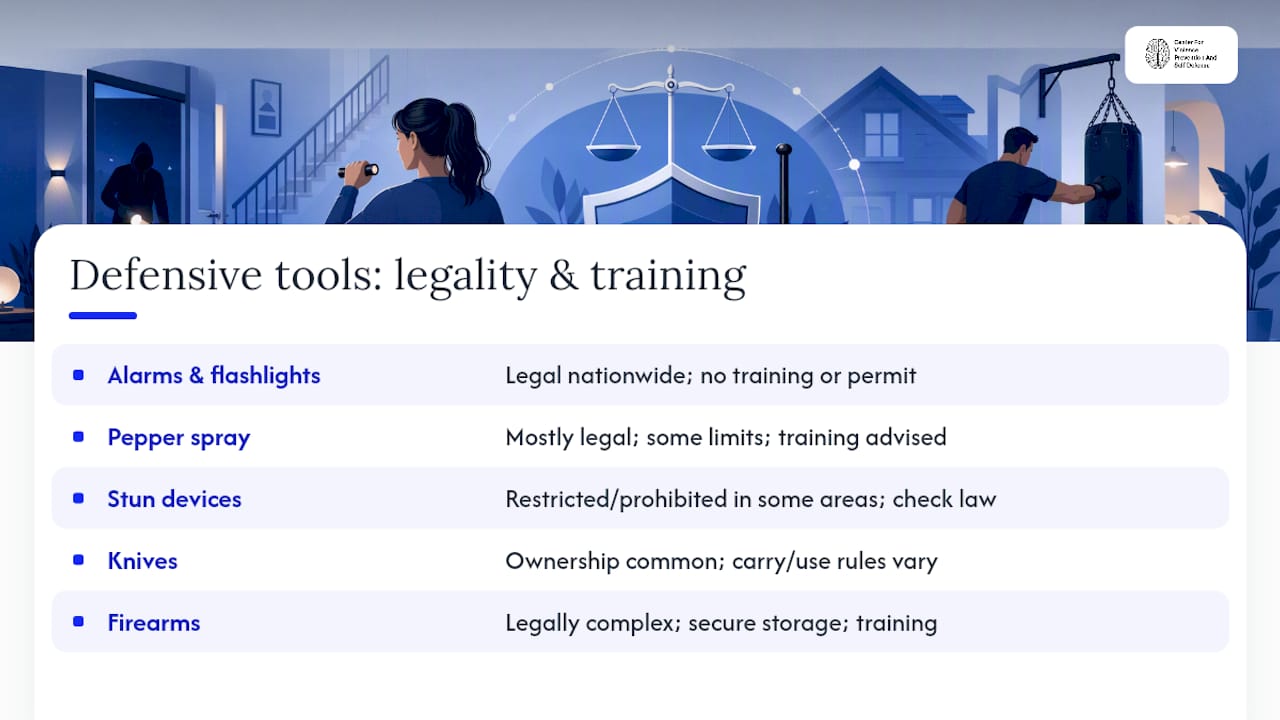
Personal alarms are legal everywhere, require no training, and are especially practical for renters and households with children. A 120-decibel alarm can startle an intruder and alert neighbors simultaneously.
Tactical flashlights are legal in all 50 states, serve a dual purpose (visibility and temporary disorientation), and require no permit.
Pepper spray is legal in most states, though some impose age restrictions, concentration limits, or container-size caps. Law-enforcement-adjacent guidance consistently recommends training with any tool you carry, because stress degrades fine motor skills. Public-safety guidance notes that early use of pepper spray, before an attacker closes distance, improves the likelihood of escape.
Stun devices (stun guns and TASERs) are prohibited or restricted in several states and some municipalities. Check your state law before purchasing.
Knives are legal to own in most states but carry significant legal complexity when used defensively. Blade-length restrictions and carry laws vary widely.
Firearms are the most legally complex option. Ownership, carry, and use are governed by a combination of federal law, state statute, and local ordinance. Safe storage, particularly in homes with children, is non-negotiable. Training must include not just marksmanship but legal context and threat-assessment decision-making.
For any tool, the rule is consistent: know the law in your state before you acquire it, store it securely, and train with it under realistic conditions.
How do you harden your home and build a family plan?
Prevention is your first line of defense. Most home invasions are opportunistic, and visible deterrents shift an intruder’s attention to easier targets.
Home-hardening checklist:
Reinforce door frames with a door-reinforcement kit; standard frames splinter easily under a kick
Install deadbolt locks on all exterior doors
Secure sliding doors with a bar or pin lock
Add window locks and consider window-break sensors
Install motion-activated lighting at all entry points
Trim shrubs near doors and windows to eliminate concealment
Use a video doorbell or exterior cameras at visible points
Family plan template:
Identify two exit routes from every room
Designate one room as the safe room (solid door, lock, phone charger, first-aid kit)
Assign a code word that signals everyone to move to the safe room without asking questions
Decide in advance who calls 911 and who moves children
Establish an outdoor meeting point for after an escape
Ready recommends keeping a well-stocked first-aid kit and completing basic first-aid training, because emergency medical help may not arrive immediately after a home incident. Consumer Reports’ emergency-response checklist adds documenting damage and securing temporary fixes as immediate post-incident priorities.
What does U.S. law say about defending your home?
Whether force is lawful in a home invasion turns on three elements: imminence (the threat is happening now, not hypothetically), proportionality (the level of force matches the threat), and reasonable belief (a reasonable person in your position would have believed the same danger existed).
Key legal concepts:
Castle Doctrine: In many states, you have no duty to retreat when you are in your own home and face an unlawful intruder.
Stand Your Ground: Many states have removed the duty to retreat in public spaces as well. NCSL’s statutory summary maps which states apply these protections and how they differ.
Duty to retreat: Some states still require you to attempt retreat before using deadly force, even at home.
Castle Doctrine and Stand Your Ground statutes do not create blanket immunity. Courts apply a post-event reasonableness standard and evaluate the totality of circumstances. You can face criminal charges or civil liability even when criminal charges are not filed, if the facts do not meet the legal threshold. CrimeBasics notes that civil exposure remains possible regardless of criminal outcome.
After using force, do this:
Call 911 immediately and state that you were attacked
Request medical help for anyone injured
Do not give detailed statements to police before speaking with a criminal-defense attorney
Preserve the scene and photograph evidence before anything is moved
Where should you get realistic self-defense training?
Training that combines situational awareness, decision-making under stress, legal context, and practical escape techniques is the most effective investment you can make. A class that only teaches striking without covering de-escalation, legal thresholds, or scenario-based decision-making leaves you underprepared.
What good training programs include:
Scenario-based practice that simulates realistic stress
De-escalation and verbal-deterrence skills
Legal briefings on your state’s self-defense rules
High-repetition physical techniques focused on escape, not dominance
Basic first-aid and trauma response
Red flags to avoid: programs that emphasize “winning” a fight over escaping it, instructors who dismiss legal context, and courses with no scenario-based component.
CVPSD (Center for Violence Prevention and Self-Defense) is a 501©(3) non-profit that delivers evidence-based self-defense training for individuals, households, and organizations. Programs cover crisis intervention, de-escalation, behavior analysis, and physical defense skills, and all curricula meet state and local laws. CVPSD partners with schools, healthcare providers, community groups, and government agencies, and has expanded its nationwide training network through local partners to reach more communities.
What should you do in the hours after a home invasion?
Immediate safety and medical needs come first. Legal and insurance steps are time-sensitive and follow closely.
Confirm everyone is safe. Check for injuries before anything else.
Call 911 if you have not already. Request medical assistance if needed.
Do not disturb the scene. Photograph everything before moving objects.
Obtain a police incident number. You will need it for insurance and legal purposes.
Contact a criminal-defense attorney before giving a detailed statement to police, even if you believe your actions were fully justified.
Notify your homeowner’s or renter’s insurance provider. Report the incident and document all losses.
Seek mental-health support. A home invasion is a traumatic event. Confidential professional counseling can help you and your family process the experience and reduce long-term psychological impact.
Contact list to prepare now:
Local police non-emergency line
Emergency medical services
Criminal-defense attorney (research one before you need one)
Insurance claims line
Why CVPSD recommends planning, avoidance, and law-aware training
The approach CVPSD uses is grounded in a straightforward reality: most people who survive a home invasion do so by avoiding a physical confrontation, not by winning one. The evidence consistently points toward escape and de-escalation as the highest-return strategies, and toward physical techniques as a last resort that requires genuine training to be usable under stress.
CVPSD’s programs are built on this sequence: recognize a threat early, create distance, use verbal deterrence, escape when possible, and defend physically only when no other option exists. Every program includes the legal context specific to the state where training is delivered, because knowing the law is part of knowing how to respond.
Organizations, community groups, and government agencies can contact CVPSD to discuss custom training programs for their teams or communities.

Sources
This article is general information, not a substitute for advice from a qualified lawyer. Consult a qualified legal professional about your own circumstances before acting on anything here.
FAQ
What is the first thing to do during a home invasion?
Call 911 immediately and attempt to escape if a safe exit is available. If escape is not possible, move to a pre-planned safe room, lock the door, and stay on the line with the dispatcher.
Does Castle Doctrine mean you can always use deadly force at home?
No. Castle Doctrine removes the duty to retreat in many states, but deadly force is still lawful only when you reasonably believe the intruder poses imminent death or serious bodily harm. Courts evaluate imminence, proportionality, and reasonableness after the fact.
Is pepper spray legal for home defense in the U.S.?
Pepper spray is legal in most states, but some impose age restrictions, concentration limits, or container-size caps. Always verify your state’s specific rules before purchasing or carrying it.
Should you confront an intruder to protect property?
No. Property alone does not legally justify deadly force in any U.S. state, and confrontation carries serious physical and legal risk. The priority is always protecting lives, not possessions.
How do you prepare your family for a home invasion before it happens?
Identify two exit routes from every room, designate a safe room with a lock and phone charger, assign roles (who calls 911, who moves children), and establish a code word that signals everyone to act without hesitation.
Recommended


