
Four Steps to Meet New York Workplace Violence Rules for Managers

Yes, New York requires workplace violence prevention programs for public employers and many retail employers, and the obligation is not optional or aspirational. If your organization is covered, you need a completed risk evaluation, a written policy modeled on the state template, a training schedule that meets the required cadence, and a clear reporting channel employees actually know about. Employees who believe their employer is out of compliance can file a complaint with the New York State Department of Labor (NYSDOL) or PESH, and organizations that need help building the training piece can turn to a practitioner resource like CVPSD.
Table of Contents
New York Legal Requirements: Labor Law 27-b, the Retail Worker Safety Act, and PESH Enforcement
Employer Compliance Checklist: Risk Evaluation, Written Program, Training, and Reporting
Practical Prevention and Response Tactics for Managers and Employees
Guidance on Addressing Domestic Violence That Affects the Workplace
What Actually Separates Compliant Programs From Effective Ones
Build a Workplace Violence Prevention Program That Actually Holds Up
New York Legal Requirements: Labor Law 27-b, the Retail Worker Safety Act, and PESH Enforcement
New York workplace violence prevention rests on two statutes and one regulation, and each one covers a different slice of the workforce. Labor Law 27-b applies to public employers, meaning state agencies, counties, municipalities, school districts, and other government bodies. Any public employer with 20 or more full-time employees must maintain a written workplace violence prevention program, and every public employer regardless of size must complete a risk evaluation and provide training, according to NYSDOL guidance.
The Retail Worker Safety Act extends similar obligations into the private sector, but only for retail. Employers with 10 or more retail employees must adopt a workplace violence prevention policy and deliver interactive training, and the law sets different training cadences by size:
Retail employers with many employees must train annually.
Retail employers with fewer employees must train periodically.
Retail employers with fewer employees must train periodically.
Starting January 1, 2027, retail employers with 500 or more employees must provide silent response buttons throughout the workplace and train staff on their use.
Behind both statutes sits 12 NYCRR Part 800.6, the state-initiated regulation that PESH enforces for public sector and state and local government work. PESH, short for Public Employee Safety and Health, operates as New York’s OSHA state plan and adopts most federal OSHA standards while layering on its own, including this workplace violence rule.
PESH conducts unannounced inspections and can issue notices of violation with abatement periods when it finds gaps, the same enforcement posture federal OSHA uses in the private sector nationally. Private retail employers fall under Retail Worker Safety Act enforcement through NYSDOL rather than PESH. Employers who want to get ahead of an inspection rather than react to one can request free consultation and pull the model policy and training template directly from NYSDOL before an inspector ever shows up.
Employer Compliance Checklist: Risk Evaluation, Written Program, Training, and Reporting
Meeting New York’s requirements comes down to four building blocks, and skipping any one of them leaves a compliance gap that shows up fast during a PESH review. Work through them in order.
Complete a risk evaluation. Pull a year of incident records, review any prior security problems at the site, and walk the physical space for blind spots, unsecured entrances, and isolated work areas. Document what you find. This record becomes your baseline evidence of good-faith effort if PESH ever asks.
Write the program, not just a policy statement. A compliant program needs a policy statement, a reporting system employees actually understand, emergency procedures specific to the site, and a documented process for employee participation in developing it. NYSDOL’s free program template covers the required structure, but you still need to add site-specific details, including exits, security devices, and known problem areas.
Deliver training on the right schedule. Training must be interactive rather than a passive video, delivered during paid work time, and cover de-escalation tactics, emergency procedures, and the use of any security devices on site, per NYSDOL’s model training requirements. If NYSDOL has published a translation for an employee’s primary language, you must provide training and the written policy in that language.
Build a reporting and recordkeeping habit. Keep every incident report, protect employee privacy around sensitive incidents, and conduct an annual review of what happened and what changed as a result.
Pro Tip: Post the written policy somewhere employees actually pass by, not buried in an employee handbook nobody opens twice a year. A policy nobody can find might as well not exist during an inspection.
Practical Prevention and Response Tactics for Managers and Employees
Legal compliance sets the floor. What actually keeps people safe day to day is a mix of environmental design and trained behavior, and the two reinforce each other.
On the environmental side, small changes reduce risk more than most managers expect:
Improve sightlines at registers, entrances, and stockrooms so isolated encounters become rare.
Limit cash on hand and use drop safes to reduce the incentive for robbery-related violence.
Control after-hours access and make sure exterior lighting actually works.
Place silent response buttons where staff can reach them without drawing attention, ahead of the 2027 mandate for large retail employers.
On the behavioral side, interactive, scenario-based training during paid work time improves retention and staff confidence compared with passive video-only training. That single distinction, interactive versus passive, is often the difference between a policy employees remember under stress and one they forgot the week they signed the acknowledgment form. De-escalation skills, co-regulation techniques for managing an agitated person’s emotional state, and basic situational awareness all belong in that training.
When an incident happens, the sequence matters. Employees should secure their own safety first, alert coworkers and management using the established reporting channel, and avoid physically intervening unless trained to do so. Managers should assist any injured person, preserve the scene for later review, and call 911 immediately for any incident involving a weapon, injury, or threat of serious harm. Afterward, pairing the statutory checklist with physical and administrative changes to the workplace is the most effective way both to reduce repeat incidents and to demonstrate compliance during a PESH review. Employers uncertain whether their response measures meet the standard can request a PESH consultation, which is separate from an enforcement inspection and will not result in citations for what it finds.
How CVPSD Training Maps to New York’s Requirements
CVPSD builds its programs around the same gap New York’s laws are designed to close: policies that exist on paper but never translate into staff who know what to do under stress. Its evidence-based curriculum addresses the interactive training standard directly, covering crisis intervention, de-escalation, and behavior analysis in formats that satisfy the “interactive, not passive” requirement NYSDOL sets out.
Programs include:
Online, self-paced courses for organizations that need flexible scheduling across shifts.
In-person, instructor-led seminars for teams that need hands-on practice and immediate feedback.
Sector-specific customization for retail, healthcare, education, and other frontline environments with different risk profiles.
Documentation of training completion that supports the recordkeeping employers need during a PESH review.
Train-the-trainer models so organizations can sustain compliance internally rather than re-booking outside training every cycle.
CVPSD has applied this same approach with frontline workforce teams, including conflict management training delivered to workforce teams in New Jersey, giving it direct experience translating regulatory language into training staff can actually use.
Guidance on Addressing Domestic Violence That Affects the Workplace
Workplace violence prevention programs often focus on stranger threats and customer aggression, but domestic violence spilling into the workplace is one of the more predictable and preventable risks employers face. An abuser who knows a victim’s work schedule and location can show up at the workplace, and that risk does not disappear just because the relationship is happening outside work hours.
Employers should build a specific protocol into their broader workplace violence prevention program rather than treating domestic violence as a separate, unrelated issue. That protocol should include a confidential way for an employee to disclose a safety concern without it becoming office gossip, a plan for temporarily adjusting a schedule or work location if a threat is credible, and a process for alerting front-desk or security staff to a specific individual who should not be granted building access. Training should cover how to recognize warning signs without prying, since many employees will not volunteer what is happening at home unless they trust the response will be discreet and supportive.
Support resources matter as much as security measures. Connecting an affected employee to counseling or advocacy resources, such as those outlined in mental health guidance for employers, can be part of a broader response alongside any physical safety planning. Managers should never assume a domestic violence situation is “personal” and therefore outside their responsibility. Once it has a plausible path into the workplace, it falls squarely inside the scope of a workplace violence prevention program.
What Actually Separates Compliant Programs From Effective Ones
Most organizations treat New York’s workplace violence rules as a paperwork exercise: adopt the template, check the training box, file the policy, move on. That approach technically satisfies Labor Law 27-b or the Retail Worker Safety Act, but it does not change what happens the first time an employee faces an agitated customer or a coworker in crisis. The gap between a compliant program and an effective one comes down to whether the training actually rewires how someone responds under stress, not whether it was delivered.
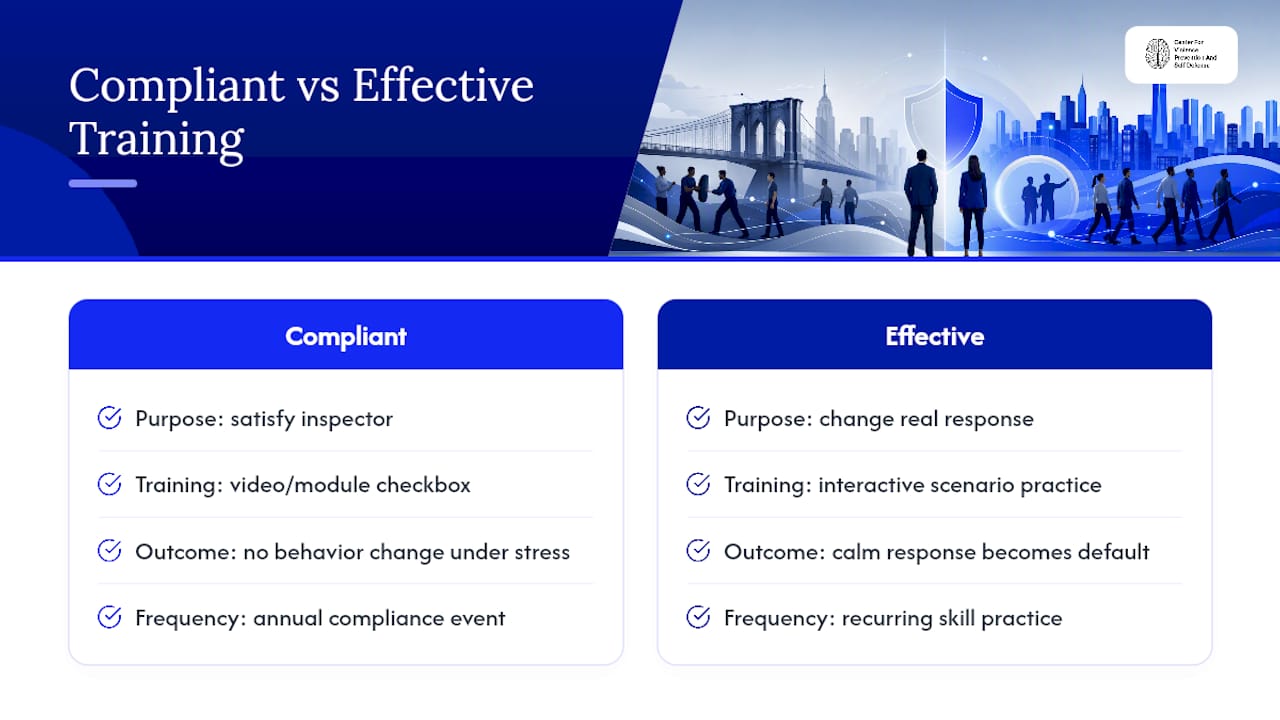
The most overlooked detail in the whole regulatory framework is the word “interactive.” NYSDOL did not require interactive training as a technicality. It required it because video modules do not build the muscle memory de-escalation actually requires. Scenario-based practice, repeated until a calm response becomes the default rather than the exception, is what separates a program that survives a PESH inspection from one that survives an actual incident.
Organizations that get this right tend to treat training as a recurring skill, not an annual compliance event. CVPSD’s work with frontline teams, including a recent workplace safety training engagement for frontline workers, consistently shows that the organizations asking harder questions about training quality, not just training frequency, are the ones whose staff actually change behavior. If your program only exists to satisfy an inspector, it will show the first time it matters.
Where to Verify New York’s Rules Directly
Employers and employees should not rely on secondhand summaries alone. Go to the primary sources.
NYSDOL’s Retail Worker Safety page for the current thresholds, training cadence, and silent response button timeline.
NYSDOL’s Workplace Violence Prevention FAQ for public employer obligations and program requirements.
OSHA’s New York State Plan page for PESH jurisdiction, enforcement authority, and how to request a consultation or file a complaint.
Anonymous complaints and on-site consultation requests can both be initiated through these same channels without triggering an enforcement inspection.
Build a Workplace Violence Prevention Program That Actually Holds Up
Reading the statute is one thing. Training a staff of retail associates, teachers, or healthcare workers to actually use de-escalation skills under real pressure is another, and that gap is where CVPSD does its work. As a 501©(3) built specifically around evidence-based crisis intervention and de-escalation training, CVPSD gives New York organizations a way to meet the interactive training standard NYSDOL requires without building a curriculum from scratch.
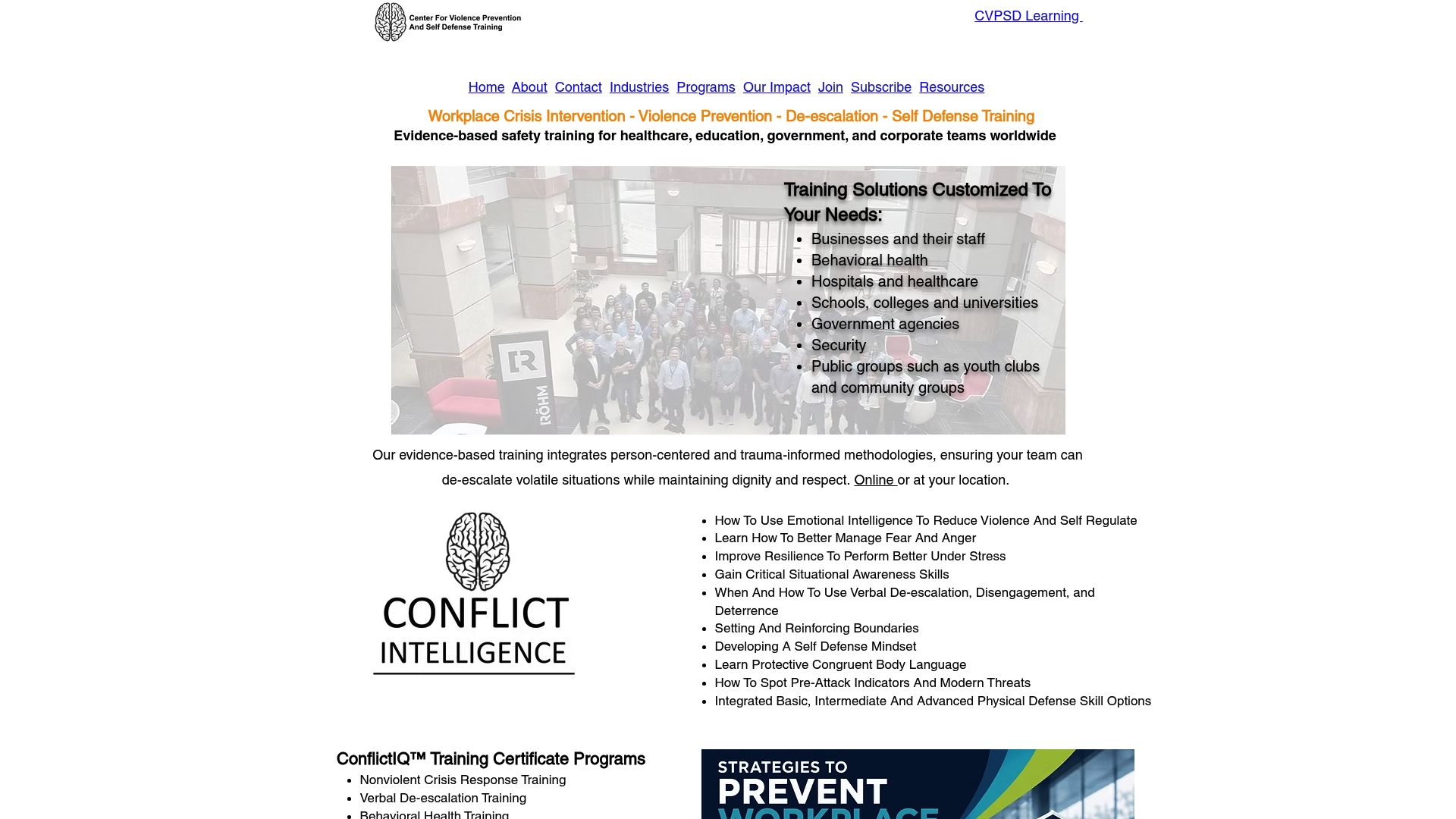
Its programs, including the tiered ConflictIQ™ training series, are built for organizations that need role-specific content, whether that is a retail floor team, a school staff, or a healthcare unit, delivered either online at your own pace or in person with an instructor. Organizations with unique site conditions or a workforce that needs deeper, hands-on practice can also book customized, instructor-led training built around their specific risk evaluation findings. If you are ready to see what fits your team, browse the full catalog of training programs and request the option that matches your compliance deadline.
Sources
FAQ
Does My Business Need a Workplace Violence Prevention Program in New York?
Public employers of any size and retail employers with 10 or more employees must have one under Labor Law 27-b and the Retail Worker Safety Act; public employers with 20 or more full-time staff must put it in writing.
How Often Must Employees Be Trained Under New York Law?
Retail employers with 50 or more employees must train annually, retail employers with fewer than 50 must train every two years, and public employers must train at initial assignment and annually.
Where Do I File a Workplace Violence Complaint in New York?
Employees can file complaints with NYSDOL for retail and public employer violations, or with PESH for state and local government workplace safety enforcement.
What Happens if PESH Finds My Organization Noncompliant?
PESH can issue a notice of violation with a required abatement period, and repeated or unresolved noncompliance can lead to further enforcement action and penalties.
Does CVPSD Offer Training That Meets New York’s Interactive Training Requirement?
Yes, CVPSD offers online self-paced and in-person programs, including the ConflictIQ™ series, designed to build practical de-escalation and crisis response skills. Current pricing is available on its site.
Recommended


