
Not Everything You Notice Needs a Judgment: How Awareness Without Judgment Can De-Escalate Conflict

Introduction: The Difference Between Noticing and Judging
“Not everything you notice needs a judgment attached to it.”
This simple principle has important implications for conflict resolution, emotional intelligence, communication, and violence prevention. It challenges a common human habit: observing another person's behavior and immediately deciding what it means, what it says about them, or what their intentions must be.
Someone raises their voice, and we conclude they are disrespectful. A coworker interrupts us, and we decide they are arrogant. A stranger stares at us, and we assume they are looking for trouble. A family member responds with a sharp tone, and we interpret it as a personal attack.
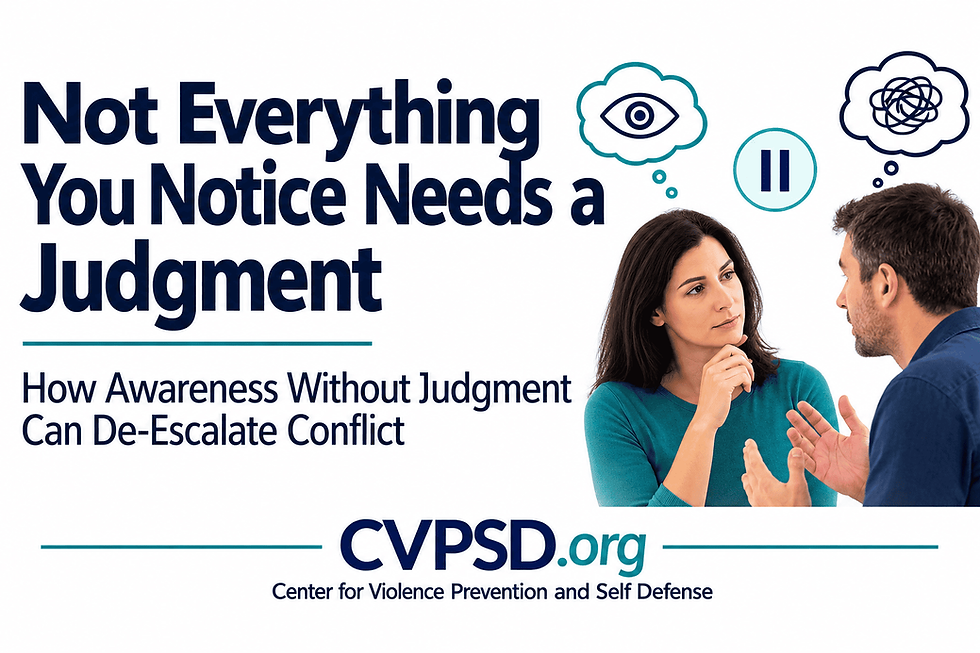
In each case, something observable has occurred. But the conclusion we draw about it may be incomplete, inaccurate, or entirely wrong.
The ability to separate observation from interpretation can create an important pause between what happens and how we respond. In a conflict, that pause can help prevent an uncomfortable interaction from becoming a confrontation.
This does not mean ignoring threatening behavior, excusing abuse, or pretending that every situation is harmless. It means learning to recognize what is happening without automatically adding assumptions that increase our emotional reaction.
For anyone working in violence prevention, crisis intervention, healthcare, education, public service, or personal safety, this distinction can be a practical de-escalation skill.
1. The Human Tendency to Attach Meaning to Behavior
People do not simply observe the world. They interpret it.
Our brains continuously process facial expressions, body language, vocal tone, movement, and social cues to help us understand what is happening and determine whether we need to act. This is useful because situations sometimes require rapid decisions. However, interpreting behavior also creates opportunities for error.
Consider the difference between these two statements:
Observation: “He is speaking loudly and standing close to me.”
Judgment: “He is an aggressive person who is trying to intimidate me.”
The observation describes behavior that another person could potentially verify. The judgment adds an interpretation of character and intent.
The judgment may be correct. It may also be wrong. The person could be angry, frightened, frustrated, hard of hearing, overwhelmed, or accustomed to communicating loudly. More information may be needed to distinguish between these possibilities.
Psychologists have studied a related tendency known as fundamental attribution error: the tendency to overemphasize personal characteristics when explaining another person's behavior while underestimating situational influences.
For example, we might describe an employee who snaps at a colleague as rude while overlooking the possibility that the employee is under extraordinary pressure or has just received distressing news.
Recognizing situational influences does not excuse inappropriate conduct. It simply prevents us from treating our first interpretation as an established fact.
The practical lesson is straightforward: observe the behavior, recognize your interpretation, and avoid confusing the two.
2. How Judgment Can Escalate a Conflict
Judgments matter because they influence our emotional responses and subsequent behavior.
When we interpret someone's actions as disrespectful, threatening, or intentionally hostile, we may become defensive. Our voice may grow louder, our posture may become more rigid, and our language may become confrontational.
The other person may then interpret our response as hostility and react accordingly. Each person begins responding not only to the original problem but also to the meaning they have assigned to the other person's behavior.
This can create a cycle of mutual escalation.
Consider a disagreement between a customer and a service employee.
The customer says, “I've already explained this three times. Why can't anyone here do their job?” The employee interprets the remark as a personal insult and responds, “You don't have to talk to me like that.”
The customer interprets the employee's response as dismissive and says, “See? This is exactly the problem with your company.”
The employee becomes more defensive, and the original service issue becomes secondary to a personal confrontation.
Now consider a different response. The employee notices the customer's raised voice and critical language without immediately deciding that the customer is a bad person or is deliberately trying to provoke a fight.
The employee might respond, “I can see that you've had to explain this more than once. Let me review what has happened and see what I can do.”
The employee has not agreed with the insult, accepted blame for everything, or surrendered professional boundaries. Instead, the employee has focused on the problem rather than escalating the judgment.
This approach is consistent with research on conflict management, emotional regulation, and de-escalation, which emphasizes the importance of managing one's own response, listening to concerns, and avoiding unnecessarily provocative communication.
The objective is not to win an argument about who is right. It is to improve the chances of reaching a safe and constructive outcome.
3. Separate What You See From What You Think It Means
A practical way to apply this principle is to divide an interaction into three parts:
Observation, interpretation, and response.
Observation identifies what happened. Interpretation describes the meaning we assign to it. Response is what we choose to do next.
For example:
Situation | Observation | Possible judgment | More useful response |
A person raises their voice | Their volume has increased | “They are trying to intimidate me.” | Speak calmly, assess the situation, and establish boundaries if needed. |
A coworker interrupts | They began speaking before I finished | “They think I am stupid.” | Say, “I'd like to finish my point, then I'll hear yours.” |
A teenager refuses an instruction | They have not followed the instruction | “They are deliberately disrespectful.” | Clarify the instruction, assess the reason for refusal, and explain the boundary. |
A customer uses profanity | They have used insulting language | “They are a terrible person.” | Address the issue while setting limits on abusive communication. |
Someone moves closer during a disagreement | The distance between us has decreased | “They are definitely about to attack.” | Create distance, monitor their behavior, identify an exit, and prioritize safety. |
The goal is not to eliminate interpretation. We need interpretation to make decisions. The goal is to recognize that interpretations are hypotheses, not automatically facts.
This distinction becomes especially important when safety is involved. You do not need to know why a person is behaving aggressively to recognize a risk and take protective action.
You can acknowledge uncertainty about someone's intentions while remaining decisive about your own safety.
4. Emotional Regulation Begins With the Pause
When a situation feels threatening or personally insulting, people may experience a rapid emotional reaction before they have fully considered the circumstances.
That reaction can influence attention, judgment, and communication. If we immediately act on our first interpretation, we may respond more aggressively than the situation requires.
A brief pause can help interrupt this process.
The pause does not have to be dramatic. It can be as simple as taking a breath, relaxing unnecessary muscle tension, allowing the other person to finish speaking, or silently asking yourself:
What did I actually observe?
What am I assuming about this person's intentions?
Is there another plausible explanation?
What response is most likely to improve safety or resolve the problem?
These questions shift attention from reacting to an assumed motive toward choosing a useful action.
Research on emotion regulation, including the work of psychologist James Gross, examines how people can influence which emotions they experience, when they experience them, and how they respond to them. Cognitive reappraisal, which involves reconsidering the meaning of a situation, is one studied strategy for regulating emotional responses.
In a conflict, reappraisal might mean replacing “This person is trying to humiliate me” with “This person is upset, and I do not yet know why.”
The second interpretation does not have to be correct to be useful. It simply leaves room for a measured response instead of committing immediately to a hostile explanation.
With practice, this pause can become a repeatable part of conflict management.
5. De-Escalation Requires Awareness Without Automatic Condemnation
Effective de-escalation involves paying close attention to behavior while resisting the urge to turn every observation into a personal judgment.
This is particularly relevant when working with people who are distressed, frustrated, frightened, confused, or experiencing a crisis.
A person who is agitated may speak rapidly, repeat questions, pace, avoid eye contact, or struggle to process information. These behaviors may indicate distress, but they do not establish a person's diagnosis, character, or intentions.
Instead of deciding that the person is being difficult, manipulative, or irrational, a responder can focus on what is observable and what the situation requires.
For example:
Rather than saying, “You're being unreasonable,” acknowledge the specific concern.
Rather than demanding, “Calm down,” reduce unnecessary verbal pressure and communicate clearly.
Rather than arguing about the person's attitude, address the immediate issue.
Rather than assuming that silence means agreement, check whether the person understands.
Rather than interpreting every movement as a threat, assess the full pattern of behavior, the context, distance, access to exits, and any observable signs of imminent danger.
This approach is compatible with trauma-informed principles that emphasize safety, trustworthiness, collaboration, and empowerment.
It is also consistent with established crisis communication practices that favor respectful communication, listening, personal space, and nonprovocative responses.
However, nonjudgment does not mean passivity. If someone threatens violence, attempts to strike another person, blocks an exit, or displays other immediate danger indicators,
protective action may be necessary. De-escalation must never take priority over escaping danger or obtaining assistance.
The objective is to remain observant without becoming unnecessarily reactive.
6. You Can Recognize Harmful Behavior Without Condemning the Person
One common misunderstanding is that withholding judgment means refusing to hold people accountable.
That is not the case.
There is a meaningful difference between identifying a behavior as unacceptable and deciding that the person who performed it is irredeemably bad.
For example:
“You threatened me, and I will not continue this conversation while you are making threats.”
This statement identifies a behavior, establishes a boundary, and communicates a consequence.
Compare it with:
“You are a dangerous, disrespectful person, and you always behave like this.”
The second statement attacks the person's identity, generalizes beyond the immediate incident, and invites an argument about character.
In many circumstances, behavior-focused language is more useful because it makes the issue specific and clarifies what needs to change.
This distinction also supports healthy boundaries in personal relationships, workplaces, schools, and public settings.
You can decide that a person's behavior is unacceptable without determining why they behaved that way. You can leave a conversation without proving the other person is wrong. You can report misconduct without making claims about motives you cannot establish.
And you can recognize a pattern of harmful behavior and take appropriate action without needing to resolve every question about the person's character.
Nonjudgment is not the absence of standards. It is the discipline of applying standards to observable conduct rather than relying on unnecessary assumptions.
7. Applying the Principle to Personal Safety and Violence Prevention
In personal safety, the distinction between observation and judgment has a particularly important application.
People sometimes become distracted by questions such as:
Is this person a bad person?
Are they trying to disrespect me?
Are they deliberately testing me?
Do I need to show them that I will not be intimidated?
These questions can shift attention away from the more useful task of assessing risk and choosing an appropriate response.
A more practical approach is to ask:
What behavior am I observing?
Is the behavior changing or intensifying?
Is the person respecting physical boundaries?
Can I maintain a safe distance?
Is an exit available?
Can I disengage without increasing the risk?
Do I need assistance?
This approach does not require you to assume that everyone is harmless. It requires you to distinguish between what you know, what you suspect, and what you need to do.
A person may be insulting without being physically dangerous. Another person may be quiet but display behavior that warrants caution. Neither demeanor alone nor a single ambiguous cue should be treated as conclusive evidence of intent.
Risk assessment is more useful when it considers the broader context and the progression of behavior rather than relying on personal dislike, stereotypes, or a single emotional impression.
For violence prevention, this principle supports a layered response: awareness, communication, boundaries, positioning, disengagement, and physical defensive action when necessary.
It also reduces the temptation to treat an interaction as a contest of pride. Personal safety is not about proving that you are tougher, more intimidating, or less willing to back down. It is about making decisions that improve your chances of reaching a safe outcome.
8. A Practical Exercise: Observe, Pause, Choose
The following exercise can help develop the skill of noticing without automatically judging.
Step 1: Identify the observable behavior.
Describe what happened without assigning a motive.
Instead of “She is trying to undermine me,” use “She disagreed with my recommendation during the meeting.”
Step 2: Identify the judgment.
Notice the conclusion you have attached to the event.
For example: “She does not respect me.”
Step 3: Consider alternative explanations.
Ask whether there are other plausible reasons for the behavior. Perhaps she disagrees with the recommendation, has different information, or has communicated poorly.
You do not have to excuse the behavior or decide which explanation is correct.
Step 4: Identify your objective.
Determine what matters most in the situation. Is it resolving a problem, protecting a boundary, communicating a concern, leaving safely, or requesting assistance?
Step 5: Choose a proportionate response.
Respond to the actual behavior and the level of risk. Ask a clarifying question when appropriate, state a boundary when needed, or disengage when continuing the interaction is unlikely to help.
Step 6: Reassess.
Observe how the person responds. Does the behavior become less intense, remain unchanged, or escalate? Adjust your response to the developing situation rather than remaining committed to your original interpretation.
This is not a technique for controlling another person's behavior. It is a way to improve your own decision-making under pressure.
Conclusion: Awareness Is More Useful When It Leaves Room for Thought
Not everything you notice needs a judgment attached to it.
A raised voice is something to notice. The assumption that the person intends to humiliate you is an interpretation. An insult is observable conduct. The conclusion that the person is entirely defined by that conduct is a judgment. A person moving closer may be a reason to reassess your safety, but you do not need certainty about their intentions before creating distance.
The distinction matters because our interpretations influence our emotional responses, and our responses influence what happens next.
In conflict, an unnecessary judgment can turn a manageable disagreement into a struggle over respect, identity, or control. By separating observation from interpretation, we create more room to listen, assess risk, communicate clearly, maintain boundaries, and disengage when necessary.
The practice is not to stop thinking critically. It is to think more precisely.
Notice the behavior. Question the assumption. Assess the risk. Choose the response.
That is the practical value of awareness without automatic judgment, and it is an important skill for anyone seeking to prevent conflict from escalating into violence.
The following sources support the psychological and practical principles discussed in this article.
1. Ross, L. (1977). The intuitive psychologist and his shortcomings: Distortions in the attribution process. In Advances in Experimental Social Psychology, 10, 173-220. Foundational work on attribution errors and how people explain others' behavior. Read the research chapter.
2. Gross, J. J. (2002). Emotion regulation: Affective, cognitive, and social consequences. Psychophysiology, 39(3), 281-291. Examines cognitive reappraisal and other ways people regulate emotional responses. Read the research.
Wiley Online Library
3. Substance Abuse and Mental Health Services Administration (SAMHSA). Trauma-Informed Approaches and Programs. Describes principles including safety, trust, collaboration, and empowerment. Read the guidance.
SAMHSA
4. McRae, K., & Gross, J. J. (2020). Emotion regulation. Emotion, 20(1), 1-9. Reviews the research on strategies for influencing emotional responses, including cognitive reappraisal. Read the research.
PubMed


