
Cut Restraints 24.6%: Practical Steps for Healthcare & Behavioral Teams

Multimodal, trauma-informed organizational programs, led by senior leadership and combining staff training, data-driven quality improvement, individualized safety plans, environmental change, and structured debriefing, are the evidence-backed way to reduce restraint and seclusion. Programs built on the Six Core Strategies framework and the Safewards model consistently outperform single-fix efforts. Organizations that adopt them can lower coercive interventions without increasing violence or injuries to staff or patients.
Table of Contents
What Does the Research Say About Restraint Reduction Strategies?
The Six Core Strategies and Safewards: How They Actually Work
What Environmental and Policy Changes Reduce Escalation Triggers?
How Should Teams Debrief After a Restraint or Seclusion Event?
How CVPSD’s Training Aligns With Evidence-Based Restraint Reduction
What Ethical and Legal Lines Should Guide Restraint Reduction Work?
What Does the Research Say About Restraint Reduction Strategies?
The evidence base for restraint reduction has matured well past pilot studies and single-site case reports. Systematic reviews now cover dozens of interventions across psychiatric, medical, and developmental-disability settings, and the pattern that emerges is consistent: programs that combine multiple components beat programs that rely on one lever alone.
A 2024 systematic review by Bertani and colleagues found that multimodal interventions were effective in 36 of 39 evaluated studies, a hit rate that single-component training programs rarely approach on their own. The same review reported outcomes from a Safewards cluster randomized controlled trial showing notable reductions in conflict events and restraint use across participating units. Those are not marginal numbers for a field where a single restraint episode carries real physical and psychological risk for everyone in the room.
The core finding: Multimodal programs succeeded in 36 of 39 studies reviewed, and a Safewards cluster trial cut restraint rates by roughly 24.6% and conflict rates by about 15%.
Child and adolescent psychiatric care offers some of the most dramatic single-study results in the literature. Perers and colleagues documented a collaborative, strength-based care model, built around trauma-informed principles and problem-solving with young patients, that produced a major reduction in total hours of seclusion and restraint in an inpatient unit. That figure represents one study, not a universal guarantee, but it demonstrates what is possible when clinical teams shift from control-based management to collaborative care.
Safety outcomes matter just as much as reduction numbers, because the fear driving resistance to restraint reduction is usually a fear of increased violence. Consensus guidance summarized in an NCBI Bookshelf review of restraint and seclusion reduction concludes that systematic implementation of evidence-based practices lowered restraint use without a corresponding rise in violent incidents. Several of the studies in that synthesis also reported fewer staff injuries and lower associated costs. That combination, less coercion and less harm, is what makes the case for organizational change rather than just clinical courage.
The limitations are real and worth naming. Many of the strongest studies come from psychiatric inpatient settings, so generalizing directly to emergency departments, medical-surgical units, or long-term care requires some caution. Sample sizes in individual trials are often modest, and program fidelity, how closely a unit actually implements the full model rather than a watered-down version, varies significantly across sites. Reviewers consistently flag that partial implementation produces partial results. A unit that trains staff in de-escalation but skips the data infrastructure and debriefing components tends to see smaller, less durable gains than one that adopts the full framework.
The Six Core Strategies and Safewards: How They Actually Work
Two frameworks dominate the restraint reduction literature, and understanding how each one operates helps clarify why combining strategies outperforms picking just one.
The Six Core Strategies framework
Developed and consolidated by the National Association of State Mental Health Program Directors (NASMHPD), the Six Core Strategies model treats restraint reduction as a system-level change project, not a training checkbox. Each strategy addresses a different layer of the organization:
Leadership toward organizational change. Executive and unit leaders publicly commit to reduction goals, allocate resources, and hold managers accountable for progress, not just outcomes on paper.
Use of data to inform practice. Units track restraint and seclusion episodes, review trends, and treat the numbers as a management tool rather than a compliance report nobody reads.
Workforce development. Staff receive real training in de-escalation, trauma-informed care, and behavior analysis, with skills reinforced through supervision and coaching, not a one-time seminar.
Use of restraint and seclusion reduction tools. Teams adopt structured risk assessments, individualized crisis plans, and comfort-focused interventions before a crisis peaks.
Consumer and family roles in inpatient settings. Patients and, where appropriate, families help shape their own safety plans and contribute to unit-level program design.
Debriefing techniques. Every restraint or seclusion episode triggers a structured review focused on prevention, not blame.
Safewards: the ten interventions
Where the Six Core Strategies operates at the organizational level, Safewards works at the unit and shift level with specific, tested interventions. The model identifies conflict originating from six sources, including the physical environment, staff team, patient community, patient characteristics, external factors, and regulatory framework, and pairs each with concrete countermeasures. Signature Safewards interventions include:
Clear mutual expectations, communicated to patients on admission rather than assumed
A “calm down methods” resource that staff and patients use together during rising tension
Structured, positive words used consistently across a shift to reduce mixed messaging
Bad news mitigation, so distressing information is delivered with support in place
Talk-down or de-escalation scripts staff rehearse before they need them
Reassurance rounds and know-each-other exercises that build rapport before crisis moments arise
The two frameworks interlock rather than compete. Leadership commitment and data infrastructure from the Six Core Strategies create the organizational conditions, budget, staffing time, accountability, that let Safewards-style shift-level interventions actually stick. A unit that adopts Safewards interventions without leadership backing tends to see gains fade once the initial enthusiasm wears off. A unit that has leadership commitment but no concrete shift-level tools often struggles to translate policy into daily practice. Insights from the Bertani review support this: multimodal interventions that pair environmental changes with staff training show larger, more sustained reductions than training delivered alone.
What Staff Training Actually Prevents Escalation?
Verbal de-escalation is often taught as a soft skill. The research treats it as a clinical competency with specific, teachable domains. Project BETA and related literature identify ten domains of verbal de-escalation that form the backbone of effective first-line response:
Respect personal space, giving the patient enough physical room to feel safe rather than cornered.
Avoid provocative language, tone, or body positioning that can be read as a threat.
Establish verbal contact early, using a calm, clear voice before the situation escalates further.
Be concise, since a calm, quiet voice carries more authority than an anxious torrent of instructions.
Identify the patient’s wants and needs rather than jumping straight to compliance demands.
Listen actively and reflect back what the patient says to show they are being heard.
Agree, or agree to disagree, on at least one point to build a foundation of cooperation.
Set clear, consistent limits framed around safety, not control.
Offer choices and realistic optimism so the patient retains a sense of agency.
Debrief the patient and staff after the encounter, whether or not it required further intervention.
Training that stops at a single classroom session rarely changes behavior under real pressure. Programs that build lasting competency use scenario-based simulation, live role-play with feedback, and direct coaching from experienced staff during actual shifts. A CVPSD trauma-informed approach to de-escalation works the same way clinical skills training always has: repetition under realistic conditions, not passive review of a slide deck.
Refresher cadence matters more than most organizations assume. Skills taught once during onboarding decay within months if they are not practiced. Quarterly scenario refreshers, paired with brief coaching after real incidents, keep de-escalation domains active in staff memory rather than buried under six months of routine care.
Pro Tip: Tie de-escalation competency checks to the same performance review cycle used for clinical skills like medication administration. When a skill is measured the same way clinical competencies are, staff and supervisors both treat it as core practice rather than an optional add-on.
Embedding these skills into hiring and supervision changes the culture faster than training alone. Ask candidates during interviews how they have handled an agitated patient in the past. Include de-escalation observation in unit rounding. Most importantly, when an incident does occur, run the debrief as a learning exercise, not a disciplinary review. Punitive debriefs, where staff fear blame more than they value the lesson, are one of the fastest ways to suppress honest incident reporting and starve your data of the detail you need to improve. A crisis prevention training program built around real-world techniques reinforces this by treating every encounter, successful or not, as a source of institutional learning.
How Do Individualized Safety Plans Reduce Restraint Use?
Restraint reduction is not just an organizational policy question. It is also a clinical planning question that depends on knowing individual patients well before a crisis hits.
Validated risk-assessment tools and early-warning systems give staff a structured way to flag rising agitation before it becomes a safety emergency. These instruments work best when reviewed at shift handoff, not buried in a chart nobody opens until after an incident. Early identification lets staff apply de-escalation domains, offering choices, adjusting the environment, involving a trusted staff member, while the patient still has capacity to engage in dialogue.
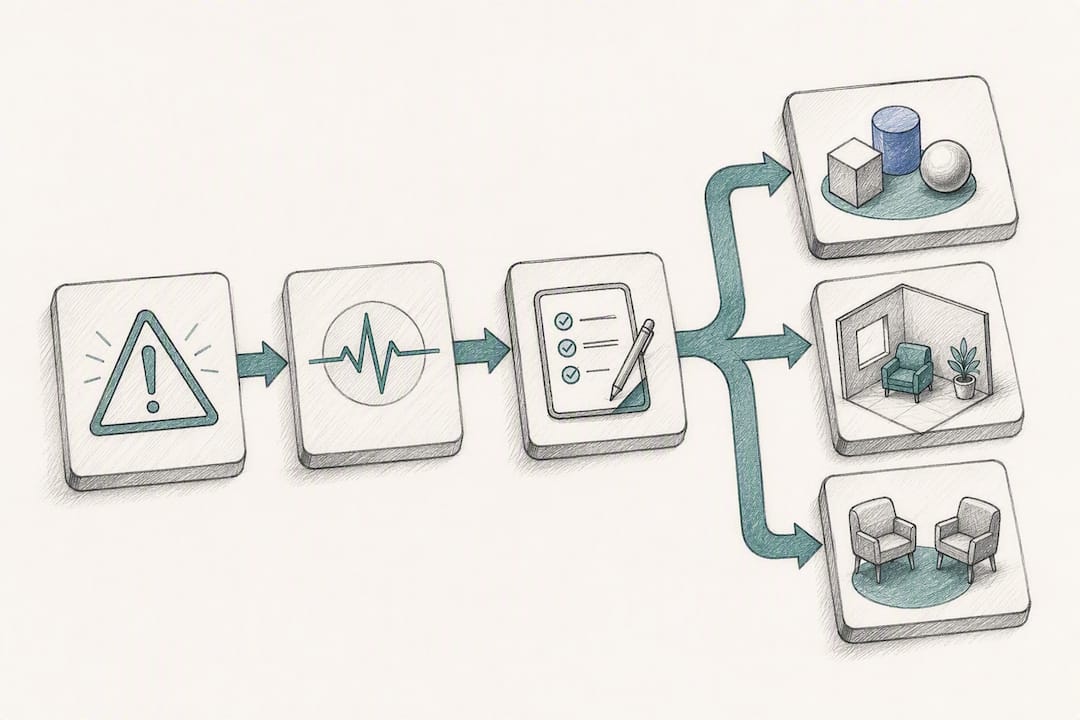
Behavioral advance directives and crisis-safety plans take this further by involving the patient directly in their own care planning. Drafted during a calm period, these documents record what has helped the patient during past crises, what has made things worse, and what supports they want staff to try first. A plan built collaboratively tends to get followed more consistently than one imposed unilaterally, because it reflects the patient’s own insight into their triggers and coping strategies.
Sensory modulation and comfort rooms give staff and patients a concrete, non-restrictive tool to use during rising distress. Effective comfort spaces typically include:
Weighted blankets or lap pads for proprioceptive input
Noise-canceling headphones or calming audio options
Adjustable lighting, since harsh fluorescent light can itself be a trigger
Tactile items such as stress balls, textured fabric, or fidget tools
A private, low-stimulation space separate from the main unit floor
Restraint-fading approaches, most developed in the context of developmental disabilities, offer a structured way to reduce reliance on mechanical protective devices over time rather than abruptly. These techniques call for genuine behavior analytic expertise and careful, incremental monitoring, since removing a support too quickly can create new safety risks for the very patient it aims to protect.
Documentation matters here in a way that is easy to overlook. Every alternative attempted before restraint, the comfort room offered, the advance directive consulted, the specific de-escalation domain applied, belongs in the record. This documentation trail does two things at once: it protects the clinical team by showing due diligence, and it builds the dataset that lets your quality team identify which alternatives are actually working for which patients.
Which Metrics Actually Drive Restraint Reduction Progress?
Data without structure just accumulates. Data with structure changes practice. Organizations serious about restraint reduction typically track a consistent core metric set and review it on a regular cadence rather than waiting for an annual compliance report.
Metric | What it captures | Why it matters |
Restraint/seclusion episodes | Overall frequency, adjusted for census | Lets you compare across units and time periods fairly |
Average duration per episode | How long each restraint or seclusion lasts | Shorter durations often signal better de-escalation follow-through |
Antecedent and trigger category | What preceded the episode (denied request, transition, unclear reason) | Identifies patterns leadership can act on directly |
Injury rate (staff and patient) | Physical harm associated with episodes | Confirms reduction efforts are not trading coercion for injury |
Repeat incidents per patient | How often the same patient is restrained | Flags cases needing an updated individualized safety plan |
Baselines come first. Before setting a reduction target, a unit needs at least a few months of consistent data collection to understand its actual starting point, including which shifts, units, or diagnoses carry the highest incident rates. Run charts and control charts, standard quality-improvement tools, let teams distinguish a genuine trend from routine week-to-week noise. Setting a SMART target reduction in restraint episodes over a defined period, gives the team something concrete to measure against rather than a vague aspiration to “do better.”
Data review should happen in a nonpunitive forum where frontline staff, not just administrators, discuss what the numbers mean. When a review surfaces a pattern, say, restraint episodes spike specifically on the overnight shift or immediately after shift change, leadership has a genuine mandate to act: adjust staffing ratios, add a handoff protocol, or schedule a de-escalation refresher for that specific team. Data that never reaches a decision maker is data collected for nothing.
What Environmental and Policy Changes Reduce Escalation Triggers?
Physical space and organizational policy shape behavior just as much as clinical skill does. A unit designed around control, locked doors, shared rooms, harsh lighting, generates more triggers than one designed around calm and autonomy.
Environmental elements with real evidence behind them include single-occupancy rooms that reduce interpersonal conflict, access to natural daylight, and dedicated sensory or comfort rooms staff can offer as a genuine alternative rather than an afterthought. Environmental changes paired with staff training produce more durable reductions than training delivered in isolation, according to the Bertani review’s broader findings.
Policy design matters just as much as physical space. Effective organizations:
Build a least-restrictive decision flowchart that staff must document following, step by step, before restraint is authorized
Use decision-support algorithms embedded in the electronic health record to prompt alternatives at the point of care
Adopt open-door policies where clinically appropriate, reducing the baseline sense of confinement that drives some escalation
Require a second clinician sign-off before restraint initiation outside of an immediate emergency
Staffing models influence outcomes directly. Rapid-response rosters, a small team trained specifically in de-escalation who can be paged to a unit before a situation peaks, give staff another option besides restraint. Multidisciplinary teams that include psychiatry, nursing, social work, and peer support bring more tools to a crisis than a single discipline working alone.
None of this holds without sustained leadership behavior. Leaders who show up during difficult shifts, ask about alternatives attempted rather than just outcomes, and protect debrief time from being canceled during busy periods are the ones who keep a restraint reduction culture alive past its first enthusiastic quarter.
How Should Teams Debrief After a Restraint or Seclusion Event?
Debriefing is where most restraint reduction programs either build momentum or quietly stall out. The strongest programs use a two-stage model.
Immediate support debrief, held within hours of the event, checks in on both the patient and staff involved. The goal here is emotional processing and immediate safety, not analysis.
Formal root cause review, held within a few business days, brings together the clinical team, a data or quality representative, and where possible the patient, to walk through what led to the episode and what could have gone differently.
Participants in the formal review should examine the antecedent, the alternatives attempted, the specific point where de-escalation stopped working, and any gaps in the patient’s individualized safety plan. Findings need to translate into concrete action items: updating a crisis plan, adjusting staffing for a specific shift, or scheduling additional coaching for a specific skill gap.
Framing determines whether this process works at all. Debriefs run as disciplinary hearings teach staff to underreport rather than disclose honestly, which quietly poisons your data quality. Successful programs explicitly protect debriefs from punitive follow-up and publish aggregated lessons learned back to the unit, so staff see their honesty produce real change rather than just paperwork.
Typical action items arising from well-run debriefs include revised comfort room protocols, additional staff assigned during known high-risk time windows, updated behavioral advance directives, and targeted refresher training for a specific de-escalation domain that broke down during the incident..
How Do You Build a Realistic Restraint Reduction Roadmap?
Moving from evidence to practice requires sequencing, not just enthusiasm. A phased roadmap keeps the effort from collapsing under its own ambition in month one.
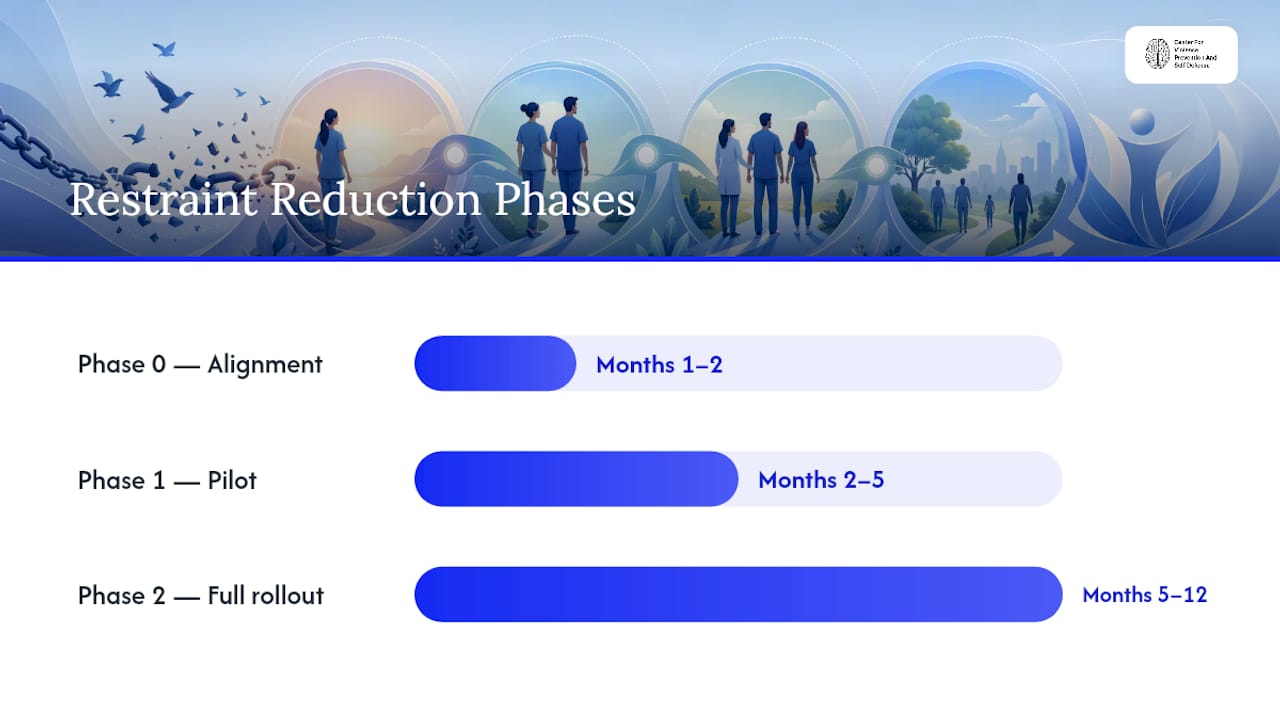
Phase 0: Alignment and baseline (months 1 to 2). Secure explicit leadership commitment, including a public statement of intent. Pull baseline restraint and seclusion data. Include patients or former patients with lived experience in early planning conversations, since involving lived experience in program design measurably improves how sustainable and acceptable the resulting program becomes.
Phase 1: Quick wins and pilot interventions (months 2 to 5). Launch de-escalation training on one pilot unit. Roll out individualized safety plans for the highest-risk patients first. Stand up a comfort room, even a modest one, and train staff on when to offer it.
Phase 2: Full rollout with governance (months 5 to 12). Expand training and safety planning house-wide. Build a data dashboard tracking the core metric set. Establish a standing, nonpunitive review committee that meets on a fixed cadence, not an as-needed basis.
Sustainment (ongoing). Schedule refresher training cycles. Report reduction progress publicly within the organization to maintain accountability. Monitor for equity gaps, checking whether restraint rates differ by race, diagnosis, or unit in ways that demand a targeted response rather than a general one.
Assign a named executive sponsor accountable for the full roadmap, not just the training rollout
Budget for comfort room supplies and simulation training time up front, not as an afterthought
Set the first formal progress review at the six-month mark, not the twelve-month mark
Pro Tip: Resist the urge to roll out every component simultaneously across every unit. Pilot on one unit first, work out the operational kinks, then scale. A rushed house-wide launch is the single most common reason these programs stall before month six.
How CVPSD’s Training Aligns With Evidence-Based Restraint Reduction
CVPSD is a 501©(3) nonprofit built specifically around the skills this evidence base calls for: crisis intervention, de-escalation, behavior analysis, and physical self-defense, delivered through training designed to meet the workforce development pillar of the Six Core Strategies framework directly.
Reducing restraint and seclusion is not a single training event. It is a sustained organizational commitment that lives or dies on whether frontline staff have real, rehearsed skills and a culture that supports using them.
Training formats built around this reality include instructor-led simulation, scenario-based coaching, and structured curricula covering the same verbal de-escalation domains that Project BETA guidance identifies as first-line practice. CVPSD’s trauma-informed care training suite was built to meet CMS and Joint Commission expectations directly, which matters for organizations that need training documentation to satisfy regulatory review, not just internal policy.
These programs map onto debriefing practice as well. Training that builds staff comfort with structured post-incident review, rather than treating debriefs as something to dread, directly supports the nonpunitive reporting culture that makes restraint reduction data trustworthy. An organization implementing the roadmap above needs a workforce partner who understands both the clinical skill and the cultural shift required to sustain it.
What Ethical and Legal Lines Should Guide Restraint Reduction Work?
The ethical principle underneath all of this is simple to state and harder to practice consistently: minimize coercion and center patient dignity in every decision. Restraint and seclusion are not neutral clinical tools. They carry real risk of physical harm and lasting psychological trauma, a reality documented in cases involving physical restraints that every training program should address directly.
Legally and clinically, restraint belongs at the end of the response chain, not the beginning. Staff training should teach a clear threshold: restraint is for imminent risk of serious physical harm, not discomfort, noncompliance, or staff convenience. Role-playing that decision point under realistic pressure does more to prevent misuse than any policy memo.
Three pitfalls undermine even well-intentioned programs. Punitive debriefing drives underreporting and corrupts your data. Ignoring lived experience in program design produces policies that look good on paper but miss what patients actually need during a crisis. And equity blind spots, failing to check whether restraint rates differ by race or diagnosis, let bias operate invisibly inside a program that claims to be evidence-based. Reviewing these three risks quarterly costs little and prevents a great deal of quiet harm.
Where CVPSD Fits in Your Restraint Reduction Plan
Reading the research is one step. Building the training infrastructure to act on it is another, and that is where most organizations lose momentum. CVPSD exists specifically to close that gap: workforce development, debriefing facilitation, and policy alignment delivered as a coordinated training engagement rather than a one-off seminar nobody remembers by month three.
Offerings map directly onto the components covered here. De-escalation and crisis intervention training builds the verbal domains staff need under pressure. Behavior analysis training supports individualized safety planning and restraint-fading work. Consulting support helps unit leaders build the debriefing structures and least-restrictive decision policies that keep a reduction program from stalling after its first quarter. Programs are available on-site, virtually, and through train-the-trainer certification, so the skill stays inside the organization rather than walking out the door when a consultant leaves.
A typical engagement moves through assessment, a focused pilot on one unit, and then a scaled rollout guided by the data your team collects along the way. Start that process by reaching out through CVPSD’s website to discuss which training format fits your unit’s current stage of readiness.
Primary Sources for Restraint Reduction Program Design
Organizations building or refining a restraint reduction program should keep a short set of primary documents on hand for reference and staff training design.
NASMHPD’s consolidated Six Core Strategies document, the foundational implementation guide for the six-strategy framework
The systematic review of restraint reduction strategies by Bertani and colleagues, covering Safewards trial data and multimodal program outcomes
The NCBI Bookshelf resource on reducing restraint and seclusion, summarizing Project BETA and APA consensus guidance
Perers and colleagues’ study on seclusion and restraint reduction in child and adolescent psychiatric care, documenting collaborative care outcomes
The review of alternatives to restraint and humanistic care approaches, covering de-escalation domains and sensory modulation tools
This article is general information, not a substitute for advice from a qualified doctor. Consult a qualified healthcare professional about your own circumstances before acting on anything here.
Sources
FAQ
What are the six core strategies of restraint reduction?
The Six Core Strategies framework consists of leadership toward organizational change, use of data to inform practice, workforce development, use of restraint and seclusion reduction tools, consumer and family roles in care, and structured debriefing techniques.
What are the three types of restraint techniques?
Restraint is generally categorized into physical restraint (manual bodily hold), mechanical restraint (a device that limits movement), and chemical restraint (medication used specifically to control behavior rather than treat a diagnosed condition).
What is a four-point restraint technique?
A four-point restraint secures both wrists and both ankles, typically to a bed frame, and represents one of the most restrictive mechanical interventions available. Consensus guidance treats it strictly as a last resort for imminent risk of serious harm, used only for the shortest duration necessary and under close, continuous monitoring.
What are the four types of restrictive interventions?
Restrictive interventions are commonly grouped into physical restraint, mechanical restraint, chemical restraint, and seclusion, which involves confining a patient alone in a room they cannot freely leave. All four carry documented risks and should follow the same least-restrictive decision pathway before use.
How does CVPSD support restraint reduction efforts?
CVPSD provides training in crisis intervention, de-escalation, and behavior analysis that aligns directly with the workforce development and debriefing components of evidence-based restraint reduction frameworks, delivered through on-site, virtual, and train-the-trainer formats.
Recommended
About the Author: William DeMuth is the Director of Training at the Center for Violence Prevention and Self Defense (CVPSD) in Freehold, NJ. With over 35 years of research in violence dynamics and personal safety, William specializes in evidence-based training that bridges the gap between compliance and real-world conflict resolution. The architect of the ConflictIQ™ program, he holds advanced certifications and has trained under diverse industry leaders. Today, he actively trains civilians, hea


