
Self-Defense Training for Organizations: A Buyer's Guide


Commission a customized, evidence-based self-defense program that balances de-escalation, psychological resilience, and simple physical skills. That single decision does more for workplace safety than any policy memo. Before you schedule your first session, work through this short checklist:
Schedule a 15-minute discovery call with at least two providers and ask each for a written curriculum.
Request proof of instructor credentials, including certification from a recognized training body and current first aid/CPR.
Confirm the program meets state and local laws and includes written informed-consent and waiver procedures.
Verify that the curriculum is trauma-informed and can accommodate participants with physical limitations or sensory needs.
Look for a nonprofit or accredited training partner whose materials cite evidence-based program standards.
Table of Contents
What program types and modules do organizations typically commission?
How is training delivered, and what logistics do you need to plan?
How do you design a curriculum that builds both skills and resilience?
What instructor qualifications and safety protocols should you require?
What organizations often get wrong about self-defense training
CVPSD offers a direct path to a custom organizational program
Why do organizations invest in self-defense training?
The case for workplace safety training goes well beyond preventing a single incident. Organizations that commission group self-defense workshops report measurable gains in employee confidence, team cohesion, and overall morale. Equally important, a documented training program signals due diligence to insurers, regulators, and prospective hires, which supports both risk mitigation and retention.
Training also connects directly to broader emergency planning. When staff understand situational awareness, verbal de-escalation, and basic escape techniques, they respond more deliberately during a crisis rather than freezing or escalating a situation. That capacity for intentional decision-making under pressure is what separates a well-prepared team from an unprepared one.
Multi-session workshops commonly run several hours and allocate roughly equal time to verbal defense, physical technique, and mental strategy. Single-session formats typically run a few hours. The research-backed takeaway: a single lunch-and-learn builds awareness, but a multi-session series produces durable behavioral change. Budget accordingly.
What program types and modules do organizations typically commission?
Common program formats
Corporate self-defense classes come in several formats, and the right choice depends on your workforce’s threat profile and schedule:
Single-session awareness workshops (1–3 hours): ideal for initial rollout or annual refreshers; cover situational awareness, verbal de-escalation, and one or two physical escape techniques.
Multi-session skill series (12+ hours across several weeks): build layered competency and allow scenario practice that reinforces retention.
Active-shooter awareness modules: focus on recognition, protocols, and evacuation decision-making, not hands-on force.
Parking-lot and travel-safety modules: cover low-light awareness, vehicle approach, and personal-space management, particularly relevant for home-visiting staff and real-estate professionals.
Role-specific tracks: tailored for customer-facing staff, healthcare triage teams, campus personnel, frontline nonprofit workers, and licensed security officers who need advanced defensive tactics.
Government workplace safety tracks: specialized programs for GSA-participating organizations and public-sector agencies.
Core modules every program should include
Regardless of format, a well-designed employee safety training program covers:
Situational awareness and threat recognition
Verbal de-escalation and assertive communication
Boundary setting and bystander intervention
Basic escape and wrist-release techniques
Low-risk physical defense appropriate for all fitness levels
Post-incident support, documentation, and reporting procedures
Sector-specific examples
A healthcare triage team benefits most from verbal de-escalation and patient de-escalation protocols. Real-estate agents conducting open houses need parking-lot safety and personal-space management. Campus staff gain most from bystander intervention and active-threat protocols. Frontline nonprofit workers serving at-risk populations need workplace violence prevention skills paired with trauma-informed communication.
How is training delivered, and what logistics do you need to plan?
Delivery formats
On-site and virtual options are now standard across the industry. The main formats are:
On-site instructor-led: the provider comes to your facility; best for physical practice and team cohesion.
Off-site at a training center: useful when your space lacks a private practice area.
Virtual live workshops: cover awareness, verbal skills, and mental strategy effectively; physical technique practice is limited.
Hybrid models: combine a virtual awareness session with one in-person physical skills day.
Mobile units: some providers bring padded mats and equipment to your location.
Session lengths and cadence
A lunch-and-learn session of about an hour works for awareness-only goals. A single-session workshop lasting a few hours can layer in basic physical techniques. A multi-session series spread across several weeks produces the most durable skill retention and is the format most providers recommend for organizations with ongoing safety obligations.
Plan a reinforcement session a few months after initial training to prevent skill decay. Many providers offer shorter refresher modules at reduced rates for returning groups.
Logistics checklist
Before you sign a contract, confirm:
A private space with adequate floor clearance for physical practice
Accessibility accommodations for participants with mobility or sensory needs
Informed-consent and waiver procedures distributed before the first session
Provider’s liability insurance documentation
A scheduling plan that minimizes operational disruption (stagger cohorts if needed)
How do you design a curriculum that builds both skills and resilience?
The most effective self-defense programs for teams treat psychological resilience and tactical skill as equally important. One useful frame: the “software” side of training covers awareness, communication, and positioning; the “hardware” side covers simple, repeatable physical responses. High-impact workshops spend nearly as much time on assertive communication and boundary-setting as on physical techniques, which makes the content accessible across fitness levels and body types.

Clear learning objectives give you a way to evaluate whether the curriculum delivers. By the end of a well-designed program, participants should be able to recognize escalation cues, use verbal boundary-setting in a simulated scenario, execute two simple escape techniques, and follow your organization’s post-incident reporting process.
Inclusivity is not optional. Require the provider to offer pre-screening for physical limitations and comfort with physical contact. Consent and bodily autonomy rules should be stated explicitly before any hands-on exercise begins. Programs should also offer gender-specific or all-gender cohort options and accommodate mobility or sensory needs. CVPSD’s commitment to diversity, equity, and inclusion provides a useful benchmark for what inclusive delivery looks like in practice.
Pro Tip: Request a discovery call or site walk-through before signing any contract. A provider who asks about your physical environment, your workforce’s threat profile, and your participants’ backgrounds before proposing a curriculum is one who will actually tailor the content, not just deliver a generic seminar.
How do you measure whether training is actually working?
Measuring impact starts before the first session. Establish a baseline with a short pre-training survey, then repeat it immediately after and again at three to six months. The table below gives you a practical KPI framework to share with your provider.

KPI | Measurement method | Frequency | Target threshold |
Participant confidence score | Pre/post self-report survey | Pre-training, post-training, 6-month follow-up | 20%+ improvement post-training |
Situational awareness score | Scenario-based skills checklist | Post-training, 6-month refresher | Pass rate on scenarios |
Incident-reporting rate | HR records comparison | Baseline vs. 6 months post-training | Increase in reports (signals awareness, not more incidents) |
Reinforcement session completion | Attendance records | 3–6 months post-training | Most of the original cohort |
Qualitative feedback | Open-ended survey | Post-training | Most participants report feeling more prepared |
Ask your provider for a sample survey template during the discovery call. A strong provider will already have one; a provider who cannot produce one is a red flag. Manager observations and scenario walk-throughs during refresher sessions add a qualitative layer that surveys alone cannot capture.
What instructor qualifications and safety protocols should you require?
Credentials to request in writing
Before any instructor enters your facility, ask for:
Certification from a recognized self-defense or martial arts training body
Current first aid and CPR certification
Documented de-escalation or crisis-intervention training
Relevant law-enforcement, clinical, or security experience where the role demands it
A background check or disclosure statement
Safety protocols to require
Every workplace violence prevention program should include written protocols covering informed consent, physical-contact rules, accommodation policies, and emergency response procedures during the session itself. Confirm the provider carries liability insurance and can produce a certificate of coverage.
Red flags to watch for: an instructor who promises combative outcomes (“your staff will be able to fight off any attacker”), refuses to modify content for trauma-informed delivery, or cannot produce written safety documentation. HR should confirm local labor and liability rules and coordinate with the organization’s risk-management counsel before any physical practice begins.
How do you choose the right training partner?
Procurement checklist
Work through these items before shortlisting providers:
Scope and customization: Can the provider tailor scenarios to your industry, facility, and workforce?
Safety documentation: Written informed-consent, waiver, and accommodation policies available before signing?
Instructor credentials: Certifications, background checks, and relevant experience documented?
Sample curriculum: Can they share a lesson plan or module outline before you commit?
References or case studies: Do they have documented outcomes from comparable organizations?
Evaluation plan: Do they offer pre/post measurement and a follow-up refresher?
Pricing breakdown: Is the quote itemized by travel, equipment, customization, and instructor time?
Scheduling flexibility: Can they work around your operational calendar?
Questions to ask on a discovery call
“Walk me through how you tailor scenarios to our specific environment.”
“What are your instructors’ certifications, and can you share documentation?”
“How do you handle participants who are uncomfortable with physical contact?”
“What does your evaluation plan look like, and what data do you share with us?”
“Can you provide a sample lesson plan for a group our size?”
“What is your process if a participant is injured during a session?”
Budget guidance
A single-session workshop for a group of 20–30 typically costs less than a multi-session series, but the per-participant value of a series is higher when you factor in skill retention. Cost drivers include instructor travel, equipment (mats, protective gear), degree of customization, and instructor seniority. Subscription or refresher models spread cost over time and maintain skill levels more effectively than a one-off event.
About CVPSD: how the organization works with teams
CVPSD (the Center for Violence Prevention and Self-Defense) is a 501©(3) nonprofit that provides evidence-based crisis intervention, de-escalation solutions, behavior analysis, and physical self-defense skills to organizations across the United States. Programs are designed to meet state and local laws, and CVPSD partners with public and private organizations, schools, nonprofits, community groups, and government agencies.
Program features that align directly with organizational buyer needs include customizable curricula, trauma-informed delivery, a government workplace safety track for public-sector clients, advanced modules for licensed security professionals, and a nationwide partner network. Every program is built around measurable learning objectives and includes a clear evaluation component.
Organizations that have worked with CVPSD consistently note the program’s ability to address real workplace scenarios rather than generic self-defense content, and the care instructors take to create a psychologically safe environment for all participants. To request a written proposal or schedule a discovery call, visit the CVPSD program page.
Key Takeaways
The most effective self-defense training for organizations combines evidence-based curriculum, trauma-informed delivery, and a structured evaluation plan that measures confidence and behavior change before and after training.
Point | Details |
Start with a multi-session series | Single sessions build awareness; 12+ hour series produce durable behavioral change. |
Require written safety protocols | Demand informed-consent, waiver, and accommodation documentation before signing any contract. |
Measure with pre/post surveys | Track confidence scores, scenario pass rates, and incident-reporting rates at baseline and 6 months. |
Tailor to role and industry | Healthcare, real estate, campus, and government staff each need sector-specific scenarios and modules. |
CVPSD as a ready option | CVPSD is a 501©(3) provider with evidence-based curricula, trauma-informed delivery, and programs that meet state and local laws. |
What organizations often get wrong about self-defense training
Most organizations that commission employee safety training make the same mistake: they treat it as a one-time event. A single 90-minute seminar checks a compliance box, but it does not build the kind of calm, deliberate response that actually protects people under pressure. The research on skill retention is clear. Without reinforcement at three to six months, most participants revert to their pre-training baseline.
The second mistake is treating physical technique as the primary outcome. The most effective programs spend as much time on verbal de-escalation, assertive communication, and situational awareness as they do on physical skills. That balance is not a compromise; it is what makes training accessible to every participant regardless of fitness level, and it is what produces measurable behavioral change in the workplace.
Organizations that get this right treat self-defense training the way they treat fire safety: a structured, recurring program with clear objectives, documented outcomes, and a reinforcement cadence built into the annual calendar. The goal is not to create fighters. The goal is to give every person on your team the awareness and communication skills to avoid a confrontation, and the confidence to act decisively if one cannot be avoided.
CVPSD offers a direct path to a custom organizational program
CVPSD gives organizational decision-makers something most providers cannot: a nonprofit partner with evidence-based curricula, trauma-informed instructors, and programs already designed to meet state and local compliance requirements. The engagement model is straightforward: a discovery call to assess your workforce’s needs, a written proposal with a full curriculum outline, and a pilot delivery with your first cohort.
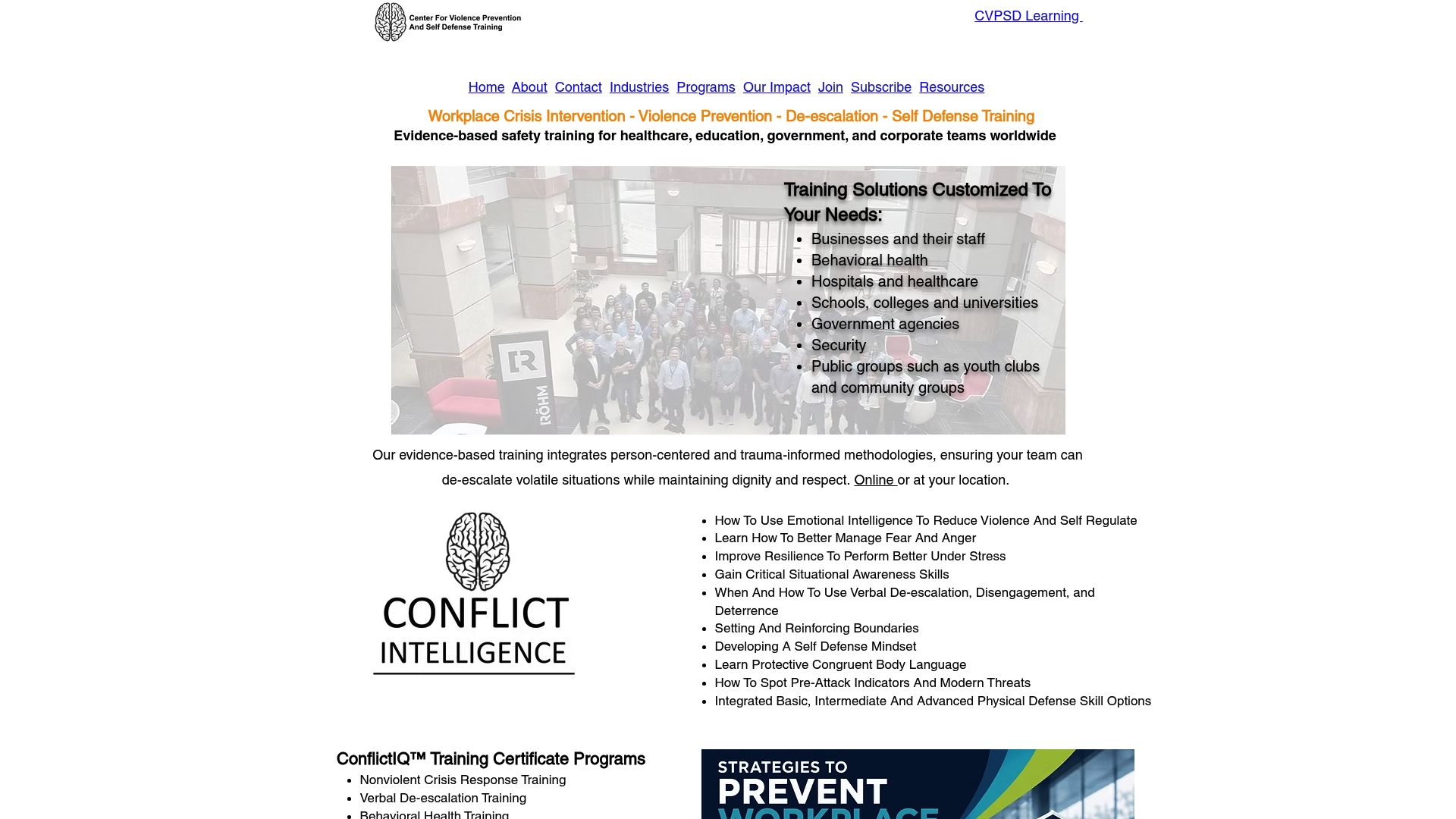
Offering highlights include customizable program formats (single-session through multi-session series), sector-specific tracks for government agencies and licensed security professionals, inclusive delivery that accommodates all fitness levels and accessibility needs, and a structured evaluation plan with pre/post measurement. CVPSD works with public and private organizations, schools, nonprofits, and government agencies across the United States.
To request a custom program proposal or schedule a discovery call, visit cvpsd.org and use the contact form. A program specialist will respond within one business day.
Useful sources and further reading
CVPSD main program page: primary resource for program descriptions, contact, and discovery-call scheduling.
Government workplace safety track — CVPSD: details on the specialized public-sector program for GSA-participating organizations.
Advanced training for licensed security officers — CVPSD: role-specific advanced modules for security professionals.
Verbal de-escalation training series — CVPSD: curriculum detail on verbal de-escalation techniques and learning outcomes.
Building a resilient workplace against violence — CVPSD: organizational readiness and resilience planning guidance.
Workplace violence prevention plan (WVPP) — CVPSD: step-by-step guidance for integrating training into a formal prevention plan.
Self-Defense For Your Group — Thousand Waves: program design reference covering session length, module balance, and multi-session formats.
Personal Safety & Self-Defense Workshop — Portland.gov: public-sector workshop model covering assertive communication, de-escalation, and escape planning.
FAQ
What is the most effective self-defense training for employees?
Programs that combine situational awareness, verbal de-escalation, and simple physical techniques across multiple sessions produce the most durable outcomes. Multi-session formats of 12 hours or more consistently outperform single-session workshops for long-term behavioral change.
Do instructors need a license to teach self-defense in the United States?
Licensing requirements vary by state and by the type of instruction offered. Organizations should ask providers to document all instructor certifications and confirm compliance with applicable state and local regulations before any physical practice begins.
What are the core principles of effective self-defense awareness?
Effective programs build on recognizing escalation cues early, using assertive communication to set boundaries, and positioning yourself to create distance or an exit. Physical techniques are a last resort, not the primary strategy.
Where can organizations find low-cost or nonprofit self-defense training?
Nonprofit providers like CVPSD offer evidence-based programs for organizations at a range of price points, including options for schools, community groups, and government agencies. Contact CVPSD directly at cvpsd.org to discuss program options that fit your budget and group size.
Recommended


