
U.S. Colleges: How Title IX Covers Stalking and Immediate Safety Steps

Yes, sex-based stalking is prohibited conduct under Title IX, and once a school recognizes it, federal rules require two things right away: supportive measures to protect your safety and access to school, and a grievance process if a formal complaint moves forward. Those obligations exist whether or not you ever contact police, and they start the moment you report, not after an investigation concludes.
Table of Contents
What Counts as Stalking Under a Title IX Stalking Policy
A Title IX stalking policy borrows its core definition from federal criminal and civil rights law: a “course of conduct” directed at a specific person that would cause a reasonable person to fear for their safety, or to suffer substantial emotional distress. That phrase, course of conduct, is doing a lot of work. It means two or more acts, not one isolated incident.
Those acts can include:
Following someone in person or tracking their location
Monitoring or surveilling someone’s activities, in person or online
Unwanted communication, including repeated texts, calls, or messages through third parties
Threatening a person directly or implying harm
Interfering with or damaging someone’s property
The “reasonable person” standard isn’t generic. University policy language, including guidance used at the University of Tennessee, frames it as a reasonable person “under similar circumstances and with similar identities” to the person reporting. Context matters. A stranger sending five messages reads differently than an ex-partner doing the same thing after a breakup.
Pro Tip: Substantial emotional distress doesn’t require a diagnosis. Difficulty sleeping, skipping classes to avoid a building, or panic when a phone buzzes are all evidence worth documenting, even without a therapist’s note.
When Stalking Triggers Title IX Versus Other Campus Policies
Not every stalking case is a Title IX case. Title IX applies specifically to sex-based harassment, meaning the conduct is connected to sex, gender, gender identity, or a related protected characteristic. The Department of Education’s 2024 Final Rule confirms stalking sits alongside sexual assault, dating violence, and domestic violence as a specific form of sex-based harassment schools must address.
Sex-based markers tend to look like:
Stalking that follows a romantic or sexual relationship, current or former
Conduct tied to gender-based harassment, threats, or comments
Behavior escalating after a person rejected a sexual advance
Non-sex-based stalking, like a roommate dispute or a conflict over money, usually falls to student conduct offices or campus safety instead. If you’re unsure which office applies, contact the Title IX Coordinator first. Coordinators are trained to make that determination and will redirect you if another office is the better fit. Waiting to figure it out yourself only delays access to help you’re entitled to regardless of the label attached to your case.
Supportive Measures Your School Owes You Right Now
Supportive measures exist to keep you safe and in school while everything else gets sorted out. Under guidance from offices like UC Berkeley’s SVSH program, these measures are non-punitive, individualized, and available whether or not you ever file a formal complaint.
Common measures include:
A no-contact order barring the other person from contacting you directly or indirectly
Class schedule changes so you avoid shared sections
Housing relocation if you live in the same residence hall or building
Campus safety escorts between buildings or to parking areas
Referrals to counseling or medical services
Supportive measures can include adjustments like extensions on assignments or exams affected by the situation
None of this requires an investigation to finish first. Practitioners who train campus staff on this consistently note that safety planning is the immediate priority, separate from and faster than any formal resolution timeline. If the situation includes threats, weapons, or a pattern of escalation, ask directly whether your case warrants a Violence Risk Assessment. Trained teams use that process to flag high-risk indicators and act before harm occurs, not after.
Pro Tip: Put every supportive measure request in writing, even a follow-up email after a phone call. “Confirming our conversation, I’m requesting a no-contact order” creates a paper trail your Coordinator can act on and you can point back to later.
Reporting Options and What Evidence to Preserve
Save everything before you need it, not after. Screenshots with visible timestamps, saved voicemails, emails, and a written timeline of dates and events all strengthen a case whether it goes through your campus or the police. Seminar materials used in campus training programs specifically recommend preserving digital metadata like message headers and timestamps to authenticate messages later, since screenshots alone can be disputed.
Practical steps to take:
Write down dates, times, and locations for every incident, even ones that felt minor at the time
Keep original files rather than only screenshots when possible, since metadata matters
Note witnesses by name and how to reach them
Save building access logs or security footage requests early, since many systems overwrite after a set window
You can report to your Title IX office, campus safety, or police, and these paths aren’t mutually exclusive. Title IX investigations use administrative remedies like no-contact orders or academic sanctions. Police involvement can pursue criminal charges, which carry a different burden of proof and timeline entirely. Many students pursue both at once. Filing a Title IX report doesn’t waive your right to also file a police report, and vice versa.
How the Grievance Process Works and What Might Happen Next
Once a formal complaint is filed, most schools offer two paths: informal resolution, where both parties agree to a resolution without a full investigation, or a formal investigation and hearing. Campus policies, including the one published by the University of Florida, outline these pathways alongside a commitment that supportive measures continue throughout resolution, not just at the start.
Rights that typically apply to both parties include:
Written notice of the allegations before any interview
The right to an advisor of their choice throughout the process
Equal access to evidence gathered during the investigation
The ability to appeal a final decision under specified grounds
Most institutions apply a preponderance of the evidence standard, meaning the decision maker asks whether it’s more likely than not that the conduct occurred. That’s a lower bar than the “beyond a reasonable doubt” standard used in criminal courts, which is part of why Title IX and police proceedings can reach different outcomes even when they cover the same incident.
Outcomes vary by severity and institution and may include remedies such as mandated training, probation, suspension, or expulsion. Interim measures like no-contact orders or housing changes are typically resolved promptly. The length of a full investigation depends on case complexity and institutional staffing.
Clery Act, VAWA, and the 2024 Federal Rule Changes
Title IX doesn’t operate alone. The Clery Act requires schools to disclose crime statistics, including stalking, and the Violence Against Women Act (VAWA) amendments to Clery specifically require campus policies addressing dating violence, domestic violence, sexual assault, and stalking. These frameworks overlap with Title IX but serve different purposes: Clery is about disclosure and reporting statistics, Title IX is about individual case response and remedy.
The Department of Education’s 2024 Final Rule reaffirmed that sex-based stalking falls under Title IX’s sex-discrimination prohibition and requires fair grievance procedures alongside supportive measures.
Here’s the part that trips people up: because federal court injunctions have blocked or delayed portions of the 2024 rule in different states at different times, some schools are still operating under 2020 regulations while others have adopted 2024 provisions. Practitioners tracking this closely note that the active framework varies by jurisdiction, so the single most useful thing you can do is check your specific institution’s current Title IX page rather than assume national uniformity.
What to Do in the First 24 to 72 Hours
If you’re in immediate danger, call 911 or campus safety before doing anything else. Get medical attention if there’s any injury, even minor. Everything below matters, but nothing outranks physical safety.
Once you’re safe, work through this sequence:
Preserve your devices and don’t delete anything, even messages that feel embarrassing or unrelated
Take screenshots of every relevant message, tagged with the date they were captured
Write a timeline while memory is fresh, listing every incident with as much detail as possible
Identify witnesses and note how you’d reach them later
Contact your Title IX Coordinator to request supportive measures in writing
Ask about a protective order if the behavior involves threats or escalation
Schedule a counseling appointment even if you feel fine, since delayed reactions to stalking are common
Pro Tip: Keep a single folder, digital or physical, with copies of every request you send and every response you get. When a case stretches over weeks, that folder becomes the clearest record of what happened and when.
Resources on stalking awareness and prevention can help you recognize escalation patterns you might otherwise dismiss as coincidence.
How Prevention Training Fills the Gap Policy Alone Can’t
Policy tells you what your school must do. It doesn’t teach you how to read a room, de-escalate a tense encounter, or recognize early warning signs before a situation becomes a formal case. That’s where CVPSD’s work picks up where the paperwork leaves off. As a nonprofit focused on crisis intervention, de-escalation, and behavior analysis, CVPSD trains campus communities to spot risk before it becomes a Title IX file.
A few habits worth adopting immediately:
Vary your routine and routes if you notice repeated, unwanted contact
Trust the discomfort of a “coincidental” run-in that happens more than once
Tell a friend or RA what’s happening so someone else has context if things escalate
Review warning signs of stalking so you can name behavior early rather than second-guessing it
Institutions looking to build these skills into staff and student training can explore CVPSD’s campus safety programming for a structured approach beyond policy compliance alone.
A Practitioner’s View on Where Title IX Falls Short
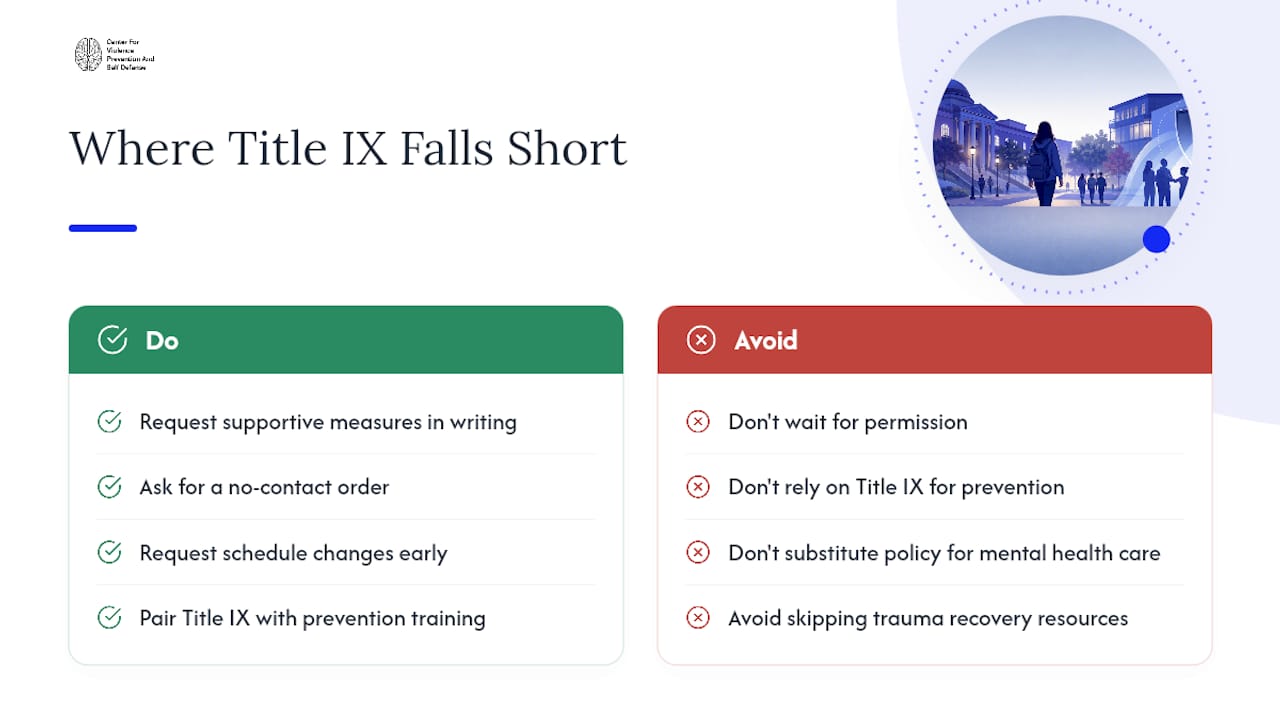
Title IX gives you a process. It does not give you certainty, and it definitely doesn’t give you speed on every front. The supportive measures piece is the most underused tool in the entire system, largely because students don’t realize they can request a no-contact order or a schedule change before any investigation even opens. Use it. Ask for it in writing. Don’t wait for permission you already have.
What Title IX can’t do is replace the skills that prevent an incident from escalating in the first place, or the mental health support that comes after. That’s a gap training fills, and it’s why CVPSD exists as a resource alongside the compliance framework, not instead of it. If your institution hasn’t invested in prevention training for staff or students, that’s worth raising with your Title IX Coordinator directly. Explore ConflictIQ training programs built for education settings, or look into customized training for your specific campus.
Trauma recovery support matters just as much; victim support resources can meaningfully speed healing after an incident, and no policy process substitutes for that care. Pair the legal process with real skill building, and you cover both the paperwork and the person. -Shawn Lebrock
This article is general information, not a substitute for advice from a qualified lawyer. Consult a qualified legal professional about your own circumstances before acting on anything here.
Sources
Definitions: Title IX Offenses — College of Saint Anselm Title IX Office
Final rule amending Title IX regulations — Federal Register (U.S. Department of Education)
Supportive measures guidance — UC Berkeley SVSH (Sexual Violence & Sexual Harassment) office
Responding to stalking seminar materials — University of Alaska training (ATIXA-style materials)
FAQ
Is Stalking Covered Under Title IX?
Yes, when stalking is sex-based, meaning connected to sex, gender, or gender identity, it falls under Title IX’s prohibition on sex-based harassment. Schools must offer supportive measures and follow grievance procedures once they have notice of the conduct.
What Are the Three Types of Harassment Under Title IX?
Title IX’s 2024 regulations address sex-based harassment broadly, with specific offenses including sexual assault, dating violence, domestic violence, and stalking called out explicitly. Quid pro quo harassment and hostile environment harassment are the two general categories these specific offenses can fall under.
What Behaviors Are Prohibited Under a Title IX Stalking Policy?
Prohibited conduct includes a course of conduct, meaning two or more acts, such as following someone, monitoring their activity, unwanted communication, threats, or interfering with their property. A single isolated incident typically doesn’t meet the course-of-conduct threshold, though schools may still address it under other policies.
What Type of Harassment Doesn’t Title IX Cover?
Title IX doesn’t cover harassment unrelated to sex, gender, or a protected identity characteristic, such as conflicts over noise, money, or general roommate disputes. Those situations usually fall under student conduct codes or general campus safety policies instead, and your Title IX Coordinator can help direct you to the right office.
Recommended


