
Prove Skills in 6–12 Months: De-escalation Evaluation for Agencies

An evidence-based training evaluation for de-escalation starts by defining specific outcomes, not by grading a workshop on applause. Leaders need mixed methods that combine administrative records, observation, and surveys, plus fidelity tracking that confirms the training was actually delivered and practiced. The National Policing Institute and NIJ both point to intermediary indicators, like communication tactics, since rare outcomes such as use-of-force incidents rarely move enough to show a training effect on their own.
Table of Contents
Tracking Fidelity, Dosage, and Whether Skills Actually Transfer
Building Your Measurement Toolkit: Checklists and Survey Items
What Cost-Effectiveness Actually Looks Like for De-Escalation Training
Adapting De-Escalation Training for Different Populations and Settings
Why Most De-Escalation Evaluations Measure the Wrong Thing First
A Practical Framework for Evaluating De-Escalation Training
Most evaluation failures trace back to skipping step one and jumping straight to a survey template. Build the framework in order, and each later step gets easier.
Step 1: Clarify goals and pick outcomes tied to your mission. Decide whether you’re trying to reduce injuries, change how officers or clinical staff talk to someone in crisis, or shift community trust. The National Policing Institute stresses this directly: there’s no universally accepted definition of de-escalation, so your agency has to define its own outcome before choosing a tool to measure it. A hospital security team chasing fewer patient restraints needs different measures than a police department chasing fewer complaints.
Step 2: Select mixed measures and align them to those outcomes. No single data source tells the whole story. Combine:
Administrative records (use-of-force reports, complaint logs, restraint incident counts)
Body-worn camera or video review scored against a structured checklist
Pre/post participant surveys using validated scales
Community or patient feedback where relevant
Step 3: Choose a study design your organization can actually sustain. A randomized trial sounds rigorous on paper, but most agencies lack the staffing to run one well. A quasi-experimental design, comparing trained and not-yet-trained units, is often more realistic.
Step 4: Build fidelity and dosage monitoring into the rollout, not as an afterthought. Track scenario-practice hours and refresher attendance alongside sign-in sheets.
Step 5: Report findings on a fixed cycle and feed them back into curriculum revisions. An evaluation that sits in a drawer for two years helps nobody currently working a shift.
Define outcomes and tie them to mission priorities
Select mixed measures across data sources
Choose a feasible study design and analytic plan
Track fidelity and dosage from day one
Report, iterate, and rebuild the next training cycle around the findings
Which Outcomes and Indicators Actually Show Training Impact
Primary outcomes like use-of-force incidents, injuries, and formal complaints matter to leadership and the public, but they’re statistically stubborn. An NIJ-funded randomized-controlled trial found training improved communication tactics without producing a measurable drop in overall use-of-force incidents. That’s not a failure of the training. It’s a reminder that rare events need years of data and large sample sizes before a real signal emerges.
The fix is intermediary indicators, which shift far more often and reflect skills your training actually teaches:
Specific communication tactics (active listening statements, calm-voice modulation, distance management)
Procedural justice markers (explaining actions, giving choices, showing respect)
Time on scene, which often increases as officers or staff slow down and de-escalate rather than force resolution
Use of a tactical pause before physical intervention
Process indicators round out the picture: attendance records, scenario performance scores, and competency checklist results collected during training itself.
A rigorous local evaluation from the Tempe Smart Policing Initiative found measurable gains in procedural justice behavior, reductions in certain force types, longer time-on-scene, and fewer subject injuries when the evaluation design and data collection were solid, according to a CNA report on training design and delivery. That’s the model worth replicating: pick two or three intermediary measures you can track monthly, rather than waiting years for a primary outcome to budge.
For a short evaluation cycle (six to twelve months), prioritize one process measure, one intermediary measure, and one primary measure. Trying to track everything at once usually means tracking nothing well.
Picking a Study Design You Can Actually Sustain
The gold-standard randomized-controlled trial (RCT) is worth pursuing when your organization is large enough to randomize entire units or shifts without disrupting operations, and when leadership can commit to multi-year follow-up. Few agencies or hospital systems have that runway.
A stepped-wedge design, where every unit eventually receives training but in a staggered sequence, is a strong middle ground. It lets every team get trained (avoiding the ethical problem of a permanent control group) while still generating comparison data.
When randomization isn’t feasible at all, quasi-experimental designs step in: compare trained units against similar, not-yet-trained units, or run a pre/post comparison within the same unit. These introduce more risk of bias, since trained and untrained groups may differ in ways beyond the training itself, but they’re far better than no comparison group at all.
RCT or stepped-wedge: best when you can randomize by unit and track for 12+ months
Quasi-experimental (matched comparison): best when randomization is politically or operationally impossible
Pre/post within one group: weakest design, but usable as a starting point when nothing else exists yet
Whichever design you choose, decide upfront whether you’re analyzing intent-to-treat (everyone assigned to training, regardless of whether they finished it) or per-protocol (only those who completed the full dosage). Fidelity tracking is what makes a per-protocol analysis possible at all. Also plan your sample size around the outcome you’re least likely to move. Rare outcomes like use-of-force incidents typically require far larger samples and longer windows than intermediary behaviors do.
Tracking Fidelity, Dosage, and Whether Skills Actually Transfer
A sign-in sheet tells you who showed up. It tells you nothing about whether they practiced the skill, retained it, or used it on a call three months later. That gap is where most evaluations quietly fail.
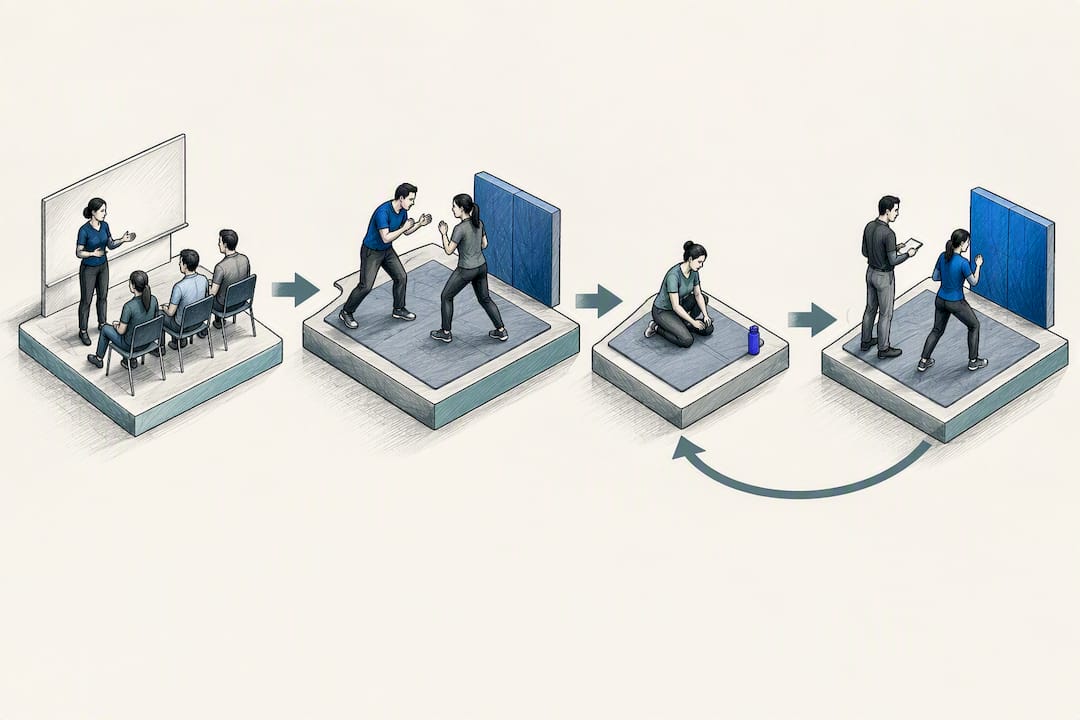
Track delivered hours, scenario-practice repetitions, and refresher attendance as separate fields, not folded into a single attendance count. A CNA report notes that measuring dosage requires operational definitions, scenario hours, simulation reps, refresher counts, logged consistently in an LMS or training record system.
Log scenario-practice counts separately from lecture-hour attendance
Use rater-observer checklists to score scenario performance, not just completion
Run inter-rater reliability checks (kappa or ICC) on those checklists before trusting the scores
Monitor trainer qualifications and confirm each session covers the core curriculum, not an abbreviated version
Pro Tip: If two raters score the same scenario video and land more than one competency band apart, that’s a rater-training problem, not a trainee problem. Fix the rater calibration before you draw conclusions about skill.
Common fidelity failures include letting trainers skip scenario practice when schedules get tight, and treating a refresher as optional once the initial certification is complete. Both quietly erode the dosage your evaluation assumes people received.
Building Your Measurement Toolkit: Checklists and Survey Items
You don’t need to invent measurement tools from scratch. Borrow structure from validated instruments and adapt the wording to your setting.
For confidence and attitude surveys, validated-style items work better than generic satisfaction questions:
“I feel confident using verbal de-escalation techniques during a high-stress encounter.” (1 to 5 scale)
“I can recognize early warning signs of escalating behavior before physical intervention becomes necessary.”
“My department/organization supports the time needed to use de-escalation tactics rather than moving quickly to force.”
For scenario-based competency assessment, the DePICT™ tool, a peer-reviewed 14-item rater-observer checklist built for mental health crisis response, is a useful structural model. It scores discrete behaviors (initial approach, verbal tone, active listening, distance management, and so on) rather than a single overall impression, which is what gives it good psychometric properties.
Toolkit element | What it measures | Best used for |
Confidence/attitude survey | Self-reported skill confidence | Pre/post comparison within one cohort |
Rater-observer checklist (DePICT™-style) | Observed scenario competency | Scoring live or recorded scenario practice |
BWC structured review form | Real-world tactic use | Field validation of training transfer |
Before deploying any checklist agency-wide, pilot it with two or three raters scoring the same set of recorded scenarios, and check their agreement rate. If reliability is weak, retrain the raters. Skipping this step is how organizations end up with data nobody trusts six months later.
How CVPSD Approaches Evaluation With Client Organizations
CVPSD builds observed skills assessment directly into its training model rather than treating evaluation as a separate add-on. Programs like ConflictIQ™ 100 through 700 cover progressively deeper competencies, from foundational conflict resolution to managing challenging behaviors through co-regulation and sensory-informed de-escalation for Pre-K12 settings, giving organizations a structured way to track skill progression across roles.
For agencies and healthcare systems that need training matched to specific compliance requirements, customized training engagements typically include observed competency checks and documentation aligned with current regulatory standards, not just a completion certificate. That documentation matters when your evaluation needs proof that dosage and fidelity, not just attendance, were tracked.
Organizations weighing whether to build an evaluation framework internally or bring in a training partner should treat CVPSD’s approach as one concrete model: define the outcome first, build assessment into delivery, and document what was actually practiced.
What Cost-Effectiveness Actually Looks Like for De-Escalation Training
Cost-effectiveness in de-escalation training isn’t just the price of the seminar divided by the number of trainees. The real calculation weighs training cost against the downstream costs it might reduce: use-of-force litigation, workers’ compensation claims from injuries during restraints, sick leave from staff burnout after violent incidents, and turnover in high-stress roles.
Because primary outcomes like injuries and use-of-force incidents move slowly, a cost-effectiveness analysis run over six months will almost always look weaker than one run over three years. Leaders comparing training options should ask vendors for the evaluation window behind any effectiveness claim, since a program that looks unimpressive at six months can show real returns at eighteen.
The cheapest per-person training cost isn’t automatically the most cost-effective choice. A low-cost, high-volume online module that nobody practices in scenario form may cost less upfront but deliver weaker skill transfer than a program that mixes shorter in-person scenario blocks with lower per-session costs spread across a self-paced foundation. Organizations weighing options should compare not just sticker price but delivered dosage per dollar: how many scenario-practice hours, refresher sessions, and observed assessments the program actually includes, not just seat count.
Budget for refresher training and fidelity monitoring from the start, not as a line item to cut when funding tightens. A program that loses its refresher cycle a year in typically loses the skill gains it built.
Adapting De-Escalation Training for Different Populations and Settings
A checklist built for police patrol encounters won’t translate cleanly to a pediatric emergency department, a K12 classroom, or a corporate security team, even though the core communication principles overlap. Operational context shapes which scenarios, terminology, and risk factors deserve emphasis.
Healthcare settings need scenario practice built around clinical realities: patients in withdrawal, dementia-related agitation, or pediatric behavioral crises each call for a different opening approach than a street encounter. Schools need training calibrated to child development stages, since co-regulation techniques for a kindergartner escalate very differently than the same principles applied with a teenager. Corporate and community settings often deal with fewer physical-safety tools and more reliance on verbal tactics and environmental management (exits, distance, third-party support).
Cultural and linguistic diversity within the population being served also matters for evaluation, not just delivery. A survey item that translates awkwardly, or a scenario script built around one cultural communication norm, can distort your pre/post results if you don’t pilot it across the groups your staff actually serves. Evaluation teams should review scenario scripts and survey wording with people who reflect the population being trained for, before rolling out the assessment tool broadly.
Why Most De-Escalation Evaluations Measure the Wrong Thing First
The conventional advice tells leaders to track use-of-force reductions as proof a training worked, and that’s exactly backward. The NIJ trial that found improved communication tactics with no detectable drop in overall force incidents should have ended that habit years ago, yet agencies keep leading budget conversations with a metric that’s mathematically unlikely to move inside a typical grant cycle.
What the research actually supports is patience paired with precision: track the behaviors your curriculum directly teaches, procedural justice markers, tactical pauses, time on scene, and let the rarer outcomes accumulate evidence over years, not quarters. The systematic reviews showing a mixed, self-report-heavy evidence base aren’t an indictment of de-escalation training itself. They’re an indictment of lazy measurement.
If there’s one thing to prioritize first, it’s fidelity tracking. An organization that can’t say how many scenario hours its staff actually practiced has no basis for interpreting any outcome, good or bad, that follows. --Shawn Lebrock
Get Help Planning Your Evaluation and Training Rollout
CVPSD gives organizations an evaluation-ready alternative to building a de-escalation program from scratch. Every engagement can build observed skills assessment and compliance documentation directly into delivery, so you’re not bolting evaluation onto training after the fact.
For organizations that already have staff, teams can start with the self-paced online conflict resolution training to establish a baseline before layering in scenario practice. For agencies, hospitals, schools, or corporate teams that need training built around specific outcomes and compliance requirements, the ConflictIQ™ program series offers a structured path from foundational skills through advanced behavior management. And if your evaluation plan calls for a fully tailored rollout, with observed competency checks and documentation matched to your regulatory standards, CVPSD’s customized training team can help design a pilot evaluation around your organization’s specific goals. Reach out to scope a pilot engagement and get a program built around the outcomes that matter to your organization.
Sources
FAQ
What Are the Main Methods for Evaluating De-Escalation Training?
The strongest evaluations combine administrative records, body-worn camera review, participant surveys, and community feedback rather than relying on one source. Pairing this mixed-methods approach with a validated competency tool like DePICT™, a clear study design (pre/post, quasi-experimental, or stepped-wedge), and fidelity tracking gives leaders evidence they can actually act on.
What Are the Four C’s of De-Escalation?
Definitions vary across training programs, and there’s no single agreed-upon “four C’s” framework in the research this article draws on. Most de-escalation curricula do emphasize calm tone, clear communication, distance and space management, and choice-giving as core behavioral pillars, even when they don’t label them that way.
What Are the Seven Stages of De-Escalation?
Frameworks describing staged de-escalation typically move through recognizing early warning signs, approaching calmly, establishing rapport, active listening, offering choices, negotiating a resolution, and disengaging or transitioning care. Exact terminology differs by curriculum, so organizations should confirm which stage model their specific training program uses before building assessment items around it.
How Long Should an Organization Wait Before Evaluating Training Results?
Process and intermediary indicators, like scenario performance scores or communication tactic use, can be measured within a few months of training. Primary outcomes such as use-of-force incidents or injuries typically need a much longer window, often a year or more, since these events are rare enough that short evaluations rarely capture a reliable signal.
Recommended
About the Author: William DeMuth is the Director of Training at the Center for Violence Prevention and Self Defense (CVPSD) in Freehold, NJ. With over 35 years of research in violence dynamics and personal safety, William specializes in evidence-based training that bridges the gap between compliance and real-world conflict resolution. The architect of the ConflictIQ™ program, he holds advanced certifications and has trained under diverse industry leaders.


