
What Is Instinctive Self-Defense? A Practical Guide


Instinctive self-defense is the practice of channeling your body’s natural stress responses into gross-motor movements that protect you during sudden, violent threats. Rather than relying on complex techniques that require years of conditioning, it works with your biology, not against it. When adrenaline floods your system, fine motor skills deteriorate rapidly. Instinctive methods are built precisely for that moment. CVPSD, the Center for Violence Prevention and Self-Defense, grounds its training in this evidence-based approach, teaching people to recognize threats, respond proportionally, and escape safely.
Core elements of instinctive self-defense include:
Gross-motor movements that remain functional under extreme stress
Pressure-tested techniques proven in realistic, not controlled, conditions
Biomechanical leverage over raw strength, making it accessible to anyone
Escape as the primary goal, not winning a fight
Simplicity, so the body reacts before the conscious mind catches up
What US law says about justified self-defense
Self-defense law in the United States rests on three pillars: necessity, proportionality, and imminence. You may use force only when you reasonably believe it is necessary to stop an unlawful physical threat that is happening right now. New York Penal Law illustrates this clearly: force is justified when someone reasonably believes it necessary to defend against the use or threatened use of unlawful physical force, the danger must be imminent, and the response must be proportionate.
Key legal boundaries every person should understand:
The threat must be physical. Emotional or hypothetical harm does not justify force.
The danger must be current. “He might do something” is not the same as “he is doing something.”
You cannot be the initial aggressor. The landmark case United States v. Peterson illustrates this: the defendant lost his self-defense claim because he threatened force first.
Force must stop when the threat stops. Continuing to strike a retreating attacker crosses from defense into assault.
These boundaries directly shape how instinctive self-defense is taught. CVPSD programs are designed to meet state and local laws, reinforcing the principle that the goal is always safe escape, never punishment.
Why your body is already wired for self-defense
The physiological case for instinctive methods is straightforward. Adrenaline flooding during a threat degrades fine motor control, making precise, complex movements unreliable. Your hands may shake. Tunnel vision narrows your field of awareness. Gross-motor movements, those driven by large muscle groups like the shoulders, hips, and core, remain accessible because they are less dependent on the neural precision that stress disrupts.
The “freeze” response is another factor. Many people assume they will act decisively under threat, but the nervous system often locks up before the conscious mind can issue a command. Repetitive, reality-based training builds muscle memory that bypasses this freeze, converting hesitation into immediate physical action. CVPSD’s approach, grounded in neurological self-defense principles, addresses this directly by training the body to respond before the thinking brain catches up.
How instinctive methods differ from tactical or sports-based training
Tactical self-defense systems teach conditioned, multi-step responses that can look impressive in a gym. The problem is that complex conditioned responses frequently fail in chaotic street encounters where stress, unpredictability, and adrenaline are all present simultaneously. Sports-based systems add another layer of risk: they are designed for rule-governed environments with referees, weight classes, and protective gear.
Key differences between instinctive and tactical or sports-based approaches:
Instinctive methods use gross-motor actions that work when fear is high; tactical systems depend on fine-motor precision that degrades under stress
Instinctive training prioritizes escape; sports training prioritizes winning
Instinctive techniques require minimal strength; many tactical systems assume a baseline of physical conditioning
Instinctive methods are pressure-tested against resisting partners; compliant drills build false confidence
CVPSD addresses the problem with traditional self-defense education directly, noting that techniques practiced on cooperative partners rarely transfer to real threats. The emphasis is always on what works when your body is working against you.
Core gross-motor movements used in instinctive self-defense
Effective instinctive techniques target the body’s most vulnerable areas and use its largest muscle groups. You do not need strength. You need mechanics and the right targets.
Primary strikes:
Palm-heel strike: Drive the heel of your open palm into the attacker’s nose or face, rotating from the hip for power
Hammer fist: A downward or sideways strike using the bottom of a closed fist, effective against the nose, jaw, or temple
Elbow strike: Short-range, high-force impact to the face, ribs, or jaw, particularly useful when grabbed from behind
Soft-tissue targets: Eyes, throat, and groin are the most effective because they cannot be strengthened through exercise. A strike to the throat or an eye gouge stops most attackers regardless of size.
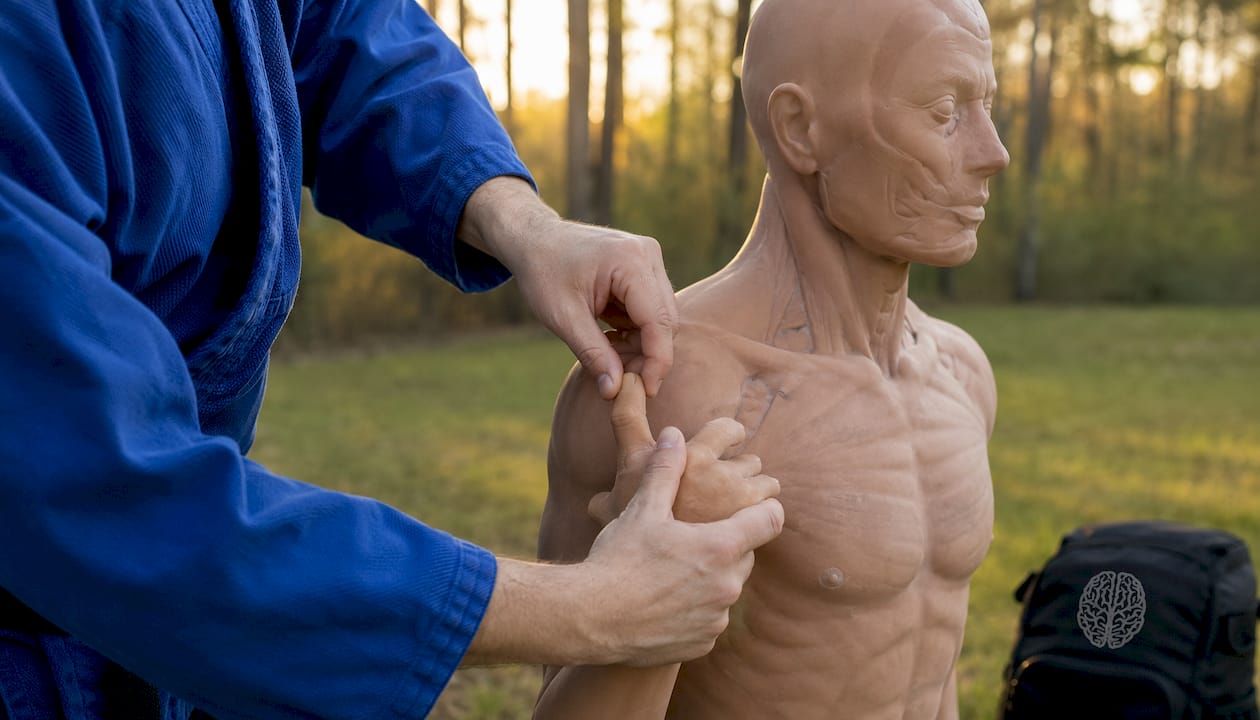
The Weak Link principle: Every grip has a structural gap where the thumb meets the fingers. Applying pressure at that junction, combined with a simultaneous retributive strike to distract the attacker, is the most efficient way to break a hold without a strength contest.
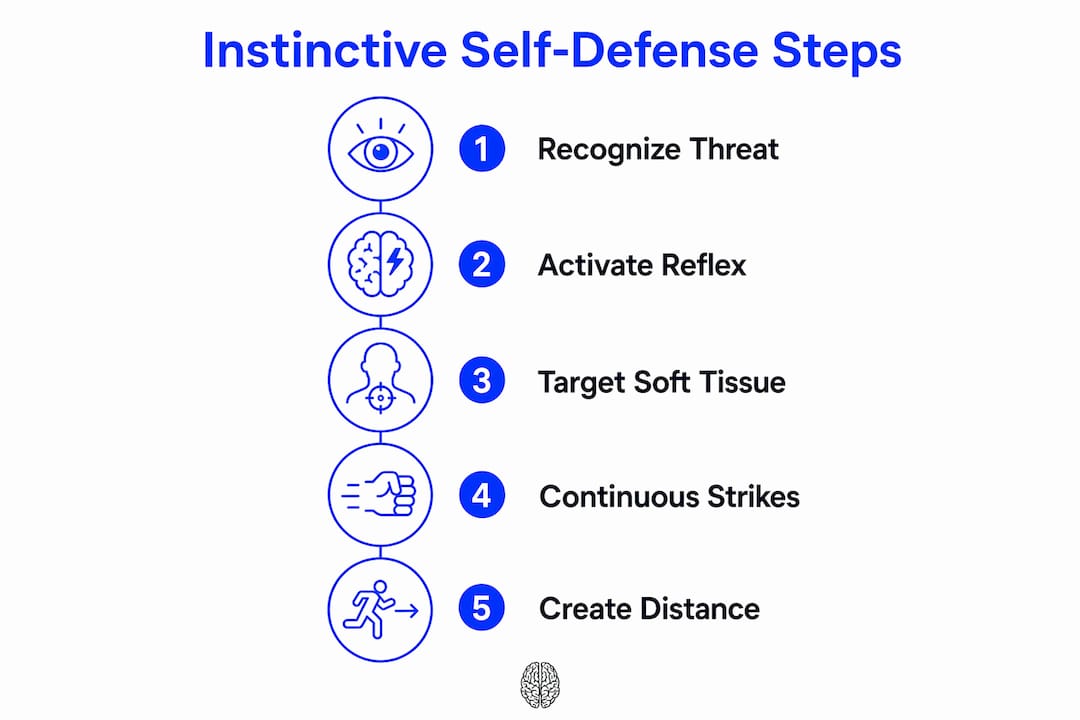
Continuous burst striking: Do not throw one strike and wait. Rapid, sustained strikes to soft-tissue targets keep the attacker off balance and create the opening needed to escape. CVPSD’s gross-motor skills training reinforces this principle as a foundation for all physical defense.
How to start building real instinctive self-defense skills
Muscle memory is the goal, and it only develops through repeated, realistic practice. Reading about a technique is a starting point. Owning it requires physical repetition under pressure.
Practical steps to build genuine capability:
Train with resisting partners. Stress-testing your techniques against someone who moves and fights back is the only way to know they will work.
Use scenario-based drills. Simulating the adrenaline dump through high-intensity exercises before practicing a technique teaches your body to perform when exhausted.
Shift your mindset. The goal is escape, not victory. Every drill should end with you moving toward an exit.
Build legal awareness. Understanding when force is and is not justified is part of training, not an afterthought.
Start with CVPSD resources. CVPSD offers both online and in-person programs built around reality-based self-defense training that mirrors real-world threat conditions.
Pro Tip: To overcome the freeze response, practice controlled exposure to stress before drilling. Do 60 seconds of intense exercise, then immediately practice your escape technique with a partner. Your nervous system learns to act even when your body is flooded with stress hormones.
Real-life scenarios where instinctive self-defense applies
Understanding how these principles play out in actual situations helps clarify why simplicity matters so much.
Wrist grab in a parking lot: An attacker grabs your wrist to control your movement. A complex joint lock requires calm and precision you will not have. Rotating your wrist toward the thumb-fingers gap while simultaneously striking the attacker’s throat breaks the hold and creates immediate distance.
Bear hug from behind: Your arms are pinned. Fine motor techniques are impossible. Driving your elbow back into the attacker’s ribs or solar plexus, stomping on the foot, and dropping your weight are all gross-motor actions that work even in a panicked state.
Frontal aggression with a push: Someone shoves you against a wall. The instinctive response is a palm-heel strike to the nose, followed by continuous strikes to the throat or eyes, then immediate movement toward an exit. The goal is disruption, not domination.
In each scenario, the pattern is the same: use a simple, high-leverage technique on a vulnerable target, create distance, and escape. Lingering to “finish” the confrontation is both legally risky and physically unnecessary.
Limitations of relying solely on instinctive self-defense
Instinctive methods are highly effective, but they are not a complete safety system on their own.
No technique replaces awareness. Most violent encounters can be avoided entirely through situational awareness and de-escalation. Physical defense is a last resort.
Instinct alone is not enough without training. Natural reactions exist, but without deliberate practice, they are uncoordinated and easy to overcome. Untrained instinct often produces panic, not effective defense.
Multiple attackers change the equation. Instinctive methods are designed for single-threat scenarios. Facing more than one attacker requires different tactical thinking and immediate escape priority.
Weapons escalate risk dramatically. Gross-motor techniques against an armed attacker carry serious injury risk. The appropriate response to a weapon is always to create distance and flee when possible.
Legal consequences follow physical action. Orientation on a retreating attacker is instinctive but legally dangerous. Knowing when to stop is as important as knowing how to act.
Instinctive self-defense works best as one layer within a broader approach that includes awareness, de-escalation, and legal literacy. CVPSD builds all of these into its programs, recognizing that physical skills alone do not constitute complete personal safety.
Key Takeaways
Instinctive self-defense works because gross-motor movements remain reliable under stress, while complex techniques degrade when adrenaline impairs fine motor control.
Point | Details |
Gross-motor skills under stress | Adrenaline degrades fine motor control; simple, large-muscle movements stay functional when it matters most. |
Legal boundaries matter | Force must be proportionate, necessary, and directed at an imminent physical threat; you cannot be the initial aggressor. |
Weak Link principle | Every grip has a gap at the thumb-fingers junction; targeting it is more effective than trying to out-muscle a stronger attacker. |
Training must include stress | Scenario-based drills with resisting partners convert the freeze response into decisive muscle-memory action. |
Escape is always the goal | Lingering after a threat has passed creates both physical and legal risk; safe exit is the only real victory. |
Recommended


