
Workplace Violence Training Requirements: What HR Must Know


Employers in the United States must provide initial and annual workplace violence prevention training to employees, with California’s Labor Code section 6401.9 (SB 553) creating the most specific statutory duties in the country. Under OSHA’s General Duty Clause, every employer has a federal obligation to maintain a workplace free from recognized hazards, and workplace violence is explicitly one of them. California went further: LC 6401.9 requires a written Workplace Violence Prevention Plan (WVPP), effective training, and documented records, enforceable since July 1, 2024. Two actions matter most right now: confirm which employees fall within your training scope, then schedule and document initial and annual training before your next inspection cycle.
Core training elements required under California LC 6401.9 and aligned with federal guidance:
How to obtain a copy of the written WVPP
How to report workplace violence incidents without fear of retaliation
Job-specific hazards and the prevention strategies that address them
De-escalation techniques and emergency response procedures
Opportunities for interactive discussion and employee participation
Post-incident trauma resources and support
Key Takeaways
California’s LC 6401.9, enforceable since July 1, 2024, requires a written WVPP, effective initial and annual training, and retention of violent incident logs and investigation records for multiple years, with training records kept for a shorter period.
Point | Details |
Federal baseline | OSHA’s General Duty Clause requires hazard mitigation; guidance is advisory, not a binding standard. |
California mandate | LC 6401.9 requires a written WVPP, initial and annual training, and records available within 15 days on request. |
Training frequency | Train initially, annually, and whenever the plan changes or a new hazard is identified. |
Retention periods | Violent incident logs and investigation records: 5 years; training records: 1 year. |
CVPSD programs | CVPSD delivers compliant, interactive training aligned with Cal/OSHA model elements for organizations across multiple industries. |
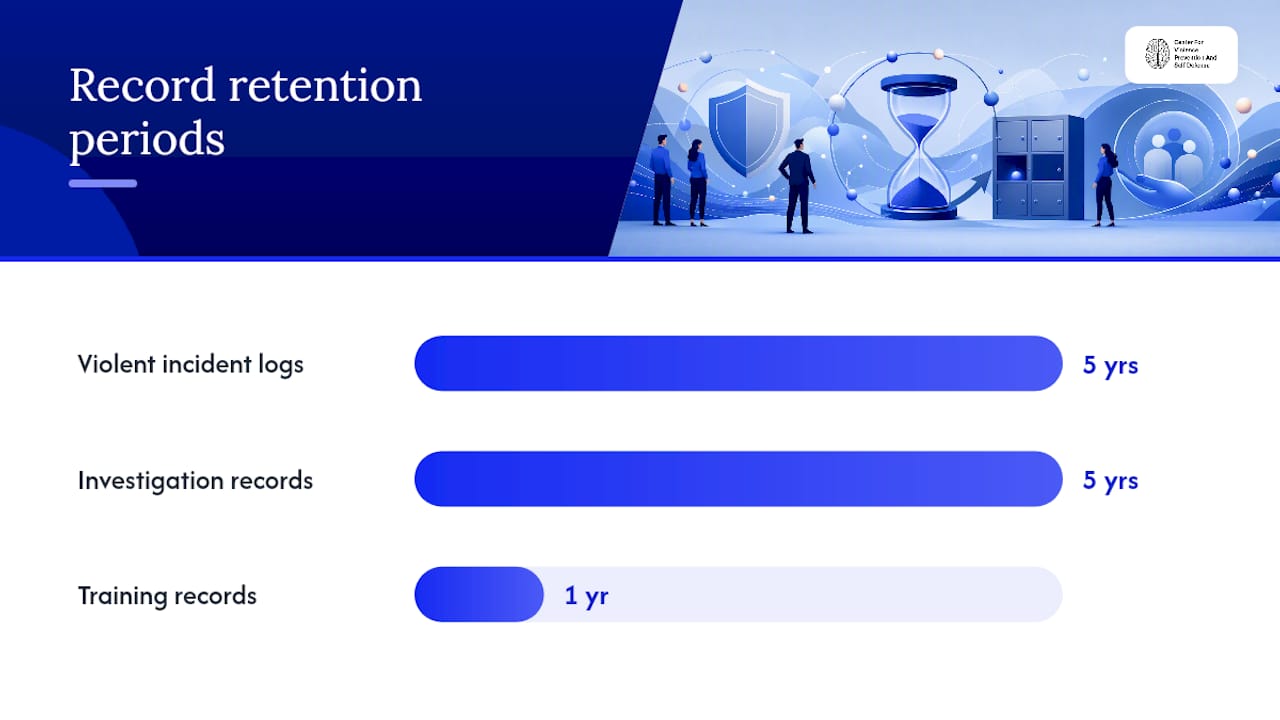
Table of Contents
1. What federal guidance from OSHA and DOL actually requires
No federal OSHA standard specifically mandates a written workplace violence prevention program for general industry. What exists is guidance, and that distinction carries real weight for compliance planning.
OSHA’s workplace violence overview frames prevention as part of the General Duty Clause obligation: employers must address recognized hazards that could cause serious harm, and workplace violence qualifies. OSHA has published industry-specific guidelines for healthcare, social services, and late-night retail, but these are advisory documents, not enforceable standards. An OSHA inspector can still cite an employer under the General Duty Clause if a serious incident occurs and the employer had no prevention program in place. That is the enforcement mechanism at the federal level.
The U.S. Department of Labor maintains its own workplace violence program, which includes training courses and policy templates that employers can consult when building or reviewing prevention programs. These resources are practical starting points, particularly for organizations without dedicated safety staff.
The practical takeaway: treat federal guidance as the floor and state law as the ceiling. When your state has no specific statute, OSHA guidance defines what a reasonable employer would do. When your state has a statute like California’s, that statute governs and federal guidance informs implementation.
2. California’s LC 6401.9 requirements: what the statute actually demands
California’s SB 553, codified as Labor Code section 6401.9, is the most detailed workplace violence prevention statute currently in effect for general industry in the United States. Compliance teams operating in California need to understand it precisely.
Written WVPP requirements
Every covered employer must establish, implement, and maintain a written WVPP. Cal/OSHA offers a model plan, but using the model alone does not guarantee compliance. The agency explicitly warns that employers must tailor the plan to their specific workplace and document worker involvement throughout the process. A plan copied without customization is a compliance risk, not a safe harbor.
The WVPP must include:
Identification of who is responsible for implementing and maintaining the plan
A process for employee involvement in developing and reviewing the plan
Methods for coordinating implementation with other employers at shared worksites
Procedures for accepting and responding to reports of workplace violence without retaliation
Procedures for emergency response
Hazard identification, evaluation, and correction procedures
Post-incident investigation procedures
Communication procedures to alert employees to workplace violence hazards
Training requirements and timing
Cal/OSHA’s employer fact sheet states training must be provided initially when the plan is first established, annually thereafter, and again whenever new or previously unidentified hazards are discovered or the plan is changed. Training materials must be appropriate to employees’ language and literacy levels. That last requirement is not a suggestion; it is part of what makes training “effective” under the statute.
Retention periods
Enforcement timeline
Cal/OSHA’s FAQ confirms that the training provisions of LC 6401.9 became enforceable on July 1, 2024. Separately, Cal/OSHA has stated that the OSHSB must adopt a General Industry standard by December 31, 2026, which means additional regulatory requirements are possible. Employers should monitor Cal/OSHA rulemaking activity through 2026 and build flexibility into their programs.
3. Which employees must be trained
The general rule under LC 6401.9 is broad: most employees working in California are in scope. Cal/OSHA’s FAQ clarifies that the training requirements apply to employees working in California, with narrow statutory exclusions for certain remote workers who work from a location of their own choosing and are the only employee at that location, and for employers with fewer than ten employees at any given time who are not accessible to the public (a limited carve-out that most employers will not qualify for).
Roles typically in scope include frontline staff, reception and customer service personnel, security officers, behavioral health workers, supervisors, and anyone who interacts with clients, patients, or the public. Supervisors warrant particular attention because they are often responsible for implementing the WVPP and responding to incidents, which means their training should go deeper than general employee training.
Temporary workers and staffing agency employees present a common gap. California guidance places responsibility on the controlling employer at the worksite, so if a temp worker is performing duties at your facility, your WVPP and training obligations extend to them. Contractors working on-site regularly should be addressed in your WVPP coordination procedures.
Fully remote employees who work from home and have no in-person contact with coworkers or the public may fall outside the statute’s scope under specific conditions, but this is a narrow exception. When in doubt, include the employee and document the rationale.
4. What your training program must cover
A compliant training curriculum under LC 6401.9 and aligned with federal guidance addresses the following required topics:
The WVPP itself: Employees must know how to obtain a copy and understand its key provisions.
Reporting procedures: How to report incidents, threats, and concerns without retaliation, and who receives those reports.
Job-specific hazards: The actual hazards present in the employee’s work environment, not generic examples.
Prevention strategies: What the employer has done or is doing to reduce those hazards.
De-escalation techniques: Verbal and non-verbal strategies for reducing tension before it becomes physical.
Emergency response: What to do when an incident occurs, including evacuation, shelter-in-place, and how to contact emergency services.
Post-incident support: Resources available to employees after a traumatic event, including employee assistance programs.
Interactive discussion: Opportunities for employees to ask questions and engage with the material.
Beyond the required topics, well-designed programs often add active shooter awareness (distinct from tactical active shooter response), bystander intervention, and role-play scenarios drawn from the specific work environment. Active shooter and tactical training courses tend to carry higher costs than general prevention and de-escalation training, so budget planning should account for the difference in workplace violence training cost across program types.
Pro Tip: When selecting a vendor or building content in-house, Cooley’s legal guidance advises making training interactive and involving employees in plan development. A passive video alone does not meet the “effective training” standard under LC 6401.9. Use scenario-based discussions, localized hazard examples, and materials adapted to the language and literacy levels of your workforce.

Effective programs are also tailored to the setting. Retail, healthcare, education, and behavioral health each require different emphasis in hazard identification and de-escalation scenarios. A single curriculum applied across all departments without customization is a compliance risk in California and a missed opportunity everywhere else. For industry-specific de-escalation training approaches, the content and scenarios should reflect the actual populations and environments your staff encounters.
5. When to train: initial timing, annual cadence, and retraining triggers
Workplace violence training frequency is not discretionary. The timing rules under LC 6401.9 are specific, and HR teams need to build them into their compliance calendars.
Initial training: Provide training when the WVPP is first established. Employees hired after the initial rollout must be trained before they begin working in a covered role.
Annual refresher: All covered employees must receive training at least once per calendar year.
Plan change: When the WVPP is revised in any material way, retrain affected employees on the changes before or immediately after implementation.
New or previously unidentified hazard: When a hazard assessment reveals a hazard not previously addressed in training, retrain the affected employee group promptly.
Post-incident: After a significant incident, targeted retraining on relevant procedures and response protocols is a best practice and, depending on the incident, may be required to correct identified gaps.
New site or role: When an employee moves to a new location or takes on a role with materially different hazard exposure, treat it as an initial training event for that context.
Regulatory update: When Cal/OSHA adopts a new General Industry standard (expected by December 31, 2026), review and update training content to reflect any new requirements.
Document training dates, attendees, materials used, and any follow-up action items for every training event. That documentation is your evidence of compliance and your first line of defense in an inspection.
6. Required records and how long to keep them
Recordkeeping is where many otherwise compliant programs fall short. Cal/OSHA inspectors routinely request records within the statutory 15-calendar-day window, and an employer who cannot produce them on time faces the same enforcement exposure as one who never ran the training.
Record Type | Retention Period |
Violent incident log | 5 years |
Training records | 1 year |
Incident investigation records | 5 years |
Cal/OSHA injury/illness log | 5 years |
What triggers a required immediate report to Cal/OSHA: Any serious injury, serious illness, or death must be reported to Cal/OSHA immediately (within 8 hours for a fatality or serious injury requiring hospitalization). Violence-related incidents that result in serious injury fall squarely within this rule. “Serious injury” includes inpatient hospitalization for other than medical observation, loss of a body part, or permanent disfigurement.
Practical guidance for centralized recordkeeping:
Store all violence-related records in a single, auditable repository, whether that is your HRIS, a dedicated safety management system, or a structured shared drive with access controls.
Map retention schedules to your HR and occupational safety systems so records are flagged for review before deletion.
Use audit-ready formats: dated entries, named attendees, version-controlled training materials, and signed acknowledgment forms.
Assign a named owner for each record type so accountability is clear before an inspection, not during one.
7. How enforcement works and what triggers an inspection
Cal/OSHA enforcement of LC 6401.9 is complaint-driven and incident-triggered. Understanding what draws an inspector to your door helps compliance teams prioritize their efforts.
Common enforcement triggers include:
Employee complaints: A single complaint about retaliation for reporting violence, inadequate training, or a missing WVPP can open an investigation.
Serious incident or fatality reporting: When an employer reports a serious injury or death, Cal/OSHA will typically open an inspection to assess whether the WVPP and training were in place and adequate.
Patterns in incident logs: If an employer’s injury and illness records show a pattern of violence-related incidents, that pattern can attract a programmed inspection.
Industry-targeted enforcement: Cal/OSHA periodically targets high-risk industries (healthcare, social services, retail) for compliance sweeps.
Referrals from other agencies: Law enforcement, workers’ compensation carriers, and other regulatory bodies can refer cases.
A typical enforcement outcome begins with an inspection, which may result in a citation, a required corrective action plan, and civil penalties. The severity of the citation depends on whether the violation is classified as general, serious, or willful. A willful violation, where the employer knew about the hazard and chose not to address it, carries the highest penalties.
Mitigation strategies that reduce enforcement risk:
Correct identified hazards promptly and document the correction.
Maintain complete, current records that are accessible within 15 days.
Document employee involvement in WVPP development and review.
Use training that is demonstrably interactive, accessible, and job-specific.
Conduct annual internal audits of your WVPP and training records before an inspector does.
8. A practical HR implementation plan: 30/60/90 days
Getting from zero to compliant is manageable when the work is sequenced. Here is a structured rollout for HR and compliance teams.
Days 1–30: Foundation
Assign a named WVPP owner (typically the HR director or safety officer).
Identify all covered employees and locations.
Conduct a workplace hazard assessment using the Cal/OSHA model WVPP as a framework. Review the WVPP components your plan must address.
Draft or adapt the written WVPP, incorporating employee input through a survey, meeting, or joint review session.
Establish the violent incident log and recordkeeping structure.
Days 31–60: Training design and pilot
Select or develop training content that covers all required topics, adapted to language and literacy levels.
Run a pilot training session with a representative employee group and collect feedback.
Revise content based on pilot feedback, particularly for job-specific hazard scenarios.
Finalize attendance tracking and training record formats.
Days 61–90: Full rollout and audit
Deliver initial training to all covered employees, documenting attendance and materials.
Integrate training reminders and annual recurrence into your HR calendar.
Conduct a records audit: confirm all logs, investigation records, and training documentation are complete and stored correctly.
Schedule a 12-month review date for the WVPP and training content.
Vendor selection criteria: Look for providers whose content explicitly aligns with LC 6401.9 required topics and the Cal/OSHA model WVPP. Confirm the program includes interactive elements, not just video playback. Ask whether materials are available in the languages your workforce speaks. Verify that the vendor provides attendance records or completion certificates in a format you can retain and produce on request.
Pro Tip: During the pilot session, ask participants to identify one hazard in their specific work area that the training did not address. Their answers will tell you whether the content is job-specific enough to meet the “effective training” standard, and their participation creates documented employee involvement in plan development, which is itself a compliance requirement.
9. Why compliance is more than a checkbox
The regulatory framework for workplace violence prevention is still maturing at the federal level, but California’s statute is already enforceable and the OSHSB rulemaking deadline of December 31, 2026 signals that more specificity is coming. HR professionals who treat this as a documentation exercise rather than a genuine safety program will find themselves exposed on two fronts: regulatory and human.
The evidence is consistent. Cooley’s guidance and Cal/OSHA’s own model materials both point to the same conclusion: passive training does not satisfy the statute, and a plan that was never shown to employees is not a plan at all. The organizations that fare best in inspections are the ones where employees can describe the WVPP, know how to report an incident, and have practiced de-escalation in a scenario that resembles their actual work environment.
Plan ownership matters more than plan length. A short, well-implemented WVPP with documented employee involvement and complete training records is more defensible than a comprehensive document that lives in a shared drive no one has read. Centralized, auditable recordkeeping is not an administrative burden; it is the mechanism that converts your training investment into legal protection.
The 15-day records production window is tight. Organizations that have not built a centralized recordkeeping system before an inspection will struggle to meet it. Build the system now, assign a named owner, and test it with a mock request before you need it for real.
CVPSD offers compliant, tailored workplace violence prevention training
Organizations that need to meet workplace violence training requirements without building a program from scratch have a direct path forward with CVPSD. The Center for Violence Prevention and Self-Defense is a 501©(3) non-profit that delivers workplace violence prevention training aligned with Cal/OSHA model elements and federal guidance, covering every required topic from WVPP orientation and reporting procedures to de-escalation and emergency response.
CVPSD offers both online and in-person formats, train-the-trainer certification, and WVPP drafting support so your compliance program is defensible from day one. The Workplace Violence Certificate Program provides credentialed training for employers in NJ, NY, and PA. Programs are adapted to your industry, workforce language, and literacy levels, which is precisely what regulators look for when evaluating whether training was “effective.” Contact CVPSD to schedule a compliance review or pilot engagement for your organization.
Sources
Primary sources for compliance work on workplace violence training requirements:
This article is general information, not a substitute for advice from a qualified lawyer. Consult a qualified legal professional about your own circumstances before acting on anything here.
FAQ
What are the core workplace violence training requirements under California law?
California Labor Code section 6401.9 requires employers to provide initial training when the WVPP is established, annual refresher training, and additional training when the plan changes or new hazards are identified. Training must cover the WVPP, reporting procedures, job-specific hazards, de-escalation, emergency response, and post-incident support.
When did California’s workplace violence training law become enforceable?
The training provisions of LC 6401.9 became enforceable on July 1, 2024, per Cal/OSHA’s FAQ. Employers with California workers should already be in compliance.
How long must employers keep workplace violence training records?
Training records must be retained for one year; violent incident logs and incident investigation records must be kept for five years. All records must be made available within 15 calendar days upon request.
Does federal OSHA require a written workplace violence prevention plan?
No federal OSHA standard currently mandates a written workplace violence prevention plan for general industry. OSHA’s General Duty Clause requires employers to address recognized hazards, and OSHA guidance informs best practices, but a binding federal standard does not yet exist for most industries.
What makes workplace violence training “effective” under California’s statute?
Effective training under LC 6401.9 must be interactive, job-specific, and delivered in language and at a literacy level appropriate to the workforce. Relying solely on a passive video does not meet this standard; scenario-based discussion and documented employee participation are key indicators of compliance.
Recommended


