
Intuition or Intrusive Thought? How to Know the Difference

Updated: Sep 13
We all have an inner dialogue, but not every thought that crosses our mind is a reflection of truth. At some point, you have likely experienced a sudden, jarring mental flash perhaps a worst-case scenario about your health, a sudden doubt about a relationship, or a vivid image of something going terribly wrong.
When these thoughts strike, it is easy to panic and ask yourself: Is this my intuition warning me, or is it just an intrusive thought?
Mistaking anxiety for a "gut feeling" can trap you in a cycle of worry, while ignoring actual intuition might mean missing a quiet, helpful nudge. By understanding how these two mental experiences operate, you can learn to separate the noise from your true inner wisdom.
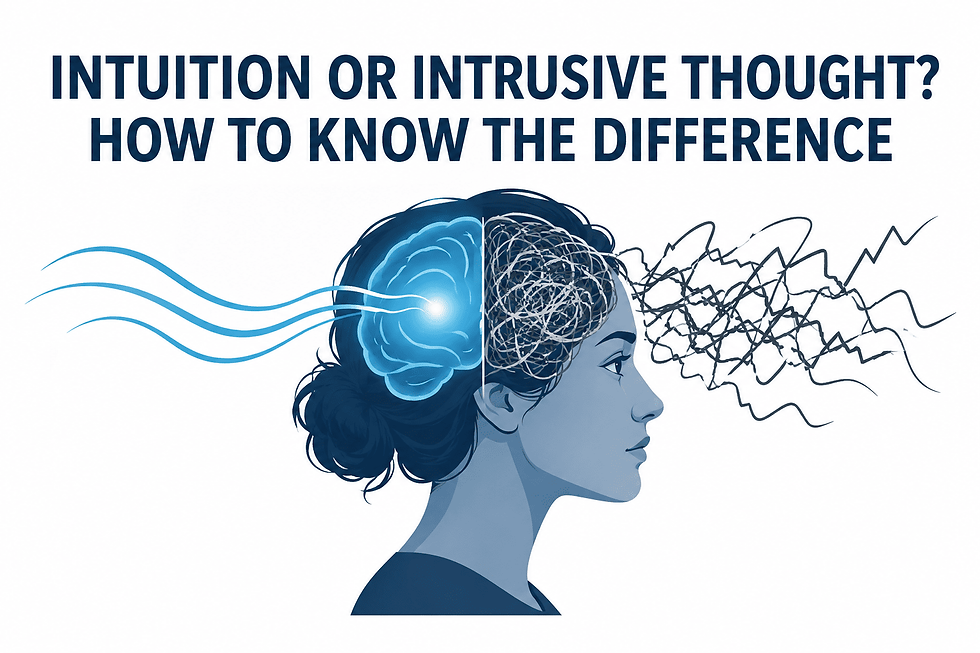
The Nature of Intrusive Thoughts: The False Alarm
Intrusive thoughts are unwanted, involuntary words, phrases, or images that burst into your mind. They are often disturbing, bizarre, or highly distressing. Because they feel so intense, our brains naturally mistake that intensity for importance.
Here is how to identify an intrusive thought:
It is loud, urgent, and frantic. Intrusive thoughts feel like an immediate emergency. They demand that you fix a problem, find an answer, or seek reassurance right now.
It is fueled by fear and anxiety. These thoughts thrive on "what-ifs." They focus heavily on catastrophe, blame, and preventing worst-case scenarios.
It traps you in a mental loop. An intrusive thought rarely arrives and leaves. Instead, it invites you to argue with it, analyze it, or replay it over and over in your head.
It attacks what you value. Intrusive thoughts are often "ego-dystonic," meaning they go completely against your actual character, desires, and morals. For instance, a deeply loving parent might experience a sudden, horrifying thought about their child getting hurt.
The Nature of Intuition: The Quiet Knowing
True intuition often called a gut feeling or an inner compass is the brain’s ability to use past experiences, subtle environmental cues, and subconscious information to make a split-second assessment. It does not require conscious reasoning, but it feels grounded.
Here is how to identify true intuition:
It is calm, neutral, and steady. Intuition does not scream. It arrives as a soft, matter-of-fact "nudge" or a quiet clarity. Even if it is warning you away from a bad situation, the underlying feeling is sober and clear, not chaotic or panicked.
It is brief and forward-moving. Intuition delivers its message and steps back. It does not demand that you sit and obsess over it for three hours, nor does it force you into a spiral of mental gymnastics.
It feels aligned. Intuition resonates with your deeper sense of self. It does not make you feel like a terrible person, nor does it make you feel alienated from your own mind.
It leaves room for curiosity. While an intrusive thought demands a rigid, immediate answer to feel safe, intuition allows you to pause, observe, and move forward with a sense of grounded awareness.
Feature | Intuition | Anxiety |
Core Driver | Internal insight and past experience | Fear, uncertainty, and perceived threat. |
The Tone | Calm, quiet, neutral, or steady. | Loud, frantic, demanding, and circular |
Physical Feeling | Groundedness, a gentle nudge, or absence of tension. | Tight chest, racing heart, or knots in the stomach. |
Time Focus | Focused heavily on the present moment. | Fixated on the future ("What if?"). |
Mental Noise | Simple and direct; lacks a long storyline. | Heavy overthinking, rumination, and worst-case scenarios. |
After-Effects | Brings a sense of clarity or relief when acted on. | Leads to more panic, doubt, and avoidance. |
How to Respond When You Are Unsure
If a thought pops up and you cannot tell which one it is, the best tool is time.
Because intrusive thoughts rely entirely on urgency to keep you hooked, practicing delay is incredibly effective. Tell yourself, "I hear this worry, but I don't need to figure it out right this second. I will look at it again in an hour."
If the thought was born of anxiety or OCD patterns, a period of calm distraction will usually cause the urgency to fade away. True intuition, however, will remain accessible as a quiet, steady truth whenever you decide to sit quietly and check back in. By changing your relationship to the noise, you can finally hear the whispers that actually matter.
Intuition Should Lead to Observation, Not Panic
A healthy response to a concerning gut feeling is:
Notice → Observe → Assess → Act
Not:
Notice → Panic → Assume → Catastrophize
If something feels wrong, slow the process down enough to look at what is actually happening. Ask yourself:
What specifically caught my attention?
What behavior am I observing?
Has the person crossed a boundary?
Is their behavior changing?
Is there an environmental factor increasing risk?
Do their words and actions match?
Is there a reasonable explanation?
What is the safest reasonable response?
You may discover that your concern was justified. You may also discover that the situation was harmless. Either outcome is useful. The objective isn't to prove that your intuition was right. The objective is to make a better decision.
Fear Can Distort Intuition
There is another side to this issue. People who have experienced significant stress or frightening situations may become highly sensitive to potential threats. Their nervous system can react quickly to ambiguous situations. That doesn't mean the person is imagining everything. It means the alarm system may be responding before enough information has been collected.
The body can essentially say:
"Pay attention."
before the conscious mind knows why.
That's why emotional regulation matters. If you are highly activated, your ability to accurately interpret ambiguous information can decrease. A neutral behavior may look threatening. An unusual event may seem catastrophic. The answer isn't necessarily to ignore the feeling.
Instead:
Regulate first. Evaluate second.
Don't Ignore Your Gut, But Don't Worship It Either
There are two common mistakes. The first is dismissing intuition completely:
"I'm probably just being paranoid."
That can cause people to ignore legitimate warning signs. The second is treating every uncomfortable feeling as proof:
"I feel it, therefore it must be true."
That can cause people to misinterpret innocent behavior, escalate unnecessary conflicts, and live in a constant state of threat awareness. Neither approach is ideal.
A better approach is:
Take the feeling seriously without automatically taking the conclusion seriously.
That distinction is powerful.
You can acknowledge:
"I feel uncomfortable."
without deciding:
"This person is dangerous."
You can recognize:
"Something seems different."
without predicting:
"Something bad is definitely going to happen."
The Safety Advantage of Uncertainty
One of the most useful personal safety skills is learning that you don't need certainty before taking a reasonable precaution. If a person makes you uncomfortable, you don't have to diagnose their intentions. If an environment feels unsafe, you don't have to prove that danger exists. If someone's behavior violates your boundaries, you don't have to explain why they are doing it.
You can simply create distance. Move toward other people. End the interaction. Leave.
Ask for assistance. The goal is not to win an argument with your intuition. The goal is to maintain your safety.
A Simple Rule to Remember
When a thought or feeling appears, ask:
"Is this giving me information, or is it demanding certainty?"
Information might sound like:
"That behavior changed."
"He's standing unusually close."
"She keeps ignoring my boundaries."
"Something about this situation doesn't match what I was told."
A demand for certainty sounds more like:
"What if something terrible happens?"
"I need to know exactly what this means."
"What if I'm missing something?"
"I can't relax until I figure this out."
The first category can help you observe your environment.
The second can pull you into an endless search for certainty.
The Goal Is Better Decisions, Not Perfect Predictions
Intuition can be useful. Intrusive thoughts can be convincing. Neither should automatically be treated as fact. The most effective approach is to develop the ability to recognize the initial signal, regulate your emotional response, examine the observable evidence, and then make a proportionate decision.
Trust your awareness. Verify your assumptions. You don't have to ignore your gut. You also don't have to obey every thought that enters your head. The real skill is knowing the difference.

About the Author: William DeMuth is the Director of Training at the Center for Violence Prevention and Self Defense (CVPSD) in Freehold, NJ. With over 35 years of research in violence dynamics and personal safety, William specializes in evidence-based training that bridges the gap between compliance and real-world conflict resolution. The architect of the ConflictIQ™ program, he holds advanced certifications and has trained under diverse industry leaders. Today, he actively trains civilians, healthcare workers, and corporate teams in situational awareness, threat assessment, behavior analysis, de-escalation strategies, and physical tactics.


