
Reading People in Conflict: The Many Forms of Human Communication

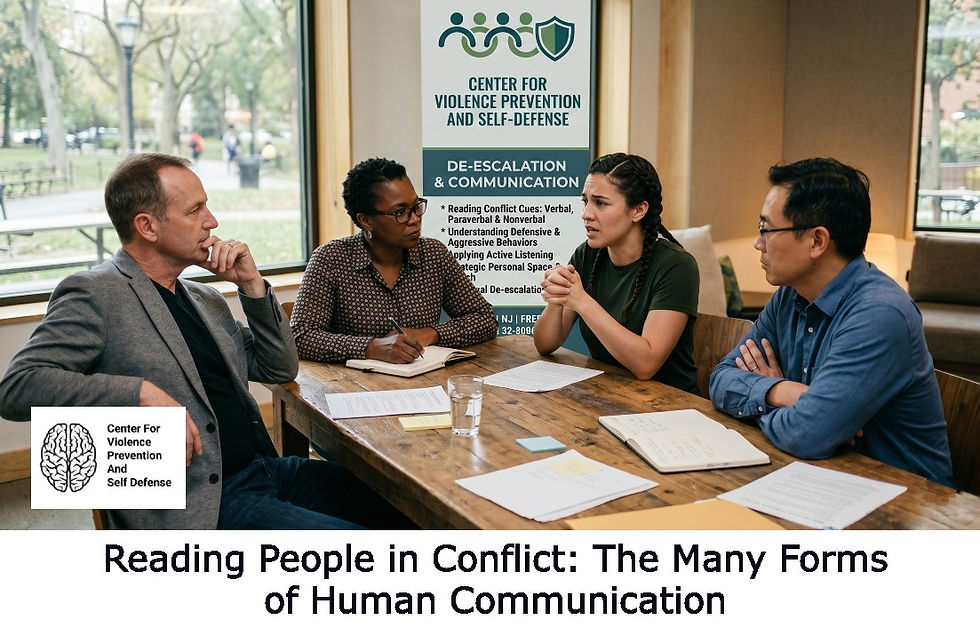
Human communication is multifaceted, extending far beyond spoken words. In conflict situations, whether personal disputes, workplace disagreements, negotiations, or mediations, effective "reading" of others often hinges more on observing how messages are delivered and the unspoken signals than on the literal content. Misinterpreting these cues can escalate tensions, while accurately decoding them fosters empathy, reveals true intentions, and aids de-escalation.
This article explores the primary forms of communication, verbal, paraverbal, nonverbal (including body language and behavior), and others, and their critical role in navigating and resolving conflicts.
1. Verbal Communication: The Words Themselves
Verbal communication involves the actual spoken or written words used to convey thoughts, needs, and positions. In conflicts, it includes statements of facts, accusations, demands, or offers.
In conflict reading:
Content reveals stated positions but often masks underlying emotions or true priorities.
Look for vagueness, inconsistencies, over-explanations, or evasiveness. These can signal deception, discomfort, or an attempt to avoid accountability.
Active listening (paraphrasing what was said) helps clarify and shows respect, reducing defensiveness.
Verbal messages are powerful but represent only a small portion of the overall communication. They are easily manipulated or filtered through social norms.
2. Paraverbal Communication: How We Say It
Paraverbal (or vocalics) refers to the vocal elements accompanying words: tone of voice, pitch, volume, pace, rhythm, pauses, and emphasis. It bridges verbal and nonverbal.
In conflict reading:
A rising pitch or faster pace often indicates stress, anger, or anxiety.
Lower volume or hesitant pauses might signal uncertainty, fear, or withdrawal.
Incongruence (for example, saying "I'm fine" in a shaky or sarcastic tone) is a major red flag for hidden resentment or dishonesty.
Deception cues can include higher pitch, more pauses, or speech errors under cognitive load.
Paraverbal signals are emotionally driven and harder to control than words, making them valuable for gauging sincerity during heated exchanges.
3. Nonverbal Communication and Body Language: The Unspoken Majority
Nonverbal communication encompasses all messages sent without words. It often accounts for a large percentage of meaning in face-to-face interactions. Key categories include:
Facial expressions: Universal emotions like anger (furrowed brows, tightened jaw), fear, or contempt show fleetingly. Microexpressions, brief and involuntary flashes, can betray true feelings even when someone tries to mask them.
Gestures and kinesics (body movements): Illustrators (hand movements emphasizing speech) often decrease when lying. Self-adaptors (touching face, fidgeting) increase with nervousness. Pointing or clenched fists signal aggression.
Posture and body movement: Open posture (uncrossed arms, leaning slightly forward) suggests engagement and willingness to resolve. Closed posture (crossed arms, turning away, shrinking) indicates defensiveness or withdrawal. Tense shoulders or fidgeting reveal stress.
Eye contact (oculesics): Steady but non-staring contact builds trust. Avoidance or excessive staring/glaring can indicate discomfort, deception, or hostility. Pupil dilation is sometimes linked to arousal or cognitive effort in lying.
Proxemics (use of space): Invading personal space escalates conflict; maintaining respectful distance (for example, arm's length) de-escalates.
Haptics (touch): A reassuring touch can calm, but unwanted contact heightens tension.
In conflict reading: Nonverbal cues often leak true emotions when verbal and nonverbal signals conflict (for example, saying "I agree" while leaning away). Clusters of cues are more reliable than isolated ones. Consider context, cultural differences, and baseline behavior. In de-escalation, mirroring calm, open body language (relaxed posture, slow movements) can reduce aggression and signal collaboration.
4. Behavioral Cues and Patterns
Behavior extends beyond immediate body language to observable actions and patterns over time, such as pacing, avoidance, compliance, or stonewalling. It includes how someone regulates the interaction (for example, interrupting, listening, or disengaging).
In conflict reading:
Withdrawal behaviors (minimal responses, physical distancing) may indicate shutdown or passive resistance.
Aggressive patterns (interrupting, raised voice combined with invading space) signal escalation risk.
Deception-related behaviors: Liars may appear more tense, less forthcoming, provide fewer details, or show increased self-touching and gaze aversion in some studies.
Positive shifts (relaxed shoulders, slower breathing, nodding) indicate de-escalation opportunities.
Behavior provides context for interpreting other cues. A usually calm person suddenly fidgeting warrants attention.
5. Other Relevant Forms
Written communication: In modern conflicts (emails, texts), tone is absent, leading to frequent misreads. Emojis or ALL CAPS attempt to compensate but are imprecise. Look for delays in response or overly formal language as potential avoidance.
Visual communication: Charts, images, or environmental cues (for example, a cluttered desk signaling stress) add layers.
Listening as communication: Active, empathetic listening (nodding, paraphrasing) is a powerful nonverbal/verbal hybrid that validates others and reduces conflict intensity.

Leading Vs Lagging Forms of Human Communication As Indicators
In human communication, the distinction between leading and lagging indicators of conflict highlights how awareness and concealment dictate our interactions. Often, individuals are either genuinely detached from their own rising levels of frustration or are actively trying to mask their emotions to maintain social harmony.
Lagging indicators, such as Verbal and Paraverbal communication, manifest only after a conflict has fully crystallized; by the time someone explicitly states their grievance or lets a sharp, sarcastic tone slip, the emotional threshold has already been crossed.
Conversely, Behavior and Body Language serve as leading indicators subtle, real-time precursors that leak out before a person even consciously registers their own irritation.
Because micro-expressions, sudden shifts in physical distance, closed postures, and avoidant eye contact are largely governed by the autonomic nervous system, they are incredibly difficult to conceal. This makes leading indicators far better predictors of impending conflict, offering a crucial window to de-escalate tension before it erupts into explicit arguments.
Practical Application in Conflict Situations
In conflicts, communication channels interact dynamically. The most useful insights come from incongruence, when words do not match tone, body, or behavior. This often reveals suppressed anger, fear, deception, or unmet needs.
Tips for reading people effectively:
Stay calm yourself: Your own stress can distort perception.
Observe clusters and baselines: Compare to the person's normal behavior.
Consider culture and context: Gestures vary widely.
Respond to nonverbal signals: Acknowledge observed emotions ("You seem frustrated. Help me understand.") to build trust.
Use your own cues strategically: Open posture, calm tone, and appropriate eye contact model de-escalation.
Behavior and Communication Resources
Precipitating Behavioral Factors: How They Influence Behavior & Crises
The Power of Behavioral Reciprocity: A Trauma-Informed Approach to Behavior Management
Don't Get Caught Offsides:Understanding the Conflict Spectrum
Beyond the "Tell": Why Pattern Recognition Trumps Behavioral Cues
How To Use Pre Attack Indicators as a Signal In Violent Situation
Bystander Verbal Intervention in Self-Defense - The Voice Is a Weapon
Mastering these forms transforms conflict from a battle of words into an opportunity for deeper understanding. While no single cue is foolproof for detecting lies or emotions, paying holistic attention to verbal content, paraverbal delivery, body language, and behavior equips you to navigate disputes with greater insight and humanity. In high-stakes situations, combining observation with clear, assertive verbal responses often leads to more durable resolutions.

About the Author: William DeMuth is the Director of Training at the Center for Violence Prevention and Self Defense (CVPSD) in Freehold, NJ. With over 35 years of research in violence dynamics and personal safety, William specializes in evidence-based training that bridges the gap between compliance and real-world conflict resolution. The architect of the ConflictIQ™ program, he holds advanced certifications and has trained under diverse industry leaders. Today, he actively trains civilians, healthcare workers, and corporate teams in situational awareness, threat assessment, behavior analysis, de-escalation strategies, and physical tactics.


