
The Science of Spotting Lies : Guide to Detecting The 7 Deception Indicators

Updated: Aug 15
Psychology & Behavior Detecting Deception:
The Science of Spotting Lies
No single behavior proves deception, but clusters of signals, especially deviations from a person's baseline, can tell you far more than you might expect.
Everyone lies. Research suggests that the average person encounters several untruths a day, ranging from harmless social lubricants to deliberate misdirection. Yet despite our intimate familiarity with deception, most of us are surprisingly poor at detecting it. We rely on gut instinct, folk wisdom, and cultural mythology about "tells" that the science often fails to support. So how do trained observers actually do it?
The answer is not a single magic signal. It is pattern recognition. Deception rarely announces itself with one dramatic gesture. Instead, it leaks through clusters of behaviors that deviate from a person's normal baseline. Understanding those clusters, and how to read them in context, is the foundation of practical deception detection.
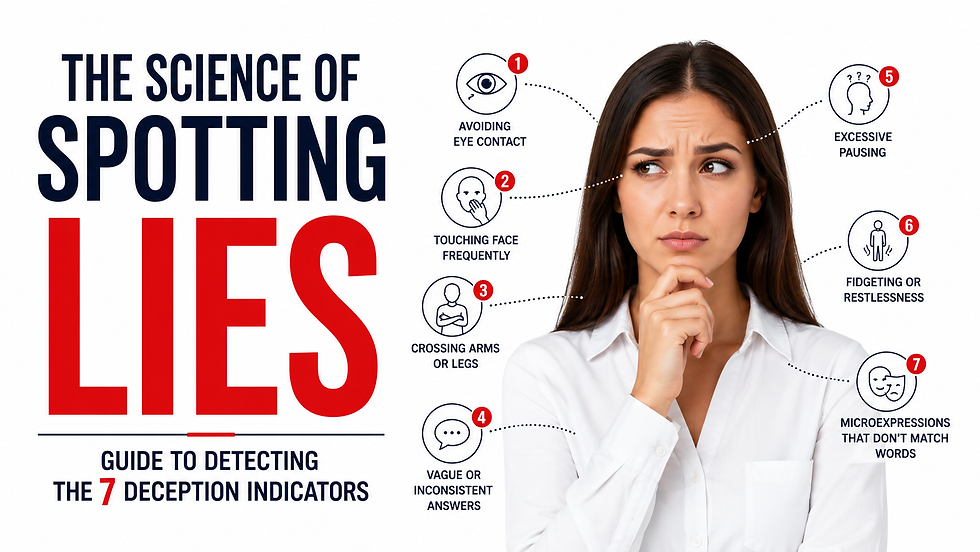
Important These indicators are tools for observation, not proof of guilt. Context always matters. Stress, nervousness, cultural difference, or cognitive load can produce many of the same signals. Use these as a guide, never as a verdict.
Framework
The 7 Categories of Deception Indicators
Deception researchers have identified seven broad categories of behavioral cues that, when observed together, meaningfully raise the likelihood that someone is being untruthful.
01 Verbal Clues | 02 Non-Verbal Behaviors | 03 Body Language |
04 Baseline Deviations | 05 Cognitive Load Signs | 06 Emotional Leaks |
07 Contextual Factors |
Verbal clues are perhaps the most conscious layer of deception. Watch for vague or overly general answers that lack specific detail, unnecessary elaboration that volunteers unsolicited information, and frequent use of distancing language. Phrases like "I think," "as far as I know," or "I guess" create psychological separation from a statement. Changes in tone, pitch, or speech rhythm are also telling.
Non-verbal behaviors operate just below the conscious surface. Avoiding eye contact or holding an unnatural stare, facial expressions that do not match the words being spoken, and microexpressions of fear, contempt, or discomfort are all worth noting. Perhaps most striking: head nodding while verbally saying "no," or shaking while saying "yes." The body often betrays what the mouth is concealing.
Body language tells its own story. A closed-off posture, crossed arms and turned shoulders, signals defensiveness. Leaning away from the questioner, fidgeting, or repetitive self-soothing movements like touching the face, neck, or mouth all indicate elevated discomfort that may point to deception.
"One sign can be a coincidence. Multiple signs together, across verbal, non-verbal, cognitive, and emotional categories, meaningfully increase the likelihood of deception."
Baseline deviations are arguably the most important category, because they are personal rather than universal. Behavior that suddenly shifts from how someone normally presents, changes in energy, expressiveness, or demeanor, or becoming more rigid or unusually relaxed, signals something is off even when that behavior would seem normal in a stranger.
Cognitive load signs reveal the mental strain of constructing a false narrative. Lying is cognitively expensive: it requires remembering the fabricated story, suppressing the truth, and monitoring your own believability simultaneously. This pressure surfaces as longer pauses before answering, difficulty recalling simple details, mental blocking when searching for words, and over-reliance on verbal fillers like "um," "uh," and "you know."
Emotional leaks occur when suppressed feelings break through the surface: sudden anger or defensiveness, inappropriate laughter or smiling at the wrong moment, widened eyes, a tense jaw, or attempts to redirect blame onto others. Contextual factors, the final category, remind us that situation shapes behavior. The higher the stakes, the greater the opportunity to deceive, and the more weight we should give to past credibility patterns.
Methodology
How to Assess Deception: A 5-Step Process
Establish a baseline: Before you can spot deviation, you need a reference point. Engage the person in neutral, low-stakes conversation first. Observe their normal rate of speech, eye contact patterns, gestures, and emotional expressiveness.
Ask clear, relevant questions: Use open-ended questions that require the person to generate narrative, not just confirm or deny. Avoid leading questions. Let the person speak at length.
Observe holistically: Look across multiple categories simultaneously, not at isolated behaviors. A single nervous gesture means very little; that same gesture combined with verbal distancing, cognitive stalling, and baseline deviation means considerably more.
Consider context: Evaluate the stakes of the situation, the person's history, and alternative explanations for what you are seeing. Anxiety, grief, neurodiverse communication styles, and cultural norms can all mimic deception signals.
Verify and corroborate: Behavioral observation is a starting point, not a conclusion. Cross-check what you have observed against external facts, prior statements, and available evidence before drawing any firm conclusion.
Practitioner Tips
The Pro Edge: What Skilled Observers Do Differently
Build rapport first. People are measurably more truthful with someone they trust. A warm, conversational approach yields more signal than an interrogative one.
Stay neutral. Revealing your suspicion changes behavior and contaminates your data. The best observers remain genuinely curious rather than skeptical.
Use silence strategically. Pausing after someone speaks creates space. Most people rush to fill silence, and what they add is often more revealing than what they originally said.
Re-ask in different ways. Deceptive accounts tend to change or lose detail when approached from a new angle. Truthful ones typically stay consistent.
Trust intuition, then verify. Your gut reaction is real data. But intuition works best as a prompt to investigate further, not as a final judgment.
The goal of deception detection is not to "catch" people, but to arrive at a clearer picture of reality. Used responsibly, with humility about its limitations and respect for context, this framework is a genuinely powerful tool for navigating the murky territory between what people say and what they mean.
Intelligence, as the researchers put it, is advantage. Know more. See clearer.

About the Author: William DeMuth is the Director of Training at the Center for Violence Prevention and Self Defense (CVPSD) in Freehold, NJ. With over 35 years of research in violence dynamics and personal safety, William specializes in evidence-based training that bridges the gap between compliance and real-world conflict resolution. The architect of the ConflictIQ™ program, he holds advanced certifications and has trained under diverse industry leaders. Today, he actively trains civilians, healthcare workers, and corporate teams in situational awareness, threat assessment, behavior analysis, de-escalation strategies, and physical tactics.


