
What Is a Preemptive Strike in Self-Defense?

A preemptive strike is a limited defensive action taken to disrupt an attacker’s movement before a threat becomes an assault, giving you the time and space to escape. It is not a first strike thrown out of anger or suspicion. It is a narrow, last-resort response to a threat that has already become imminent, reasonable, and unavoidable by any other means.
Before you consider it, four constraints have to hold at once:
Imminence — the danger is happening now, not a possibility you’re anticipating.
Reasonable belief — a reasonable person in your position would perceive the same danger.
Proportionality — your response matches the level of threat, nothing more.
Last resort — you have no safe way to retreat, de-escalate, or call for help.
These four constraints echo across the frameworks that govern lawful self-defense and workplace safety. The Cornell Law School Legal Information Institute defines self-defense as force used against imminent unlawful force, justified only when the belief in that danger is reasonable and the response proportionate. The Veterans Health Administration builds its threat-management model around structured professional judgment and multidisciplinary threat-assessment teams rather than reflexive physical response. And OSHA’s guidance on workplace violence prevention treats hands-on skills as one piece of a much larger prevention system, not the first move.
Key Takeaways
A lawful preemptive action in self-defense is a narrow, last-resort tactic used only when imminence, reasonable belief, proportionality, and the absence of safer alternatives all hold true at once.
Point | Details |
Definition | A preemptive strike disrupts an imminent attacker’s movement to create time and space to escape, not to punish or continue a fight. |
Four-part test | Imminence, reasonable belief, proportionality, and last resort must all be present before acting. |
Nonphysical steps first | Situational awareness, environmental positioning, verbal limit-setting, and de-escalation come before any physical response. |
Documentation matters | Time-stamped accounts, witness statements, and reporting reduce legal risk after any physical intervention. |
Organizational readiness | CVPSD builds BTAM-integrated, PMDB-style training programs that prioritize prevention before physical skill. |
This article is general information, not a substitute for advice from a qualified lawyer. Consult a qualified legal professional about your own circumstances before acting on anything here.
Table of Contents
When Is a Preemptive Action Justified? A Decision Checklist
Every one of the four constraints above has to be true at the same time, not just one or two. Here’s how to read each one under pressure:
Imminence means the danger is unfolding in seconds, not minutes. A person raising a fist and stepping toward you is imminent. A person yelling threats from across a parking lot, with no movement toward you, usually is not.
Reasonable belief asks whether an objective observer, not just you in a heightened state, would conclude the same danger exists. Adrenaline distorts perception, so this standard exists to keep your read of the situation honest.
Proportionality means your action matches the threat. Disrupting a grip that’s trapping you against a wall is proportionate. Continuing to strike after the person has released you is not.
Last resort means you’ve run out of safer options. If you can step back, call out for help, or move toward an exit, that path comes first.
Concrete behavioral cues help translate these standards into real decisions:
A raised fist paired with a forward step toward you.
Sustained verbal threats combined with movement toward a weapon or toward you.
A grip or hold that physically prevents you from leaving.
Certain conditions should stop you cold instead of pushing you toward action:
You’re uncertain whether the person actually intends harm.
You still have a clear path to retreat.
Bystanders are present who could de-escalate or intervene verbally.
Acting now would likely escalate the situation rather than end it.
Nonphysical Alternatives Come First: The Escalation Ladder
Physical intervention sits at the very bottom of a much longer list of options, and most encounters never need it. The CISA De-escalation Action Guide frames de-escalation as communication used specifically to stabilize or slow a potentially violent situation without force, and it works far more often than people expect.
The ladder, from lowest to highest intensity, looks like this:
Situational awareness — noticing agitation, isolation risk, or blocked exits before they matter.
Environmental controls — positioning yourself near an exit, using alarms, or moving to a monitored space.
Verbal limit-setting — a calm, clear statement of a boundary (“I need you to step back”).
Practiced de-escalation techniques — empathic acknowledgment paired with a calm, quiet tone, which tends to carry more authority than a rushed stream of instructions.
Disengagement and escape — physically leaving the area once an opening exists.
Reporting and threat referral — flagging the incident to security, HR, or a threat-assessment team so it doesn’t recur.
Combine these rather than treating them as sequential steps you exhaust one at a time. Calm limit-setting while quietly repositioning toward a doorway does more than either tactic alone.
Pro Tip: Watch for the point where continued talking raises your risk instead of lowering it, such as the person closing distance despite your words. That’s the signal that de-escalation has done what it can, and a limited physical response may be the only option left.
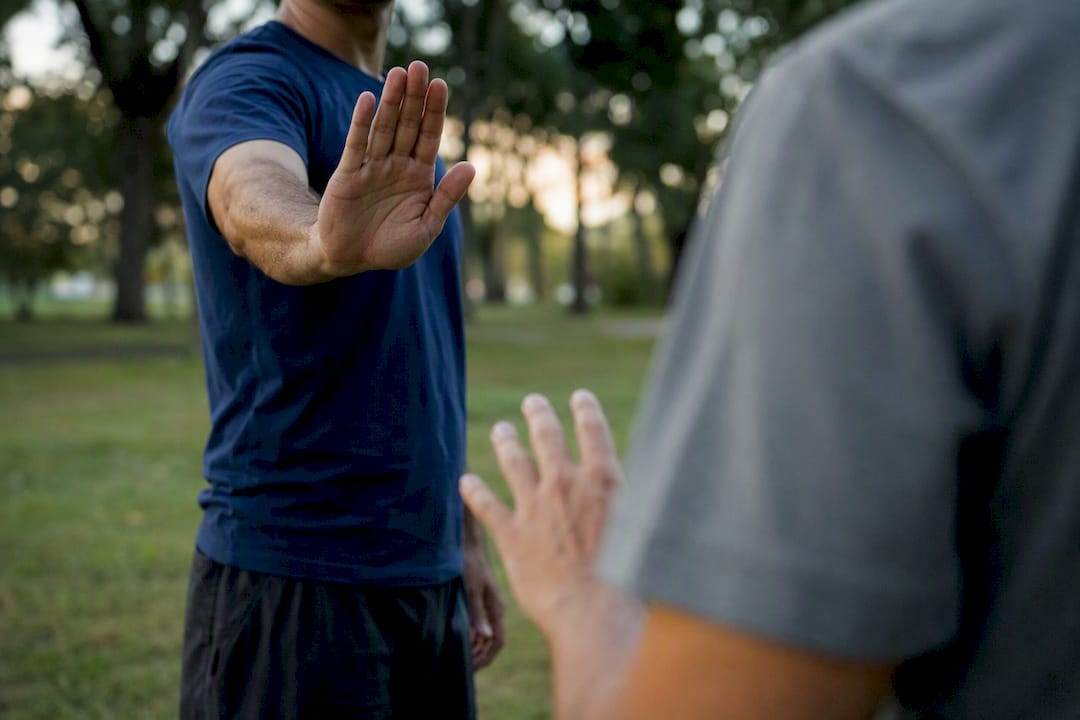
What Lawful, Limited Preemptive Interventions Look Like
A limited preemptive intervention has exactly one job: disrupt the attacker’s ability to close distance or maintain control long enough for you to create space and leave. It is not designed to win a fight, restrain someone, or deliver punishment. The moment you have an opening to escape, the intervention is over.
In practice, that looks like a small set of low-intensity tactics:
Evasive footwork that removes you from the line of attack.
A break-grip technique that releases a hold without prolonged struggle.
A controlled push-off that creates immediate distance.
A brief distraction strike aimed at balance, not injury, that opens a path to leave.
The minimal-intensity principle governs all of it: use the smallest amount of force that accomplishes disruption and escape, nothing more.
The goal of any preemptive physical action in an interpersonal setting is narrow and specific: interrupt momentum, buy space, and get out. It is not to control, subdue, or continue engaging once that space exists.
Legal exposure rises fast once force extends beyond that narrow purpose. State statutes generally protect force used to defend against imminent unlawful force, but they draw hard lines around deadly force and place the burden of justification on the person who used force. Missouri’s self-defense statute is a clear example, permitting defensive force under specific conditions while sharply limiting anything beyond that. Avoid weapon use unless the threat clearly meets your jurisdiction’s legal standard for it, and never continue a hold or strike once the danger has passed.
Pro Tip: If you’re forced to act, note the time, note any witnesses, and move to a monitored or populated area immediately afterward. A clear account given soon after an incident holds up far better than one reconstructed days later.
Once you’re safe, get checked for injury, report the incident to the appropriate authority, and consult legal counsel if the encounter involved any physical contact. An appropriate use looks like breaking a wrist grip and immediately walking away. An inappropriate one looks like striking someone repeatedly after they’ve already released you.
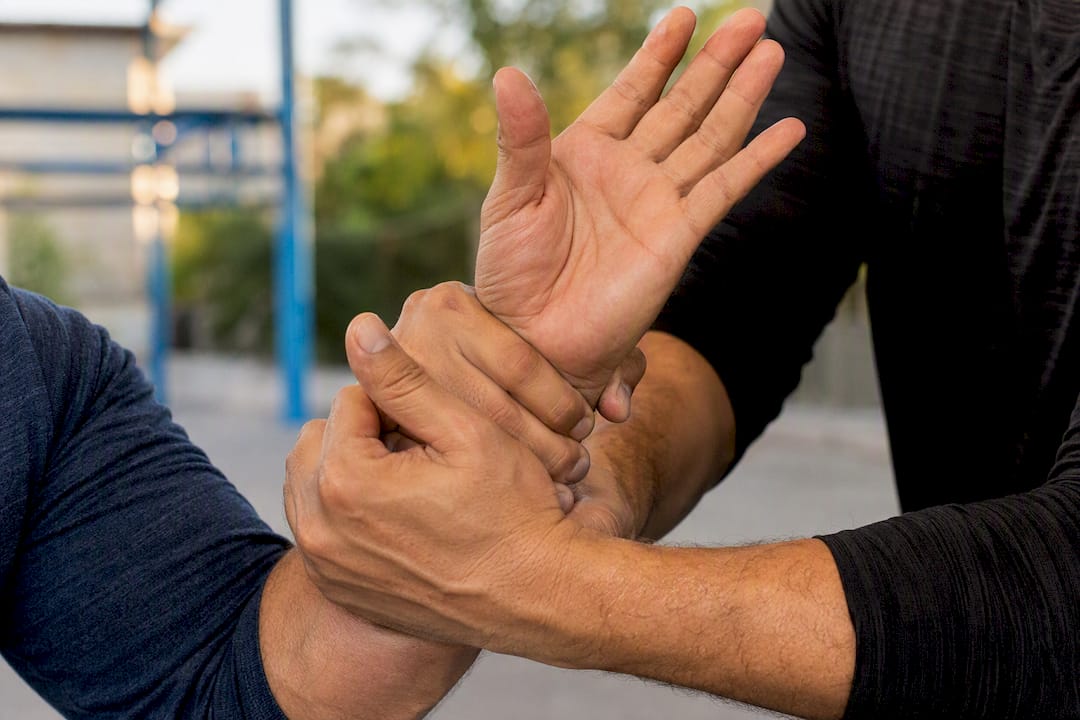
Training Best Practices for Lawful Preemptive Response
Training that teaches physical technique in isolation produces exactly the wrong instinct: reaching for force before exhausting safer options. Programs modeled on prevention and management of disruptive behavior (PMDB) integrate verbal de-escalation, environmental awareness, and hands-on skill in a single curriculum, and that integration is what makes the physical piece safe to use at all.
A training program worth requiring should include:
Behavioral threat assessment literacy, so participants recognize escalation before it becomes physical.
Scenario-based rehearsal that mirrors realistic conditions, not choreographed drills.
Supervised, hands-on technique practice with qualified instructors.
Post-incident documentation training, so staff know what to record and why.
Federal guidance on workplace violence prevention breaks training into tiers, recommending combined instruction in de-escalation and personal safety/evasion skills for employees facing moderate risk. Competency should be measured by observable skill transfer under stress, not attendance alone.
Confirm the curriculum blends verbal, environmental, and physical components rather than teaching physical skills alone.
Confirm instructors hold documented qualifications and follow safety protocols for contact-based practice.
Confirm the program includes after-action documentation training, not just technique drills.
Pro Tip: Ask any training provider how they measure skill transfer under stress, not just technique accuracy in a calm classroom setting. That gap is where most training programs quietly fail.
Organizational Steps That Reduce the Need for Physical Response
The organizations with the fewest violent incidents are rarely the ones with the best physical response. They’re the ones that catch escalating behavior early enough that physical response never becomes necessary. Behavioral threat experts consistently point out that violence is rarely sudden. Argumentative patterns and persistent grievances tend to surface well before an incident, which makes early reporting one of the strongest prevention levers available.
A workplace violence prevention structure needs:
A written policy defining unacceptable behavior and response protocols.
Accessible, confidential reporting channels staff will actually use.
A trained, multidisciplinary behavioral threat assessment team.
Documented escalation protocols that specify who does what, and when.
Environmental hardening: safe rooms, accessible alarms, controlled entry points.
A consistent training cadence, not a one-time seminar.
A typical flow looks like this: a staff member reports concerning behavior, a BTAM team triages the report using structured professional judgment, and the team recommends mitigation, whether that’s an environmental change, a behavioral intervention, or targeted training for the affected team.
After any incident involving physical contact, treat it as a reportable safety event. Collect witness statements, preserve any available video, and document exactly what happened and why. That record protects staff legally and feeds directly back into the BTAM process for review.
Why Prevention Has to Come Before Physical Skill
CVPSD has built its curriculum around one conviction: the physical piece of self-defense only earns its place after de-escalation, environmental awareness, and behavioral threat assessment have been exhausted. Our experience training organizations in BTAM and PMDB-style programs has shown that skill without judgment creates liability, not safety. Every program we design is tailored to the legal and regulatory context of the organization we’re serving, because a lawful response in one setting can be excessive in another.
Get Integrated Training Built Around Your Organization
Reading about de-escalation and behavioral threat assessment is one thing. Building a team that can actually recognize escalation, intervene safely, and document it correctly takes structured, hands-on training.

CVPSD designs integrated programs that combine behavioral threat assessment, verbal de-escalation, and supervised physical skill practice, tailored to your organization’s legal and regulatory environment rather than a generic template. Our teams have worked with healthcare systems, schools, and federal agencies, including a training partnership approved by the Defense Logistics Agency. If your organization needs staff who can recognize risk early and respond within lawful, proportional limits, visit CVPSD to discuss program design or request a training demo.
Sources
FAQ
What Is a Preemptive Strike in Self-Defense Terms?
It’s a limited defensive action taken to disrupt an imminent attack, creating enough time and space to escape rather than to continue engaging.
Is a Preemptive Strike Legal?
It can be, but only when the threat is imminent, your belief in danger is reasonable, your response is proportional, and no safer alternative exists; laws vary by state, so check your jurisdiction’s statute.
What’s the Difference Between De-Escalation and a Preemptive Strike?
De-escalation uses communication to reduce tension without force, while a preemptive strike is a physical last resort used only after de-escalation and disengagement aren’t possible.
How Does BTAM Relate to Preemptive Action?
Behavioral threat assessment and management identifies and manages escalating risk before it reaches a physical stage, which is why organizations that use BTAM rely on physical intervention far less often.
Does CVPSD Train People in Preemptive Response?
Yes. CVPSD builds integrated programs that teach de-escalation, behavioral threat recognition, and limited physical skills together, so physical response is always the last option, not the first.
Recommended


