
What Is Self-Defense: Legal Definition and Practical Steps


Self-defense is the use of force or other protective measures to prevent imminent harm to yourself or others, recognized under U.S. law as a justification for actions that would otherwise be criminal when specific legal conditions are met. Merriam-Webster defines it as both a plea of legal justification and the act of defending oneself or close relatives. The right is real, but it is not unlimited.
Three legal caveats every person should know:
Imminence: The threat must be happening now, not anticipated in the future.
Proportionality: Your response must match the level of force used against you.
Initial aggressor / jurisdiction: If you started the confrontation, or if your state requires retreat, your claim may fail.
Before any physical response, consider these three practical priorities:
Avoid the situation entirely when you recognize warning signs early.
De-escalate using calm, neutral communication to reduce tension.
Escape to safety as soon as a clear path exists.
Table of Contents
How U.S. law defines self-defense
Under U.S. criminal and tort law, self-defense is a justification defense: it does not deny that force was used, but argues the force was legally permitted. Courts evaluate five core elements when assessing whether a claim will succeed.
Innocence. The defender must not have been the initial aggressor. In United States v. Peterson, the court found that a defendant who provoked the confrontation could not then claim self-defense when the other party responded. Starting a fight forfeits the right to claim it.
Imminence. The threat must be immediate. A fear of future harm, no matter how reasonable, does not satisfy this element. Courts look for evidence that the danger was present and unavoidable at the moment force was used.
Proportionality. The force used must match the threat faced. Responding to a shove with lethal force almost always fails this test. Legal experts note that proportionality remains a core constraint across every U.S. jurisdiction, even those with stand-your-ground provisions.
Reasonable belief. The defender must have genuinely and reasonably believed force was necessary. Courts apply an objective standard: would a reasonable person in the same situation have shared that belief? Subjective fear alone is not enough.
Avoidance (where required). Some states impose a duty to retreat before using force if a safe retreat is available. Others have stand-your-ground laws that remove this requirement entirely. Training summaries list avoidance as the fifth practical element precisely because it is the one most likely to vary by state.
Pro Tip: Before relying on any assumption about your state’s retreat rules, look up your state’s specific statute at your state legislature’s website or consult a licensed attorney. Stand-your-ground and duty-to-retreat states reach very different legal outcomes from identical facts.
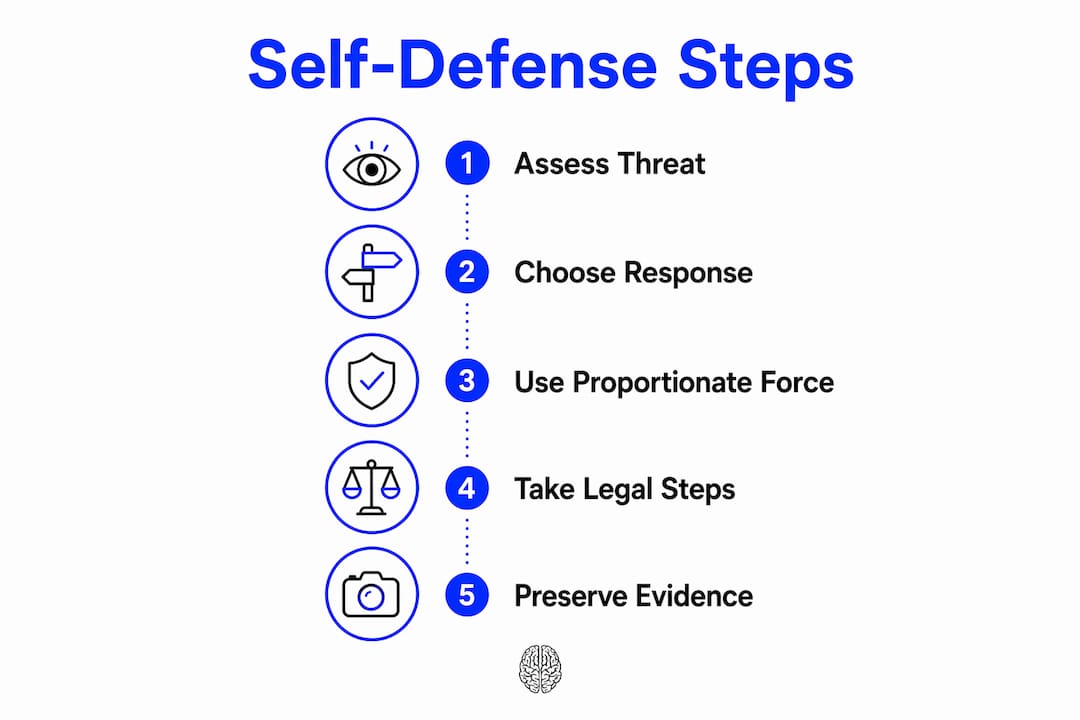
What types of self-defense are there?
Self-defense is broader than fighting. It spans verbal communication, physical techniques, and the use of tools, each with different legal risks and training requirements.
Physical self-defense
Physical self-defense includes both unarmed techniques (strikes, breaks, takedowns) and armed responses (firearms, pepper spray, impact tools). Armed and unarmed approaches carry different legal consequences: using a weapon raises the proportionality bar significantly, and some tools are restricted by state or local law. Unarmed techniques are generally lower-risk legally, though they still require proportionality.

Verbal self-defense and de-escalation
Verbal self-defense uses tone, body language, and deliberate phrasing to prevent a situation from becoming physical. Psychology Today notes that responding to the underlying presupposition of a verbal attack, rather than its surface content, removes the emotional fuel an aggressor is seeking. Practical techniques include:
Neutral questioning: “What do you need right now?” redirects without escalating.
The broken record technique: Calmly repeating a boundary statement without argument.
Non-reactive posture: Keeping a relaxed, open stance signals calm authority rather than submission or aggression.
Verbal intervention is often the safest first option because it carries no legal risk and frequently stops escalation before it starts.
Improvised and tool-based defense
Everyday objects can serve a defensive purpose in an emergency, but their use is subject to the same proportionality and reasonableness standards as any other force. The goal in improvised defense is always to create distance and escape, not to subdue or punish.

Type | Primary goal | Legal risk | Training needed | Realistic effectiveness |
Unarmed physical | Create distance, escape | Low to moderate | Moderate | High with practice |
Armed (firearm, spray) | Stop serious threat | Higher; varies by state | Significant | High when trained |
Verbal / de-escalation | Prevent escalation | Very low | Low to moderate | High in early-stage conflicts |
Improvised tools | Create escape opportunity | Moderate | Low | Situational |
Pro Tip: De-escalation training is not a soft alternative to physical training. Practical guides show that posture, tone, and scripted responses are primary tools for defusing aggression. Learning both verbal and physical skills gives you the widest range of options.
When is force legally justified?
Knowing the legal elements is one thing. Applying them to a real situation is another. Two concepts drive most self-defense outcomes: imminence and proportionality.
Imminence in practice. A threat is imminent when it is happening now or is seconds away. Someone threatening you verbally from across a parking lot does not meet the imminence standard. Someone who has grabbed you and raised a fist does. Courts look at physical proximity, the aggressor’s capability, and whether the defender had any reasonable alternative.
Proportionality and the lethal force line. Non-lethal force (blocking, pushing, using pepper spray) is generally justified against non-lethal threats. Lethal force is legally reserved for situations involving a reasonable belief of death or serious bodily injury. Crossing that line against a lesser threat is one of the most common reasons self-defense claims fail.
Justified vs. unjustified responses:
Justified: A person grabs you from behind in an isolated area at night. You strike to break free and run.
Unjustified: An argument over a parking space escalates to shoving. You draw a weapon.
Justified: Someone breaks into your home and advances toward you. You use force to stop the threat.
Unjustified: A neighbor threatens you verbally. You follow them and confront them physically.
Jurisdictional differences matter. Stand-your-ground laws remove the duty to retreat in states like Florida and Texas, meaning a person may hold their ground when threatened in a place they have a legal right to be. Duty-to-retreat states require that you attempt to leave safely before using force, if doing so is possible. The same physical act can be legally justified in one state and criminal in another.
Check your state’s statute directly. The Legal Information Institute at Cornell provides a reliable starting point for understanding how courts interpret these rules nationally.
Common myths about self-defense that can get you hurt
Misconceptions about self-defense are not just inaccurate; they create real legal and physical risk.
Myth: You can use any force you want if you feel threatened.Fact: Proportionality is a hard legal limit. Feeling afraid does not justify lethal force against a non-lethal threat.
Myth: Verbal aggression is harmless, so you can ignore it.Fact: Many physical attacks begin with verbal escalation. Recognizing and responding to verbal aggression early is a core safety skill.
Myth: Stand-your-ground means you can fight instead of retreat anywhere.Fact: Stand-your-ground applies only in states that have enacted it, and even then, you must not be the initial aggressor and must be in a place you have a legal right to be.
Myth: Self-defense training is only about fighting.Fact: Evidence-based programs prioritize avoidance, de-escalation, and escape. Physical techniques are the last resort, not the first lesson.
Myth: If you were attacked, you automatically have a valid self-defense claim.Fact: Courts examine all five elements. Prior threats, your own actions, and the level of force you used all affect the outcome.
Pro Tip: Never rely on what you read in a social media post or heard from a friend about your state’s self-defense laws. Confirm the current rules at your state legislature’s website or with a licensed attorney in your jurisdiction.
What effective self-defense training actually teaches you
The goal of good training is not to make you a fighter. It is to give you calm decision-making under stress, a clear set of options, and the physical skills to execute the last resort if everything else fails.
The defensive mindset
Practitioners consistently emphasize that the most valuable outcome of training is a mindset that supports situational awareness and measured response, not aggression. You learn to recognize pre-attack indicators, choose the safest exit, and stay calm enough to use verbal tools before physical ones.
How to choose a class
Evidence-based curriculum. Look for programs grounded in research, not sport competition or entertainment. CVPSD’s programs, for example, are built on evidence-based crisis intervention and behavior analysis.
Emphasis on gross-motor skills. Under adrenaline, fine-motor techniques fail. Quality programs teach palm strikes, wrist breaks, and simple releases that hold up under stress.
Realistic scenario practice. Role-play under pressure builds automatic responses. A class that only drills techniques on a compliant partner is not preparing you for real conditions.
Instructor credentials. Ask whether instructors have verifiable training backgrounds and whether the curriculum is reviewed for legal accuracy. Instructor qualifications matter more than rank or style.
De-escalation content. Any program that skips verbal skills is incomplete. Physical techniques without communication skills leave a critical gap.
What beginners should expect to learn
Verbal boundary-setting scripts and de-escalation responses
Awareness and avoidance habits (pre-attack recognition, environmental scanning)
Simple gross-motor strikes and break-away techniques
Safe exit strategies from common threat scenarios
Basic understanding of legal limits on force
Pro Tip: When evaluating a program, ask the instructor directly: “Does your curriculum prioritize escape and legal safety, or winning the fight?” A program that emphasizes escape reduces both injury risk and legal exposure. If the instructor hesitates or dismisses the question, look elsewhere.
What to do immediately after a self-defense incident
How you respond in the minutes and hours after an incident shapes both your safety and your legal position. Follow these steps in order.
Get to safety first. Move away from the threat. Do not remain at the scene if the danger is ongoing.
Call 911. Report the incident immediately. Being the first to call establishes your account and demonstrates you were not the aggressor.
Request medical attention. Even if you feel fine, document any injuries through a medical professional. Adrenaline masks pain, and documented injuries support your account.
Preserve physical evidence. Do not clean up, move objects, or change clothes before law enforcement arrives. Photograph injuries, the scene, and any relevant objects.
Record witness information. Get names and contact details from anyone who saw the incident before they leave.
Write down your account. As soon as it is safe to do so, write a detailed account of what happened, in sequence, while memory is fresh. Include what you heard, saw, and felt.
Contact an attorney before making detailed statements to police. You have the right to legal counsel. Cooperate with law enforcement, but understand that detailed statements made under stress can be misinterpreted. An attorney can help you present your account accurately.
Pro Tip: Preserve all digital evidence: texts, voicemails, or social media messages from the other party. Then go dark on your own social media. Anything you post about the incident can be used against you, even if your intent was to explain what happened.
Key Takeaways
Self-defense in the United States is a legally bounded right that requires imminence, proportionality, and non-aggressor status, with jurisdiction determining whether retreat is also required.
Point | Details |
Legal definition | Self-defense justifies force only when the threat is imminent, the response is proportional, and you are not the initial aggressor. |
Jurisdiction matters | Stand-your-ground and duty-to-retreat states reach different outcomes from identical facts; always check your state’s statute. |
Verbal tools come first | De-escalation and verbal boundary-setting reduce escalation before physical force becomes necessary. |
Training priorities | Evidence-based classes emphasize escape, gross-motor skills, and realistic scenarios over complex fighting techniques. |
CVPSD programs | CVPSD offers online and in-person training covering crisis intervention, de-escalation, and physical self-defense skills grounded in evidence-based research. |
Why de-escalation deserves more credit than it gets
Most conversations about self-defense focus on physical techniques, and that emphasis quietly distorts how people think about safety. The legal framework itself tells a different story: every element courts examine, from imminence to proportionality to the initial aggressor rule, rewards the person who tried to avoid the fight, not the one who was best prepared to win it.
What CVPSD sees consistently in training and community work is that people who have practiced verbal de-escalation respond more calmly under stress, make better decisions about when physical force is actually necessary, and face far less legal exposure afterward. That is not a coincidence. A calm, clear verbal response in the early seconds of a confrontation does more to protect you, legally and physically, than any strike technique.
The other thing worth saying plainly: the defensive mindset is not passivity. Choosing to de-escalate, to exit, to set a verbal boundary rather than engage physically takes more discipline and situational awareness than swinging. Training that builds those skills alongside physical techniques produces people who are genuinely safer, not just more confident.
CVPSD is a 501©(3) non-profit, and its programs are built on that principle: evidence-based, legally grounded, and focused on the full range of options, not just the last one.
CVPSD training programs: a practical next step
Physical safety is a skill, and skills require practice. CVPSD delivers both online and in-person self-defense training through a curriculum built on crisis intervention techniques, de-escalation solutions, behavior analysis, and physical self-defense. Programs are designed to meet state and local laws and are available to individuals, schools, community groups, nonprofits, and government agencies.

What sets CVPSD apart from a general martial arts class is the integration of legal awareness and verbal skills into every program, not as an afterthought but as the foundation. Whether you are looking for a first introduction to personal safety or a structured program for your organization, CVPSD’s evidence-based programs are built to give you real options, not just physical techniques. Visit cvpsd.org to review class schedules, program options, and community resources.
This article provides general information about self-defense law and training in the United States. It is not legal advice. Consult a licensed attorney in your jurisdiction for guidance specific to your situation, and verify current statutes at your state legislature’s official website.
Useful sources and where to check state-specific rules
The following sources are reliable starting points for understanding self-defense law and training in the United States.
Legal Information Institute, Cornell Law School — The most accessible plain-language summary of U.S. self-defense law, including key elements and case references. Start here for the legal framework.
Britannica: Self-defense law — Covers proportionality, retreat rules, and jurisdictional differences with editorial authority.
Merriam-Webster: Self-defense — Concise dictionary and legal-usage definitions; useful for understanding how the term is applied in both everyday and legal contexts.
Stanford Encyclopedia of Philosophy: Self-Defense — The most thorough philosophical and moral analysis of defensive harm, including liability, culpability, and the limits of justification.
Study.com: Self-Defense — Definition, Rules & Examples — Structured instructional summary of how courts evaluate self-defense claims; good for understanding the reasonable-belief and proportionality tests.
Your state legislature’s official website — Search “[your state] self-defense statute” to find the exact language governing your jurisdiction. No secondary source substitutes for the actual statute.
CVPSD Resource Library — Training programs, community resources, and evidence-based guidance on violence prevention and personal safety across the United States.
For any situation where force was used, consult a licensed criminal defense attorney in your state before making statements to law enforcement or on social media.
Recommended


