
Healthcare Leaders: Compliance Ready Workplace Violence Committee


A workplace violence committee is a standing interdisciplinary body that co-authors and oversees your organization’s violence prevention program. The single best first step is to draft a one-page charter and name at least one decision-maker along with your core members. Success looks like regular meetings, a prevention plan the committee actually owns, and annual reviews grounded in real incident data rather than good intentions.
Executive Summary
Regular meetings, a clear prevention plan, and annual reviews grounded in incident data are essential for an effective workplace violence committee.
Healthcare organizations should include frontline staff, security, HR, risk management, legal counsel, and patient representatives, with staffing terms assigned to ensure continuity.
The committee must develop, review, and update core policies like zero-tolerance, reporting procedures, response protocols, and post-incident support, following a structured review cycle.
Incident and near-miss reporting should enable quick investigations, consistent documentation, and feedback to staff to encourage ongoing reporting and data collection.
Committees require dedicated budget authority, staff participation without added workload, and meaningful external collaborations to maintain functionality and compliance.
Table of Contents
What Is a Workplace Violence Committee, and Who Should Sit on It?
How Should the Committee’s Charter and Authority Be Structured?
How Often Should the Committee Meet, and What Should Get Documented?
How Should Incidents and Near-Misses Get Reported and Investigated?
How Should the Committee Approach Staff Training and Engagement?
What Conflict Resolution Techniques Fit Workplace Violence Situations Specifically?
How Should the Committee Coordinate With Outside Stakeholders?
What Post-Incident Mental Health Support Should the Committee Arrange?
What Is a Workplace Violence Committee, and Who Should Sit on It?
A workplace violence committee only works if the right people are in the room, and healthcare settings need broader representation than most other industries. OSHA and NIOSH both recommend multidisciplinary teams for healthcare organizations that include direct-care staff and union representatives whenever they’re available, not just managers reading incident reports secondhand.
A well-built committee for a hospital or clinic typically includes:
Frontline direct-care staff (nurses, aides, techs who work the floor)
Security or facilities safety personnel
Human resources representation
Risk management or compliance staff
Administration with actual authority to approve changes
Legal counsel, at least in an advisory capacity
Patient or union representation where applicable
Committee size matters less than staggered terms and named individuals. Anonymous seats invite absenteeism; named members with defined terms preserve institutional memory when someone transfers or retires. Some states go further than “recommended” and legislate it. Connecticut, for example, requires that at least half the committee be non-management, while Ohio’s statute calls for direct-care representation plus a patient or family member. Treat these thresholds as a floor, not a target.
How Should the Committee’s Charter and Authority Be Structured?
A charter without teeth produces meetings without outcomes. Before your committee holds its first real session, put the following in writing and get it signed:
Scope: what the committee covers (prevention, response, post-incident review, or all three).
Authority level: whether the committee is purely advisory or co-authors binding policy alongside leadership.
Escalation path: who the committee reports to, and how urgent findings reach that person within days, not weeks.
Executive sign-off: a CEO or COO signature on the charter itself, signaling this isn’t a side project.
Budget authority: at least one member who can approve spending, because recommendations without funding routinely stall and quietly erode staff trust in the whole process.
Advisory committees tend to satisfy the letter of a statute but rarely move fast enough during an actual crisis. Co-author models, where the committee directly shapes binding policy, align more closely with what Joint Commission surveyors expect during accreditation review: documented interdisciplinary worksite analysis, not a committee that exists on paper alone.
Which Policies Should the Committee Own and Maintain?
The committee’s real output isn’t the meeting. It’s the written policy stack that survives staff turnover and gets referenced during an actual event. At minimum, your committee should draft, review, and periodically update:
A zero-tolerance policy defining prohibited behavior in plain language
A reporting procedure that protects confidentiality and shields staff from retaliation
A response protocol covering both active threats and lower-level disruptive behavior
Post-incident support procedures, including counseling access
An anti-retaliation clause with teeth, not just a sentence buried in the handbook
Each policy should move through a defined lifecycle: committee drafts it, the full committee reviews and revises it, leadership signs off, and the policy gets a periodic review date, typically annual. Sample program templates from state labor agencies show this same structure, pairing a named program administrator with a documented review cycle rather than a static PDF nobody revisits.
Store policies somewhere staff actually check, an intranet safety hub or onboarding packet, and communicate updates through shift huddles or email digests rather than assuming people will find a revised policy on their own.
How Often Should the Committee Meet, and What Should Get Documented?
Meeting cadence depends on incident volume, facility size, and whatever your state statute sets as a minimum. Guidance on effective safety programs shows meeting frequency ranging from every 10 working days to quarterly, with core duties spanning hazard assessments, policy updates, incident review, and training oversight.
For most hospitals and larger clinics, monthly meetings hit the right balance between staying current and not burning out volunteer members. Smaller practices with lower incident rates can often justify quarterly cadences, provided they document a clear escalation process for anything urgent between sessions.
Whatever cadence you pick, documentation discipline matters more than frequency:
Post minutes within five business days of every meeting
Track attendance, since absentee patterns often predict a committee losing steam
Assign every action item to a named owner with a deadline, not a vague “the team will look into it”
Follow up on open items at the start of the next meeting before adding new business
How Should Incidents and Near-Misses Get Reported and Investigated?
An underreported incident teaches you nothing, and near-misses get skipped far more often than actual assaults. Building a process that captures both requires:
A reporting form employees actually trust. Keep it short, allow anonymous submission where feasible, and route it through a confidential channel separate from the general chain of command.
A fast investigation trigger. Assign someone to open every report within 24 to 48 hours, preserve physical evidence or footage before it’s overwritten, and interview witnesses while memory is fresh.
A documentation standard. Record what happened, contributing factors, and corrective action in a consistent format the committee can review later without re-interviewing anyone.
A near-miss capture mechanism. Treat close calls with the same reporting rigor as actual incidents, since near-miss data is one of the most underused prevention levers committees have available.
A feedback loop back to staff. Tell the workforce what changed as a result of a report. Silence after reporting is the fastest way to kill future reporting.
What Metrics Should the Committee Track for Program Review?
Data turns a committee from a discussion group into an improvement engine. A small, consistent set of metrics tracked monthly tends to outperform sprawling dashboards leadership eventually stops reading. Focus on:
Total incidents and near-misses, tracked by unit or location
Time-to-investigation for each reported event
Training completion percentage across staff categories
Repeat-location or repeat-perpetrator patterns
Corrective actions closed versus still open
Statistic Callout: Workplace violence remains a leading contributor to fatal and nonfatal occupational injuries, and healthcare workers face notably elevated assault rates compared to other industries, according to OSHA’s overview of workplace violence. That single fact is usually enough to justify the resources a committee needs.
Structure your annual review around a checklist: Did metrics improve or worsen year over year? Were policy updates documented and communicated? Did training completion hit target? Answering those questions in writing, every year, is what regulators and accreditors actually look for.
How Should the Committee Approach Staff Training and Engagement?
Training only counts if it’s tracked, tested, and reinforced, not just delivered once during onboarding and forgotten. The committee should own the training calendar and set expectations for:
Recognition training: spotting escalation cues before they become incidents
De-escalation technique refreshers, ideally scenario-based rather than lecture-based
Reporting procedure walkthroughs, so staff know exactly what to do and who to tell
Post-incident care awareness, so coworkers know how to support someone after an event
Track completion by department and audit it the same way you’d audit any compliance requirement. Tabletop exercises and role-play drills matter here because training alone rarely validates whether protocols actually work under pressure. Peer champions on each unit, staff who reinforce de-escalation habits during daily work, tend to move the needle more than annual refreshers alone.
Pro Tip: Run a 15-minute tabletop scenario at the start of a shift huddle once a quarter. Short, frequent drills build muscle memory faster than a single annual training day ever will.
Programs like comprehensive violence prevention training for frontline workers show how structured, recurring sessions build the kind of retention a one-time seminar can’t.
What Do OSHA, the Joint Commission, and State Laws Require?
Federal guidance sets expectations even without a single binding standard specific to workplace violence. OSHA’s recommended practices for safety and health programs lay out core committee duties: hazard assessments, policy development, incident review, and training oversight. NIOSH research reinforces the case for interdisciplinary teams in healthcare specifically, given how disproportionately that sector experiences violent incidents.
The Joint Commission raised the bar further with its 2022 standards, which require interdisciplinary worksite analysis and a written prevention program for accredited hospitals. Committees are the most common mechanism hospitals use to satisfy that requirement, since a written program without a body actively maintaining it tends to go stale fast.
State statutes add another layer, and they vary meaningfully:
Connecticut requires committees with at least 50% non-management representation.
Ohio mandates direct-care staff representation plus a patient or family member on the committee.
Texas has its own workplace violence prevention requirements for healthcare facilities, with specific reporting and training provisions.
The FBI’s guidance on workplace violence also offers useful threat-assessment framing that many committees fold into their training curriculum, particularly around recognizing behavioral warning signs before they escalate. Treat every one of these as a floor. Statutory minimums rarely match what an effective, active committee actually does year-round.
What Templates Should the Committee Keep on Hand?
Building every document from scratch wastes time the committee doesn’t have. Keep a small library of adaptable templates:
Charter checklist: scope, authority level, reporting line, executive signature line, and review date
Meeting agenda template: open action items, new incident review, policy updates, training status, next steps
Incident investigation checklist: intake date, evidence preserved, witnesses interviewed, findings, corrective action, closure date
Facility inspection checklist: entry points, lighting, alarm systems, staff-only access zones, camera coverage gaps
A small clinic with fifteen staff members doesn’t need the same inspection checklist as a 400-bed hospital. Scale the detail to the facility, not the other way around. The core structure, name, date, owner, deadline, stays constant regardless of size.
How Does CVPSD Recommend Running Committee Exercises?
Hands-off de-escalation exercises work best when they mirror real shift conditions rather than a classroom setting. Run scenarios where participants practice verbal techniques without physical contact, then debrief immediately while details are fresh.
To keep momentum after the initial launch:
Schedule one tabletop scenario per quarter tied to a real incident type your facility has actually seen
Fold training modules into existing staff meetings instead of creating a separate mandatory session
Publish a short monthly update, even three sentences, showing what the committee acted on
Pro Tip: Post one visible “win” per quarter, a policy update, a completed training milestone, anything concrete, where staff can see it. Momentum dies quietly when nobody outside the committee room knows anything is happening.
Facilities operating under heightened regulatory scrutiny have adapted hands-off training formats specifically to keep drills realistic without introducing physical risk.
What Conflict Resolution Techniques Fit Workplace Violence Situations Specifically?
Standard workplace mediation techniques often assume both parties are reasoning calmly, which rarely holds true in a workplace violence scenario. The committee needs a different toolkit built around de-escalation rather than negotiation.
Calm authority matters more than volume or urgency. A quiet, steady voice carries more weight during a tense encounter than an anxious stream of instructions, because raised voices tend to trigger the same fight-or-flight response in an agitated person that you’re trying to interrupt. Staff trained in this approach learn to lower their own tone deliberately, even when instinct says to match the other person’s energy.
Empathic acknowledgment comes next. Naming what someone appears to be feeling, “It sounds like you’re really frustrated about this wait,” without agreeing to demands, often defuses tension faster than jumping straight to problem-solving. The goal isn’t resolution in the moment. It’s buying time and space for the situation to cool.
Non-threatening positioning matters physically too: maintaining distance, avoiding cornering the other person, and keeping an exit path open for both parties. Committees should build this into training rather than assuming staff will improvise it correctly under stress.
For conflicts between staff members rather than patient or visitor incidents, the committee should maintain a separate, faster track: direct one-on-one mediation facilitated by HR, with a clear timeline for resolution and documented follow-up. Letting interpersonal conflict simmer unaddressed is one of the more common precursors to escalation that internal investigations later flag.
How Should the Committee Coordinate With Outside Stakeholders?
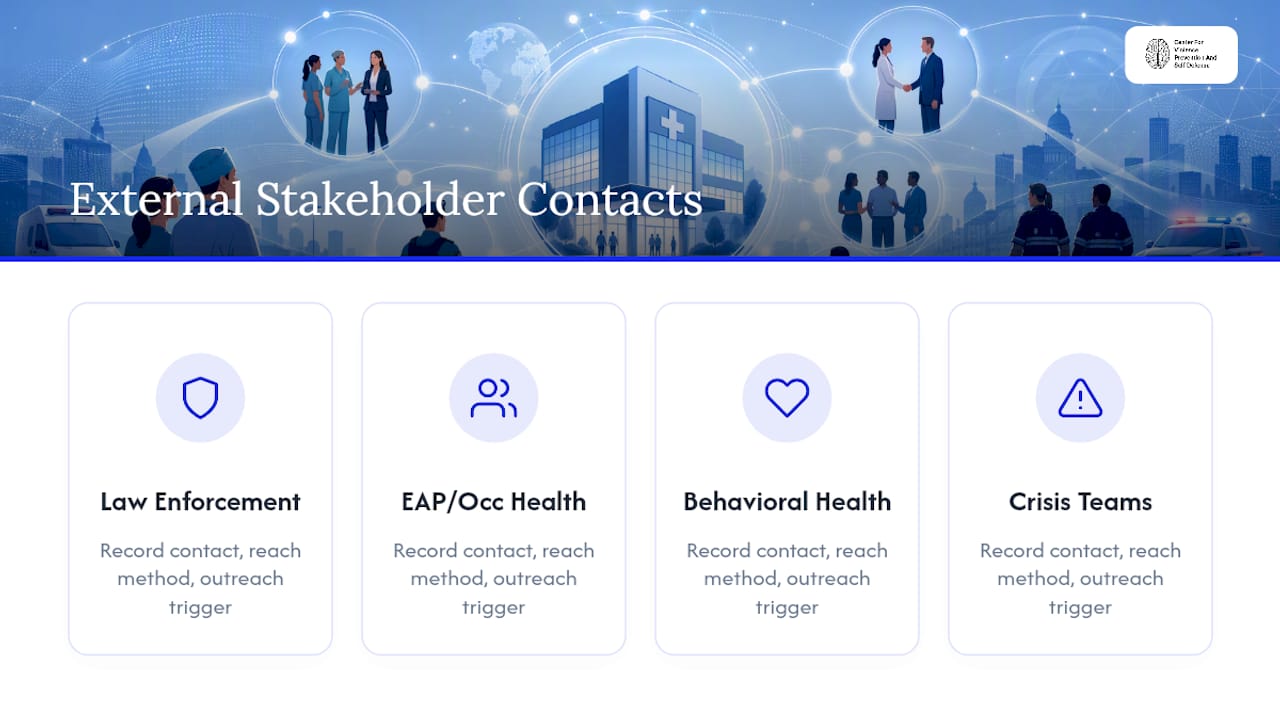
No committee operates in isolation, and pretending otherwise leaves gaps during an actual emergency. Law enforcement coordination should happen well before an incident, not during one. Invite a local liaison officer to review your facility’s response protocol annually, walk the physical space with them, and confirm response time expectations given your location.
Healthcare providers connected to your organization, employee assistance programs, occupational health, behavioral health partners, need a defined role in the response chain too. If your facility refers staff externally for counseling after an incident, that referral pathway should be documented in the same charter that governs the committee itself, not improvised after the fact.
Community mental health resources and crisis intervention teams are worth formalizing as well, particularly for organizations serving populations where behavioral health crises are a recurring trigger for incidents. A standing relationship, even an informal point of contact, beats scrambling to find a number during an actual crisis.
Document every external relationship the same way you’d document an internal policy: who the contact is, how to reach them, and what triggers that outreach. Review these contacts annually alongside your broader program review, since staff turnover on the outside affects your response capability just as much as turnover on the inside.
How Much Budget and Staffing Should the Committee Get?
Committees fail more often from resource starvation than from bad intentions. Before the first meeting, leadership should allocate time, not just approval, for members to participate without treating committee work as an unpaid extra shift on top of full clinical duties.
A realistic budget line covers several categories: paid meeting time for non-exempt staff, training materials and instructor fees if using an outside provider, minor facility upgrades flagged during inspections (lighting, door locks, panic buttons), and any software or forms system used for incident reporting. None of these need to be expensive individually, but skipping the line item entirely guarantees recommendations stall at the “someday” stage.
The single most important budget decision is naming a member with actual spending authority on the committee itself, rather than routing every request through a separate approval chain that adds weeks of delay. Facilities that build this into the charter from day one report far fewer stalled initiatives than those relying on ad hoc approval after each meeting.
Reassess the budget annually alongside your program review. A facility that just installed new badge-access doors doesn’t need the same line item next year, but incident trends might justify shifting funds toward additional training instead. Treat the budget as a living document tied to your metrics, not a static number set once and forgotten.
What Post-Incident Mental Health Support Should the Committee Arrange?
An incident doesn’t end when the immediate threat is over. Staff who experience or witness violence need a clear, fast path to support, and the committee is responsible for making sure that path exists and is known before anyone needs it.
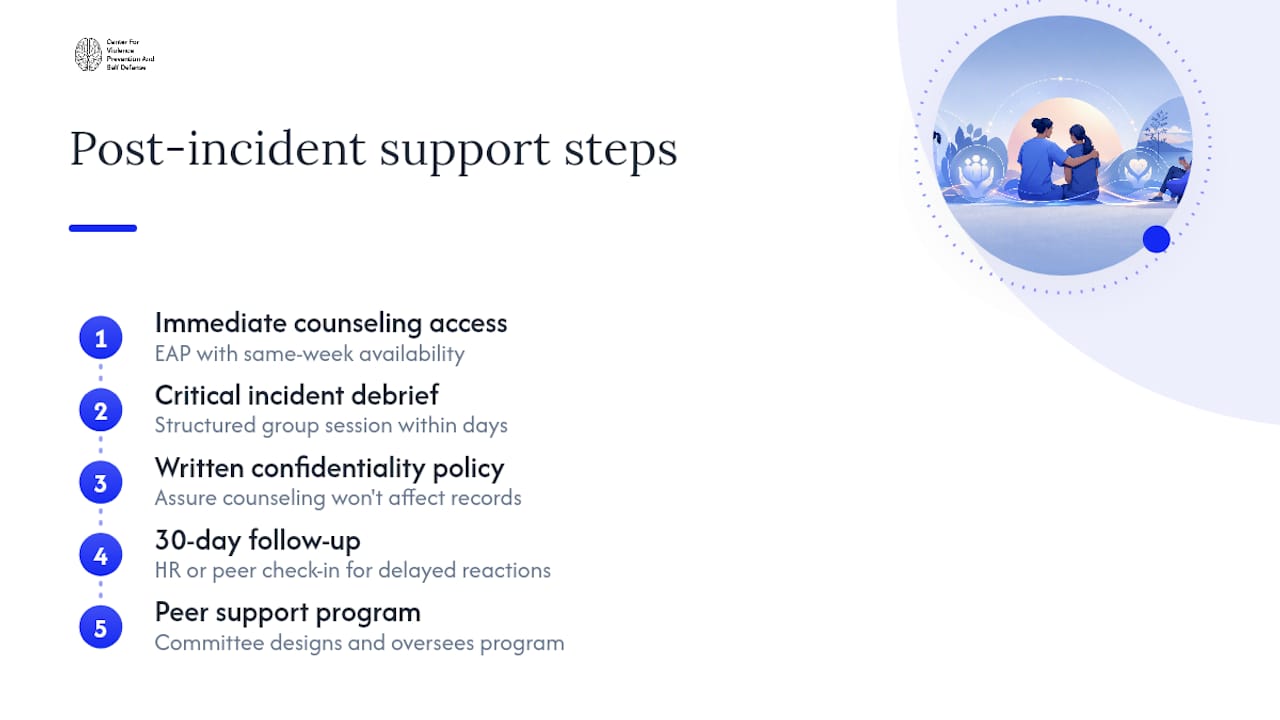
At minimum, the committee should confirm access to an employee assistance program with same-week counseling availability, not a general referral line that takes weeks to schedule. For more serious incidents, facilities often bring in critical incident stress debriefing, a structured group session held within days of the event where affected staff process what happened with a trained facilitator.
Confidentiality matters as much here as it does in incident reporting. Staff need assurance that seeking counseling won’t appear on a performance record or get mentioned casually by a supervisor. Committees should put that assurance in writing as part of the post-incident support policy, not leave it as an informal understanding.
Follow-up matters too. A single debriefing session immediately after an incident helps, but lasting impact often shows up weeks later. Building a 30-day check-in into the response protocol, a simple call or message from HR or a peer support contact, catches delayed reactions that an immediate debriefing might miss.
Peer support programs, where trained coworkers offer informal support alongside formal counseling, have grown common in healthcare settings specifically because staff often trust a peer’s check-in more than a scheduled appointment with someone unfamiliar. If your facility has the staffing to build one, the committee should own its design and oversight the same way it owns any other prevention policy.
Common Committee Failure Modes and Quick Fixes
The most common failure is a committee stacked entirely with management, which technically satisfies a headcount requirement while missing the frontline perspective that actually catches risk early. Fix it by recruiting at least two direct-care staff before your next charter revision, not after the next incident forces the question.
Infrequent meetings are the second killer. A quarterly cadence that quietly becomes “whenever we get around to it” signals to staff that the committee isn’t serious, and that perception spreads fast. Fix it with a standing calendar invite nobody can quietly skip.
The third failure, missing budget authority, is the one leadership underestimates most. A committee that recommends changes nobody can fund becomes a committee nobody bothers attending. Small, visible wins, a fixed door lock, a published policy update, build trust faster than any framework on paper.
How CVPSD Supports Your Committee’s Work
Building an effective workplace violence committee internally is entirely possible, and many organizations do it well with the guidance above. Where CVPSD fits is the gap between having a charter on paper and having staff who can actually execute de-escalation under pressure, which is a skill set most internal teams don’t have the bandwidth to build from scratch.
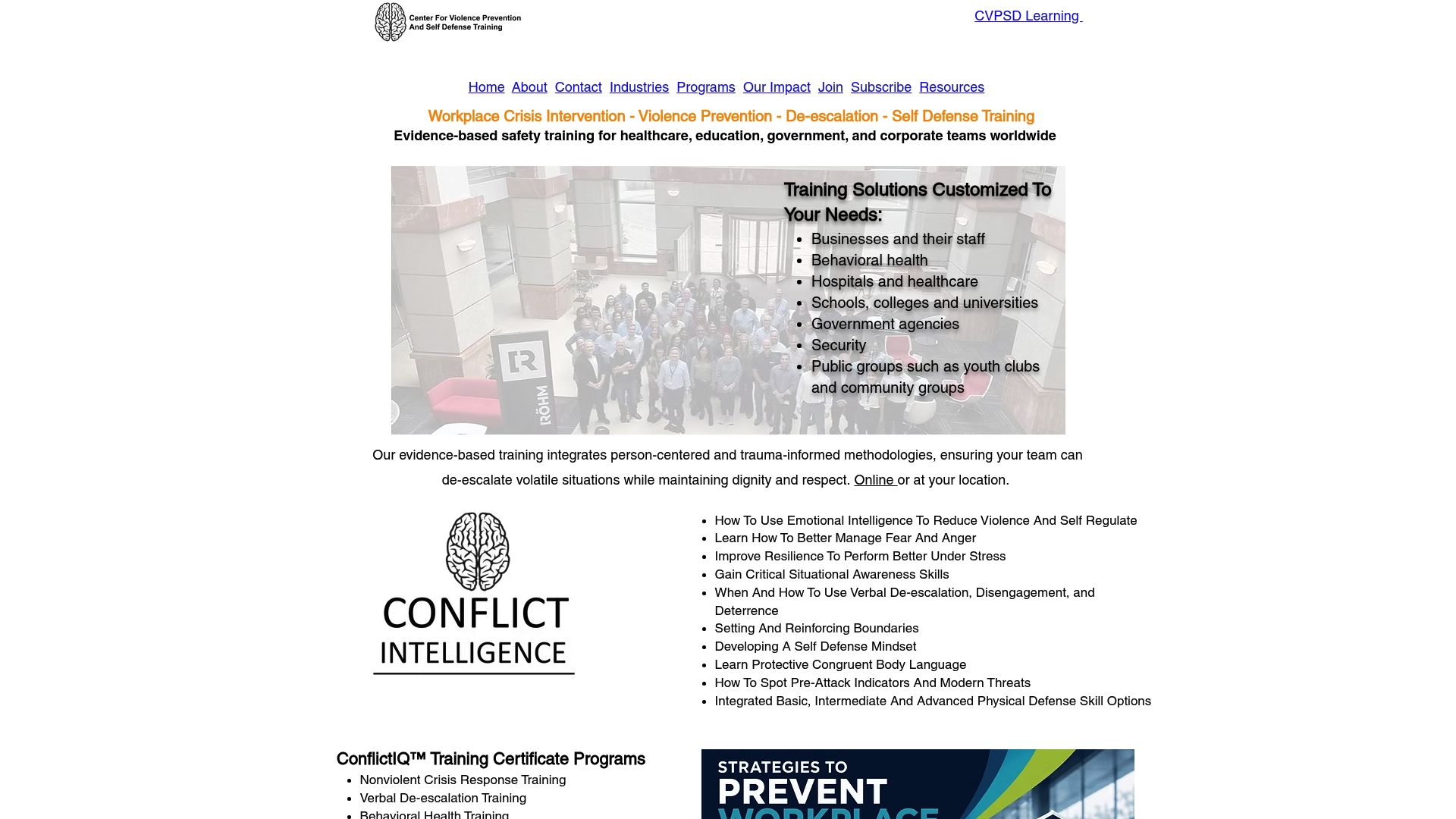
The organization offers train-the-trainer certification so committees can build internal training capacity rather than depending on outside instructors indefinitely, along with tabletop facilitation for organizations that want a neutral outside voice running scenario drills. The Workplace Violence Certificate Program gives committees a structured curriculum to require of staff rather than assembling training piecemeal from whatever’s available online.
Use an outside provider when your committee needs credentialed instruction fast, when internal staff lack de-escalation training experience, or when accreditation timelines don’t leave room for building a program from zero. If your committee is at that stage, visit CVPSD to discuss which training format fits your facility’s size and risk profile.
Sources
For primary guidance beyond what’s linked throughout this article, start with OSHA’s workplace violence overview, the Joint Commission’s 2022 prevention standards, and your state’s specific healthcare safety committee statute. NIOSH publishes complementary research on healthcare-sector risk factors worth reviewing alongside OSHA’s practical guidance.
FAQ
What Counts as Threatening Behavior in the Workplace?
Threatening behavior includes verbal threats, intimidating body language, aggressive gestures, and any explicit or implied statement of intent to cause harm, and committees should train staff to report even ambiguous cases rather than waiting for a clear-cut threat.
What Are Some Subtle Signs of Harassment at Work?
Subtle signs include repeated unwanted contact, exclusion from normal workplace communication, veiled comments framed as jokes, and a pattern of behavior that feels different one-on-one than it does in front of witnesses.
What Are the Different Types of Workplace Violence?
Workplace violence is generally grouped into four categories: violence from strangers with no legitimate business relationship, violence from customers or patients, violence between coworkers, and violence carried over from a personal relationship into the workplace.
What Role Does Law Enforcement Play in Reporting Workplace Violence?
Law enforcement handles criminal incidents, threat investigations that rise to the level of a crime, and emergency response, while the committee’s internal reporting and investigation process runs in parallel and should route serious threats to police promptly rather than waiting for internal review to conclude.
Does a Workplace Violence Committee Need to Include Non-Management Staff?
Yes, both federal guidance and several state statutes call for it. OSHA recommends multidisciplinary healthcare committees that include direct-care staff, and states like Connecticut require at least half the committee to be non-management by law.
Recommended

About the Author: William DeMuth is the Director of Training at the Center for Violence Prevention and Self Defense (CVPSD) in Freehold, NJ. With over 35 years of research in violence dynamics and personal safety, William specializes in evidence-based training that bridges the gap between compliance and real-world conflict resolution. The architect of the ConflictIQ™ program, he holds advanced certifications and has trained under diverse industry leaders. Today, he actively trains civilians, healthcare workers, and corporate teams in situational awareness, threat assessment, behavior analysis, de-escalation strategies, and physical tactics.


