
The Situational Awareness Opportunity Curve™ SAOC: Navigating the Seconds That Matter

Updated: Mar 5
Why Early Decisions Determine Outcomes in Violence Prevention
Time isn't just a measurement in situational awareness it’s a resource that evaporates. Whether you are a first responder, a nurse working a risk unit, or navigating a high-conflict corporate environment, understanding the Situational Awareness Opportunity Curve™ (SAOC) is the difference between proactive mastery and reactive survival.
The core philosophy is simple yet brutal: Your options are never more plentiful than they are at the moment a threat is first detectable. This is not philosophy. It is pattern recognition drawn from real-world violence dynamics.
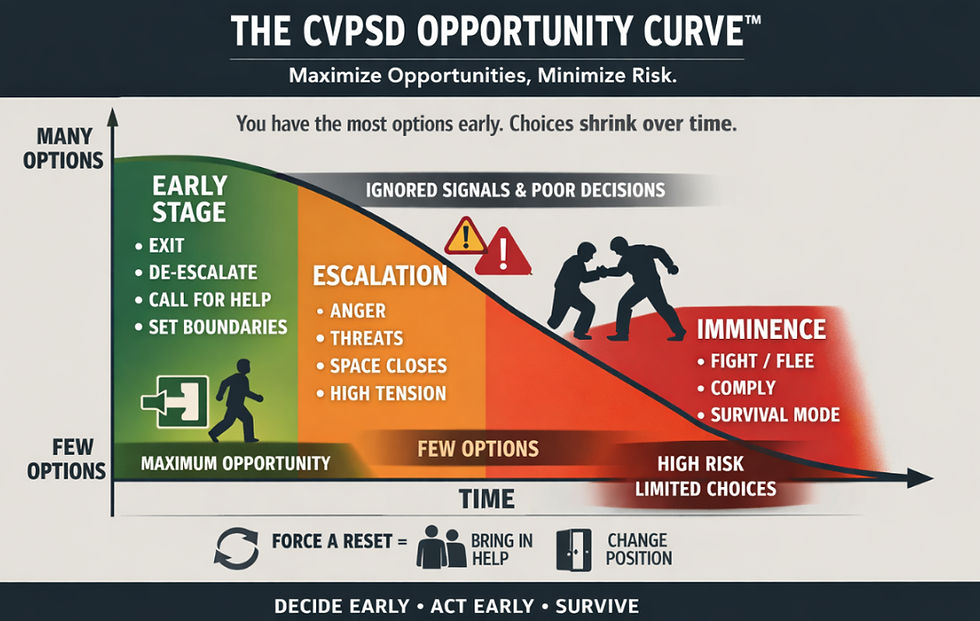
The Anatomy of the Decline
At the onset of any critical event, your "Opportunity Space" is at its maximum. You have the luxury of distance, the benefit of multiple exit routes, and the time to process information. However, as the event unfolds, the curve begins a steep descent.
This decline is accelerated by two primary factors:
Ignored Signals: Every "weak signal" or red flag that is bypassed is a closed door. By the time a signal becomes a loud, undeniable reality, several tactical advantages have already vanished.
Poor Decision-Making: Choosing a sub-optimal path often "locks" you into a specific trajectory, narrowing your future choices and forcing you into a corner.
In situational awareness, success is defined by the density of your available options. When your opportunities hit zero, you are no longer a participant in the outcome you are a victim of it.
What Is the Situational Awareness Opportunity Curve™ SAOC?
Picture a downward sloping curve.
At the far left, early in the timeline, you have maximum flexibility:
You can leave.
You can reposition.
You can disengage verbally.
You can call for help.
You can establish boundaries.
You can change environments.
As time passes, and as behavior escalates, the curve drops:
Space closes.
Emotions rise.
Ego enters.
Exit routes narrow.
Physical confrontation becomes more likely.
By the time violence is imminent, your choices are limited to high-risk, high-consequence actions. The Situational Awareness Opportunity Curve™ teaches one core truth:Delay costs options.
Phase 1: Early Signals, Maximum Control
In the beginning, most conflicts whisper before they scream.
You might notice:
A shift in tone.
Invasion of personal space.
Repeated boundary testing.
Agitation.
Fixation.
Target glancing.
Escalating language.
These are pre-incident indicators. At this stage, you are still operating from a position of strategic advantage. You are thinking clearly. Your heart rate is manageable. Your mobility is intact. This is where prevention lives. Ignoring these signals is not neutral. It is a decision. And that decision moves you down the curve.
Phase 2: Escalation, Shrinking Options
Now emotion drives behavior.
The aggressor commits more deeply. You may feel pressure to:
“Win” the argument.
Prove a point.
Save face.
Stand your ground unnecessarily.
Match tone with tone.
This is where many people make the critical error of reacting instead of responding.
Reacting accelerates descent on the curve.
Now:
Distance has closed.
Adrenaline is rising.
Cognitive bandwidth narrows.
You are closer to physical engagement.
Your opportunities have decreased because earlier ones were not taken.
Phase 3: Imminence, Limited Outcomes
At the bottom of the curve, choices are binary:
Fight.
Escape under pressure.
Comply.
Sustain injury.
The environment controls you more than you control the environment.
At this point, success depends on skill under stress, but understand this clearly:
The lowest part of the curve is survival mode, not optimal mode.
Winning at the bottom of the curve is far harder than exiting at the top.
Why Opportunities Equal Survival
We often focus on the "right" move, but the CVPSD model suggests that preserving the ability to make any move is more vital.
Proactive Buffer: High opportunity levels allow for "soft" corrections small shifts in behavior that steer you away from danger without escalation.
The Survival Threshold: Once you fall below a certain point on the curve, your actions become frantic and instinctive (the "Flight, Fight, or Freeze" zone). Survival in this zone is often left to luck rather than skill.
Forcing the Reset: Reclaiming the Curve
The most empowering aspect of the Situational Awareness Opportunity Curve™ is the concept of the Reset. If you realize you’ve waited too long and your options are dwindling, you don't have to follow the curve to zero. You can "force a reset."
A reset is a deliberate, often radical action intended to break the current momentum of a situation and "buy" more time or space. Examples include:
Physical Disengagement: Creating distance to regain a wider field of view.
Changing the Environment: Moving to a different room or location to alter the tactical layout.
Disruptive Communication: Breaking the "script" of a confrontation to startle an adversary and create a momentary pause.
By forcing a reset, you effectively jump back up the curve, restoring the opportunities necessary to secure a win.
The Critical Variable: Recognizing Opportunity
Opportunity is not obvious to untrained individuals.
Most people:
Normalize red flags.
Rationalize behavior.
Delay action.
Hope the problem resolves itself.
Hope is not a strategy.
The Situational Awareness Opportunity Curve™ reframes situational awareness as an opportunity management problem. If you miss early opportunities, you are forced into harder ones later.
You have the greatest number of safe options at the earliest point of an encounter.Those options shrink over time as warning signals are ignored or poor decisions are made.
The Race Against the Clock
Situational awareness isn't about seeing the future; it's about managing the present so the future remains flexible. The Situational Awareness Opportunity Curve™ reminds us that every second of hesitation is an opportunity surrendered. To survive and thrive, you must act while the curve is high and have the courage to reset when it drops too low.

About The Author
William DeMuth, Director of Training
With over 30 years of research in violence dynamics and personal safety, William specializes in evidence-based training with layered personal safety skills for real-world conflict resolution. He holds advanced certifications and has trained under diverse industry leaders including Lt. Col. Dave Grossman and Craig Douglas (ShivWorks), and is the architect of the ConflictIQ™ program. He actively trains civilians, law enforcement, healthcare workers, and corporate teams in behavioral analysis, situational awareness, de-escalation strategies, and physical skills.
Situational Awareness Training Series
From Playcraft To Tradecraft To Witchcraft: How Playful Learning Enhances Situation Awareness Skills
Why "Things are never so bad that they can't get worse" is a Mindset for Life
Diversion Tactics Highly Manipulative People Use To Bait You Into Engagement
How Can you Tell The Difference Between Paranoia and Intuition
How To Prevent Misconceptions And Common Biases In Assessing Behavior Analysis In Threat Detection
Situational Awareness in Practice: What to Make of a Hyper-Vigilant Person
The Power of Proxemics: Enhancing Violence Prevention and Self-Defense through Situational Awareness
Cultivating Vigilance: How to Develop Situational Awareness For Self Defense Through Training
How To Use Pre Attack Indicators as a Signal In Violent Situation
Pre-Incident Indicators: Unveiling How Predators Engage Their Targets
Spotting The Pre-Incident Indicators For Personal Self Defense
How To Spot The Top 8 Pre-Incident Indicators That Predators Use
Pre-Incident Indicators: Unveiling How Predators Engage Their Targets
Navigating Risk: Identifying High-Risk Areas for Personal Safety


